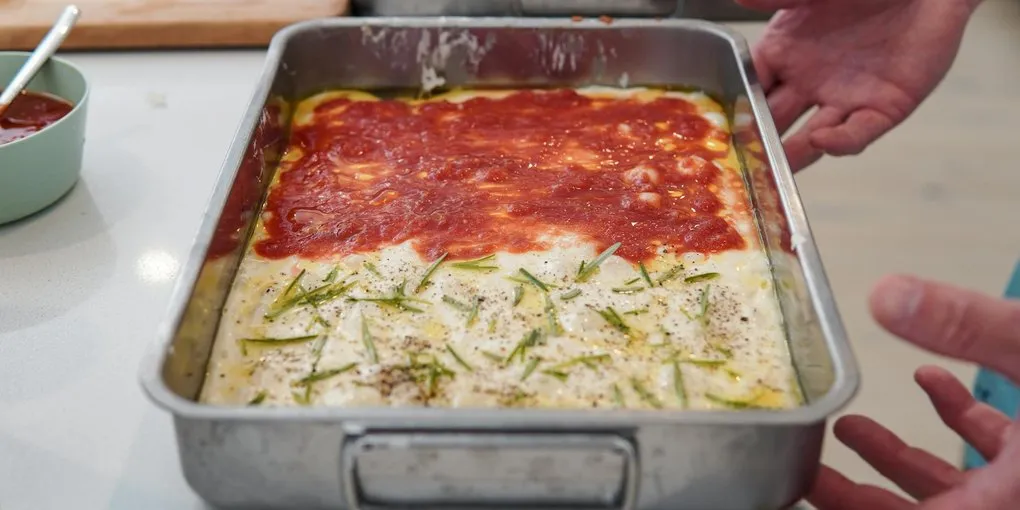
Altoona-style pizza is the kind of regional pie that breaks the internet whenever it surfaces on a national food site. Sicilian-style sheet dough. A sweet tomato sauce. Slices of peppercorn salami laid down first. Rings of raw green bell pepper next. And then, on top, melted slabs of American cheese - yes, the orange kind, the kind your grandmother put on a sandwich. Cut into squares and served from the rectangular pan it baked in.
You either find that description charming or appalling, and most of the internet has picked appalling. People in Blair County, Pennsylvania disagree. They are right, in a specific and defensible way, and this article is about why.
The pizza came out of one downtown hotel kitchen, almost died with that hotel in a 2013 fire, and survived because a handful of local pizzerias decided the recipe was worth keeping. It is not a “bad pizza.” It is a pizza built around a different idea of what cheese is for. Once you understand the idea, the American cheese stops looking like a mistake and starts looking like the whole point.
Where Altoona-style pizza came from
Altoona-style pizza originated at the Altoona Hotel in downtown Altoona, Pennsylvania. The most-cited origin window is the 1950s, the date used by Wikipedia and The Takeout’s regional food coverage, though some local sources (including Uncovering PA) push the date later, into the 1960s or 1970s. There is no founder backstory the way there is for Lombardi’s in New York or Pizzeria Brandi in Naples - no single named pizzaiolo, no founding-day photograph. It was a hotel-restaurant menu item, added as an inexpensive option, and it stuck.
The original cheese was Velveeta. Locals will tell you this is the historically accurate spec, and they are right; American cheese is the modern substitution. The most-cited local replacement is Clearfield American cheese, made by Clearfield Cheese Co. in Curwensville, Pennsylvania - a regional dairy whose product is what many post-Hotel pizzerias use in place of national brands. Locals say it melts cleaner and tastes less industrial than the supermarket alternatives.
The Altoona Hotel burned down in January 2013. By then the pizza was already a regional curiosity rather than a hotel exclusive - versions were being served at independent pizzerias around Blair County. After the fire, that local network became the only way the recipe survived. The most-referenced post-fire keeper is 29th Street Pizza Subs and More, owned by Steve Corklic, which has sold its version as “Altoona Sicilian” for nearly two decades. Other Blair County establishments mentioned by local food media include Jack and George’s, Caesar Battiste Club, and Dino’s.
What makes Altoona-style pizza different
The defining structural choice is the cheese being on top of the toppings, not under them. On a New York slice or a Neapolitan, sliced or shredded mozzarella sits directly on the sauce, and pepperoni or sausage goes on top of the cheese. On an Altoona pie, the order inverts: sauce, peppercorn salami, green pepper rings, American cheese slabs.
That inversion solves a particular problem. American cheese melts low (around 130-140 degF) and goes from solid to flowing in seconds. If it sat under the toppings, it would dissolve into the sauce and disappear by the time the salami was hot. Up top, it sets into a continuous yellow blanket that traps the toppings underneath in a sealed, bubbling envelope. The bell pepper steams instead of charring. The salami releases its fat upward, where it pools in the cheese and creates the same orange grease slick you see on a New York pepperoni - only here it is structural, not incidental.
The dough is Sicilian-style: thick, focaccia-adjacent, pressed into a rectangular sheet pan, allowed to rise in the pan, and baked from cold. This is the same dough family that produces grandma pies and Detroit-style, but Altoona pizza is its own thing because of how the bake interacts with the cheese topology. Where a Detroit pie pulls all of its visual identity from the caramelized cheese frico edge, an Altoona pie’s identity sits on top, in plain view, and looks nothing like Detroit.
The cut is into squares - 9 to 12 per pan, depending on the pizzeria. Locally these are called “cuts,” not slices. The terminology overlap with Detroit, Sicilian, grandma, and tavern-style pizzas is real, but they are all square-cut for the same reason: a rectangular pan does not give you wedges.
Why American cheese actually works here
The instinctive criticism - “that’s not real cheese” - misses what processed American cheese actually is and what it does in this application.
American cheese is an emulsified product made from real cheese (typically a young Cheddar or Colby base) that has been blended with sodium phosphate or sodium citrate to emulsify the fat with the milk solids and water. Those emulsifying salts are what let the cheese melt smoothly without breaking. Real Cheddar at 350 degF splits into a greasy puddle and a stringy curd; Cheddar processed with sodium citrate stays homogeneous and silky no matter how hot you take it. This is the same chemistry behind a great mac-and-cheese sauce or a perfect cheeseburger melt - and it is the same family of behavior that explains why Provel on St. Louis-style pizza and provolone-American blends on Old Forge pizza melt so smoothly.
For a thick Sicilian-doughed pie that bakes for 18 to 25 minutes at 425-475 degF, that melt behavior is genuinely useful. Mozzarella under the same conditions would brown, dry out, and develop a leathery skin. American cheese stays glossy, stays connected, and finishes the bake looking like it just came out of the oven even after the toppings are fully cooked.
The flavor is the second argument. Salami, green pepper, and sweet tomato sauce together are an aggressive combination - fatty, vegetal, acidic. American cheese is mild, slightly salty, and lactic-sweet. It does not compete; it ties the rest together. Mozzarella on the same pie would disappear.
Pizza science writer Nathan Myhrvold’s Modernist Pizza makes the same point about regional American pies that get dismissed for using “wrong” cheese: every regional style evolved its cheese choice to match its specific dough, sauce, oven, and bake time. Altoona’s cheese choice is not an accident. It is engineered for this exact pie.
The Altoona pie in context
Altoona is not unique in being mocked by national food media for being structurally strange. Quad Cities pizza uses molasses and malt in the dough and a Frankenstein sausage spread instead of slices. St. Louis-style pizza uses Provel - a processed blend of provolone, Swiss, and Cheddar - and has a yeastless cracker crust. Old Forge-style “red pies” in northeast Pennsylvania use double-crust trays and American cheese mixed with mozzarella. Detroit-style pizza uses brick cheese all the way to the pan edge to create the caramelized frico halo.
The recurring pattern: a regional pizza style anchored in a specific local product (Provel, brick cheese, peppercorn salami, Clearfield American) gets called inauthentic by outsiders, then a generation of food writers eventually rediscovers it and calls it a hidden gem. Altoona is currently somewhere between those two phases. It has been written up by The Takeout, Tasting Table, Chowhound, Food Republic, the Philadelphia Inquirer, and PMQ Pizza in the last few years, but it has not yet had the Detroit-style breakthrough where chains start putting their own version on the national menu.
What sets Altoona apart from those other regional styles is how concentrated its geography is. Detroit pizza spread across the Midwest and then nationally because there were dozens of square-pan pizzerias in metro Detroit by the 1980s; the recipe diffused. Altoona pizza is essentially a single town’s variant. The current count of pizzerias serving a recognizable Altoona-style pie is small enough to fit on one road trip.
How to make Altoona-style pizza at home
The dough is a standard sheet-pan Sicilian - high-hydration (around 70%), 12.5-13% protein bread flour, mixed lightly, bulk-fermented, then pressed into an oiled rectangular pan and given a final rise in the pan before topping. A 13x18-inch half sheet pan is the most common home format, and yields the right thickness when you start with about 700-800g of dough. For the full Sicilian dough mechanics, see our Sicilian vs. grandma comparison and pan oil and crust frying chemistry.
The toppings, in order:
- A thin, sweet tomato sauce. Use a smooth puree of canned crushed tomatoes with a pinch of sugar (or no sugar if your tomatoes are sweet enough), salt, and dried oregano. Resist the urge to use a chunky San Marzano sauce - Altoona pizza wants the sauce to disappear into the dough, not stand up as its own layer. For the basic mechanics see how to make pizza sauce.
- Sliced peppercorn salami. This is non-negotiable for authenticity, and the variety is explicitly named in Wikipedia and Uncovering PA’s coverage: a cooked, deli-style salami studded with whole black peppercorns. Look for a coarse-ground Italian-style salami with visible peppercorns, sliced thin, in a single layer. Standard Genoa salami without peppercorns is the wrong product. Pepperoni is also wrong - the heat and curing profile are different.
- Rings of raw green bell pepper. Sliced about 1/4 inch thick, laid on top of the salami. They will steam-soften under the cheese during the bake.
- Slabs of American cheese. The original calls for Velveeta. Clearfield American cheese from Curwensville, PA is the most-cited local upgrade. Failing that, genuine American cheese slices from a deli counter - not the individually wrapped singles - give the closest authentic result. Lay the slices in a single overlapping layer that completely covers the surface.
Bake at 450 degF for 18-22 minutes, until the cheese is fully melted and just starting to get a few darker patches at the edges. The dough underneath should be golden and pull cleanly away from the pan.
Cut into 12 squares and serve from the pan. There is no rotation, no broiler finish, no peel-handling drama. The whole point of the style is that it was an inexpensive, easy-to-make-in-volume hotel-kitchen menu item, and the at-home version honors that.
What this pizza is actually for
Altoona-style pizza is not trying to be a Margherita. It is not trying to compete with a New York slice or a wood-fired Neapolitan. It is what it is: a thick, soft, square pie with a bright sweet sauce, peppered salami, a vegetal layer of bell pepper, and a melted American-cheese cap holding the whole thing together. Eaten warm from the pan, it is genuinely good in a way that has very little to do with how it photographs.
The deeper lesson is one that runs through every regional American pizza style worth keeping: ingredient choices that look wrong from outside almost always make sense once you see how the rest of the pie is built. The American cheese on Altoona pizza, the Provel on St. Louis pizza, the brick cheese on Detroit pizza - these are not failures of authenticity. They are local solutions to local conditions. The pizzerias that survived to keep serving them did so because the people who lived there kept asking for them.
That is enough authenticity for any pizza style.
Frequently Asked Questions
- What cheese is on Altoona-style pizza?
- American cheese, in slabs, melted on top of the other toppings rather than underneath them. The original recipe at the Altoona Hotel used Velveeta. Modern versions use deli-cut American cheese slices, with many local pizzerias preferring Clearfield brand American cheese from Curwensville, Pennsylvania over national supermarket brands.
- Why is the cheese on top of the toppings instead of under them?
- American cheese melts at low temperatures (around 130-140 degF) and would dissolve into the sauce if placed underneath. Putting it on top forms a continuous melted blanket that seals in the salami and bell peppers, traps the rendered salami fat in the cheese layer, and steams the bell pepper instead of charring it. The emulsifying salts in American cheese (sodium phosphate or sodium citrate) keep the melt smooth and glossy through a 20-minute bake.
- Where can I find Altoona-style pizza?
- Altoona-style pizza is highly localized to Blair County in central Pennsylvania. The most-referenced current spot is 29th Street Pizza Subs and More, owned by Steve Corklic, which sells its version as 'Altoona Sicilian.' Local food media also point to Jack and George's, Caesar Battiste Club, and Dino's. The original Altoona Hotel burned down in January 2013, so the recipe now survives only through these local independents.
- Is Altoona-style pizza related to Sicilian pizza?
- The dough is Sicilian-style: a thick, high-hydration sheet dough pressed into a rectangular pan and baked from cold. But the toppings (salami, green pepper, American cheese on top) are unique to Altoona and not part of any Sicilian tradition. Think of Altoona as a Sicilian dough plus a hotel-kitchen American topping idea. 29th Street Pizza in fact markets their version as 'Altoona Sicilian.'
- What kind of salami goes on Altoona-style pizza?
- A cooked, deli-style Italian salami studded with whole black peppercorns, sliced thin. Peppercorn salami is the canonical choice in the published descriptions of the style (Wikipedia, Uncovering PA). Standard Genoa salami without peppercorns is the wrong product. Pepperoni is also not authentic - the cure profile and heat level are different.
- How is Altoona-style pizza cut and served?
- Cut into squares (typically 9 to 12 per half-sheet pan), served from the pan it baked in. Locally these are called 'cuts,' not slices. This is consistent with other square-cut regional styles (Detroit, Sicilian, grandma, tavern-style), all of which use rectangular or square pans.
- Why does Altoona-style pizza get mocked online?
- The combination of American cheese on top of pizza, raw green bell pepper rings, and the salami-then-pepper-then-cheese inversion violates several things people expect to see on a pizza. From outside, it looks like a child's craft project. From the inside - once you taste a properly made one - the engineering choices make sense. This pattern (regional weird-looking pizza eventually being rediscovered as legitimate) has happened before with Detroit-style and St. Louis-style pizza.
Some links above are Amazon affiliate links. As an Amazon Associate, jayarr.pizza earns from qualifying purchases at no extra cost to you. We only recommend products we’d buy ourselves.