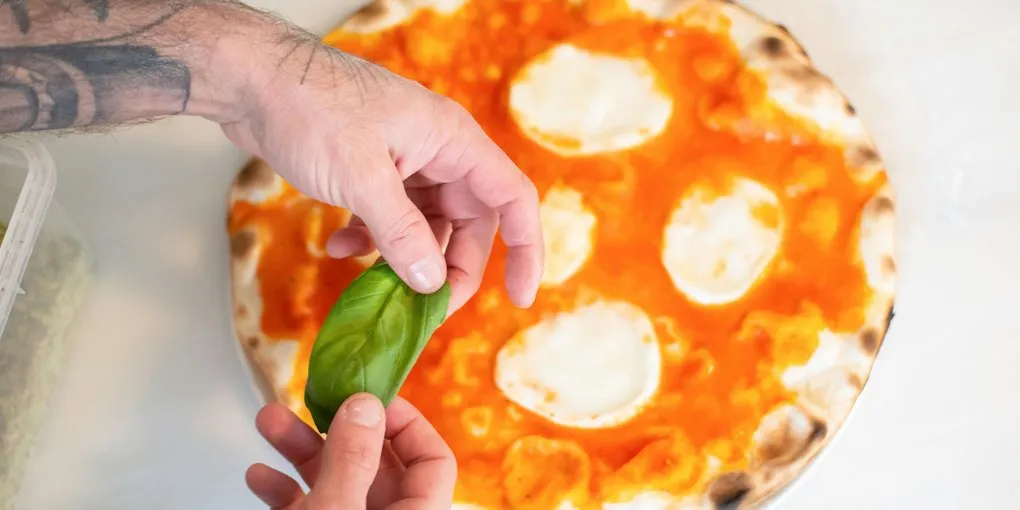
A pizza al padellino is, structurally, a personal pan pizza about seven inches across, with a tall airy crumb, a crispy oil-fried bottom, and a small lip up the pan walls. It is baked one at a time in a small round non-handled aluminum pan called a padellino (or tegamino, depending on which Turin pizzeria you ask). Each pan holds a single dough ball — one pizza per person — which is exactly how it is served in Turin: each diner gets their own pan, with their own combination of toppings.
The format dates to early-to-mid twentieth-century Turin and is widely associated with the city’s parallel tradition of farinata (chickpea pancake), the two often served together in Piedmontese eateries. No single inventor is reliably documented in English-language sources; the consensus is that pan pizza became established in Turin during the 1930s, then evolved during the post-war boom as the dough hydration and rise time were tuned to match the cooking time of farinata. The aluminum baking dish, originally a practical tool to keep the pizza separated from the chickpea batter, also turned out to be useful for serving controlled single portions.
This recipe is a faithful home version. It uses a 65% hydration dough with a 24-hour cold ferment, a 7-inch deep-dish personal pan, generous oil for the fry-on-the-bottom, and a fast 525F bake. The result is a pizza that sits between Neapolitan thinness and Sicilian thickness, with a unique combination of soft chewy crumb and crispy oil-fried bottom that does not quite exist in any other style.
If you have made our Kenji’s foolproof pan pizza at home — the no-knead 10-inch round cast-iron version — pizza al padellino is its smaller, single-portion Italian cousin. The technique overlaps but the format and the dough are different.
What Makes Pizza al Padellino Distinct
Pizza al padellino is a single-serving pan pizza, smaller than a Sicilian or Detroit slice, deeper than a Neapolitan, with a uniquely chewy crumb and oil-fried bottom from baking in a small heavily oiled pan. The format is the dish.
A few specific dimensions distinguish it from related pan pizzas:
Size. Pans run 16 to 18 cm (about 6.3 to 7.1 inches) in diameter. One pizza fills one pan; one person eats one pizza. This is in contrast to Sicilian (large rectangular sheet) or Detroit (10x14 inch rectangle, 4-6 servings per pan).
Depth. Pans are typically 2 to 3 cm deep — about an inch. The dough rises and bakes to fill that depth, producing a finished pizza about 2-3 cm thick. Sicilian is thicker (typically 4-5 cm); Neapolitan is much thinner (under 1 cm everywhere except the cornicione).
Hydration and dough character. Padellino uses a 60-65% hydration dough — wetter than a Neapolitan but drier than a Sicilian. The dough is meant to be soft and pliable, not the high-hydration sticky doughs of focaccia or pan pizza extremism. The crumb is open but chewy, similar in feel to a soft Italian roll. For the science of how hydration affects crumb structure, see the pizza dough hydration guide.
The oil treatment. The pan is oiled generously — 1.5 to 2 tablespoons of olive oil per pan, which is a lot relative to the pan size. The oil pools at the bottom and conducts heat directly into the dough’s underside while frying it slightly, producing a deep golden, slightly crisp bottom that retains a hint of oil sheen. This is closer to Detroit’s frico-edge logic than to Neapolitan’s leoparded char.
Topping treatment. Less is more. The dough wants to rise; heavy toppings push it down and produce a denser pizza. Classic toppings are simple — Margherita (sauce + fior di latte + basil), marinara, salame piccante, capricciosa. Avoid high-water vegetables like fresh tomato or zucchini that release moisture mid-bake.
Why the Small Pan Format Works
The small-pan format solves several problems that other pizza styles handle differently:
Portion control. Pizza al taglio sells by weight; Neapolitan sells one large pizza per person; Sicilian sells by the slice from a shared pan. Padellino’s “one pan, one person” approach gives you exact-portion control with no waste and no negotiation about who gets the last slice.
Topping customization without slowing service. Each pan is built to order, so each person at the table can have a different topping combination. This was a real practical advantage in mid-twentieth-century Turin, when pizzerie served the city’s industrial workforce during fast lunch and dinner shifts.
Bake consistency. A small dough ball baked in a small pan reaches the right temperature in the right time without the edge-vs-center bake unevenness that plagues larger pizzas. Every bite of a 7-inch padellino was at the same heat zone for the same amount of time.
Heat geometry. The deep pan walls trap heat radiating from the oven sides as well as the bottom. The dough sees conduction from the pan bottom (oil-mediated, intense), conduction from the pan walls (mild), and radiation from above. The combined heat field cooks the small dough evenly in 7-10 minutes at 525F.
Pan options for home cooks: A LloydPans 7-inch deep-dish pan is the closest readily-available match to the traditional Italian padellino. A 6-inch Lodge cast-iron skillet is workable but conducts heat faster, so reduce bake time by 1-2 minutes. Hard-anodized aluminum padellino pans from Italian manufacturers like Agnelli or Crisma are the traditional standard if you can source them. A non-stick mini pizza pan will do in a pinch but the coating limits oven temp to 500F maximum.
Check price on Amazon → LloydPans 7-Inch Deep-Dish Personal Pan
How Padellino Sits in the Italian Pizza Landscape
Padellino is Turin’s contribution; the city is in Piedmont, in northwestern Italy, far from the Naples-and-Rome axis that dominates pizza canon. Northern Italy has its own bread and pizza traditions — sfogliata, focaccia di Recco, pizza alla pala — and padellino fits that lineage more than it fits the Neapolitan one.
What padellino shares with Roman tonda is being Northern-Italian, electric-deck-oven-baked, restaurant-portion. What it shares with NY slice is the lower bake temp and the moderate hydration. What makes it unique is the small-pan format and the oil-fry-on-bottom treatment that no other style does.
If you read the Pinsa Romana page, you will notice that pinsa is also a Northern Italian pizza-adjacent dish — but pinsa is a single trademarked product (Di Marco), uses a proprietary multi-grain flour blend, and is shaped flat and oblong, not deep-pan small-round. Pinsa and padellino are siblings, not the same dish.
The Recipe
This recipe makes four pizzas in 7-inch personal pans. The dough is a 65% hydration build with a 24-hour cold ferment. Total active time after dough is mixed: about 12 minutes per pizza.
Dough (makes four ~290g balls)
| Ingredient | Weight | Baker’s % |
|---|---|---|
| Tipo 00 flour or bread flour | 700g | 100% |
| Water (cool, 65F) | 455g | 65% |
| Fine sea salt | 17g | 2.4% |
| Instant dry yeast | 1.5g | 0.21% |
| Extra-virgin olive oil (in dough) | 14g | 2% |
The 0.21% yeast loading is intentionally low for a 24-hour cold retard — the long fridge time does the lifting. If you cannot wait that long, see the same-day adjustment in the FAQ below.
Method:
- Whisk flour and yeast in a large bowl.
- Add the water and mix by hand until no dry flour remains. Rest 20 minutes.
- Add salt and olive oil; mix until incorporated.
- Cover and rest 30 minutes. Perform three sets of stretch-and-folds, 30 minutes apart. For technique, see how to stretch pizza dough.
- Cover tightly and refrigerate 18-24 hours. The cold retard develops flavor passively — see cold fermentation explained.
- Tip out, divide into four 290g balls, and ball tightly. Cover and rest 60-90 minutes at room temperature.
Pan Setup (per pan)
- 1.5 to 2 tablespoons (about 20-25 ml) extra-virgin olive oil
- A dusting of semolina (optional — for extra crisp bottom)
Pour the oil into the bottom of the pan and tilt to coat the bottom and the lower 1 cm of the walls. The oil should pool slightly in the center.
Stretching into the Pan
This is a two-stage stretch with a rest in between. The reason: dough that is forced too far in one push springs back during the bake and produces uneven thickness.
- Take one 290g dough ball. Press it down on a lightly floured surface to flatten.
- Transfer to the oiled pan. Use your fingertips to push the dough out from the center toward the pan walls. Stop when the dough covers about 80 percent of the pan’s diameter — leave a 1 cm gap to the wall on all sides. Do not fight it.
- Cover and rest 15 minutes. The dough relaxes.
- Push the dough the rest of the way to the pan walls and slightly up the sides — about 1 cm up the walls. This creates the rim.
- Final proof 20-30 minutes covered with plastic wrap. The dough should look puffy and have small bubbles visible underneath.
Topping (per pan, classic Margherita)
- 50g San Marzano DOP tomatoes, hand-crushed and lightly salted (no cooking)
- 60-70g fior di latte, sliced and lightly drained on paper towels
- 3-4 fresh basil leaves
- 1 tsp grated Parmigiano (optional)
- Drizzle of EVOO post-bake
Bake
- Preheat your oven to 525F (or your max if lower) with a baking steel on the lower-middle rack at least 45 minutes before baking. Padellino bakes on the lower rack — closer to the oven’s bottom heating element — to get the bottom crispy.
- Top the pizza while the pan is still on the counter. Spoon hand-crushed tomato in the center, leaving a 1 cm border at the dough rim. Distribute fior di latte slices. Tear basil over.
- Slide the pan onto the steel. Do not preheat the pan; the dough is already in it.
- Bake 8-10 minutes. The cheese should be melted and bubbly, the crust rim should be deeply golden, and the bottom — peek with a spatula — should be dark golden with crisp oil-fried texture.
- Optional broiler finish. If the cheese needs another 30 seconds of heat to spot, switch to broil for 30-60 seconds. Watch closely.
- Slide the pizza out of the pan onto a cutting board — a fish spatula works well. The bottom should release cleanly because of the oil. If it sticks, run the spatula under it to free.
- Finish with EVOO drizzle and flaky salt. Cut into quarters or eat whole.
Making Multiple Pies for Dinner
Padellino is designed for one-at-a-time service, but you can absolutely make four pies for dinner. Three options:
Option A: Stagger the bakes. Bake one pan at a time, 8-10 minutes each, while the next pan is finishing its proof. Total elapsed time: about 45 minutes for four pizzas. Each diner gets a fresh-out-of-oven pie.
Option B: Bake two simultaneously. A standard home oven steel can fit two 7-inch pans side-by-side. Bake two at a time for 8-10 minutes, then the next two. This trades freshness for speed.
Option C: All four at once. Use the steel and another rack with a second steel or stone. Four pans across two racks. Rotate halfway through. The bake will be slightly less even but is acceptable for a casual gathering.
Restaurants in Turin run dedicated pizza ovens with multiple decks, so all four come out simultaneously. At home, Option A is the closest you will get to the restaurant experience.
Practical Notes
Do not skip the second push. The dough must reach the pan walls. If you stop short, you get an irregular round with a thick lip — visually unconvincing and structurally less good. Two-stage push with a 15-minute rest is what gets a clean pan-edge result.
Use enough oil. This recipe calls for 1.5-2 tablespoons per pan, which sounds like a lot. It is. The oil does two jobs: it lubricates the pan so the dough releases cleanly, and it conducts heat into the bottom of the dough during the bake, frying the underside. Skim the oil and you get a stickier, paler bottom.
The lower rack is non-negotiable. Padellino lives or dies by bottom heat. The lower-middle rack puts the pan close enough to the oven floor to get strong bottom conduction without burning. Upper-rack baking gives you melted cheese and a flabby bottom. Use the lower rack. For more on rack geometry and preheat strategy, see how to bake pizza in a home oven.
Do not overload with toppings. The dough needs to rise during the bake. Too much sauce or cheese pushes it down and produces a denser, breadier pizza. The classic 50g sauce + 70g cheese per 7-inch pan is the calibrated number; deviating up by more than 50% starts to compromise the rise.
Reheating works. Padellino reheats unusually well — the oil-fried bottom retains its texture if you put it back in a 400F oven for 5 minutes. This makes it good for next-day lunch, which is a meaningful practical advantage over Neapolitan-style pizza, which is awful the day after.
Where to Eat Padellino in Turin
If you find yourself in Turin and want to compare your home version to the source material, Gambero Rosso International’s guide names a few addresses worth visiting: Cecchi (via Madama Cristina, 92), Da Gino (via Monginevro, 46), Lentini’s (corso Orbassano, 470), Il Padellino (corso Vinzaglio, 21b), Padellino & Farinata (via Maria Vittoria, 37a), and Ruràl Pizza (via Mantova, 27). Many serve their padellino alongside the city’s other regional bake — a slice of farinata, the chickpea-flour pancake that shares oven space with the small pans.
Sources: Gambero Rosso International, “Pizza al padellino: what It is and where to eat the best in Turin”; TasteAtlas, Pizza al Padellino entry; Pasta Grammar, “Pizza al Padellino — Italian Pan Pizza Recipe”; Tortellini & Co, “Pizza al Tegamino Recipe”; Olives for Dinner, “Pizza al Padellino (Italian Skillet Pizza Recipe)”; CNN Travel, “Make your own pan pizza like Stanley Tucci’s Italian pizzeria.”
Some links above are affiliate links — as an Amazon Associate, JayArr Pizza earns from qualifying purchases at no additional cost to you.
Frequently Asked Questions
- What is the difference between padellino and tegamino?
- The two terms refer to the same dish in everyday use, but they map to different regional preferences within Piedmont. Padellino literally means 'small pan' — diminutive of padella, a frying pan. Tegamino literally means 'small skillet' — diminutive of tegame, a saucepan or saute pan. Some Turin pizzerie list the dish as pizza al padellino; others list it as pizza al tegamino. The pan they bake it in is the same. In specialty Italian cookware, padellino tends to be the term for round non-handled small pans used for pizza specifically, while tegamino is the term for slightly deeper saute-pan-shaped cookware. For practical purposes, you can use either term, and the recipe is the same.
- What pan size and material works best?
- A 7-inch (16-18 cm) round, deep-dish, non-handled pan is the ideal. Hard-anodized aluminum (LloydPans 7-inch, Italian Agnelli or Crisma brands) is the closest match to the traditional padellino — it conducts heat fast and evenly, releases dough cleanly, and tolerates 550F+ without coating issues. Cast iron (6-inch Lodge skillet) is workable but heat-conducts faster than aluminum, so reduce bake time by 1-2 minutes. Carbon steel behaves similarly to cast iron and is slightly lighter to handle. Non-stick coated pans work but limit oven temp to 500F maximum (most non-stick coatings degrade above 500F) — acceptable for entry-level practice but not the long-term solution. A 7-inch springform or tart pan with removable bottom works in a pinch but the seam can leak oil.
- Can I make padellino in a larger pan?
- Technically yes, but you lose the 'personal pan' identity that defines the dish. A 10-inch or 12-inch pan with a 290-gram dough ball will produce a thinner, larger pizza with the same oil-fried bottom — closer to a Detroit or focaccia format than a true padellino. If you want to scale up, increase the dough proportionally: a 10-inch pan needs about 425 grams; a 12-inch pan about 580 grams. Bake time stretches to 12-15 minutes for the larger sizes. The result is a pan pizza, but the Italian convention treats the small-pan, single-portion format as essential to the dish's identity.
- Why oil the pan so heavily?
- The oil does two jobs that are hard to substitute for. First, it acts as a heat-transfer medium between the hot pan and the dough — oil at 300F+ conducts heat into the dough's bottom faster and more evenly than dry pan-to-dough contact. The result is the characteristic golden-brown, slightly fried bottom that distinguishes padellino from a regular pan pizza. Second, the oil provides slip — the dough shrinks slightly during the bake, and the oil layer ensures the pizza releases cleanly when you slide it out. Skim the oil and the bottom is paler, less crisp, and prone to sticking. The 1.5-2 tablespoons-per-pan ratio is calibrated; less is meaningfully worse.
- Can I use a same-day dough?
- Yes, with adjustments. For same-day padellino, use 4g of yeast (instead of 1.5g), water at 80F, and bulk-ferment for 4 hours at room temperature with three stretch-and-folds in the first 90 minutes. Divide and ball, bench rest 30 minutes (instead of 60-90), and proceed with the pan-stretching method. The dough will be slightly denser and less developed in flavor than the 24-hour cold-ferment version, but the pan-fried character and chewy crumb still come through. Many Turin pizzerie do same-day dough during high-volume service. The 24-hour version is meaningfully better in flavor, but the same-day version is better than no padellino at all.
- Who invented pizza al padellino, and when?
- No single inventor is reliably documented in the available English-language sources. The consensus is that pan pizza became established in Turin during the 1930s and was further developed in the post-war period — the dough hydration and rise time tuned to 'synchronize' with the cooking time of farinata, the chickpea pancake the small pans were originally designed to keep separate from the dough. Specific founder-and-year claims tied to individual Turin pizzerie do not hold up to cross-source verification, so the honest answer is: a Piedmontese tradition that crystallized in the 1930s and matured into its current form during the post-war decades.
- Why is the yeast amount so low (0.21%)?
- The 1.5g IDY in 700g flour (0.21%) is calibrated for the 18-24 hour cold ferment. Long cold retards do not need much yeast — fermentation continues slowly in the fridge, and excess yeast over-proofs the dough during the cold rest. Standard cold-ferment recipes run 0.1-0.5% yeast for 24-72 hour windows. For a same-day version, see the same-day FAQ above. If you scale this recipe for a longer (48-72 hour) cold ferment, drop the yeast to about 0.5g per 700g flour.