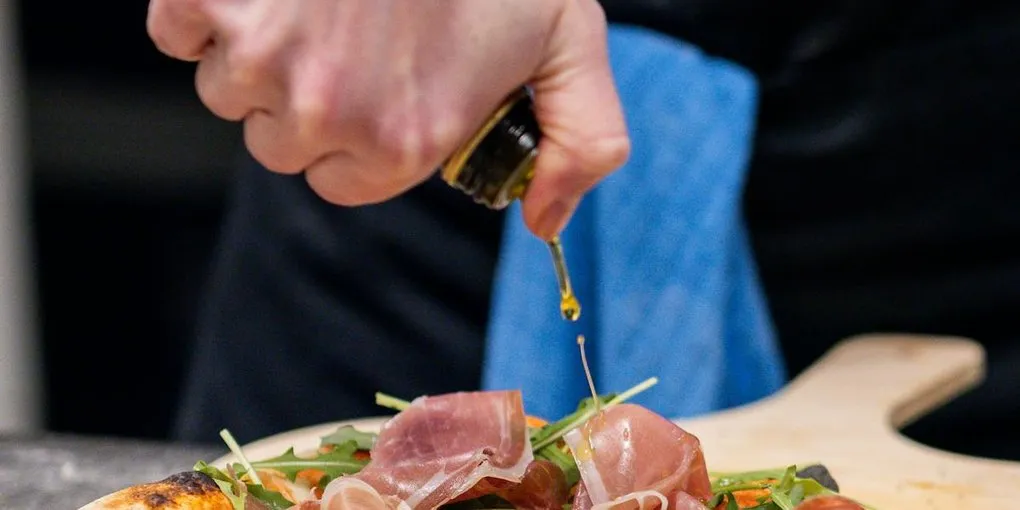
Most home pizza recipes tell you to drizzle olive oil before baking. Most great pizzerias drizzle it after. The gap between those two habits is not tradition — it is chemistry.
When you add EVOO matters more than how much you add. The timing determines which compounds survive to your plate, how much lycopene your body actually absorbs from the tomato sauce, and whether the oil contributes anything beyond grease.
What EVOO Contains That Is Worth Preserving
Extra virgin olive oil earns its premium over cheap refined oil through two categories of compounds: phenolics (oleuropein, hydroxytyrosol, oleocanthal) and volatile aromatics (the grassy, fruity, peppery notes that distinguish a good oil the moment you open the bottle).
The phenolics are the antioxidants, the anti-inflammatories, and the source of the slight bitterness and throat-catch that serious olive oil drinkers value. The volatiles are the flavor — they are what makes a fresh-harvest oil smell alive.
Both are fragile under heat. [Masi pp. 94-95]
The 90-Second Neapolitan Bake: How Much Damage Happens
EVOO is the most thermally stable oil during a standard pizza bake. A Neapolitan wood-fired oven runs at 380-400C (716-752F), and a 60-90 second bake is not enough time for the oil to reach its smoke point of 210-220C (410-428F). No acrylamide forms, the oil does not break down into harmful compounds, and there is no safety concern.
But “not harmful” is not the same as “unchanged.”
Laboratory analysis during a 90-second Neapolitan bake shows approximately 30% loss of phenolic compounds. That is a meaningful drop in the oil’s bioactive value. The volatile aromatics — the compounds responsible for fresh olive oil’s distinctive smell and flavor — experience even greater losses, because volatiles by definition escape into the air at elevated temperatures. The fruity aroma of fresh oil is largely gone after 90 seconds in a 750F oven. [Masi pp. 94-95]
What happens to the bitter phenols is interesting: they migrate to the liquid phase and some hydrolyze in the acidic tomato environment, losing their bitter character in the process. The net result is that the oil contributes some antioxidant function and a small contribution to the flavor profile, but not the full expression of a high-quality EVOO.
The Home Oven Bake: More Time, More Loss
A home oven baking at 500-550F (260-290C) for 7-8 minutes exposes the oil to lower peak temperatures but far more total time. The extended bake gives volatile compounds more opportunity to evaporate and phenolics more time to degrade.
The practical result: the difference between a high-quality finishing EVOO and cheap pure olive oil becomes essentially zero when both are baked in a home oven. For dough (where the oil is buried in the structure) and for pre-bake brushing on the crust, inexpensive pure olive oil performs the same structural functions at a fraction of the cost. [Myhrvold p. 354]
This is not a money-saving trick — it is the correct application of each oil type. Cheap oil where quality cannot be perceived; good oil where quality can.
The Lycopene Argument for Pre-Bake Oil
There is one reason to put olive oil on before baking that has nothing to do with the oil itself: lycopene.
Lycopene is the red carotenoid pigment in tomato sauce. It is the compound responsible for much of tomato’s association with cardiovascular and prostate health. Lycopene is lipophilic — it bonds with fat before your body can absorb it. Without a fat present, a significant portion of the lycopene in tomato sauce passes through you unabsorbed. [Masi pp. 90-91]
When you drizzle oil onto the pizza before baking, it combines with the tomato sauce during the bake and creates an ideal lycopene delivery system. The heat actually increases lycopene bioavailability compared to raw tomatoes — baking does not compromise lycopene, it enhances it. The fat-lycopene bond formed during cooking persists through eating and digestion.
The practical implication: For the lycopene benefit, the oil can go on before or after baking. The bond forms either way. But for flavor and phenolic preservation, post-bake wins clearly.
When Post-Bake Finishing Is the Right Move
Adding EVOO after the pizza exits the oven preserves everything that pre-bake heat destroys.
The pizza surface coming out of a home oven is typically 200-350F (93-177C) depending on the area — hot enough to activate the volatile aromatics in a finishing oil, but cool enough that they do not immediately flash off. When you drizzle good EVOO over a pizza that just came out of the oven:
- The heat activates the aromatics — the grassy, fruity notes bloom into the air and onto your palate.
- The oil has seconds to heat rather than minutes, so losses are minimal.
- The phenolics remain largely intact — you are getting the oil’s bioactive compounds.
- The oil spreads across the surface and concentrates in depressions, distributing flavor unevenly in an interesting way.
This is the Roman tradition. Roman pizza styles — especially al taglio — finish with a brushstroke of olive oil after the pizza exits the oven. It is not decorative. It is the single biggest flavor upgrade available in the last 10 seconds of pizza production. [Forkish Ch2]
By Oven Type: A Practical Breakdown
The argument for post-bake finishing is strongest for long bakes and weakest for ultra-short ones.
Neapolitan wood-fired (60-90 seconds at 900F): The case for post-bake is still valid — 30% phenolic loss is real — but the argument is less dramatic because the bake is so short. Some of the oil’s character survives. Many Neapolitan pizzerias add a swirl of oil before baking and another after. The pre-bake swirl contributes to the sauce’s texture and aids lycopene absorption; the post-bake swirl delivers flavor.
Portable oven (60-90 seconds at 800-900F): Same as wood-fired. A brief swirl of oil over the sauce before launching is fine. Add a finishing drizzle after pulling the pizza.
Home oven with steel (7-8 minutes at 500-550F): Post-bake finishing is strongly preferred. Eight minutes at 500F destroys a meaningful portion of everything that makes premium EVOO worth buying. Use cheap pure olive oil in the dough and for pre-bake brushing. Reserve your good EVOO for after the oven. A pizza steel delivers the best results here.
Extended pan bakes (Detroit, Sicilian — 12-25 minutes): The dough has plenty of oil for richness and crust function. A finishing drizzle on the hot pizza after baking is the right application for EVOO here too.
What to Actually Do: A Decision Tree
Are you baking in a 500-550F home oven? Use pure olive oil on and in the dough. Drizzle good EVOO only after baking.
Are you baking in a wood-fired or portable oven at 800F+? A swirl of oil over the sauce before launch contributes to lycopene absorption and sauce texture. A finishing drizzle after baking adds the fresh flavor. Both have value.
Are you making a Roman-style pizza? Finish with oil after baking, as tradition dictates. The post-bake brushstroke is part of the flavor profile. [Forkish Ch2]
Are you using a pan pizza method? Oil in the pan is structural — it fries the bottom of the crust. EVOO drizzled after baking is a flavor addition. They serve different purposes.
Which Oil to Use for Finishing
Not all olive oil is worth finishing with. Once the oil bypasses the oven, quality becomes directly perceptible.
Look for:
- A recent harvest date (not just “best by” — olive oil fades with age and should ideally be used within 12-18 months of harvest)
- Dark glass or tin packaging — light degrades olive oil rapidly
- Fruity, medium-peppery character rather than intensely bitter — pizza toppings are delicate, and an aggressive Tuscan oil can overwhelm mozzarella and tomato
- Single-origin or estate oils rather than blended commodity oil
Gemignani uses Filippo Berio or Corto for finishing — both fruity without being peppery or grassy enough to compete with the other toppings. That is a useful calibration. [Gemignani, Theory]
A simple test: taste a spoonful before putting it on your pizza. If you would not enjoy it on bread, do not put it on your finished pizza.
Shop finishing EVOO on AmazonThe Bitter Phenol Question
Some people avoid pre-bake EVOO because they find baked olive oil bitter. There is a chemical explanation for this.
During baking, bitter phenols in olive oil migrate into the liquid phase rather than evaporating into the air. In an acidic environment — like tomato sauce — complex phenols also hydrolyze and can register on the palate as bitterness. The specific phenols responsible for the pleasant throat-catch in fresh EVOO become differently expressed after baking. [Masi pp. 94-95]
The fix is not to avoid oil before baking — it is to choose a less intensely phenolic oil for the pre-bake application. Mild, fruity oils hold up better than peppery Sicilian or intensely bitter Tuscan varieties.
One More Thing: The Lycopene-Fat Bond Is Not Oil-Specific
Worth clarifying: the lycopene absorption benefit does not require EVOO specifically. Any fat — butter on a Detroit-style pizza, lard in a Sicilian dough, cheese fat from mozzarella — facilitates lycopene absorption. The oil-tomato pairing is nutritionally ideal, but it is the fat-lycopene bond that matters, not the specific fat source. [Masi pp. 90-91]
This means that even pizza styles using little or no olive oil still deliver bioavailable lycopene, as long as there is fat in the equation — and there always is.
The EVOO-on-tomato combination is excellent both nutritionally and gastronomically. That combination holds whether the oil goes on before or after baking. For flavor and phenolic preservation, post-bake is correct. For convenience and lycopene, either timing works.
The bottom line: Save your good olive oil for after the oven. It lasts longer, delivers more of its best compounds, and makes your pizza taste noticeably better than oil that spent 8 minutes in a 500F oven.
Related: Finishing Oils and Flaky Salt | Pizza Dough with Oil, Butter, or Lard | The Maillard Reaction and Pizza | Herbs on Pizza | Home Pizza Oven Temperature Guide
Frequently Asked Questions
- Does olive oil go on pizza before or after baking?
- For the best flavor and maximum preservation of EVOO's phenolic compounds and volatile aromatics, add it after baking. During a 7-8 minute home oven bake, a meaningful portion of what makes premium olive oil taste premium evaporates or degrades. Post-bake finishing delivers the oil's fruity, complex character directly to your palate. In short Neapolitan or portable-oven bakes (60-90 seconds), a pre-bake swirl over the sauce is reasonable, but a post-bake finishing drizzle still adds the most flavor.
- Can I use cheap olive oil in the dough and save good EVOO for finishing?
- Yes, and this is actually the correct approach. When olive oil is baked into the dough or brushed on before the pizza goes in the oven, heat eliminates any quality advantage of premium EVOO. Cheap pure olive oil performs the same structural functions in the dough. Reserve a small amount of high-quality EVOO for the 10 seconds after the pizza comes out -- that is where quality becomes directly perceptible.
- Why do Italians say tomato and olive oil are a perfect combination?
- Lycopene -- the red pigment that gives tomatoes their color -- is lipophilic, meaning it bonds with fat before your body can absorb it. Without fat present, much of the lycopene in tomato sauce passes through you unabsorbed. Olive oil (or any fat) enables your body to actually absorb lycopene from the tomato. Baking does not destroy lycopene -- it actually increases bioavailability compared to raw tomatoes. The fat-tomato combination is not just a taste preference; it is nutritionally meaningful.
- Does olive oil make pizza crust burn faster?
- In a home oven baking at 500-550F, olive oil in or on the dough will not push a pizza past its normal burn point. The concern is more relevant in very high-temperature portable ovens (800-950F) where any sugar or fat in the dough caramelizes much faster. For portable ovens, a drizzle of oil directly over the dough (not the sauce) before launch can cause the crust rim to char quickly. Finishing with oil after baking eliminates that risk entirely.
- What kind of olive oil should I use to finish pizza?
- Choose a fruity, medium-peppery EVOO rather than an intensely bitter or pungent variety. Pizza toppings are relatively delicate, and an aggressive Sicilian or Tuscan oil can overwhelm mozzarella and tomato. Look for a recent harvest date on the label, dark glass packaging, and single-origin sourcing. Gemignani recommends Filippo Berio or Corto -- both fruity without competing with delicate toppings.