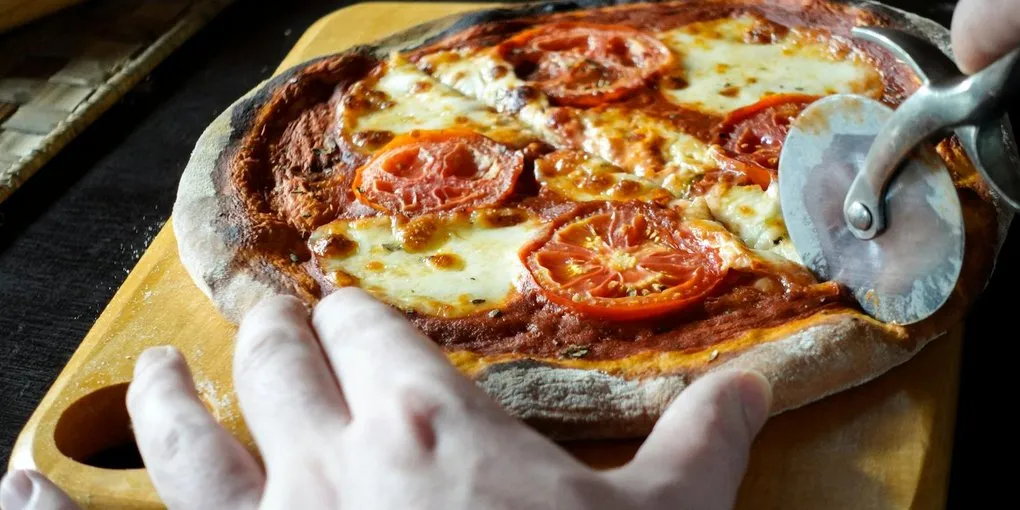
There’s a style of pizza made along the Illinois-Iowa border that uses malt syrup and molasses in the dough, grinds its sausage twice, puts cheese on top of everything, cuts the finished pie into strips with a hinged paper cutter, and somehow remains almost completely unknown outside its home region.
Quad Cities pizza is one of the most distinctive regional styles in America. Every element — the dark, nutty, slightly sweet crust; the spicy tomato sauce; the fennel-laced double-ground sausage; the cheese-over-toppings assembly — reflects specific choices made by the pizzerias of Davenport, Rock Island, Moline, and Bettendorf. These aren’t accidents or shortcuts. They’re deliberate, decades-old traditions that produce a pizza unlike anything else in the country.
The Dough: Dark, Nutty, and Slightly Sweet
The defining characteristic of Quad Cities dough is the inclusion of malt syrup and molasses. Both are mixed into the dough, and both contribute to the dark, mahogany-colored crust that distinguishes this style visually from any other pizza you’ve seen.
Here’s what makes this interesting from a science standpoint: despite the molasses and malt in the formula, the sweetness in the finished crust is practically undetectable. You don’t eat a slice and think “sweet pizza.” What you experience is a nutty, almost toasted quality — a depth of flavor that’s hard to place if you don’t know what you’re tasting.
The explanation is twofold. First, the quantities are small enough that the sugar impact on the palate is subtle. Second, much of the sugar from the malt and molasses participates in Maillard browning during baking, converting from sweet simple sugars into complex, bitter-sweet melanoidins (the brown pigments and flavor compounds of the Maillard reaction). The sweetness gets consumed by chemistry and emerges as color and complexity rather than a sweet taste.
Malt syrup is concentrated barley malt extract — the same product used in brewing. It provides maltose (a fermentable sugar that yeast metabolizes readily), plus diastatic enzymes if the malt is unconverted, plus the characteristic malty flavor. If you’ve worked with diastatic malt powder in other pizza doughs for browning and fermentation benefits, Quad Cities dough takes a similar principle but uses liquid malt syrup instead of powder, and in larger proportion.
Molasses adds iron, calcium, and trace minerals along with sucrose and invert sugars. Its flavor contribution is more complex than malt — there are bitter notes, earthy notes, and the characteristic depth that distinguishes molasses from plain sugar. In the finished crust, these compounds interact with the Maillard reaction products to create the distinctive dark, nutty profile.
The combination of malt and molasses also affects the crust texture. Sugars are hygroscopic — they attract and hold moisture. A crust with malt and molasses retains slightly more internal moisture during baking than an unsweetened lean dough, even as the exterior browns aggressively. The result is a crust that’s dark and firm on the outside but slightly more tender inside than you’d expect from looking at it.
The Sausage: Ground, Cooked, Ground Again, Cooked Again
If the dough is distinctive, the sausage is genuinely unusual. Quad Cities pizza sausage goes through a process that no other regional style replicates:
-
Start with fennel-laced pork. The base is standard Italian-American sausage seasoning: pork shoulder, fennel seed, salt, black pepper. The fennel is the dominant spice note.
-
Cook the seasoned pork. Brown or roast the sausage until fully cooked through.
-
Cool and grind again. After cooking, the sausage is cooled and then run through a grinder a second time. This breaks the already-cooked meat into a very fine, almost crumbly texture.
-
Cook again on the pizza. The double-ground, pre-cooked sausage goes onto the pizza and bakes with everything else.
The double-grinding produces a texture completely unlike the chunky, cohesive sausage crumbles you’d find on a New York or Neapolitan pizza. Quad Cities sausage is fine-grained, loose, and distributes evenly across the surface almost like a seasoned meat powder. It doesn’t form clumps. It doesn’t have that springy bite of once-cooked sausage.
The flavor impact of the double cooking is significant. The first cook renders excess fat and develops Maillard flavors in the meat. The second grind exposes new surface area. The second cook (on the pizza) develops additional Maillard compounds on those fresh surfaces. The result is deeply savory, almost jerky-like in its concentrated flavor, with fennel as the persistent through-line. The science is similar to what happens with pepperoni during baking — repeated heat exposure drives progressively deeper flavor development.
The Sauce: Spicy Tomato With Cayenne
Quad Cities pizza sauce diverges from both the uncooked Neapolitan tradition and the gently simmered American standard. It’s a spicy tomato sauce with cayenne pepper as a defining ingredient.
The cayenne provides a noticeable but not overwhelming heat that contrasts with the sweet-nutty crust and the rich, fennel-forward sausage. It’s a deliberate counterpoint — the sauce is the bright, spicy element in a pizza where every other component leans toward richness and depth.
Most Quad Cities pizzerias keep their exact sauce recipes proprietary, but the consistent elements across the style are: crushed or ground tomatoes, cayenne pepper (not generic “red pepper flakes” — specifically cayenne for its clean, sharp heat), oregano, garlic, and sometimes a touch of sugar to balance the cayenne’s bite.
The sauce is applied generously. Quad Cities pizza is not a dry-topped pie. The spicy sauce is a primary flavor component, not a background element.
The Build: Cheese on Top of Everything
Quad Cities assembly order is another distinguishing feature: cheese goes on top of the toppings, not underneath them.
On a standard American pizza, toppings sit on top of cheese, exposed to direct radiant heat from the oven ceiling. They brown, dry out, and can burn if the bake goes long. On a Quad Cities pizza, the cheese blanket covers everything, protecting the toppings from direct heat and creating a different cooking dynamic.
The toppings steam gently under the melting cheese, staying moister and more tender. The sausage, already double-cooked and relatively dry, benefits from this protection — it doesn’t dry out further. The sauce stays vibrant under the cheese layer.
The cheese itself — typically mozzarella — melts into a smooth, unbroken layer over the top. There’s less browning on the cheese than you’d see on a New York or Neapolitan pizza because the toppings underneath provide moisture (sauce steam) that keeps the cheese surface temperature moderated.
This assembly technique shares a logical foundation with Detroit style (cheese on top of toppings), NJ tomato pie (sauce on top of cheese), and deep-dish (cheese on the bottom, sauce on top). Cheese-down or cheese-over-toppings assembly protects underlying ingredients and often produces superior cheese pull.
The Strip Cut: A Paper Cutter and an Attitude
The most visually distinctive element of Quad Cities pizza is the cut. Forget wedges. Forget squares. Quad Cities pizza is strip-cut — sliced into long, narrow rectangular strips using a hinged paper cutter (also called a lever-action cutter or “rocker blade” in some descriptions).
The strips run across the full width of the round pizza, creating pieces that range from narrow center strips (mostly toppings and crust) to wider edge strips (more crust relative to toppings). The varied proportions are part of the experience — you choose your preferred crust-to-topping ratio by picking your strip.
The paper cutter produces cleaner, straighter cuts than a pizza wheel, and it handles the thick toppings-under-cheese assembly without dragging cheese off the surface. It’s a practical solution to a practical problem: a standard pizza wheel tends to pull the cheese blanket sideways when cutting through Quad Cities pizza’s thick topping layer.
The Quad Cities Pizza Experience
Eating Quad Cities pizza for the first time is genuinely disorienting if you’re calibrated to any mainstream pizza style. The flavor profile hits differently because every component is doing something unexpected:
The crust is dark but not burnt, nutty but not sweet, and has more depth than any lean dough can produce. The sweetness of the malt and molasses has been converted to Maillard complexity. The texture is firm but not hard — there’s a slight give that comes from the sugar-retained moisture.
The sausage is unlike any pizza sausage you’ve had. The double-grind, double-cook process produces an almost granular texture that distributes evenly, and the flavor is concentrated, fennel-forward, and deeply savory.
The sauce bites. Not aggressively, but the cayenne is there, and it cuts through the richness of the cheese and sausage and the sweetness of the crust. Without the cayenne, the pizza would risk being one-dimensionally rich. With it, there’s a brightness that keeps you reaching for the next strip.
And the strips themselves change the eating experience. A narrow center strip is mostly toppings — intense, saucy, sausage-heavy. A wider edge strip is more crust-forward, showcasing the malt-molasses flavor. You get to choose your adventure with each piece.
Making Quad Cities Pizza at Home
This is an advanced project because some elements require advance preparation, but nothing here is technically difficult.
The Dough
Start with a standard pizza dough formula (65-68% hydration, bread flour at 13-14% protein) and add:
-
Malt syrup: 2-3% of flour weight. Barley malt syrup is available at brewing supply stores and health food stores. If you can only find diastatic malt powder, use 2% powder — you’ll get the enzymatic benefit but not the full malty sweetness of the syrup.
-
Molasses: 1-2% of flour weight. Use regular unsulphured molasses (not blackstrap, which is too bitter). This small amount is enough to darken the crust and add depth without making the dough taste sweet.
Cold ferment for 24-48 hours. The sugars from the malt and molasses give yeast extra fuel, so watch for over-proofing — you may need to reduce yeast slightly compared to your baseline recipe.
The Sausage
Start with 1 pound of ground pork shoulder. Mix in:
- 2 teaspoons fennel seed (lightly crushed in a mortar or spice grinder)
- 1 teaspoon fine sea salt
- 1/2 teaspoon black pepper
- Optional: pinch of red pepper flakes for additional heat
Cook the seasoned pork in a skillet until fully browned. Cool completely. Run through a meat grinder on the fine plate, or pulse in a food processor until the texture is fine and crumbly (not paste). Spread on a sheet pan and keep refrigerated until assembly.
The Sauce
Blend or process:
- 14 oz crushed tomatoes
- 2 cloves garlic
- 1 teaspoon dried oregano
- 1/2 to 1 teaspoon cayenne pepper (start with 1/2, adjust to taste)
- 1/2 teaspoon fine sea salt
- 1 teaspoon sugar (optional, to balance the cayenne)
- 1 tablespoon olive oil
This is applied uncooked or with a brief simmer. The cayenne should be noticeable but not dominant.
Assembly and Bake
- Stretch dough to 12-14 inches on a semolina-dusted peel.
- Spread the spicy sauce generously.
- Distribute the double-ground sausage evenly.
- Add any other toppings.
- Cover everything with shredded mozzarella, edge to edge.
- Bake on a preheated steel at 500-550F for 8-10 minutes until the cheese is fully melted and the crust is dark golden-brown.
Cut into strips. A bench scraper works if you don’t have a rocker blade — press straight down across the pizza to make parallel cuts about 1.5 inches apart.
Why Quad Cities Pizza Matters
In a country where regional pizza styles are increasingly homogenized by national chains and Instagram trends, Quad Cities pizza remains stubbornly, defiantly local. The malt-and-molasses dough, the double-ground sausage, the cayenne-spiked sauce, the cheese-over-toppings assembly, and the strip cut are all specific to this one metropolitan area straddling the Mississippi River.
It meets the criteria for a true pizza style: it affects the basic structure of the pizza (not just the toppings), and it’s made by multiple independent pizzerias in the region.
It’s also one of the most replicable at home. Every element is achievable with standard kitchen equipment and widely available ingredients. The only thing you might need to source is malt syrup, and a brewing supply store or Amazon solves that.
The Bottom Line
Quad Cities pizza exists in its own category. The malt syrup and molasses create a dark, nutty, complex crust that doesn’t taste sweet despite its ingredients. The double-ground, double-cooked fennel sausage has a texture and flavor concentration unlike anything on other pizza styles. The cayenne-spiked sauce provides the brightness that the rich components need. Cheese on top protects everything underneath. And the strip cut is both practical (handles the thick topping layer cleanly) and experiential (different crust-to-topping ratios in every strip).
If you’ve worked through Neapolitan, Detroit, and New York at home, Quad Cities is the next frontier. It rewards attention to detail, uses techniques (double-grinding, malt dough) that expand your pizza-making skills, and produces something genuinely different from anything else in your rotation.
Frequently Asked Questions
- What makes Quad Cities pizza different from other styles?
- Five distinguishing elements: dough made with malt syrup and molasses (dark, nutty crust), fennel-laced sausage that's cooked, cooled, ground again, and cooked again (fine crumbly texture), spicy tomato sauce with cayenne pepper, cheese applied on top of all toppings, and the finished pizza is strip-cut with a hinged paper cutter rather than cut into wedges or squares.
- Does Quad Cities pizza taste sweet because of the molasses and malt?
- No. Despite the malt syrup and molasses in the dough, the sweetness in the finished crust is practically undetectable. Most of the sugar participates in Maillard browning during baking, converting from simple sugars into complex melanoidins -- the brown pigments and flavor compounds that give the crust its distinctive dark, nutty depth rather than sweetness.
- Why is Quad Cities pizza sausage ground twice?
- The double-grind, double-cook process produces a very fine, almost crumbly texture that distributes evenly across the pizza surface. The first cook renders fat and develops Maillard flavors. The second grind exposes new surface area. The second cook on the pizza develops additional flavor on those fresh surfaces. The result is deeply savory, concentrated, and unlike sausage on any other pizza style.
- Why is Quad Cities pizza cut into strips instead of slices?
- The strip cut is both practical and traditional. A hinged paper cutter produces cleaner, straighter cuts through the thick topping-under-cheese layer than a standard pizza wheel, which tends to drag cheese off the surface. The strips also create varied eating experiences -- narrow center strips are topping-heavy while wider edge strips showcase more of the malt-molasses crust.
- Where is Quad Cities pizza from?
- The Quad Cities are a metropolitan area straddling the Mississippi River at the Illinois-Iowa border: Davenport and Bettendorf on the Iowa side, Rock Island and Moline on the Illinois side. The style is made by multiple independent pizzerias in the region and is recognized as one of the distinct American pizza styles.
- Can I make Quad Cities pizza at home?
- Yes. Start with a bread flour dough at 65-68% hydration and add 2-3% malt syrup and 1-2% molasses. For the sausage, season ground pork with fennel, cook it, cool it, grind it again through a fine plate, then use it as a topping. Make a sauce with cayenne pepper for heat. Assemble with toppings first, cheese on top. Bake on a steel at 500-550F for 8-10 minutes. Cut into strips with a bench scraper.