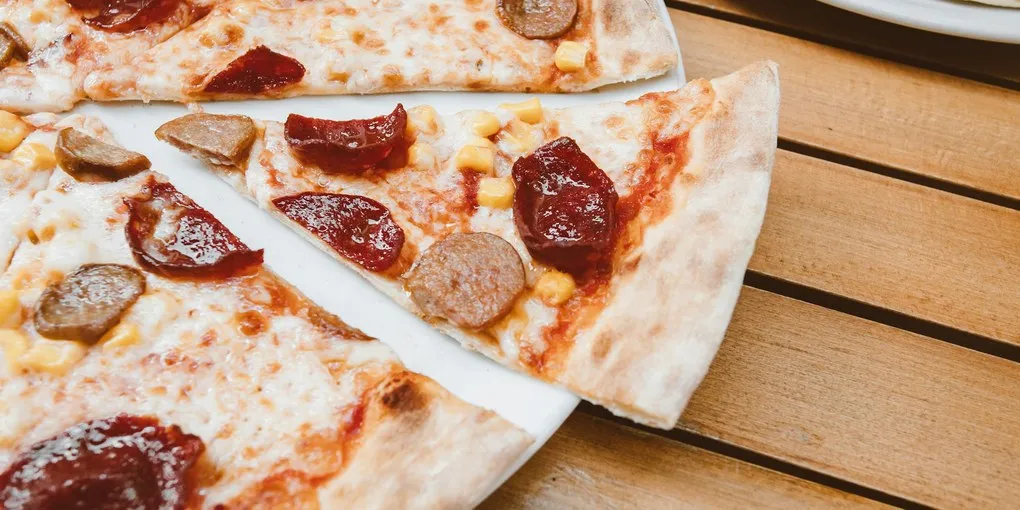
St. Louis pizza starts arguments. Not debates — arguments. The kind where someone from the East Coast takes one bite, stares at the slice, and says “this isn’t pizza.” And the person from St. Louis across the table says “you’re wrong,” and neither side budges.
The reason is Provel cheese. Everything else about St. Louis pizza — the cracker-thin crust, the sweet sauce, the square cut — contributes to the style’s identity. But Provel is the line in the sand. You accept it or you don’t. There’s almost no middle ground.
This guide covers what defines St. Louis style, how to make it at home using Tony Gemignani’s method from The Pizza Bible, and why this regional style — popularized at Amedeo Fiore’s Melrose Pizzeria, which opened in 1945 in the basement of 204 N. Sarah St. — deserves a spot in the American pizza canon whether you personally like Provel or not.
What Makes It St. Louis Style
Four elements, all mandatory. Remove any one and you have a different pizza.
Cracker crust. Ultra-thin, rolled (not stretched), docked to prevent any puffing. The thinnest crust of any American regional style. No chew, no rise, no air pockets. It snaps when you bend it.
Provel cheese. A processed cheese blend of provolone, Swiss, and cheddar developed for the St. Louis market by Chicago-based J.S. Hoffman Co. (patent application filed 1947, trademark registered 1950) and distributed locally through Costa Grocery (later Roma Grocery Co.). It melts into a gooey, almost liquid state — guilty-pleasure texture somewhere between Velveeta and fondue. Virtually unknown outside the St. Louis metro area.
Sweet tomato sauce. Sweeter than any other regional pizza sauce, with simple syrup as an explicit ingredient. Not candy-sweet, but noticeably sweeter than a New York or Neapolitan sauce.
Tavern cut (party cut). Cut into small squares, not triangles. Shared with Chicago cracker-thin and other Midwestern styles, but combined with Provel and the sweet sauce, the tavern cut is part of the identity.
Nathan Myhrvold includes St. Louis in his classification of legitimate regional pizza styles in Modernist Pizza, noting it satisfies both of his mandatory criteria: it affects the basic structure of the pizza, and it’s made by multiple independent pizzerias across the region — not just one shop’s signature.
The Provel Question
Provel is processed cheese. That’s not a criticism — it’s a fact that determines whether you’ll enjoy this pizza.
The blend is provolone, Swiss, and cheddar, combined with emulsifying salts into a smooth, uniform product. The product was developed by the Chicago-based J.S. Hoffman Co. — Hoffman filed the patent application in 1947 and the trademark was registered in 1950 — in collaboration with St. Louis grocer Tony Costa. Costa’s downtown St. Louis store (later renamed Roma Grocery Co.) became the early local distributor, which is how an out-of-town product became a regional St. Louis identity. It melts at a lower temperature than natural cheese, producing a gooey, almost stringless coating that flows across the pizza surface in a way that mozzarella never does.
People who grew up with Provel describe it as comfort food. People encountering it for the first time often describe it as “weird” or “fake-tasting.” Both reactions are honest. If you enjoy Velveeta on nachos or American cheese on a smash burger, you’ll probably enjoy Provel on pizza. If processed cheese makes you uncomfortable on principle, St. Louis pizza will be a hard sell.
Where to Find Provel
If you don’t live in St. Louis, you won’t find Provel at your local grocery store. It’s available online through several retailers — search for “Provel cheese” on Amazon or specialty cheese sites. It ships cold-packed. Expect to pay a premium over what St. Louis residents pay at their Schnucks or Dierbergs.
Provel comes in blocks, ropes (sticks), and pre-shredded. For pizza, shredded or diced is easiest — it melts fast and distributes evenly across the thin crust.
The Cracker Crust
St. Louis crust is the thinnest in the American pizza landscape. Gemignani’s recipe uses an 8-ounce (227g) dough ball — the smallest of any recipe in The Pizza Bible — rolled out to a 14-inch round. That’s an absurdly thin sheet of dough.
The crust is rolled with a rolling pin, not hand-stretched. Hand stretching would be nearly impossible at this thickness, and the goal isn’t a supple, elastic disc with a puffy cornicione. The goal is a rigid, uniform cracker. After rolling, you trim the edge to a clean 14-inch circle with a pizza wheel and dock the entire surface — poke small holes across it with a dough docker or fork to prevent any air bubbles from forming during baking.
No starter is used. This is one of a handful of exceptions in Gemignani’s system (along with Chicago deep-dish, Detroit, and Grandma) where the dough is made without a pre-ferment. There’s no time for the dough to develop fermentation flavor — it’s rolled so thin and baked so quickly that starter complexity would be lost. The crust’s job is structure and crunch, not flavor.
The result is closer to a flatbread or a large cracker than to what most people picture when they think “pizza crust.” It’s crisp. It’s rigid. It holds toppings without folding. And it shatters if you try to fold a slice in half, which is why no one folds St. Louis pizza — they pick up a square and eat it flat.
If you’re used to Neapolitan or NY-style pizza, the crust will feel like it’s missing something. That’s intentional. The crust is a delivery mechanism for Provel and sauce. It’s supposed to stay out of the way. For more on how different crusts behave and why, see how to stretch pizza dough.
The Sweet Sauce
St. Louis tomato sauce is unlike any other regional pizza sauce. It’s sweet — deliberately, measurably sweet — because it includes simple syrup as a core ingredient.
St. Louis Tomato Sauce (Gemignani)
| Ingredient | Amount |
|---|---|
| Ground tomatoes | 120g |
| Tomato paste | 125g |
| Simple syrup | 55g |
| Dried oregano | pinch |
| Fine sea salt | pinch |
Simple syrup: Dissolve 50g sugar in 58g water over low heat. Cool before using.
Method: Combine all ingredients and puree with an immersion blender until smooth.
The ratio here is striking — tomato paste nearly equals the ground tomatoes by weight, and the simple syrup is a significant addition. The result is a thick, concentrated sauce with a noticeable sweetness that balances the salty, processed funk of the Provel. It’s not dessert-sweet. It’s sweet the way Kansas City barbecue sauce is sweet — enough to notice, enough to polarize, enough to be a defining characteristic.
Compare this to a basic Neapolitan sauce — just crushed San Marzano tomatoes, salt, and maybe basil — and you can see how far apart these traditions sit.
Full Recipe: St. Louis Style Pizza (Gemignani Method)
Dough
Use Gemignani’s Master Dough (without starter), scaled to an 8-ounce (227g) dough ball. This is a basic flour-water-salt-yeast dough — nothing exotic. The magic is in how thin you roll it and how you handle it after that.
Equipment
- Rolling pin
- Dough docker or fork
- Pizza wheel (for trimming)
- Pizza stone or baking steel, preheated
- Pizza peel
Assembly
-
Roll the dough ultra-thin. On a lightly floured surface, roll the 8oz dough ball into a round slightly larger than 14 inches. Roll from the center outward, rotating the dough a quarter-turn between passes to keep it circular. The dough should be thin enough that you can almost see through it — translucent in spots is fine.
-
Trim to 14 inches. Use a pizza wheel to cut a clean circle. A 14-inch plate or pot lid makes a good template.
-
Dock the entire surface. Run a dough docker across the entire round, or poke holes every inch with a fork. Every. Inch. Undocked areas will puff into bubbles during baking, creating uneven thickness. The crust should stay uniformly flat.
-
Transfer to a floured pizza peel.
-
Sauce first, but bake in two stages. Spread the St. Louis tomato sauce in a thin, even layer across the docked crust, leaving a minimal edge (St. Louis pizza has almost no exposed crust border). For more on why staged baking helps thin crusts, see our two-stage home-oven bake guide.
-
Bake sauce-only for 4 minutes. Slide the pizza onto a preheated stone or steel. Bake at your oven’s maximum temperature (500-550F for most home ovens) for 4 minutes with sauce only. This par-sets the cracker crust before the cheese goes on, producing a crisper result.
-
Add Provel cheese. Remove from oven, distribute shredded or diced Provel evenly across the surface. Add toppings if desired.
-
Return to oven. Bake until the Provel is melted, gooey, and starting to brown in spots — typically 4-6 more minutes depending on your oven temperature.
-
Tavern cut. Transfer to a cutting board. Cut into 16 small squares using a pizza wheel or rocker — 4 cuts lengthwise, 3 cuts crosswise. The squares should be roughly 3-4 inches each.
Timing Summary
| Step | Duration |
|---|---|
| Make dough | 15 min |
| Rest dough | 30-60 min |
| Roll + dock + trim | 5 min |
| Sauce application | 2 min |
| First bake (sauce only) | 4 min |
| Add cheese + toppings | 2 min |
| Second bake | 4-6 min |
| Cut + serve | 2 min |
Total active time is under 30 minutes, plus the dough rest. This is one of the fastest pizza recipes you’ll make.
St. Louis vs. Chicago Cracker-Thin
These two styles get confused constantly. Both are thin-crust, both use a tavern cut, and both come from the Midwest. But the similarities are mostly superficial.
Crust: Both are thin, but Chicago cracker-thin uses a dough made with a poolish starter and pressed edges (St. Louis uses no starter). Chicago cracker-thin is rolled, trimmed slightly larger than the target size, and the edges are pressed flat. The crust is dock-heavy — aggressively docked. St. Louis is thinner still, using the smallest dough ball of any style.
Cheese: Chicago cracker-thin uses mozzarella. St. Louis uses Provel. This is the single biggest difference.
Sauce: Chicago cracker-thin uses a standard pizza sauce — no simple syrup. St. Louis sauce is sweet, thick, and tomato-paste-heavy.
Dough composition: Chicago cracker-thin dough contains no lard or butter. St. Louis dough is a straightforward flour-water-salt-yeast formula as well, but the two diverge on fermentation (starter vs. no starter) and hydration.
Cut: Both use tavern/party cut (squares). This is the shared Midwestern DNA.
The practical difference at the table: Chicago cracker-thin tastes like a very thin pizza with familiar ingredients. St. Louis tastes like something else entirely — Provel and sweet sauce create a flavor profile with no analog in other American pizza traditions.
The Tavern Cut: Why Squares
The tavern cut — also called party cut or Chicago cut — predates both St. Louis and Chicago cracker-thin pizza as a serving convention. It emerged from Midwestern taverns and bars where pizza was served as a shared snack alongside beer, not as individual entrees. Small squares are easier to grab from a communal tray, easier to eat one-handed while holding a drink, and portion more naturally for a group.
For bar pizza enthusiasts, the tavern cut is familiar territory. But St. Louis takes it further than most: 16 squares from a 14-inch round produces genuinely small pieces. The center squares have no crust edge at all — just sauce, Provel, and toppings. The perimeter squares have one thin edge of cracker crust. Neither piece is meant to be a meal on its own. St. Louis pizza is fundamentally communal — a shared thing, a few squares at a time.
The 16-piece cut also makes sense structurally. The cracker crust is rigid and fragile. A traditional triangle cut from a 14-inch pizza would produce slices 7 inches long that would snap under their own weight when picked up. Small squares stay intact.
Where It Sits Among Regional Styles
St. Louis is one of a growing cluster of regional American styles that have earned their own chapters in the modern pizza canon. Gemignani and Myhrvold both document:
- Chicago deep-dish and cracker-thin — two Chicago traditions under one city name
- New Haven apizza — coal-fired, charred, low-salt, sometimes cheeseless
- Detroit style — rectangular, blue-steel pan, brick cheese, racing-stripe sauce
- Old Forge style — Pennsylvania coal-country pan pizza with a prebaked shell
- Quad Cities style — malt-and-molasses dough, double-ground sausage, strip cut
Each one affects the basic structure of the pizza and is made by multiple independent pizzerias — Myhrvold’s two-part test for a legitimate regional style. St. Louis clears that bar easily, with dozens of independent shops across the metro area making Provel-topped cracker pies.
Is St. Louis Pizza Good?
This is the wrong question, but everyone asks it.
St. Louis pizza is a fully realized regional style with its own internal logic. The cracker crust delivers crispy bites. The Provel melts into a gooey blanket that coats every square uniformly. The sweet sauce balances the salty cheese. The tavern cut makes it a social food. Everything works together.
The issue isn’t quality — it’s expectation. If you approach St. Louis pizza expecting it to taste like New York or Naples, you’ll be disappointed. It doesn’t taste like those things. It isn’t trying to.
Tony Gemignani includes St. Louis in The Pizza Bible alongside Neapolitan, New York, and every other major style. Myhrvold classifies it as a legitimate regional style. Amedeo Fiore opened Melrose Pizzeria in 1945 — predating most of the styles Americans now consider “classic.” St. Louis has been making pizza this way for roughly eighty years. The tradition is not a gimmick.
Try it on its own terms. If Provel isn’t for you, that’s a legitimate preference. But the style itself is sound.
Frequently Asked Questions
- What is Provel cheese?
- Provel is a processed cheese blend of provolone, Swiss, and cheddar developed by Chicago-based J.S. Hoffman Co. for the St. Louis market — the patent application was filed in 1947 and the trademark was registered in 1950 — and distributed locally through grocer Tony Costa's Costa Grocery (later Roma Grocery Co.). Emulsifying salts bind the three cheeses into a smooth, uniform product that melts at a lower temperature than natural cheese. The result is a gooey, almost liquid melt — less stringy than mozzarella, more like fondue or Velveeta in texture. The flavor is mild, slightly smoky, and salty. Provel is virtually unknown outside the St. Louis metro area and remains one of the most geographically isolated cheese products in America.
- Where can I buy Provel cheese?
- If you live in St. Louis, it's at every grocery store — Schnucks, Dierbergs, and most independent markets carry it in blocks, ropes, and pre-shredded bags. Outside St. Louis, you won't find it on shelves. Order online through Amazon or specialty cheese retailers. It ships cold-packed and arrives in good condition. Expect to pay more than locals do. For pizza, buy shredded or dice it from a block — it melts fast and distributes evenly across the thin crust. One standard block covers a 14-inch pizza with the gooey-but-not-drowning coverage the style calls for.
- Is St. Louis pizza actually good?
- This depends entirely on whether you accept Provel cheese. The style itself is internally consistent — cracker crust for crunch, gooey Provel for richness, sweet sauce for balance, tavern cut for communal eating. Everything works together. Tony Gemignani includes it in The Pizza Bible alongside Neapolitan and New York. Myhrvold classifies it as a legitimate regional style in Modernist Pizza. Amedeo Fiore's Melrose Pizzeria opened in St. Louis in 1945, making the tradition older than most classic American pizza styles. The style is sound. Whether you enjoy the specific flavor of Provel is a personal preference, not a quality judgment.
- Why is St. Louis pizza cut into squares?
- The tavern cut (also called party cut) is a Midwestern convention that emerged from bars and taverns where pizza was served as a shared snack alongside drinks, not as individual entrees. Small squares are easy to grab one-handed from a communal tray while holding a beer. For St. Louis pizza specifically, the tavern cut also solves a structural problem: the cracker crust is rigid and fragile. A full-length triangle slice from a 14-inch round would snap under its own weight. Small squares — 16 from a standard round — stay intact. Center squares have no crust edge; perimeter squares have one thin border. Neither is meant to be a full serving. St. Louis pizza is communal by design.
- What makes St. Louis pizza crust so thin?
- Three factors. First, the dough ball is tiny — 8 ounces (227g), the smallest of any recipe in Gemignani's The Pizza Bible. Second, it's rolled with a rolling pin rather than hand-stretched, which compresses it to a uniform thinness impossible to achieve by hand. Third, the entire surface is docked — poked with small holes using a dough docker or fork — to prevent any air bubbles from forming during baking. The result is a cracker-like sheet that's rigid, snaps when bent, and has zero puff. No cornicione, no charred bubbles, no chew. The crust exists to carry Provel and sauce, not to be a feature on its own. It's closer to a flatbread or a large cracker than to what most people picture as pizza crust.
- Is St. Louis style really pizza?
- By any reasonable definition, yes. It's bread dough baked with sauce and cheese. Myhrvold's classification in Modernist Pizza uses two criteria for a legitimate regional style: (1) it must affect the basic structure of the pizza, and (2) it must be made by multiple independent pizzerias. St. Louis qualifies on both counts — the Provel cheese and cracker crust fundamentally alter the structure, and dozens of independent pizzerias across the metro area make this style. The is-it-pizza debate usually comes down to Provel being a processed cheese, but plenty of accepted pizza traditions use non-traditional ingredients. Detroit uses brick cheese. Chicago deep-dish uses butter and lard in the crust. New Haven chars the crust nearly black. Regional variation is what makes American pizza interesting.
- What's a good substitute for Provel cheese?
- There is no perfect substitute — Provel's melt characteristics are unique to its specific blend and processing. The closest approximation is a combination of low-moisture provolone and white American cheese in roughly equal parts, shredded and mixed together. The provolone provides a similar flavor baseline, and the American cheese (which is also a processed product with emulsifying salts) mimics Provel's gooey, low-temperature melt. Some people use a three-cheese blend of provolone, Swiss, and mild cheddar (matching Provel's base cheeses) with a small amount of cream cheese to approximate the smooth melt. None of these replicate Provel exactly. If you're making St. Louis pizza to experience the style authentically, order real Provel online. If you just want a thin, square-cut pizza with a sweet sauce, the substitute blend will get you close enough.
Sources: Gemignani, The Pizza Bible (St. Louis recipe, Master Dough without starter, St. Louis Tomato Sauce, tavern cut, two-stage bake); Myhrvold & Migoya, Modernist Pizza (pp. 148-152, regional style classification, thin-crust family, tavern cut history); Feast Magazine and KSDK reporting on Amedeo Fiore and Melrose Pizzeria (1945, 204 N. Sarah St.); J.S. Hoffman Co. Provel patent application (1947) and trademark registration (1950); Tony Costa / Costa Grocery (later Roma Grocery Co.) as early St. Louis Provel distributor.