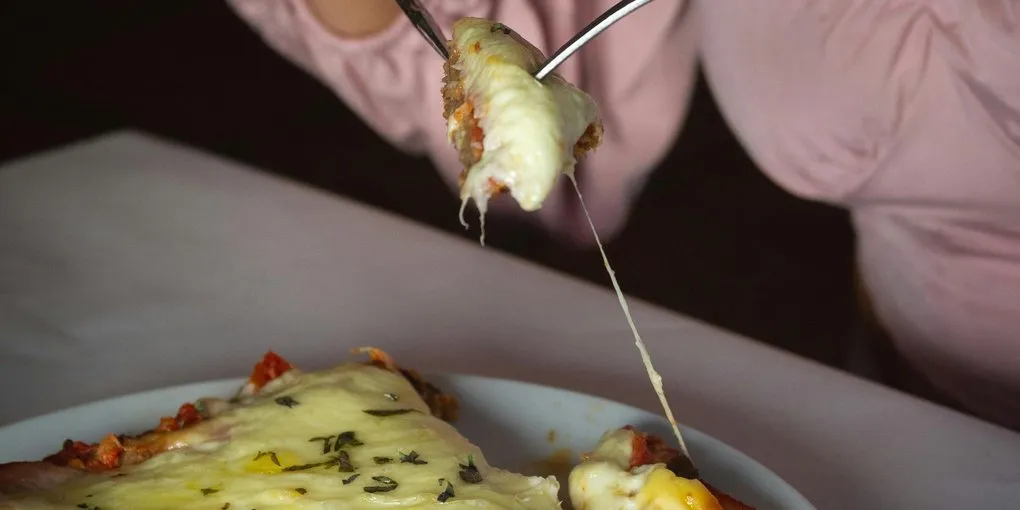
If you have only eaten pizza the way New Yorkers and Neapolitans make it, fugazzeta will read like a category mistake. It is a sandwich. The bottom layer is a ten- or twelve-inch dough disc pressed into an oiled pan. On top of that goes a stratum of shredded mozzarella thick enough to be its own course. Then a second disc of dough seals everything in. Only then does the onion topping go on, with another fistful of cheese and a generous slick of olive oil. It bakes for twenty minutes and comes out looking like a cross between a stuffed crust pizza and a Genoese focaccia, because that is essentially what it is.
The dish belongs to Buenos Aires the way a New Haven white clam pie belongs to Wooster Street. You can find it in the porteño classics — Banchero, Las Cuartetas, El Cuartito, Pin Pun, Güerrín — and you can argue about whose version is best, but you cannot argue that fugazzeta belongs to Italy, even though it descends from a Genoese flatbread. Argentina took focaccia, layered it with the cheese-loving palate that defines River Plate cooking, and turned out something unmistakable.
This recipe is a faithful home version. It uses a long cold ferment for flavor, low-moisture mozzarella for stretch and structure, and the ice-water onion soak that is the single most important step in the entire build. Skip the soak and you have a pizza with raw onions on it. Do it right and you have fugazzeta.
What Makes Fugazzeta Argentine, Not Italian
Fugazzeta is a Buenos Aires invention, not an Italian regional style. The Genoese fügassa (focaccia in Ligurian dialect) crossed the Atlantic with the wave of Italian immigrants who reshaped Argentine cuisine — Italians, particularly from Genoa, settled the port neighborhood of La Boca starting in the mid-19th century, with roughly three million arriving at the port of Buenos Aires between 1870 and 1920. By the early twentieth century, Buenos Aires pizzerias were calling their thick-crusted onion focaccia fugazza. Fugazzeta — fugazza plus the diminutive -etta — was the next move: split the fugazza, cram cheese inside, top it again, and bake.
Credit usually lands with the Banchero family. The chronology, drawn from Argentine reporting and the City of Buenos Aires’s own tourism record: Genoese immigrant Agustín Banchero arrived in La Boca in 1893 and opened the Riachuelo bakery with his son Juan, where he served his version of Italian focaccia. In 1932, Juan and his sons Antonio and Tito opened Pizzería Banchero on Avenida Almirante Brown in La Boca, still operating today. The family is credited with the cheese variants: Juan first added cheese on top to revive a dry fugazza, producing fugazza con queso, which then evolved into the stuffed fugazzeta — two discs sandwiching the cheese, onions on top.
Wikipedia and Saveur both note the date is hard to pin down — sources place it anywhere between 1893 and 1932 — and other Buenos Aires pizzerias have rival claims. The cheese in the original was cuartirolo, an Argentine fresh cow’s-milk cheese with a mild tang, not the low-moisture mozzarella most modern recipes call for. What is uncontested: Banchero’s La Boca shop is the spiritual home of the dish, and it has been making fugazzeta there for somewhere between roughly nine and thirteen decades depending on which date you choose as the start.
What distinguishes Argentine pizza in general, and fugazzeta in particular, is cheese density. Buenos Aires pizzerias pile on muzzarella (the local cow’s-milk fior di latte) at a rate that would make a Neapolitan pizzaiolo wince. Italian Neapolitan style targets a thin layer of fior di latte that doesn’t smother the dough; Argentine style treats cheese as a structural element. Fugazzeta is that aesthetic taken to its logical conclusion — cheese as the entire middle stratum.
The Two-Disc Sandwich Structure
The defining structural fact of fugazzeta is that it has two layers of dough sandwiching cheese, with onions on top. Most pan pizzas have one disc; stuffed pizzas like Chicago deep-dish use two but treat the top one as a sealing crust with a chunky tomato slurry above (see chicago-deep-dish-vs-tavern for the deep-dish family). Fugazzeta does neither. The bottom disc bakes in direct contact with the oiled pan; the top disc seals over the cheese; the onions sit on top of the top disc like the topping of a focaccia. This produces a tall, almost square cross-section that is half pizza, half stuffed bread.
The reason this works structurally is steam release. A sealed cheese-stuffed pizza is a good way to produce a soggy bottom — the cheese melts, water vapor builds up, and there is nowhere for it to go. Fugazzeta solves the problem two ways. The pinched-edge seal is good but not perfect; some pizzaioli also score or dock the top disc to give steam an escape. And the high oven temperature — 475F for twenty minutes or so — drives off enough moisture quickly that the cheese sandwich firms up before the bottom can sog.
The other structural decision is the cheese layer thickness. Restaurant fugazzeta typically uses 250–350 grams of low-moisture mozzarella between the two discs for a roughly 11x14 inch pan. That is more cheese than a Neapolitan margherita uses in total. Use less and the dish reads as bready focaccia with an afterthought of cheese; use more and the cheese pushes the seams and leaks. The 250–300g window is the sweet spot.
Why You Soak the Onions in Ice Water
The single technique decision that separates good fugazzeta from mediocre fugazzeta is what you do with the onions before they go on top. Slicing them thin and putting them on raw produces a pizza topped with raw onions. Soaking sliced onions in salted ice water for thirty to sixty minutes mellows the sulfur compounds responsible for raw onion’s harshness, draws out cell water that would otherwise evaporate during baking, and leaves you with onions that taste sweet, slightly crisp, and only mildly oniony.
The chemistry is straightforward. Cutting an onion ruptures cells and releases alliinase, which converts S-alkenyl cysteine sulfoxides into the sulfur volatiles you smell as “raw onion.” Cold water slows the reaction; salt draws cell water out via osmosis, taking some of the volatiles with it. After thirty minutes in ice water with a tablespoon of salt, sliced onion has lost most of its bite. After sixty minutes it tastes almost like sweet onion right out of the fridge. Drain thoroughly, pat dry, and the onions are ready to take a twenty-minute bake without burning or going acrid.
This step is non-negotiable. Authentic Food Quest, America’s Test Kitchen, and every Buenos Aires pizzeria’s home recipe I’ve consulted specify the ice-water soak. It is the move that makes the dish.
The Recipe
This recipe makes one fugazzeta in an 11x14 inch quarter sheet pan or a 13-inch round pan. The dough is built around a 24-hour cold ferment for flavor; if you are short on time, a 4-hour same-day rise will work, but the flavor will be flatter (see cold-ferment-acetic-lactic-acid-flavor for why time matters here).
Dough (makes two ~850g discs)
| Ingredient | Weight | Baker’s % |
|---|---|---|
| Bread flour (12.5–13% protein) | 650g | 65% |
| Tipo 00 flour | 350g | 35% |
| Water (cool, 65F) | 700g | 70% |
| Fine sea salt | 22g | 2.2% |
| Instant dry yeast | 2g | 0.2% |
| Extra-virgin olive oil (in dough) | 30g | 3% |
Method:
- Whisk both flours together in a large bowl. In a second bowl, dissolve the yeast in the cool water; add the salt and olive oil and stir until dissolved.
- Pour the wet into the dry and mix by hand or with a Danish dough whisk until no dry flour remains, about 2 minutes. Cover and rest 30 minutes (autolyse).
- Wet your hands and perform four sets of stretch-and-folds, 30 minutes apart. After the fourth set, the dough should be smooth, springy, and pulling away from the sides of the bowl.
- Cover tightly and refrigerate 18–24 hours.
- Tip the dough onto a lightly floured surface, divide into two equal pieces (about 850g each), and shape each into a tight ball. Cover and rest 60–90 minutes at room temperature until pliable.
Onion Topping
- 3 medium yellow or sweet onions (about 750g total), sliced as thinly as you can — a mandoline at 1.5–2mm is ideal
- 1 tbsp fine sea salt
- 4 cups (about 1 liter) ice water
- 1 tbsp dried oregano
- 2 tbsp extra-virgin olive oil
- Flaky sea salt to finish
Method: Combine the sliced onions with the salt and ice water in a bowl. Soak 30–60 minutes. Drain in a colander and press out as much water as you can — the onions should be visibly limp, not crisp. Pat dry on a clean towel. Toss with the olive oil and oregano just before topping.
Assembly and Bake
- 250–300g shredded low-moisture whole-milk mozzarella for the inside
- 75–100g additional shredded low-moisture mozzarella for the top
- 50g grated provolone (optional — for sharper edge)
- 2 tbsp olive oil for the pan
- Olive oil for finishing
- Preheat your oven to 475F (245C) with a rack in the center. If you own a baking steel, slide it on the lower rack — it will help the bottom crisp.
- Oil the pan generously, about 2 tablespoons of olive oil spread to coat the entire surface and the sides.
- Stretch the bottom disc. Take one dough ball, press it flat on a lightly floured surface, and stretch by hand to roughly the dimensions of the pan. Lay it in the pan and gently push it to the corners and slightly up the sides, leaving a small lip.
- Layer the inside cheese. Spread 250–300g shredded mozzarella in an even layer across the dough, leaving a half-inch border of bare dough at the edges so you can seal.
- Stretch and lay the top disc. Stretch the second dough ball to the same size as the first. Lay it carefully over the cheese.
- Seal the seam. Pinch the top dough firmly into the bottom dough’s bare border all the way around. The seal does not need to be pretty, but it does need to be tight. Optionally, dock the top with a fork in 6–8 places to release steam.
- Top with onions. Spread the drained, oiled, oregano-tossed onions evenly across the top dough. Scatter the additional 75–100g of mozzarella (and provolone if using) over the onions. Drizzle with another tablespoon of olive oil. Finish with a pinch of flaky salt.
- Bake for 18–22 minutes, until the top cheese is bubbly and golden, the onion edges are caramelized but not blackened, and the bottom (peek with a thin spatula) is deeply browned. If the top is browning too fast and the bottom isn’t there yet, drop the pan onto the steel for the last 3 minutes.
- Rest 5 minutes. Cut into squares — never radial wedges. Fugazzeta is a square-cut pizza.
Cheese Choice
Argentine pizzerias use local muzzarella — a young, low-moisture cow’s-milk mozzarella that sits between Italian fior di latte and American block mozz on the moisture continuum. The original Banchero fugazzeta used cuartirolo, a fresh Argentine cow’s-milk cheese with a mild tang that’s hard to find outside Argentina. American supermarkets don’t carry an exact equivalent for either. Two practical substitutes work well:
Low-moisture, whole-milk mozzarella is the default. Galbani and Polly-O both work; the supermarket brick variety (not pre-shredded, which is dusted with anti-caking starch) gives better stretch and melt. Shred it yourself.
A blend of low-moisture mozzarella and provolone at roughly 4:1 gets you closer to the slight tang Argentine muzzarella has. Use a young provolone (not the aged hot stuff) — the goal is body, not bite.
Avoid fresh mozzarella di bufala or fior di latte for fugazzeta. They release too much water during the bake and turn the bottom soggy. Save them for neapolitan-pizza-at-home — and for the full mozzarella decision tree, see low-moisture-vs-fresh-mozzarella.
Why a Pan, Not a Stone
Fugazzeta is structurally a pan pizza. The oil at the pan-dough interface conducts heat directly into the bottom disc, frying it golden while the steam-rich interior of the cheese sandwich finishes setting up. A baking steel or stone will preheat the bottom of the pan but it cannot replace the oil-fry effect. If you try to make this on parchment over a stone, the bottom will be pale and the seam will be more likely to leak. The pan is the format. A quarter sheet (11x14 in / 28x36 cm) or a 13-inch deep-dish round both work — the difference is square versus round slices.
The same logic informs the related recipe-foolproof-pan-pizza build: oil-on-pan does work that no preheated surface alone can do.
Variants
Fugazza con queso is fugazzeta’s simpler sibling and, by the Banchero family timeline, actually came first — a single dough disc with onions and a layer of mozzarella on top, no stuffing. Less dramatic, faster to make, and what most non-specialty Buenos Aires shops will hand you when you say “fugazza.”
Fugazza (no cheese) is the original Genoese-derived focaccia: dough, onions, oregano, oil, salt. It predates the cheesed variants and is still widely served in Argentina as a side or aperitivo.
Fugazzeta rellena (“filled fugazzeta”) is the same structure but with additional fillings — ham, spinach, palm hearts — added to the cheese layer. It walks closer to a calzone or a stromboli depending on what’s inside, but the two-disc-sandwich structure stays.
Provincial variations exist across Argentina. Rosario tends toward a thicker dough; Cordoba sometimes adds bell pepper to the onion layer. Buenos Aires fugazzeta — the version above — is the canonical one.
For a different focaccia-adjacent format that uses a single disc and toppings, see focaccia-pizza-at-home.
Fugazzeta vs Other Two-Dough Pizzas
A Few Things That Will Go Wrong
The most common failure is a soggy bottom. The fix is heat. Make sure your oven is fully preheated for at least 30 minutes before baking. If your oven runs cool, push to 500F. Drop the pan onto a steel for the last few minutes if the bottom is still pale.
The second-most-common failure is a cheese leak. The pinch-seal needs to be firm, and the top dough needs enough lip to grab. If your top disc is shrinking back as you stretch it, let it rest another 10 minutes before placing.
The third is bitter, pungent onion. This always means you cut corners on the soak. Sixty minutes in heavily salted ice water is the safest option; if you only have thirty, double-check that the water is actually cold (refresh ice if needed), and squeeze hard when draining.
Sources: Wikipedia (Fugazza, Argentine pizza); City of Buenos Aires tourism record on Pizzería Banchero; Saveur, Buenos Aires pizza guide; America’s Test Kitchen, “How to Make Stuffed Fugazzeta”; Authentic Food Quest, fugazzeta recipe; Breadtopia, fugazzeta recipe. Cross-checked against PIZZA_KNOWLEDGE_SYNTHESIS.md for hydration, yeast ratios, salt percentage, and cold-ferment behavior.
Frequently Asked Questions
- What is the difference between fugazza and fugazzeta?
- Fugazza is the single-disc Argentine onion focaccia derived from the Genoese fügassa. Fugazzeta is the cheese-stuffed version — two discs of dough sandwiching a thick layer of mozzarella, with onions and more cheese on top. The diminutive suffix -etta implies 'little fugazza,' but the dish is actually larger and richer than fugazza, not smaller. Fugazzeta is the Buenos Aires invention; fugazza predates it and is closer to the Italian original. If a pizzeria menu lists both, the one with cheese inside is fugazzeta.
- Can I skip the onion ice-water soak?
- No, not if you want the dish to taste right. Raw sliced onions on top of a 20-minute bake produce a pungent, sulfurous topping that tastes harshly of onion and undercuts the sweet, almost confit-like character that defines authentic fugazzeta. The 30–60 minute soak in salted ice water draws out cell water, mellows the alliinase reaction that produces sulfur volatiles, and leaves you with sweet, slightly translucent slices. Every authoritative recipe — from America's Test Kitchen to Buenos Aires-native sources — specifies the soak. Skipping it will give you a pizza you don't enjoy as much, and you won't be able to figure out why until you make it again with the soak.
- What pan size should I use?
- The two practical formats are an 11x14 inch (28x36 cm) quarter sheet pan for square-cut slices, or a 13-inch round pan with sides at least 1.5 inches deep. Both fit the 850-gram dough discs called for in the recipe with a small lip up the pan sides. A standard 9x13 lasagna pan is slightly small but workable; you'll get a slightly thicker fugazzeta. Avoid pizza pans without sides — fugazzeta needs walls to hold the cheese sandwich together while baking. Cast iron is fine but heat-conducts faster than aluminum, so check the bottom at 15 minutes to avoid over-browning.
- Can I make the dough the same day?
- Yes, but you'll lose flavor. A same-day version: increase the yeast to 5g (0.5%), use water at 80F instead of cool water, and bulk ferment for 4 hours at room temperature with stretch-and-folds in the first 90 minutes. Divide, ball, and rest 60–90 minutes. The result is acceptable — the structural payoff (two discs, cheese, onions) still works — but the dough will taste flatter and chewier. The 18–24 hour cold ferment that the main recipe uses develops the lactic and acetic notes that round out the dough's flavor. If you have the planning bandwidth, do the cold version.
- Why are the slices cut into squares?
- Because fugazzeta is structurally a pan pizza, not a hearth pizza. Square cuts give you slices with consistent stuffing-to-edge ratio, regardless of position. Radial wedges work for thin-crust pies where the center is the star and the rim is a handle, but fugazzeta's center is no different from its edge — every slice is the same dough/cheese/onion sandwich. Buenos Aires pizzerias serve fugazzeta in 6 or 8 squares from a quarter-sheet, or 8 squares from a 13-inch round (cut tic-tac-toe style with the corners removed). The square cut is one of the visual tells of an authentic Argentine pizza.
- Who actually invented fugazzeta?
- Credit goes to the Banchero family in La Boca, Buenos Aires, but with caveats. The Genoese baker Agustín Banchero immigrated to La Boca in 1893 and opened the Riachuelo bakery with his son Juan, where they served the original cheese-less Genoese fugazza. Juan Banchero is credited with first adding cheese (cuartirolo) to revive a dry fugazza, producing fugazza con queso, which then evolved into the stuffed fugazzeta. Pizzería Banchero — the still-operating shop on Avenida Almirante Brown — opened in 1932. Wikipedia and Saveur both note the exact date of fugazzeta's invention is hard to pin down: sources place it anywhere between 1893 and 1932, and other Buenos Aires pizzerias have rival claims. What is uncontested is that Banchero's La Boca shop is the spiritual home of the dish.