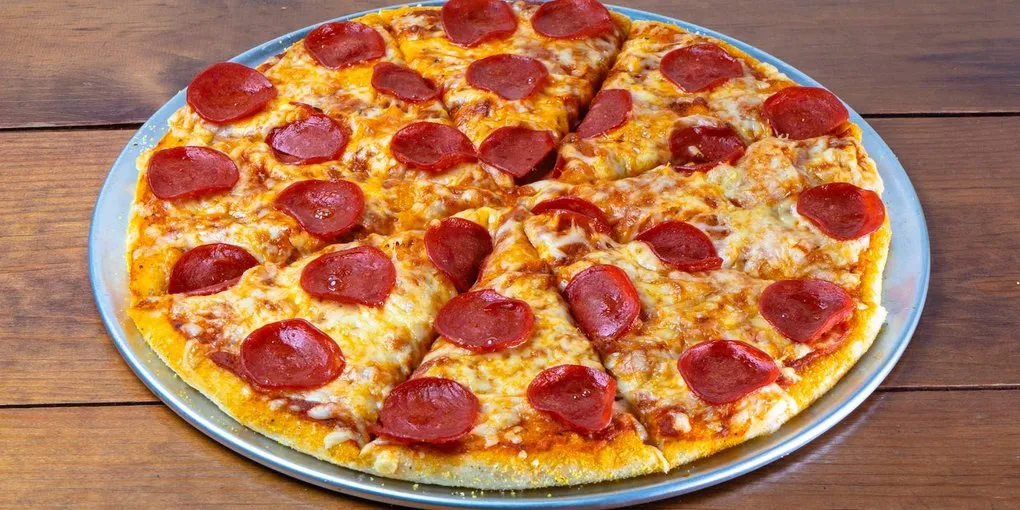
Buffalo, New York is famous for chicken wings, beef on weck, and a particular regional pizza that almost nobody outside Western New York talked about until very recently. Buffalo-style pizza is thick but airy, baked in a heavily oiled pan, dressed with a slightly sweet tomato sauce, smothered in low-moisture mozzarella, and finished with the topping that has launched a thousand Instagram posts in the last five years: cup-and-char pepperoni.
Cup-and-char pepperoni is having a moment in New York City pizza right now. Slice shops in Brooklyn and Manhattan put it on menus, food writers call it the topping of the decade, and the cured-meat aisle at specialty grocers now carries it. What almost none of the coverage mentions is that this pepperoni - the kind that curls up into little crisp-edged grease cups in the oven - has been the everyday Buffalo pizzeria default since the postwar years, and Buffalo has been the country’s largest single market for it for roughly seventy years.
This is a story about a regional pizza style that has been hiding in plain sight, and a topping that took half a century to become an overnight success.
What Buffalo-style pizza actually is
Buffalo-style pizza has a specific structural recipe that distinguishes it from New York-style, Sicilian, and the various other thick-pan pies it gets mistaken for.
The dough is medium-to-thick - thicker than New York, thinner than a true Sicilian. It is a yeasted, lightly oiled dough that gets pressed into a heavily oiled pan, given a final rise, and baked. The interior crumb stays airy and somewhat focaccia-adjacent; the bottom and the perimeter get crisp from the oil contact. Bake time runs 8 to 12 minutes at typical pizzeria deck temperatures of 550 to 600 degF.
The sauce is the most regionally variable element. The Buffalo standard is sweeter than a New York sauce - there is genuinely sugar in there, often a noticeable amount. It is also more oregano-forward than a Neapolitan-style sauce, and tomato paste is a common ingredient, giving the sauce a thicker, more concentrated body than a pureed-whole-tomato approach.
The cheese load is heavy. A Buffalo pie can carry close to twice the cheese-per-square-inch of a comparable New York slice. The cheese goes edge to edge and often climbs the rim of the pan. As it bakes, it forms toasty brown spots - the visual signature of the style alongside the pepperoni.
The pepperoni is the part that has gone viral. Cup-and-char pepperoni is a small-diameter (typically 1 to 1.25 inch) cured sausage sliced thin from a casing-on chub. When the slices hit oven heat, the casing contracts faster than the meat, pulling the slice edges upward into a small bowl shape. The curled edges char and crisp; the center stays flatter and holds a small pool of rendered, spice-saturated fat. A Buffalo pie typically carries 25 to 40 cup-and-char slices, often piled to the edge of the crust where they sometimes drape over and crisp against the pan.
For the full science of why pepperoni cups - including the role of casing type, slice thickness, fat composition, and bake-temperature sweet spot - see our dedicated pepperoni science guide. The short version: Buffalo’s pizzerias built their style around a defining cured-meat behavior, and the rest of the country eventually caught up.
The result is a pizza that is structurally heavy in cheese and meat, sweet in sauce, and built on a tender-but-crisp pan-baked base.
Where the style came from
Buffalo’s pizza tradition centers on a small group of legacy pizzerias that have operated since the postwar period.
Bocce Club Pizza is the most-cited founder of the regional style. Dino Pacciotti, a returning WWII veteran, purchased the existing Bocce Club venue on Hickory Street in 1946 with his brother-in-law Michael Sacco. The club had bocce ball courts in the yard and served drinks and sandwiches inside; Pacciotti found an old pizza oven in the basement and began experimenting. By 1955, Bocce was selling pizza in corrugated take-out boxes - innovative for an era when most pizzeria pizza was eaten on premises. Bocce later moved to its now-iconic Bailey Avenue location and is still run by the Pacciotti family.
La Nova Pizzeria opened in 1957 when Joe Todaro Sr. - known locally as Papa Joe - started the original shop at 43 South Niagara Street in the City of Tonawanda. Urban renewal closed the first location after about a decade; his son Joe Todaro Jr. (Big Joe) reopened La Nova in 1971 on West Ferry Street in North Buffalo, where the famous current location still operates. La Nova went on to win national PMQ recognition, ship its pies via Goldbelly, and become the official pizza of the Buffalo Bills in 2013.
Picasso’s Pizza opened in 1980 in West Seneca, run by the DiGiore family, whose Western New York roots trace to grandfather Fioravante DiGiore arriving from Naples in 1915. Picasso’s is one of the most heavily Buffalo-style-coded pizzerias in the region - cup-and-char pepperoni, square cut, sweet sauce, focaccia-doughed crust - and now ships nationally via Goldbelly.
Imperial Pizza opened in the late 1980s on Abbott Road in South Buffalo (with 1992 sometimes cited as the formal founding year). Imperial helped define the modern Buffalo-style consensus alongside the older legacy shops, and recently expanded to a second location near Canisius University.
The cumulative effect of these pizzerias - and the long tail of neighborhood independents alongside them - all serving variations on the same general structural idea (sweet sauce, heavy cheese, thick-but-airy dough, plenty of small natural-casing-style pepperoni) produced a regional consensus style by the 1970s.
The cup-and-char pepperoni element traces to Battistoni Italian Specialty Meats, a Buffalo-area cured meat producer founded in 1931 by Italian immigrant Umberto Battistoni. The company was originally called Bison Products and was rebranded Battistoni in 1994 to honor the family legacy. Battistoni’s small-diameter, cupping-style pepperoni - now formally marketed under the Cup & Char name - is the canonical Buffalo product. Buffalo pizzerias adopted Battistoni and similar small cupping-style pepperonis as their default in the postwar years, and that choice - slightly accidental, slightly local-supply-driven - became the defining topping of the regional style.
Why cup-and-char pepperoni curls (and tastes different)
The full mechanism is covered in detail in our pepperoni science post. The brief version: the cup forms because the casing around each slice contracts faster under heat than the meat inside it. The casing pulls the slice perimeter upward; the center stays in place; you get a small bowl shape, typically 1 to 2 inches across, with a charred lip and a center that holds a pool of rendered fat.
Two practical points worth noting in the Buffalo context:
Casing type matters more than casing source. Both natural animal casings (pig or sheep intestine) and edible collagen casings produce cupping behavior, because both contract faster than the meat they surround. Battistoni’s current Cup & Char product line uses an edible collagen casing engineered specifically for the cup behavior; Smithfield’s Margherita Natural Casing Pepperoni - the other widely-distributed cupping pepperoni in the US - uses a true natural casing. The flavor and chew differ slightly between the two, but the cup-and-char effect is reliable from either. What does not cup is standard cellulose-cased pepperoni (where the casing is peeled off before slicing) - which is what most pre-sliced bagged pepperoni in American supermarkets is.
Diameter matters. Cup-and-char pepperonis are typically 1 to 1.25 inches in diameter, versus the standard 1.5 to 2 inches for the cellulose-cased flat slices most pizzerias use. More slices fit per pizza, which means more total pepperoni edge per square inch and more total Maillard-browned surface area per bite.
The cup-and-char pepperoni boom outside Buffalo
For decades, cup-and-char pepperoni was a Buffalo regional thing. Visiting food writers occasionally wrote about it, but it did not spread.
Around 2018 to 2020, a generation of Brooklyn and Manhattan pizzerias started putting cup-and-char on their menus - Lucali, Roberta’s, Scarr’s Pizza, and Joe’s Pizza variants among them. Coverage from Eater NY, The New York Times Cooking section, and the food-Instagram ecosystem amplified it from there. By 2023 to 2024 it was a recognizable national pepperoni trend. Step Out Buffalo, the local food publication, has documented the back-spread phenomenon - Buffalo natives rolling their eyes at NYC food media discovering a topping they grew up on.
The PMQ Pizza trade publication has run multiple pieces in the last few years arguing that Buffalo-style pizza deserves a spot on the national pizza-style map alongside Detroit, New Haven, Old Forge, and Quad Cities. The argument is the same one Detroit-style had to make a decade ago: a regional style with a defensible structural identity, a defining ingredient, and a critical mass of legacy pizzerias has earned the right to be considered a style, not a quirk.
How to make Buffalo-style pizza at home
The home version is more achievable than most regional styles because it does not require an extreme oven temperature.
Dough. Use a medium-protein bread flour (12.5 to 13%). Hydration around 65%, salt 2%, instant dry yeast 0.4%, oil 3% (in the dough). Mix briefly, bulk ferment 24 hours cold, divide into roughly 700g portions, and press into heavily oiled 12-inch round cake pans or quarter-sheet pans. Let proof in the pan another 1 to 2 hours at room temperature. The mechanics are the same as a pan-pizza dough - this is not a hearth-baked style.
Sauce. Aim for sweeter than a New York sauce. A workable home version: one 28-oz can crushed tomatoes, 2 tablespoons tomato paste, 1.5 teaspoons sugar, 1 teaspoon dried oregano, 1 teaspoon salt, a pinch of garlic powder. No cooking - the sauce cooks on the pizza. See our general pizza sauce primer for variations.
Cheese. Low-moisture whole-milk mozzarella, grated from a block. Use about 8 ounces per 12-inch pie - heavier than a standard New York pie. Cover the surface edge to edge. The browning behavior of low-moisture mozzarella is what gives Buffalo pizza its toasty-cheese surface signature.
Pepperoni. This is the part you cannot fudge. Standard pre-shredded-cheese-aisle pepperoni will not cup. You need a small-diameter (1 to 1.25 inch) cupping-style pepperoni - either natural-casing (the original Buffalo template) or the engineered edible collagen casing that Battistoni now uses for their commercial product line.
The most commonly available retail options:
- Battistoni Cup & Char Pepperoni - the canonical Buffalo product, 5-oz sliced retail pouch. Edible collagen casing engineered for cupping. Check price on Amazon. The product the Buffalo pizzerias actually buy.
- Margherita Natural Casing Pepperoni (Smithfield) - widely available retail and foodservice. True natural casing, slightly more pronounced char on the lip. Check price on Amazon.
- Ezzo Sausage Company pepperoni - the enthusiast benchmark covered in our pepperoni science guide. Higher beef proportion, natural casing, strong cup. Check price on Amazon.
If buying whole sticks rather than pre-sliced, aim for slices roughly 1/8 inch (3 mm) thick - the sweet spot for cup depth without burning the lip during a 10 to 12 minute bake.
Pile pepperoni heavy - 30 to 40 slices per 12-inch pie, slightly overlapping at the rim.
Bake. 500 to 525 degF on a preheated baking steel or stone, with the pan placed directly on the steel. About 10 to 14 minutes. The cheese should have toasty brown spots, the pepperoni cups should be visibly curled with crisp edges and oil pools, and the bottom of the pan should release the pizza cleanly with a thin spatula. For more on the home pizza-oven temperature ceiling, see our oven-temp guide.
Slice into squares (Buffalo-style typically gets the party cut, not wedges) and serve hot from the pan.
Where Buffalo-style pizza fits in the American regional map
Detroit-style pizza spent decades as a curiosity, then broke through nationally in the 2010s. Old Forge-style, New Haven apizza, and Quad Cities pizza have followed similar trajectories from regional cult food to national interest. Buffalo-style pizza is currently in the early phase of the same arc.
What makes Buffalo’s case strong is the cup-and-char pepperoni - a defining ingredient that is hard to fake or substitute, that ties the pizza to a specific regional supplier ecosystem (Battistoni in Buffalo, Margherita and Ezzo for the export market), and that has its own independent food-trend momentum. The pepperoni did the marketing work the pizza style itself never managed to do. That is unusual, but it is also how cuisines actually spread: a single distinctive element catches on, and the larger context follows.
If Buffalo-style pizza becomes the next regional style to break out nationally, the pepperoni will deserve most of the credit.
Frequently Asked Questions
- What is Buffalo-style pizza?
- Buffalo-style pizza is a Western New York regional style featuring a medium-thick, pan-baked crust; a sweet tomato-paste-based sauce; a heavy load of low-moisture mozzarella with toasty brown spots; and small-diameter cup-and-char pepperoni piled to the rim. It is typically cut into squares and served straight from the pan.
- What is cup-and-char pepperoni?
- Cup-and-char pepperoni is small-diameter pepperoni (typically 1 to 1.25 inches across) sliced from a casing-on chub. When baked, the casing contracts faster than the meat, curling the slices into small bowl shapes with charred crisp edges and a pool of rendered fat in the center. The casing can be either true natural animal casing (Smithfield Margherita, Ezzo) or edible collagen casing engineered for cupping (Battistoni's current line). What does not cup is standard cellulose-cased pepperoni where the casing is peeled off before slicing.
- Where can I buy cup-and-char pepperoni?
- The canonical Buffalo brand is Battistoni Italian Specialty Meats, founded 1931, sold in 5-oz retail pouches as 'Cup & Char.' Other cupping-style pepperonis widely available outside Western New York include Smithfield's Margherita Natural Casing Pepperoni (the foodservice and retail standby) and Ezzo Sausage Company (the home-enthusiast favorite). All three are available online; Battistoni, Margherita, and Ezzo all reliably cup. Standard supermarket pre-sliced pepperoni in cellulose casing will not cup.
- Why does some pepperoni curl and some doesn't?
- Curling is a function of the casing, not the meat or the spice. Pepperoni made in synthetic cellulose casings (peeled off before slicing) lies flat. Pepperoni stuffed in either true natural casing or edible collagen casing - and left in that casing during slicing - curls because the casing contracts faster than the meat as it heats. Buffalo pizzerias have used small cupping-style pepperoni since the 1950s; large national producers shifted to cellulose for processing efficiency, which is why most American pizza pepperoni today is flat. Our pepperoni science guide has the full mechanism.
- What pizzerias started Buffalo-style pizza?
- Bocce Club Pizza, opened on Hickory Street in 1946 by Dino Pacciotti and his brother-in-law Michael Sacco, is the most-cited founder. Other anchor Buffalo pizzerias include La Nova (1957, founded by Joe Todaro Sr. in Tonawanda; current West Ferry Street location opened 1971), Picasso's (1980, DiGiore family, West Seneca), and Imperial Pizza (late 1980s on Abbott Road in South Buffalo). The regional consensus style emerged from many Buffalo pizzerias serving variations on the same structural idea through the 1950s to 1970s.
- How is Buffalo-style pizza different from New York-style?
- Buffalo pizza is thicker, sweeter in sauce, much heavier in cheese, and built on a pan-baked dough rather than a hearth-baked dough. New York pizza is thin, foldable, baked directly on a deck oven, and uses a less sweet sauce. The cup-and-char pepperoni is also a defining Buffalo element that NY pizza traditionally lacked, though NYC slice shops have adopted it heavily since around 2020.
- Can I make Buffalo-style pizza in a home oven?
- Yes. Buffalo-style does not require the extreme temperatures of Neapolitan pizza. A 500 to 525 degF home oven preheated with a baking steel for 45 minutes will bake an excellent Buffalo-style pie in about 10 to 14 minutes. The pizza is built and baked in a heavily oiled 12-inch round cake pan or a quarter-sheet pan placed directly on the preheated steel. The dough proofs in the pan before topping.
Some links above are Amazon affiliate links. As an Amazon Associate, jayarr.pizza earns from qualifying purchases at no extra cost to you. We only recommend products we’d buy ourselves.