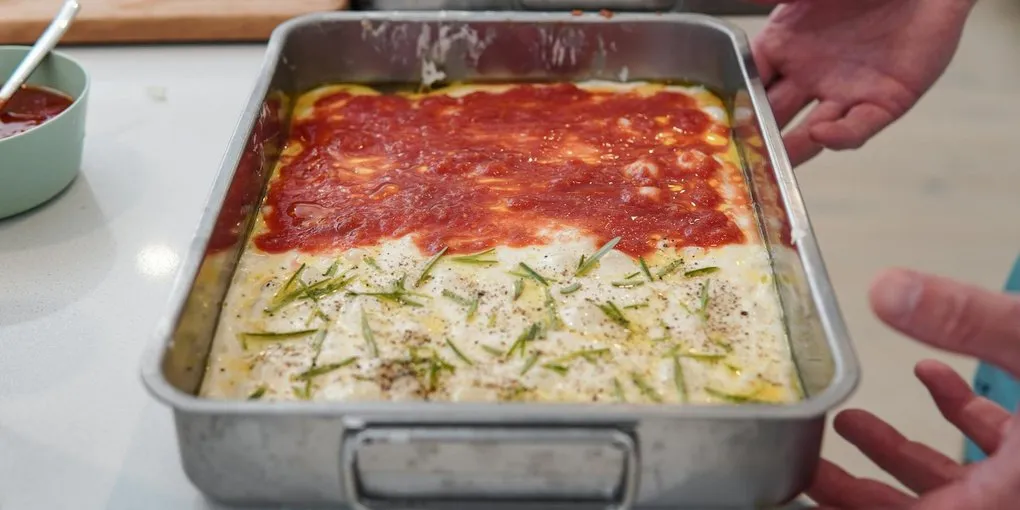
In a borough of about 8,000 people in northeastern Pennsylvania, roughly 12 pizzerias serve a style of pizza that exists essentially nowhere else. Old Forge, Pennsylvania — a former coal mining town about 10 miles south of Scranton — has the highest per-capita concentration of pizzerias of any community in the United States, and every single one makes pizza that would be unrecognizable to someone from New York, Chicago, or Naples.
No mozzarella. A sweetened, white-bread crust. Provolone and American cheese blended. Rectangular pans. A prebaked “shell” that eliminates the gel layer problem. And an origin story rooted in Prohibition-era speakeasies run by coal miners’ wives.
Old Forge pizza doesn’t look like what you think pizza looks like. That’s the point.
The Origin: Speakeasies and Coal
The story of Old Forge pizza begins in the 1930s, during Prohibition and the depths of the Depression, in a town built entirely around anthracite coal mining.
Old Forge’s population was predominantly Italian-American, and the men worked underground in the mines. While the men were in the shafts, their wives operated illegal bars — speakeasies — out of their homes and storefronts. To keep customers eating (and drinking), they made pizza using whatever ingredients were affordable and available in rural northeastern Pennsylvania.
This is the critical context for understanding why Old Forge pizza uses the ingredients it does. The women weren’t making an artistic statement or rebelling against Italian tradition. They were feeding coal miners on a tight budget with what they could get.
Mozzarella was expensive and hard to source in 1930s rural Pennsylvania. The Italian-American specialty cheese supply chain didn’t reach small mining towns the way it reached New York or Philadelphia. But American cheese was cheap, widely available, and melted easily. Provolone was an Italian-American staple that could be sourced from local Italian delis.
The crust was sweetened because white bread — the kind of enriched, slightly sweet, soft-crumbed bread that was a staple of American working-class kitchens — was the baseline for everything baked in these homes. The pizza crust evolved from bread dough, not from Italian pizza dough, and it carried the sweetness of the bread tradition with it.
The rectangular pans were what was available: standard baking pans from the hardware store, the kind used for cakes and casseroles. There was no specialty pizza equipment in a coal-country speakeasy.
What emerged from these constraints was a pizza style that was completely independent of the New York and New Haven traditions developing simultaneously on the East Coast, and even more distant from the Neapolitan tradition. Old Forge pizza was invented from first principles by women who needed to feed people affordably, and every element of the style reflects that pragmatic origin.
The Crust: Sweetened White Bread
Old Forge crust is unlike any other pizza crust in America. It’s a sweetened, enriched dough that’s closer to white sandwich bread than to any Italian pizza tradition. The dough contains sugar (sometimes a noticeable amount), oil or shortening, and sometimes milk — all hallmarks of American enriched bread dough.
The texture is soft, with a tight, uniform crumb. There’s no open, airy structure like Neapolitan or Detroit. The crumb is fine and even, like pullman bread. The bottom develops a moderate crispness from the pan, but the overall character is tender and slightly sweet.
This bread-like quality is deliberate and essential. It provides a neutral, lightly sweet platform that doesn’t compete with the distinctive cheese blend and allows the toppings to dominate the flavor profile. Italian pizza dough — with its fermentation-driven complexity, slight acidity, and chewy gluten structure — would be completely wrong for this application.
The sweetness also affects the Maillard browning during baking. The extra sugars in the dough brown faster and more deeply than lean dough, producing a golden-brown bottom and edges that are visually distinct from the pale bottoms of many pan pizzas. The sugar caramelizes slightly where the dough contacts the pan, adding another flavor dimension.
The Shell: Prebaked and Brilliant
Here’s where Old Forge pizza solves a problem that Nathan Myhrvold calls “a fundamental flaw in pizza making” — the gel layer. That white, gummy line between crust and toppings that plagues almost every topped pizza is caused by moisture from sauce and toppings condensing at the dough interface and preventing full starch gelatinization.
Old Forge pizza eliminates the gel layer entirely through prebaking. The dough is pressed into rectangular pans and baked as a bare “shell” before any toppings are added. This allows the starch to fully gelatinize and the protein structure to set completely without any interference from wet toppings.
The prebaked shell is essentially a finished bread product — fully baked, structurally sound, with no raw or under-gelatinized starch anywhere. When toppings and cheese are added and the pizza goes back in the oven for a second bake, the crust heats through without any risk of the gel layer forming.
This prebake technique is independently validated by Myhrvold’s research (he tested 120 pizzas specifically investigating the gel layer and concluded that prebaking is the only complete fix) and by Gemignani’s professional practice (he parbakes his Sicilian dough for 14 minutes before adding toppings, and notes the parbaked shell can hold for up to 10 hours — ideal for party prep).
In Old Forge, the prebaked shells are often made in the morning, stacked, and used throughout the day as orders come in. This makes service fast — add toppings and cheese to a prebaked shell, second-bake until the cheese melts and browns, cut, and serve. The operational efficiency of this system is part of why 12 pizzerias can thrive in a town of 8,000 people. Turnover is fast.
The Cheese: No Mozzarella Allowed
The most initially surprising element of Old Forge pizza is the cheese: a blend of provolone and American cheese.
No mozzarella. Not even a little. In the traditional version, mozzarella is simply not part of the formula. This is a direct legacy of the style’s speakeasy origins — mozzarella wasn’t available, and the combination that was available turned out to produce something worth keeping.
Provolone provides the Italian-American flavor anchor. It’s sharp, tangy, and has a firm texture that melts into strings and sheets rather than the soft, pillowy melt of mozzarella. Aged provolone contributes more flavor intensity; younger provolone melts more smoothly. Most Old Forge pizzerias use a medium-aged provolone that balances flavor with meltability.
American cheese provides the melt physics. American cheese is a processed cheese product designed to melt smoothly, evenly, and completely. It brings fat and emulsifying salts that create a uniform, luscious melt that coats every surface. It also adds a mild, slightly sweet, buttery flavor that complements the sweetened crust.
The blend produces a cheese layer that behaves differently from mozzarella in every way. It melts into a smoother, more uniform sheet. It doesn’t form the large bubbles or browned spots that mozzarella produces. The color when melted is more golden-yellow than the white of melted mozzarella. And the flavor is richer, tangier (from the provolone), and more complex than mozzarella alone.
For anyone raised on mozzarella-based pizza, the first bite of Old Forge pizza requires a recalibration. The cheese tastes “wrong” for about three seconds, and then it tastes interesting, and then it tastes right. The provolone-American combination is one of those things that works specifically because nobody set out to design it — it emerged from necessity and survived because people liked it.
Two Styles: Red and White
Old Forge pizzerias typically offer two versions:
Red pizza features a tomato-based sauce under the provolone-American cheese blend. The sauce varies by pizzeria but is generally a cooked, seasoned tomato sauce (not the raw Neapolitan style). The sauce application is moderate — this isn’t a sauce-heavy pizza, partly because the prebaked shell doesn’t need moisture compensation and partly because the cheese blend is the star.
White pizza skips the tomato sauce entirely and uses a blend of the provolone and American cheese with additions that vary by pizzeria — some add onions, some use garlic oil as a base, some add other Italian cheeses. White is widely considered the more distinctive of the two versions, the one that showcases the cheese blend most directly.
Both versions are sold “by the cut” — you order a specific number of rectangular pieces, not a whole pizza. This is the standard ordering system throughout Old Forge and reflects the pan-baked, rectangular format of the pizza.
Distinct from Sicilian
People unfamiliar with Old Forge pizza sometimes try to categorize it as “Sicilian-style” because it’s rectangular and pan-baked. This misses significant differences:
Crust texture. Sicilian (whether Palermo sfincione or American Sicilian) has an airy, bread-like crumb with large, irregular holes — closer to focaccia. Old Forge crust is tight, fine-crumbed, and uniform, closer to sandwich bread.
Cheese. Authentic Palermo sfincione uses caciocavallo (no mozzarella in the traditional version either, interestingly). American Sicilian uses mozzarella. Old Forge uses provolone and American.
Assembly. Sicilian toppings are typically applied to raw dough that rises and bakes with the toppings in a single bake. Old Forge uses the prebaked shell system with toppings added for a second bake.
Dough enrichment. Old Forge dough is sweetened and enriched (sugar, oil/shortening, sometimes milk). Traditional Sicilian dough is lean or lightly oiled.
Thickness. Old Forge is typically thinner than American Sicilian — more like a thick focaccia-thin than a deep Sicilian-thick.
The distinction matters because the techniques are different. If you approach Old Forge pizza with Sicilian methods (high hydration, single bake, mozzarella), you’ll end up with something that doesn’t resemble Old Forge pizza at all.
Making Old Forge Pizza at Home
The Shell
Start with an enriched dough: bread flour at 12-13% protein, 60-65% hydration, 2-3% sugar, 3-4% oil or melted shortening, 2% salt, and standard yeast amounts. This should feel like a soft, slightly tacky bread dough — not the wet, slack dough of high-hydration pizza.
Oil a rectangular baking pan (a 9x13-inch pan works for a single pizza, a half sheet pan for a larger one). Press the dough into the pan, working it into the corners over multiple press-and-rest sessions (20 minutes between each). Let it rise at room temperature until puffy — about 1-1.5 hours.
Bake the empty shell at 400-425F for 12-15 minutes until the top is lightly golden and the structure is fully set. You should be able to tap the surface and hear a hollow sound. Remove and cool.
The shells keep well — wrap tightly and refrigerate for up to 2 days, or freeze for up to 2 months.
The Cheese Blend
Use a blend of:
- 2/3 provolone (medium-aged, not sharp piccante), shredded
- 1/3 American cheese (white American from the deli counter, not individually wrapped slices — deli American has better melt and flavor)
Shred or slice the provolone. Tear or chop the American cheese into small pieces that will distribute evenly. Toss together.
Assembly and Second Bake
For red pizza: spread a thin layer of cooked tomato sauce over the prebaked shell. Top with the provolone-American blend, edge to edge.
For white pizza: brush the shell lightly with garlic oil or olive oil. Scatter thinly sliced onions if desired. Top with the cheese blend, edge to edge.
Second-bake at 425-450F for 10-12 minutes until the cheese is fully melted, lightly golden, and beginning to bubble. The prebaked shell doesn’t need long — you’re just melting cheese and warming through.
Cut into rectangles. Serve by the piece.
What to Expect
The crust will be soft and bread-like, with a golden-brown bottom from the pan contact. The cheese will be smoother and more uniform than mozzarella-based pizza, with a golden color and a tangy-rich flavor from the provolone. The overall impression is comfort food — satisfying, unpretentious, and unlike anything else in the pizza world.
Why Old Forge Pizza Matters
Old Forge pizza matters for the same reason all deeply regional food traditions matter: it’s an artifact of a specific place, time, and set of circumstances that can’t be replicated by any chain or trend.
It emerged from necessity — Italian-American women feeding coal miners during Prohibition with the ingredients they could afford. It survived because it was good. It thrived because a small, tight-knit community kept making it the same way for nearly a century. And it persists today in a town where the ratio of pizzerias to residents is unlike anywhere else in the country.
Myhrvold’s research team classified it as a distinct American pizza style — one that meets both criteria for style recognition: it affects the fundamental structure of the pizza (not just the toppings), and it’s made by multiple independent establishments.
For home pizza makers, Old Forge is a valuable addition to the repertoire because it uses completely different techniques than most styles. The prebaked shell method, the enriched dough, and the provolone-American cheese blend all teach you something about how pizza works when you change the fundamental assumptions.
The Bottom Line
Old Forge pizza is a coal-country original: sweetened white-bread crust prebaked into a shell, topped with provolone and American cheese (no mozzarella), served by the cut from rectangular pans. It emerged from 1930s speakeasies where miners’ wives made pizza with what they could afford, and it endures because the combination works.
The prebaked shell solves the gel layer problem that plagues most topped pizza. The provolone-American blend produces a melt unlike mozzarella — smoother, tangier, more golden. And the sweetened crust provides a neutral, tender platform that lets the cheese and toppings dominate.
Twelve pizzerias serving 8,000 people, all making essentially the same style, all still in business. That’s not tradition for tradition’s sake. That’s a product people want.
Frequently Asked Questions
- What is Old Forge pizza?
- Old Forge pizza is a regional style from Old Forge, Pennsylvania -- a small borough near Scranton with about 12 pizzerias serving 8,000 people. It features a sweetened white-bread crust that's prebaked as a shell before topping, a cheese blend of provolone and American (no mozzarella), rectangular pans, and is sold by the cut in rectangular pieces.
- Why doesn't Old Forge pizza use mozzarella?
- The style originated in 1930s speakeasies run by coal miners' wives during Prohibition. Mozzarella was expensive and hard to source in rural northeastern Pennsylvania, but American cheese was cheap and widely available, and provolone could be found at local Italian delis. The provolone-American combination emerged from necessity and survived because people liked the result.
- What does Old Forge pizza taste like?
- The provolone-American cheese blend melts into a smoother, more golden, tangier layer than mozzarella. The crust is soft and bread-like with a slight sweetness and golden-brown bottom. The overall impression is rich, comforting, and unlike any mozzarella-based pizza. It comes in red (tomato sauce) and white (garlic oil, sometimes onions) versions.
- How does prebaking the shell help Old Forge pizza?
- Prebaking the dough as an empty shell allows starch to fully gelatinize and the protein structure to set completely before wet toppings are added. This eliminates the gel layer -- the white, gummy line between crust and toppings that Nathan Myhrvold calls a fundamental flaw in pizza making. His research on 120 pizzas confirmed prebaking is the only complete fix.
- Is Old Forge pizza the same as Sicilian pizza?
- No. Despite both being rectangular and pan-baked, they differ significantly. Old Forge crust is tight-crumbed, sweetened, and enriched (like sandwich bread), while Sicilian is airy and focaccia-like. Old Forge uses provolone and American cheese; Sicilian uses mozzarella. Old Forge prebakes the shell; Sicilian bakes once with toppings. The techniques are fundamentally different.
- Can I make Old Forge pizza at home?
- Yes. Make an enriched dough (bread flour, 60-65% hydration, 2-3% sugar, 3-4% oil, standard yeast). Press into a 9x13 pan, let rise, and prebake at 400-425F for 12-15 minutes until golden and set. Cool the shell, add sauce (red) or garlic oil (white), top with a blend of 2/3 shredded provolone and 1/3 deli American cheese. Second-bake at 425-450F for 10-12 minutes until cheese is melted and golden.
- Where is Old Forge, Pennsylvania?
- Old Forge is a small borough of about 8,000 people in Lackawanna County, northeastern Pennsylvania, roughly 10 miles south of Scranton. It's located in the former anthracite coal mining region and has the highest per-capita concentration of pizzerias in the United States, all serving the same distinctive regional style.