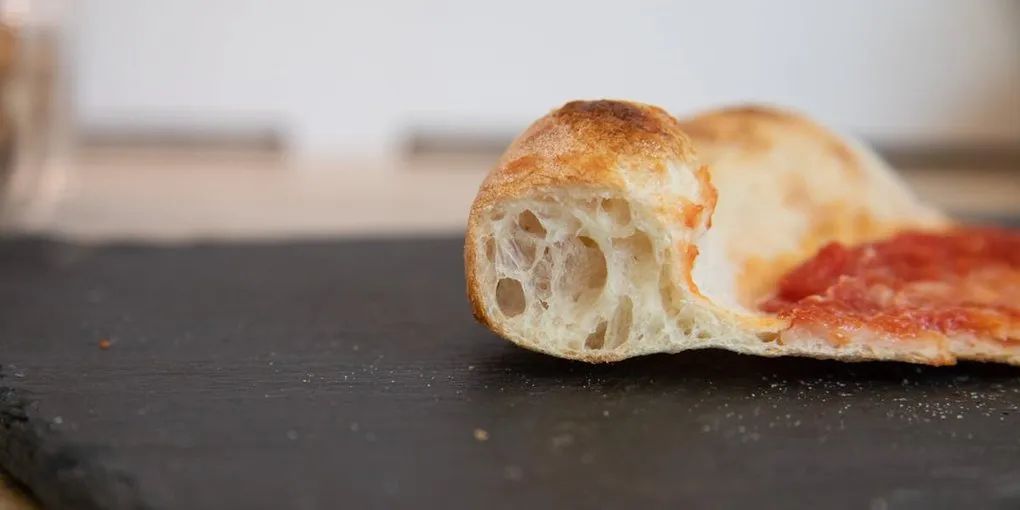
Raw pizza dough is soft, stretchy, and would collapse if you poked it. Three minutes later, it holds its shape permanently. The bubbles are locked in position. The crumb is set. You can slice it, fold it, hold it by the crust with one hand, and the tip doesn’t flop past a certain point.
The transformation responsible for most of that structural change is starch gelatinization — the process by which ordered, crystalline starch granules absorb water, swell, lose their internal organization, and become a disordered gel. It’s happening in your pizza during every bake, between roughly 50C and 70C internal temperature, and it determines crumb texture, moisture distribution, and how your pizza ages after it leaves the oven.
This is the least glamorous part of pizza science. But it is arguably the most consequential for the eating experience.
What Starch Does in Pizza Dough
Starch is the most abundant component in wheat flour. It doesn’t participate in dough formation the way gluten does — starch granules just sit there during mixing, fermentation, and proofing, inert passengers in the gluten network. But they absorb approximately 46% of the water in your dough, making them a massive reservoir of moisture waiting to play their role during baking.
Each starch granule is a tiny ordered structure: alternating crystalline regions (organized chains of amylose and amylopectin) and amorphous regions (disordered zones). In raw dough, these granules are intact, rigid, and opaque. When you look at a cross-section of raw dough under magnification, you’d see discrete, clearly bounded granules embedded throughout the gluten matrix.
Starch in flour comes in two relevant categories. Intact granules behave as described above. Damaged starch — granules cracked or shattered during the milling process — behaves very differently: it absorbs 2-4 times more water than undamaged starch, and amylase enzymes attack it preferentially.
This damaged starch fraction matters for pizza in two ways. First, it affects hydration: a flour with 10% damaged starch will absorb noticeably more water at the same hydration percentage than a flour with 5% damaged starch. Hard wheat flour typically has 8-12% damaged starch; soft wheat has less than 4%. Second, damaged starch feeds fermentation — amylase converts it into sugars that yeast can metabolize, which is why aggressive milling can accelerate fermentation and browning.
The Gelatinization Process
When starch granules are heated above 50C in the presence of water (a minimum of roughly 25% moisture is needed), gelatinization begins. For wheat starch specifically, the process occurs across a range of 50-70C, though the exact temperature depends on the botanical variety and damage level.
Here’s what happens inside each granule, step by step:
Granule swelling. Water molecules penetrate the amorphous regions of the granule first, because these disordered zones have weaker intermolecular forces. The granule begins to swell as it absorbs water.
Crystal disruption. As temperature continues to rise, the energy becomes sufficient to break the hydrogen bonds holding the crystalline regions together. The ordered structure disintegrates. The granule loses its birefringence — a property of crystalline materials that causes them to refract light in a characteristic pattern. Under polarized light microscopy, gelatinized starch goes dark where raw starch showed a bright “Maltese cross” pattern.
Solubilization. Amylose molecules (the linear starch chains) leach out of the swollen granule into the surrounding water. The granule is no longer a discrete particle — it’s becoming part of a continuous gel matrix.
Gel formation. The leached amylose, the swollen remnants of the granules, and the surrounding water form a disordered gel. This gel has dramatically higher viscosity than the raw starch-water mixture. In pizza terms, the thin, flexible walls of each gas bubble have just become thick, rigid, and permanent.
What Happens During the Pizza Bake
During baking, gelatinization doesn’t happen in isolation. It’s one event in a cascade that transforms soft dough into rigid crust.
Water migration is the key subplot. As starch gelatinizes, it pulls water away from the surrounding gluten network. Gluten contributed the structural scaffolding during fermentation and oven spring, but now starch is taking over as the primary structure-former. The water that was hydrating gluten molecules migrates into the expanding starch gel.
This water migration has consequences. Dehydrated gluten becomes more rigid. The starch gel, now loaded with water, increases in viscosity around each gas bubble. The combination of stiffened gluten and viscous starch gel locks the bubble network in position. This is why Phase 4 of Masi’s six-phase baking model (52-99C) marks the beginning of permanent structure: the bubbles can no longer expand, merge, or collapse because the walls surrounding them have gelled.
The interaction with protein cross-linking matters. At 65-70C (Phase 5), proteins coagulate and form permanent disulphide bonds — what Masi calls “vulcanization.” This happens simultaneously with the later stages of gelatinization. The starch gel and the cross-linked protein network reinforce each other, creating a composite material that is far stronger than either component alone.
By the time internal temperature reaches 95-97C, both systems are fully set. The crumb is permanent. The texture you’ll experience when you bite into that slice was determined in this roughly 50-degree window of transformation.
Damaged Starch and Diastatic Malt: The Connection
The damaged starch fraction in your flour connects directly to one of the most useful pizza dough additives: diastatic malt.
Amylase enzymes — both the alpha-amylases naturally present in flour and any added through diastatic malt — preferentially attack damaged starch granules rather than intact ones. Damaged granules have exposed surfaces that enzymes can latch onto.
Flour contains only about 0.5% fermentable sugars naturally. Nearly all the sugar that feeds yeast fermentation and fuels Maillard browning must be generated by amylase breaking down starch. Damaged starch is the primary substrate for this conversion.
Diastatic malt powder adds active amylase enzymes to the dough. At 0.5-1% of flour weight, it compensates for home ovens that cannot reach Neapolitan temperatures — the extra sugar production boosts Maillard browning at lower baking temperatures. Gemignani uses 2% diastatic malt as a standard ingredient in his Master Dough, not as an optional additive, specifically for this reason.
The relationship is direct: more damaged starch gives amylase more to work with, which produces more fermentable sugars, which feeds both yeast activity and crust browning. But too much damaged starch creates problems — the dough becomes sticky, the crumb turns gummy, and excessive sugar production can cause premature burning. Italian flour mills like Caputo minimize starch damage through controlled milling (32 rollers per pass), which is one reason Caputo flour produces consistently clean results.
Retrogradation: Why Pizza Stales
After baking, as pizza cools, a second starch transformation begins: retrogradation. This is the process by which disordered starch gel molecules slowly reassociate into partially ordered crystalline structures. It is, in essence, a partial reversal of gelatinization — though it never fully returns to the original state.
Retrogradation is the primary mechanism behind staling. When you eat leftover pizza the next morning and the crust is stiff, chewy, and has lost its original texture, that’s retrogradation.
The process happens in two stages:
Fast retrogradation (amylose). The linear amylose chains that leached out during gelatinization re-associate within hours. They form a relatively rigid gel that stiffens the crumb quickly. This is why pizza crust texture changes noticeably within the first 4-6 hours after baking.
Slow retrogradation (amylopectin). The branched amylopectin molecules retrograde over days to weeks, gradually increasing firmness. This is the longer-term staling process.
Wheat starch has a relatively high amylose content compared to rice or potato starch, which means wheat-based products (including pizza crust) stale faster than products made with low-amylose starches.
The Reheating Paradox
Here’s the practical consequence that every pizza eater has experienced: reheating stale pizza temporarily reverses retrogradation. The heat re-melts the retrograded starch crystals, restoring some of the original soft, pliable texture.
But here’s the catch — and this is not widely understood — reheated pizza stales faster the second time. Each cycle of retrogradation-reheating-retrogradation results in more extensive crystal formation. The starch network “remembers” its previous associations and reforms them more efficiently.
This is why twice-reheated pizza is always worse than once-reheated pizza, regardless of your reheating method. The starch chemistry is working against you on each cycle.
Slowing Retrogradation
Several factors influence retrogradation rate:
Temperature. Staling is fastest at refrigerator temperatures (4-7C) and slows significantly at freezer temperatures. Room temperature staling falls in between. This is why refrigerated leftover pizza feels staler than pizza left covered at room temperature for the same duration — the fridge actually accelerates the amylopectin retrogradation rate.
Solutes. Salt, sugars, lipids, and proteins all slow retrogradation by interfering with the re-association of starch chains. This is one underappreciated reason why enriched doughs (those containing fat and sugar) stay softer longer than lean doughs.
Moisture content. Drier crusts retrograde faster because there’s less water to keep the gel disordered. A pizza with a moist, soft crumb will maintain its texture longer than an ultra-thin, dry-baked crust.
What This Means for Your Pizza
The science of starch gelatinization has direct practical implications:
Hydration and crumb texture are linked through starch. Higher-hydration doughs provide more water for starch to absorb during gelatinization, producing a more developed gel and a softer, moister crumb. This is part of why 70-75% hydration pan pizza doughs produce that open, pillowy interior — the abundant water allows starch to gelatinize thoroughly. Lower-hydration doughs (55-60%) produce a denser, crisper crumb because less water is available for the gel to absorb.
Fermentation length affects starch behavior. During long cold fermentation, amylase enzymes convert damaged starch into sugars at a higher rate relative to yeast activity (yeast drops to 10% activity at 4C while enzymes retain 40-50%). This means a 48-hour cold ferment produces dough with more free sugars, better browning potential, and slightly modified starch behavior compared to a same-day dough.
The gel layer problem is a gelatinization failure. That white, gummy line between crust and sauce is starch that never fully gelatinized because the evaporative cooling from the sauce kept the interface temperature too low. It’s raw gel — partially gelatinized but never finished. Prebaking the dough, or using cheese-first assembly (Detroit, NJ tomato pie), solves this by allowing full gelatinization before the wet sauce inhibits heat transfer. If you’re struggling with a soggy pizza bottom, this is one of the underlying mechanisms at work.
Reheating method matters because of retrogradation. A skillet reheat works well because it applies intense conductive heat to the bottom (re-crisping the base) while the residual heat gently warms the upper crumb. An oven reheat at 450F for 5-7 minutes restores more of the original texture than a microwave, which heats unevenly and can locally overheat the starch past its gel point, creating rubbery spots. But no reheating method can fully undo retrogradation — the first bake is always the best bake.
The Bottom Line
Starch gelatinization is the structural backbone of pizza crust. It’s the process that transforms soft, expandable dough into rigid, sliceable, foldable crust. It works in concert with protein cross-linking to lock the bubble network in place, creating the crumb texture you experience in every bite.
The temperature window is narrow (50-70C for wheat starch), the water demands are significant (starch absorbs 46% of dough water), and the aftermath — retrogradation — determines how your pizza ages. Understanding this single transformation connects hydration choices, fermentation strategy, flour selection, and reheating technique into a coherent picture of crust behavior.
The best crust isn’t the one with the most impressive char or the puffiest rim. It’s the one where starch gelatinization happened completely, uniformly, and with the right amount of water — and you ate it before retrogradation had a chance to undo the work.
Frequently Asked Questions
- What is starch gelatinization in pizza?
- Starch gelatinization is the process by which starch granules in flour absorb water, swell, lose their crystalline structure, and form a gel when heated above 50C. In pizza baking, this transforms the soft bubble walls into a rigid crumb structure that holds its shape permanently. It is the main reason raw dough becomes sliceable crust.
- At what temperature does starch gelatinize in pizza dough?
- Wheat starch gelatinizes across a range of 50-70C, depending on the specific wheat variety and how much starch damage occurred during milling. This happens during Phase 4 of the baking process, overlapping with the protein cross-linking that begins at 65C. Together, these two processes create the permanent crumb structure.
- What is damaged starch and why does it matter for pizza?
- Damaged starch is granules that were cracked or broken during milling. It absorbs 2-4 times more water than intact starch and is preferentially attacked by amylase enzymes, converting to sugars that feed yeast and fuel browning. Hard wheat flour has 8-12% damaged starch. Too much makes dough sticky and crumb gummy; too little slows fermentation.
- Why does reheated pizza stale faster the second time?
- Retrogradation (staling) occurs when disordered starch gel molecules re-associate into partially crystalline structures. Reheating temporarily reverses this, but the starch network reforms its previous associations more efficiently each cycle. Each reheat-and-cool cycle produces more extensive crystal formation, meaning the crust stiffens faster after each reheating.
- What is the best way to reheat pizza to minimize staling effects?
- A skillet on medium heat re-crisps the base through conductive heat while gently warming the upper crumb. An oven at 450F for 5-7 minutes also works well by restoring some of the original texture. Microwaving heats unevenly and can create rubbery spots from localized over-gelatinization. No method fully reverses retrogradation, but conductive and convective reheating come closest.
- How does starch gelatinization relate to the gel layer problem?
- The gel layer -- that white, gummy line between crust and sauce -- is starch that never fully gelatinized. Evaporative cooling from the sauce keeps the interface temperature too low for complete gelatinization. The fix is to separate the wet sauce from the raw dough during initial baking: prebake the dough, use cheese-first assembly, or apply sauce after baking.
- Does higher hydration dough produce better starch gelatinization?
- Higher hydration provides more water for starch to absorb during gelatinization, which generally produces a more developed gel and softer, moister crumb. This is why 70-75% hydration pan pizza doughs create that open, pillowy interior. Lower-hydration doughs (55-60%) produce denser, crisper crumb because less water is available for the gel phase.