Nathan Myhrvold and Francisco Migoya spent years producing Modernist Pizza, baking over 12,000 pizzas, visiting 255 pizzerias in more than 20 countries, and analyzing a database of 1,800 recipes. The result is the most scientifically rigorous pizza reference ever published.
Among the most valuable contributions are the myths it dismantles. Pizza culture is thick with received wisdom — things “everyone knows” that turn out to be unsupported or outright wrong when subjected to controlled testing. Here are seven commonly held beliefs that Myhrvold’s lab work disproved, with the specific evidence behind each finding.
Myth 1: Wood-Fired Ovens Add Flavor to Pizza
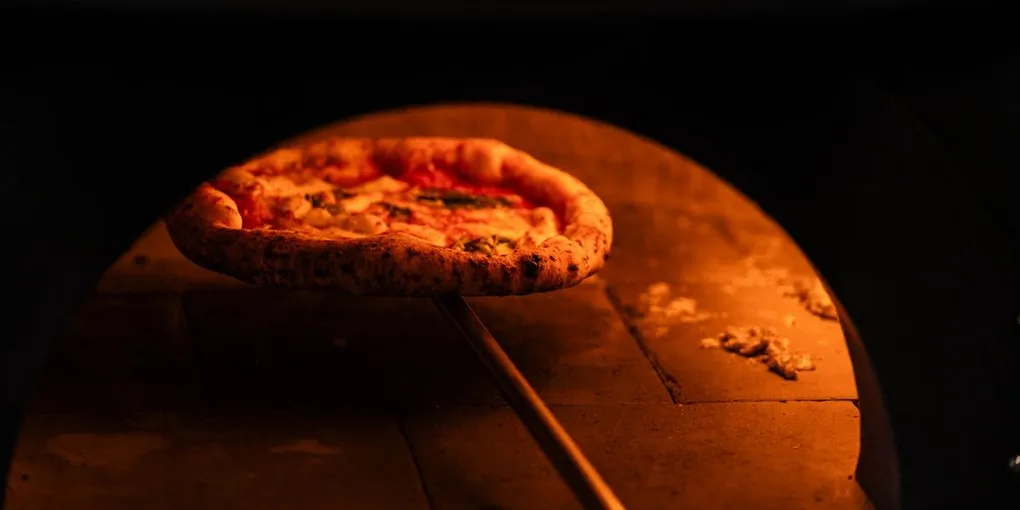
Smoke from a wood-fired oven does not contact the pizza during baking. The claim that wood fire infuses crust and toppings with flavor is one of the most persistent misconceptions in pizza culture.
What the research shows: Smoke from the burning wood rises to the top of the dome and exits through the vent. The pizza, sitting on the oven floor, never contacts the smoke stream. “If the wood is flavoring the pizza, there’s something wrong with either the technique or oven hygiene” (Myhrvold p. 418).
Myhrvold calls the perceived flavor advantage of wood-fired ovens “the marketing effect.” The actual advantage is temperature — the 900F+ floor and 800F+ dome produce qualitatively different pizza through the Maillard reaction, leopard spotting, and moisture retention, all driven by thermal radiation, not smoke.
Masi independently agrees: “The concept of a particular aroma from wood to the pizza is FALSE” (Masi p. 86). Two independent sources reach the same conclusion.
Why this matters: A propane portable pizza oven at 900F produces the same pizza as a wood-fired oven at 900F, minus the fuel management headaches. The heat is what matters, not the fuel source.
Myth 2: NYC Water Makes Better Pizza Dough
Municipal tap water works perfectly well for pizza dough regardless of where you live. Myhrvold tested five different water types across all master dough recipes, baking over 100 pizzas in this single experiment.
The team tested tap water, distilled water, filtered water, hard mineral water (2,488 ppm total dissolved solids), and water chlorinated to the maximum legal limit (4 ppm). The results were definitive. Tap water was consistently preferred. Chlorinated water had no negative effect — Neapolitan dough with 4 ppm chlorine (far more than any municipal supply) showed “excellent volume, leoparding, and added crispiness” (Myhrvold pp. 318-320).
The only water that consistently underperformed was hard mineral water (2,488 ppm TDS). High calcium and magnesium concentrations tightened the gluten network excessively, producing lower volume and denser crumb. This aligns with Masi’s finding that water above 20 French degrees of hardness makes dough “too rigid” (Masi pp. 47-48).
The verdict: “Don’t fetishize water. If you can drink it, you can use it in your dough” (Myhrvold pp. 318-320). This directly contradicts Forkish, who recommends filtered, non-chlorinated water. The NYC water myth is just that.
Myth 3: 00 Flour Means the Finest Grind
The 00 designation in the Italian flour classification system refers to ash content, not particle size. This distinction matters for every baker choosing flour.
What the research shows: The 00 designation indicates less than or equal to 0.55% ash remaining after the flour is burned (Myhrvold p. 284). Ash content reflects how much bran and germ remain in the flour after milling. Lower ash means more thoroughly refined, whiter flour with less bran material.
Myhrvold’s lab tested the particle size of multiple flour types. The smallest average particle size was NOT found in the 00 category. Some non-00 flours had finer particles than 00 flours. The 00 designation tells you about refinement (how much of the whole grain was removed), not about how aggressively the remaining endosperm was milled.
The Italian flour classification system runs from 00 (most refined, lowest ash) through 0, 1, 2, to integrale/whole wheat (least refined, highest ash):
| Type | Max Ash % | Notes |
|---|---|---|
| 00 | 0.55% or less | Most refined, whitest |
| 0 | 0.65% or less | Slightly more bran |
| 1 | 0.80% or less | Medium extraction |
| 2 | 0.95% or less | Higher extraction |
| Integrale | 1.30-1.70% | Full grain |
(Masi pp. 37-38)
Why this matters: Understanding what 00 actually means prevents two common mistakes. First, assuming that any 00 flour is good for pizza (a 00 pastry flour with 8% protein will make terrible pizza). Second, assuming that non-00 flour cannot make excellent pizza (American bread flour at 14% protein makes outstanding NY-style dough).
The practical guidance is to look at protein percentage and W value (if available), not the 00 label alone. Caputo Blue Bag (Pizzeria) has approximately 12.5% protein. These numbers, not the 00 designation, are what make it suitable for Neapolitan pizza.
Myth 4: Low-Yeast Pizza Is More Digestible
Digestibility claims for long-fermented pizza lack scientific evidence. Despite their near-universal acceptance among Italian pizzaioli, Myhrvold could find no controlled studies supporting them.
What the research shows: Myhrvold investigated this claim thoroughly and reported: “We were unable to find scientific proof of any of this” (Myhrvold pp. 163-164).
The core logical problem: yeast dies during baking. All Saccharomyces cerevisiae cells are killed at oven temperatures well before the pizza is done — Masi places thermal death at 50-60C / 122-140F (Masi pp. 48-50), while other sources note lethality beginning as low as 46C / 114F. By the time pizza exits the oven, every yeast cell is dead regardless of how much was in the dough.
Long fermentation does produce real benefits: more complex flavor (50+ compounds that do not exist in quick dough), better Maillard browning, more extensible dough, and increased mineral bioavailability through phytase activity (Masi pp. 44-45). These are genuine advantages. “More digestible” is not among them based on available evidence.
Why this matters: If you choose long fermentation for flavor and texture, the science fully supports those benefits. If you choose it for digestibility, know that those claims lack evidence.
Myth 5: The Float Test Reliably Indicates Sourdough Readiness
Volume tracking is a more reliable method for assessing sourdough starter readiness than the popular float test. Myhrvold’s research demonstrated that density relative to water does not correlate cleanly with leavening power.
What the research shows: The float test is unreliable. Myhrvold found that levain can float when it is past its peak and has begun declining, and it can sink while still having adequate leavening power (Myhrvold p. 340).
The float test measures gas retention — whether the levain has enough trapped CO2 to be less dense than water. But gas retention does not correlate cleanly with leavening power. A post-peak levain may still float while its microorganisms are depleted. A young, vigorously fermenting starter may sink despite excellent leavening potential.
The better test: Volume tracking. Mark the container at the feeding point and look for 2-2.5x rise. Use a straight-sided container with a rubber band marking the starting level. This directly measures gas production rather than relying on density as an indirect proxy.
Myth 6: Steam Helps Pizza Like It Helps Bread
Steam injection is actively harmful to pizza baking. Myhrvold tested this directly and found the opposite of what bread bakers might expect.
What the research shows: The results of steam injection: soft crust (not crisp), reduced volume, and wet toppings (Myhrvold pp. 417-419).
Pizza and bread have fundamentally different requirements. Bread benefits from delayed crust formation to maximize volume. Pizza needs rapid crust setting and dry conditions for the Maillard reaction and leopard spotting. Pizza also has exposed wet toppings — adding steam to an environment that already has moisture from sauce and cheese makes everything wetter, the cheese fails to brown, and the crust stays pale and soft.
Why this matters: Home bakers coming from bread instinctively add steam (spraying water, placing a pan of water, using a Dutch oven). All of these should be avoided for pizza. If your oven has a steam injection feature, do not use it when baking pizza in a home oven.
Myth 7: AVPN-Certified Pizzerias Follow AVPN Rules
Not a single AVPN-certified pizzeria that Myhrvold’s team visited in Naples followed ALL the AVPN rules. The organization’s standards were “more aspirational than actual” — essentially a committee invention rather than a documentation of what was actually being made.
The AVPN specified upmarket changes (fior di latte, DOP San Marzano tomatoes) that were not what was typically being served. Their campaign slogan, “If you hear a crunch, it’s not authentic,” contradicts the preference of most Italians outside Naples, who actually prefer crispier crust (Myhrvold pp. 161-162).
Ciro Salvo’s 50 Kalo, widely considered one of the best pizzerias in Naples, runs at 70% hydration — 11-15 percentage points above the AVPN specification. Da Attilio uses more salt than the standard allows. These are not obscure shops cutting corners. They are celebrated pizzerias that deviate from the “rules” because the rules do not reflect what actually makes the best pizza.
Why this matters: AVPN certification is a marketing tool more than a quality guarantee. Some of the best pizza in Naples comes from pizzerias that deliberately break AVPN rules. Some of the most disappointing pizza in Naples comes from AVPN-certified establishments. Myhrvold specifically calls out the “old-school disease” — famous old pizzerias (Da Michele, Brandi) that trade on reputation rather than quality, while innovators like Ciro Salvo and Franco Pepe produce genuinely superior pizza.
For home bakers, the practical takeaway: do not treat AVPN specifications as the definitive guide to Neapolitan pizza. Use them as a starting point, but feel free to adjust hydration, salt, fermentation time, and flour to match your oven and your preferences. The best pizzaioli in Naples do exactly that.
What the Science Does Support
Debunking myths is only useful if it points toward what actually works. Here is what the same rigorous research validates:
Long cold fermentation produces measurably better pizza. Over 50 flavor compounds develop during 24-72 hours of cold fermentation that do not exist in same-day dough. Enzymatic breakdown of starch and protein creates the substrates for Maillard browning and complex flavor. Every authoritative source agrees on this point — Forkish, Gemignani, Myhrvold, Masi, and Iacopelli.
Temperature is the dominant variable. Thermal radiation follows the T-to-the-fourth power law. At 400C, an oven produces 16 times more thermal radiation than at 200C (Myhrvold p. 402). This is why a 900F oven produces qualitatively different pizza than a 500F oven — it is not about being “hotter,” it is about exponentially more energy.
Baking surface material matters more than most people think. Steel conducts heat 18-20 times faster than cordierite (Myhrvold pp. 422-424). The choice of baking surface affects bottom crust development more than any other single variable in a home oven setup.
Hydration must match oven temperature. Higher oven temperature requires lower hydration; lower oven temperature requires higher hydration to compensate for moisture loss during the longer bake. This inverse relationship is one of the most practically useful principles in pizza making.
Matching flour strength to bake time is critical. Longer bake times (home oven) demand stronger flour with higher protein. Short bakes (portable oven) work best with softer flour. Using Italian 00 (W220-270) in a 7-8 minute home oven bake produces anemic crusts because the flour was designed for 60-second bakes at 900F.
The Bottom Line
Science does not care about tradition, marketing, or what “everyone knows.” Myhrvold’s contribution to pizza making is not that he invented better techniques — it is that he tested the assumptions underlying existing techniques and found that several of them were wrong.
Wood does not flavor pizza. NYC water is not special. 00 means ash content, not grind size. Digestibility claims lack evidence. The float test is unreliable. Steam hurts pizza. And the AVPN rules are aspirational, not descriptive.
What does matter — long fermentation, temperature management, proper hydration, appropriate flour, and a good baking surface — is less romantic but far more useful. The best pizza comes from understanding the physics and chemistry of what is actually happening in your oven, not from following rules that even their originators do not follow.
Frequently Asked Questions
- Does wood-fired pizza actually taste different from gas-fired pizza?
- Wood-fired pizza baked at 900F and gas-fired pizza baked at 900F produce essentially the same result. Myhrvold's research confirmed that smoke from wood rises to the dome and exits through the vent without contacting the pizza. The flavor differences people perceive come from temperature and baking time, not fuel source. Masi independently confirmed the same finding.
- Does the type of water I use for pizza dough matter?
- Barely. Myhrvold tested tap, distilled, filtered, hard mineral, and heavily chlorinated water across all dough recipes (100+ pizzas). Tap water was consistently preferred. Chlorinated water showed excellent results. The only water that performed poorly was extremely hard mineral water (2,488 ppm TDS), which tightened gluten excessively and reduced volume. If your tap water is drinkable, it is fine for pizza dough.
- What does 00 flour actually mean?
- The 00 designation refers to ash content (0.55% or less), not particle size or grind fineness. Lab tests proved that 00 flour is not the most finely ground -- some non-00 flours had smaller average particle sizes. The number tells you how much bran and germ remain after milling. A 00 pastry flour and a 00 pizza flour can have wildly different protein levels and performance.
- Is long-fermented pizza dough really more digestible?
- There is no scientific evidence supporting this claim. Myhrvold reported being unable to find scientific proof of digestibility benefits from low-yeast, long-fermented dough. All yeast dies during baking (at 50-60C), so the amount in raw dough is irrelevant to the finished pizza. Long fermentation does produce real benefits -- better flavor, browning, and extensibility -- but digestibility is not among them based on available evidence.
- Why is the float test for sourdough unreliable?
- The float test measures gas retention (density relative to water), not leavening power. A past-peak levain may still float because it has trapped gas even though its microorganisms are depleted. A young, actively fermenting starter may sink despite having excellent leavening potential. Volume tracking (watching for 2-2.5x rise from the feeding point) is a more reliable indicator of readiness.
- Should I add steam when baking pizza in my home oven?
- No. Myhrvold tested steam injection for pizza and found it harmful -- producing soft crust, reduced volume, and wet toppings. Steam benefits bread baking by delaying crust formation, but pizza needs the opposite: rapid crust setting, dry surface conditions for Maillard browning, and no additional moisture on top of already-wet toppings.
- Do AVPN-certified pizzerias make the best pizza in Naples?
- Not necessarily. Myhrvold found that not a single AVPN-certified pizzeria followed all the AVPN rules, and some of the best pizza in Naples comes from non-certified innovators like Ciro Salvo (50 Kalo) and Franco Pepe. AVPN certification is more of a marketing designation than a quality guarantee. The best pizzerias innovate rather than rigidly following a set of aspirational rules.