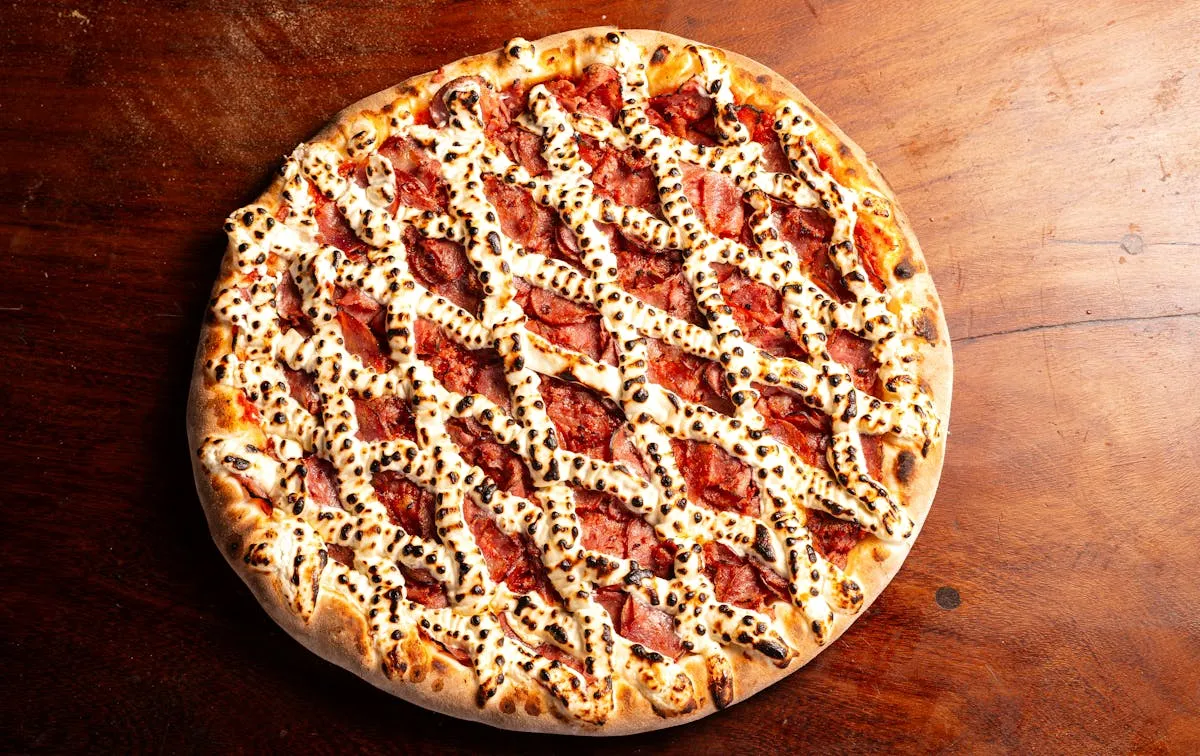
A soggy pizza bottom has one root cause: water that can’t escape. Whether it’s moisture from the sauce, the cheese, the toppings, or the baking surface itself, something is trapping water against the underside of the dough and preventing it from crisping. The good news is that every cause has a specific fix. Here are the five culprits, ranked from most common to least, and what to do about each one.
The Science: Myhrvold’s Gel Layer Problem
Before diving into individual fixes, it helps to understand what’s physically happening. Nathan Myhrvold’s team baked 120 pizzas specifically to study the soggy-bottom phenomenon and identified what they call the “gel layer” — a white, gummy, undercooked line of starch between the crust and the sauce.
Here’s the mechanism: sauce creates a cool, wet surface on top of the dough. As the pizza bakes, steam rises from the dough but condenses when it hits that cool layer. The starch in that zone gelatinizes (absorbs water and swells) but never gets hot enough or dry enough to fully set. The result is that pale, gummy stripe you see when you cut a slice in half.
Myhrvold calls this a “fundamental flaw in pizza making” — even marinara pizza with no cheese can show a visible gel layer. The only complete fix he found was prebaking the dough before adding toppings. But there are several mitigations that dramatically reduce the problem.
Cause 1: Insufficient Preheat
This is the most common cause and the easiest to fix. Your baking surface — whether steel, stone, or pan — was not hot enough when the pizza went in.
Home ovens lie. The “preheat complete” beep means the air has reached temperature, not the baking surface. Myhrvold’s team measured this precisely: home oven air heats in about 21 seconds, but the walls and surfaces take much longer. At 22 minutes of preheating, significant cold spots remain on the baking surface. A cold steel or stone can’t transfer enough heat to the dough bottom fast enough, so the underside steams instead of crisps.
The fix: Preheat for a minimum of 45 minutes with a steel, 60 minutes with a stone, at your oven’s maximum temperature. Use an infrared thermometer to verify — the coolest corner of your surface should be within 5-9F of your target temperature. Myhrvold recommends preheating 15-25F above your target to compensate for the temperature drop when you open the oven door.
Gemignani preheats at 500F for a full hour with two stones in his home oven setup. That’s not excessive.
Cause 2: Too Much Sauce
Fresh tomatoes contain approximately 94% water. Even canned San Marzano tomatoes, drained, carry significant moisture. Too much sauce creates a reservoir of water sitting directly on the dough with nowhere to go.
The EU TSG standard for Neapolitan pizza specifies just 60-80g of tomato sauce per pizza when using mozzarella. That’s roughly 2-3 tablespoons spread across a 12-inch pizza. Most home bakers use two to three times that amount.
The fix: Use less sauce than you think you need. Spread it thin enough that you can see the dough through the sauce in spots — that’s the traditional Neapolitan standard. If you like a saucier pizza, drain your tomatoes for 10-15 minutes in a fine-mesh strainer before blending. Forkish’s smooth sauce recipe starts by draining canned whole tomatoes for 10-15 minutes before processing.
For wet sauces (fresh tomato, pesto), consider the two-stage approach: sauce on the dough first, bake until the crust sets, then add cheese and remaining toppings for a second shorter bake. Iacopelli uses this method specifically to prevent sogginess in home ovens.
Cause 3: Wet Mozzarella Not Drained
Fresh mozzarella (fior di latte) contains 62-65% water. Mozzarella di bufala is even wetter. When you place slices of fresh mozz on a pizza in a home oven, it releases that moisture over a 7-8 minute bake. In a 900F wood-fired oven, the pizza is done in 90 seconds — the cheese barely has time to release moisture. In a home oven, it’s a flood.
The fix: Cut fresh mozzarella the night before and drain it in a colander in the refrigerator overnight. Iacopelli considers this essential for home oven pizza. Alternatively, slice it 1-2 hours before baking and let it sit on paper towels, pressing gently to wick away surface moisture.
Masi recommends reducing fresh mozzarella to about 45% moisture content before using it on pizza. That means the mozzarella should feel noticeably firmer and drier than it did out of the package.
For consistent results with less fuss, use low-moisture mozzarella (grated from a block, not pre-shredded with anti-caking agents). It contains much less water and performs reliably in longer home-oven bakes. Gemignani considers low-moisture dry mozzarella the secret to true NY coal-fired pizza.
Cause 4: Too Many Toppings
Every topping releases moisture during baking. Vegetables are the worst offenders — mushrooms, peppers, onions, and fresh tomato slices all contain 85-95% water. Stack enough of them on a pizza and you’re baking a steam bath.
Dense toppings also create a physical barrier that traps rising steam against the dough surface. The moisture can’t evaporate upward because it’s blocked by a layer of vegetables and cheese. Knowing which toppings to pre-cook and which can go on raw makes a big difference.
The fix: Use roughly half the toppings you think you need. This is counterintuitive, especially for home cooks accustomed to loading up a pizza. Gemignani’s Commandment #6: thou shalt not overtop thy pizza.
For moisture-heavy vegetables, pre-cook them. Saute mushrooms until they’ve released and evaporated their liquid. Roast peppers and blot them. Squeeze excess moisture from defrosted frozen spinach. Slice onions thin and roast them first. Any vegetable that releases significant water during cooking should be dealt with before it goes on the pizza.
Cause 5: The Baking Surface Lost Its Heat
If you’re making multiple pizzas, each one absorbs heat from the steel or stone. Without adequate recovery time between pizzas, the second and third pizzas go onto a progressively cooler surface.
A standard 1/4-inch baking steel loses significant temperature after one pizza. By the second pizza, bottom crisping is noticeably weaker. By the third, you’re likely getting a soggy bottom. For a deeper dive on how steel thickness affects heat retention, see our thickness guide.
The fix: Wait 3-5 minutes between pizzas for the surface to recover, and verify with an IR thermometer before launching the next one. Upgrading from 1/4-inch to 3/8-inch steel is the single most impactful equipment change — the thicker steel stores substantially more thermal energy and recovers faster. Myhrvold’s optimal specification is 12mm (roughly 1/2 inch), though the practical sweet spot is 3/8-inch for most home bakers.
Gemignani’s two-stone method solves this elegantly: bake the first half of the pizza on one surface, then transfer to a second surface (which hasn’t been cooled by dough contact) to crisp the bottom. “Any time you want to crisp the bottom more, move it to the other stone.”
The Nuclear Option: Cheese-Down Assembly
Myhrvold’s research showed that putting cheese directly on the dough and sauce on top of the cheese dramatically reduces the gel layer. The cheese acts as a moisture barrier between the wet sauce and the dough. This isn’t theoretical — it’s the assembly method used in Detroit-style pizza, New Jersey tomato pie, Chicago deep-dish, and Gemignani’s competition-winning “New Yorker” recipe.
You don’t have to go full cheese-down for every pizza. But if you’re consistently fighting a soggy bottom despite addressing the other causes, reversing the cheese and sauce order is the single most effective structural change you can make.
Quick Reference: The Five Fixes
| Cause | Fix | Impact |
|---|---|---|
| Insufficient preheat | 45-60 min preheat, verify with IR thermometer | Highest |
| Too much sauce | Drain tomatoes, use less, see dough through sauce | High |
| Wet mozzarella | Drain overnight, or use low-moisture mozz | High |
| Too many toppings | Halve your toppings, pre-cook wet vegetables | Medium |
| Cold surface (multi-pizza) | Wait 3-5 min between pizzas, upgrade to 3/8” steel | Medium |
The first three fixes alone will solve 90% of soggy-bottom problems. Apply all five and add a cooling rack after baking (to prevent trapped steam from softening the bottom as it rests), and you’ll consistently produce pizza with a crisp, spotted underside.
Frequently Asked Questions
- Why is the middle of my pizza soggy but the edges are crispy?
- The center stays cooler and wetter than the rim because sauce and toppings concentrate there. The ungarnished rim heats faster and rises higher, while the center stays below 100C because the latent heat of vaporization from wet sauce steals energy -- the sauce boils, and evaporation absorbs enormous heat that would otherwise cook the dough. Use less sauce in the center, spread toppings more evenly toward the edges, and make sure your baking surface is fully preheated.
- Does a pizza stone cause soggy bottoms?
- A stone doesn't inherently cause sogginess, but it recovers heat more slowly than steel after absorbing heat from a pizza. Stone thermal conductivity is roughly 18-20x lower than steel, so it transfers heat to the dough bottom more slowly. If your stone wasn't preheated long enough (minimum 60 minutes), or you're baking multiple pizzas without recovery time, a stone will underperform. A baking steel at the same temperature crisps the bottom faster and recovers more quickly.
- Should I prebake the pizza dough to prevent sogginess?
- It works -- Myhrvold found that prebaking is the only complete fix for the gel layer problem. Several legitimate styles use prebaking: Gemignani's Sicilian method parbakes for 14 minutes before adding toppings, Detroit-style parbakes 5 minutes before adding cheese, and Bonci-style al taglio prebakes the crust entirely and adds toppings cold afterward. For Neapolitan-style pizza where prebaking feels wrong, the other mitigations (draining cheese, reducing sauce, proper preheat) are usually sufficient.
- Does putting cheese under the sauce help with soggy pizza?
- Yes, significantly. Myhrvold tested this directly and found that cheese-on-dough-first, sauce-on-top produces a much smaller gel layer. The cheese creates a fat-based moisture barrier between the wet sauce and the dough. This assembly order is used in Detroit-style pizza, New Jersey tomato pie, Chicago deep-dish, and several competition-winning recipes. It changes the look and eating experience but is the most effective structural fix for persistent sogginess.
- How long should I preheat my pizza stone or steel?
- Minimum 45 minutes for steel, 60 minutes for stone, at your oven's maximum temperature. The oven's preheat complete signal only means the air is hot -- the baking surface takes much longer to reach equilibrium. Use an infrared thermometer to verify: the coolest spot on your surface should be within 5-9F of your target. Preheat 15-25F above target to compensate for heat loss when you open the door.
- Why is my pizza soggy on a pizza steel?
- Even steel can produce a soggy bottom if the preheat was insufficient, if you're using too much sauce or wet cheese, or if you're baking multiple pizzas without letting the steel recover (3-5 minutes between pizzas). Also check your steel thickness -- a 3/16-inch steel has much less thermal mass than a 3/8-inch steel and drops temperature more dramatically after each pizza. Upgrading from 1/4-inch to 3/8-inch is the single most impactful thickness change for heat retention.
For the full troubleshooting guide covering 27+ pizza defects with root causes and fixes, see our Pizza Dough Troubleshooting pillar article.