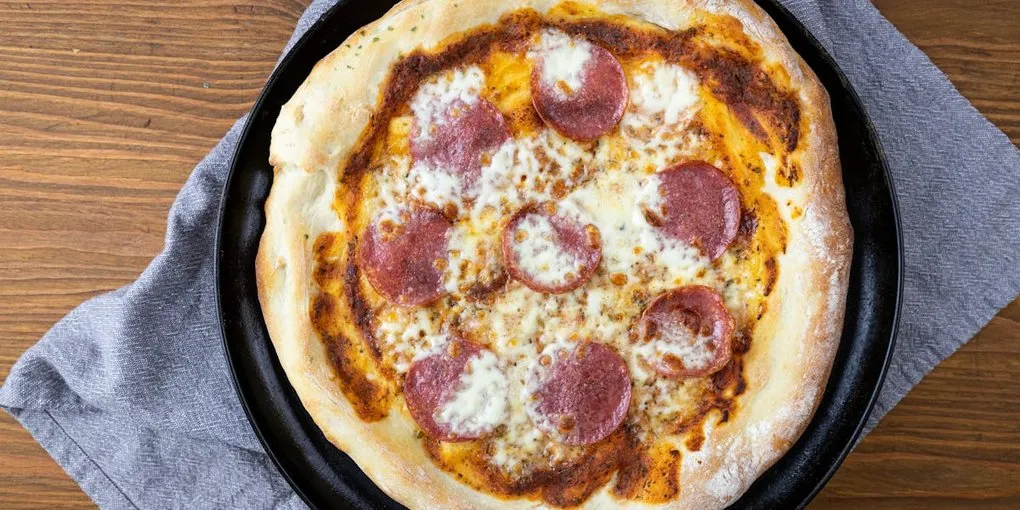
You pulled the pizza out of your 550-degree home oven after seven minutes and the crust looks fine. Cooked through, structurally sound, but pale. The deep golden-brown cornicione you see in every pizzeria photo is nowhere to be found. The flavor is good but flat — missing the roasted complexity that separates decent pizza from great pizza.
The fix is a single ingredient that most home pizza recipes never mention: diastatic malt powder. Tony Gemignani uses it as a standard component in his Master Dough — not an optional additive, but a core ingredient at 2% of flour weight. Kenji Lopez-Alt includes it at the same 2% in his New York dough formula, calling it a “key innovation.” Nathan Myhrvold recommends 0.5-1% for general use.
This is the single most effective browning booster available to home oven bakers. Here is how it works and why it matters.
What Diastatic Malt Actually Is
Diastatic malt powder is made from sprouted barley. The sprouting process activates enzymes — primarily amylase — inside the grain. The barley is then dried at low temperature to preserve those enzymes, and ground into a fine powder.
That “diastatic” label is the critical distinction. It means the enzymes are still alive and active. When you add diastatic malt to dough, you are adding two things simultaneously:
- Maltose — a reducing sugar that directly participates in the Maillard reaction and feeds yeast.
- Active amylase enzymes — which continue breaking down flour starch into additional sugars during fermentation and early baking.
Non-diastatic malt powder, by contrast, has been heated to high temperatures during processing. The enzymes are dead. You are adding sweetness and color (it is essentially a malt-flavored sugar), but you are not getting the enzymatic action that makes diastatic malt so powerful. For browning enhancement specifically, you need the active enzyme version.
Why Home Ovens Need Help
The browning problem in home ovens is a physics problem. In a 900-degree Neapolitan oven, the pizza bakes in 60-90 seconds. Radiant heat energy scales with the fourth power of absolute temperature (the Stefan-Boltzmann law). A wood-fired oven at 900 degrees Fahrenheit delivers several times more radiant energy than a home oven at 550 degrees Fahrenheit — enough to drive the crust surface well past the Maillard threshold almost instantly.
In a 550-degree home oven with a 7-8 minute bake, the dough surface heats more slowly and radiant energy is dramatically lower. The pizza can finish baking — crust cooked through, cheese melted, toppings done — before the Maillard reaction has produced meaningful color on the crust.
The Maillard reaction needs two reactants to proceed: amino acids (from protein breakdown) and reducing sugars (simple sugars like glucose, fructose, and maltose). Flour naturally contains only about 0.5% fermentable sugars. The rest must be unlocked by amylase enzymes breaking down starch during fermentation — or supplied directly.
This is exactly what diastatic malt does. It floods the system with both ready-made maltose and additional amylase enzymes that keep converting starch to sugar throughout fermentation and into the early moments of baking. More reducing sugars available at bake time means the Maillard reaction starts earlier and runs further during your limited bake window.
How Much to Use
The experts disagree on dosage, and the right amount depends on your oven and process.
| Source | Diastatic Malt % | Context |
|---|---|---|
| Gemignani Master Dough | 2% | 24-48hr cold ferment, 500-degree home oven |
| Kenji Lopez-Alt NY Dough | 2% | 24-72hr cold ferment, 500-degree home oven on steel |
| Myhrvold (general recommendation) | 0.5-1% | General use across styles |
| Gemignani Napoletana Dough | 2% | Home oven only — omit in wood-fired |
| Gemignani Deep-Dish | 2.1% | 24-48hr cold ferment |
Gemignani’s 2% is the most aggressive dosage, and he uses it across almost all of his 14 published dough formulas — Master Dough with and without starter, Napoletana, Sicilian, Cracker-Thin, Deep-Dish, Romana, and Multigrain all include diastatic malt. For him, this is not a home-baker shortcut. It is a core component that enhances browning, tenderness, and flavor simultaneously.
If you have never used diastatic malt before, start at 1% and bake a batch. Then try 2% and compare. In a 550-degree home oven, the difference between 0% and 2% is visible and dramatic — the crust goes from “structurally done but pale” to “deeply golden-brown with complex roasted flavor” in the same oven at the same temperature for the same bake time.
The Compound Effect with Cold Fermentation
Diastatic malt and cold fermentation are synergistic. During cold fermentation at 4 degrees Celsius, yeast drops to roughly 10% activity while enzymes retain 40-50% of their function. The amylase from your malt powder keeps working through the entire cold rest, converting starch to sugar even while the yeast is mostly dormant.
After a 48-hour cold ferment, your dough already contains significantly more free sugars and free amino acids than same-day dough — both sides of the Maillard reaction equation have been loaded by enzymatic action. Adding diastatic malt on top of that means even more amylase working alongside the flour’s native enzymes, accelerating sugar production during the entire cold rest.
A 48-hour cold-fermented dough with 2% diastatic malt has maximal free sugars from three sources (native flour sugars, enzymatic breakdown, and malt-supplied maltose) and maximal free amino acids from protease activity. This produces the maximum browning potential available to a home oven baker.
When to Leave It Out
There is a clear temperature threshold: omit diastatic malt when baking above 650 degrees Fahrenheit.
In a portable pizza oven hitting 800-950 degrees, the Maillard reaction proceeds aggressively without any help. The extra sugar from malt can push browning into burning. This is why Gemignani specifies that his Napoletana dough formula uses malt for home ovens only — in a 900-degree wood-fired oven, you do not need it and should not use it.
The flour selection by oven type follows the same logic. Italian 00 flours designed for high-temperature ovens — Caputo Pizzeria (blue bag, W260-270), Caputo Classica (W220-240) — are unmalted. They do not need malt because they are designed for 60-90 second bakes where browning happens from sheer thermal energy. Caputo Americana (W360-380), designed specifically for home ovens, actually contains malt in the flour itself.
The practical rule: if your bake is under 3 minutes, skip the malt. If your bake is 7-8 minutes or longer, malt is one of the most impactful additions you can make.
Beyond Browning: What Else Malt Does
The benefits extend past color:
Tenderness. The sugars produced by amylase activity tenderize the crumb. Malt-enhanced dough produces a crust that is noticeably less tough than dough without it — the same sugars that drive browning also interfere with gluten cross-linking at the surface, yielding a more delicate texture.
Yeast fuel. Maltose feeds yeast. In a long cold ferment where the native flour sugars get consumed early, the malt’s continuing enzymatic action provides a fresh supply of fermentable sugars. This helps sustain fermentation through multi-day cold retards without the off-flavors that come from yeast starvation.
Flavor complexity. Maltose contributes a subtle sweetness and malty depth that complements fermentation flavors. It is not the sweetness of added sugar — it is the same family of flavors you get from malted barley in beer. In a well-fermented, malt-enhanced dough, the crust tastes more complete.
Where to Buy It
Diastatic malt powder is a standard homebrewing ingredient — any beer-brewing supply store carries it. It is also available from King Arthur Baking and Amazon. Make sure the label specifies “diastatic” — if it just says “malt powder” or “malt extract,” it is likely non-diastatic (enzyme-dead).
A one-pound bag costs around $8-12 and lasts months at typical pizza volumes. Store it in a cool, dry place — the enzymes degrade faster in heat and humidity.
One caution: barley malt extract (liquid) is not the same product. You want the dry powder form. Liquid malt extract is typically non-diastatic and behaves more like honey or molasses in dough — it adds sweetness and some color but none of the enzymatic activity.
How to Add It
Gemignani’s mixing order places diastatic malt with the dry ingredients: combine flour and malt before adding any liquid. This ensures even distribution throughout the dough. If you are adapting an existing recipe, simply whisk the malt powder into your flour before proceeding with your normal process.
For a standard home pizza dough using 500g of flour:
- 1% malt = 5g (conservative, Myhrvold range)
- 2% malt = 10g (Gemignani/Kenji standard)
No other recipe adjustments needed. The malt does not meaningfully change hydration, and the additional yeast food does not require reducing your yeast amount for cold-fermented doughs where the yeast is already at minimal levels.
Diastatic vs. Non-Diastatic: A Quick Reference
Non-diastatic malt has legitimate uses — it is what gives bagels their characteristic shiny, mahogany crust when added to the boiling water. But for pizza dough where you want ongoing enzymatic activity during a long ferment, diastatic is the correct choice.
The Bottom Line
Diastatic malt powder is the most underrated ingredient in home pizza baking. At 2% of flour weight, it transforms the browning and flavor of pizza baked in a standard home oven — no equipment changes, no technique changes, just one addition to your existing process. Gemignani treats it as non-negotiable in his Master Dough. Kenji Lopez-Alt calls it a key innovation. Myhrvold recommends it specifically to compensate for the thermal limitations of home ovens.
If you are making pizza in anything under 650 degrees, this should be in your dough. The difference is visible on the first bake.
Sources: Gemignani, The Pizza Bible (Master Dough formulas, diastatic malt as standard ingredient, 14 dough formulas, mixing order, oven temperature thresholds); Masi, Romano & Coccia, The Neapolitan Pizza (flour fermentable sugar content 0.5%, enzyme activity at cold temperatures, Maillard reaction mechanism, amylase science); Myhrvold & Migoya, Modernist Pizza Vol 1 (diastatic malt 0.5-1% recommendation, baking physics, Stefan-Boltzmann thermal radiation); Lopez-Alt, Serious Eats (NY dough 2% diastatic malt, key innovation); Caputo flour specifications.
Frequently Asked Questions
- What is the difference between diastatic and non-diastatic malt powder?
- Diastatic malt contains active amylase enzymes that continue breaking down starch into sugar during fermentation and early baking. Non-diastatic malt has been heat-treated to kill those enzymes, so it only adds a fixed amount of sweetness. For pizza dough browning, you want diastatic — the ongoing enzymatic activity is what makes it so effective.
- How much diastatic malt powder should I add to pizza dough?
- Tony Gemignani and Kenji Lopez-Alt both use 2% of flour weight as their standard — that is 10g per 500g of flour. Nathan Myhrvold recommends 0.5-1% for general use. Start at 1% if you have never used it before, then try 2% and compare.
- Will diastatic malt make my pizza dough taste sweet?
- No. At 1-2% of flour weight, the maltose adds a subtle malty depth rather than perceptible sweetness. The sugars produced by the enzymes are mostly consumed by yeast during fermentation or converted into Maillard browning compounds during baking. The flavor effect is more roasted complexity than sweetness.
- Can I use diastatic malt in a portable pizza oven like an Ooni?
- You should skip it. Above 650 degrees Fahrenheit, the Maillard reaction proceeds aggressively without help, and the extra sugar from malt can push browning into burning. Gemignani specifically notes that his Napoletana dough uses malt for home ovens only.
- Where can I buy diastatic malt powder?
- Beer-brewing supply stores carry it as a standard homebrewing ingredient. It is also available from King Arthur Baking and Amazon. A one-pound bag costs $8-12 and lasts months. Make sure the label specifies diastatic — if it just says malt powder, it is likely the non-diastatic version.
- Can I substitute honey or sugar for diastatic malt?
- Honey and sugar add reducing sugars that help with browning, but they do not provide the active amylase enzymes that diastatic malt contains. Those enzymes keep producing new sugars throughout fermentation. Sugar or honey will help with color, but diastatic malt does more.
- Does diastatic malt change how I need to adjust my recipe?
- No other adjustments are needed. At 1-2%, diastatic malt does not meaningfully affect hydration, and the additional yeast food does not require reducing your yeast amount in cold-fermented doughs where yeast is already at minimal levels.