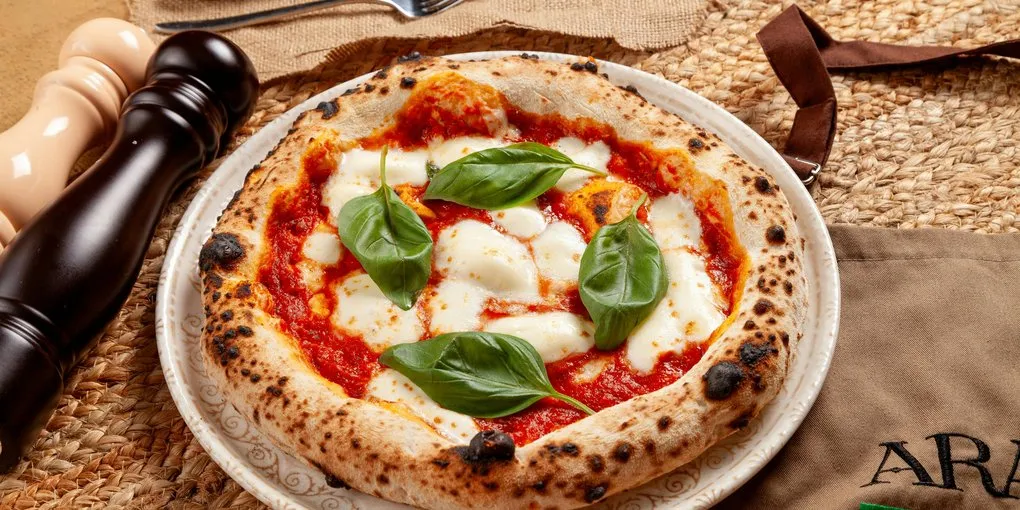
Every pizza menu in the world tells some version of the same story. In June 1889, the visiting Queen Margherita of Savoy summons a Neapolitan pizzaiolo named Raffaele Esposito to the royal palace at Capodimonte. He bakes her three pizzas; she chooses the tricolor one (red tomato, white mozzarella, green basil) made in the colors of the new Italian flag. He names it after her. Modern pizza is born.
It is a beautiful origin story, and it is reprinted in cookbooks, on restaurant walls, and in Wikipedia entries every day. The problem is that almost everything about it falls apart under historical scrutiny — and that the foundational document for the whole legend, the famous “Galli letter” of royal thanks, was systematically dismantled by Harvard food historian Zachary Nowak in a 2014 peer-reviewed paper that identified four independent forgery indicators. None of this means modern Naples invented the Margherita pizza out of thin air. It does mean the story of who, what, and exactly when is much hazier than the tourist plaques claim.
This article walks through the popular legend in detail, then through the historical evidence and the academic critique, and ends on what is most likely actually true. Whether the literal story is accurate matters less than the marketing power it has carried for 135 years.
The Popular Legend
The legend, as it is told today, is remarkably consistent across sources. The dates and specific names are almost always the same.
In June 1889, King Umberto I of Italy and his consort, Queen Margherita of Savoy, visited Naples on a royal tour. The Queen, as the story goes, was tired of French haute cuisine being served at every official function and asked to try the local food of the common people. Pizza in 1889 Naples was strictly a working-class street food — cheap, eaten standing up, and not considered fit for royalty.
Pizzaiolo Raffaele Esposito had purchased the establishment at Salita Sant’Anna di Palazzo 1/2 in 1883 (it had been founded in 1780 by Pietro Colicchio as Pizzeria di Pietro e basta così) and renamed it Pizzeria della Regina d’Italia. According to the legend, Esposito and his wife Maria Giovanna Brandi were summoned to the Capodimonte Palace to prepare pizzas for Their Majesties. He prepared three: a mastunicola with lard, basil, and cheese; a marinara with garlic, oil, oregano, and tomato; and a third topped with tomato, mozzarella, and basil — chosen specifically, the legend says, to honor the Italian tricolor (red, white, green) that became the Kingdom of Italy’s flag at unification on 17 March 1861.
The Queen, the story goes, preferred the third. Esposito named it Pizza Margherita in her honor. As proof of her appreciation, the Queen’s head of table services — usually identified as Galli Camillo (sometimes “Galli di Camillo”) — wrote a thank-you letter on royal letterhead. That letter, dated June 11, 1889, became the founding document of modern pizza. It hangs (in reproduction) on the wall of Pizzeria Brandi to this day, and the restaurant carries a plaque commemorating its role in pizza history.
That is the story. It is told as historical fact in nearly every English-language pizza book, in countless food media articles, and in the marketing of Pizzeria Brandi itself.
The Inconvenient Earlier Records
The first crack in the legend appears thirty-six years before it allegedly happened.
In 1853, the Neapolitan writer Emanuele Rocco contributed an essay titled “Il pizzajulo” to Francesco de Bourcard’s two-volume work Usi e costumi di Napoli e contorni descritti e dipinti (Customs and Traditions of Naples and Its Surroundings, Described and Illustrated). The first volume, containing Rocco’s essay, was published in 1853; the second appeared in 1858. In it, Rocco describes the standard pizza toppings then sold by Naples’ street pizzaioli. Among the variations he lists: pizza topped with basilico, muzzarella, e pomodoro — basil, mozzarella, and tomato. The combination of tomato, mozzarella, and basil that the legend says Esposito invented in 1889 was, by Rocco’s account, already a standard Neapolitan offering thirty-six years earlier.
Rocco is not the only earlier source. Bourcard himself, writing in the same period, describes Neapolitan street pizza topped with various combinations of oil, salt, oregano, garlic, anchovies, cheese, and tomato. Various 18th- and early-19th-century travel accounts describe Neapolitan pizza topped with tomato (which arrived in Naples in the 1700s after centuries of being treated as ornamental in Europe) and assorted dairy. By the 1880s, fior di latte mozzarella was widely available in Naples, and the combination with sliced tomato and basil was, depending on the pizzeria, either commonplace or a minor variation. It was not an invention. It was an existing dish that may or may not have been served to a queen.
This pattern is consistent with what modern food historians find in nearly every “founding” food legend: the dish predates the supposed inventor by years or decades, and what actually happened was a renaming, a popularization, or a marketing event.
The Galli Letter Problem
The single most important piece of evidence for the Esposito-Margherita story is the thank-you letter, dated June 11, 1889. It is the only contemporary documentation that anyone visited the palace, that Esposito made three pizzas, and that the Queen named one. Without it, the whole story rests on Brandi family oral tradition.
The letter was systematically examined by Zachary Nowak, a food historian at the Umbra Institute and a doctoral candidate in American Studies at Harvard, in a peer-reviewed paper published in 2014: “Folklore, Fakelore, History: Invented Tradition and the Origins of the Pizza Margherita” (Food, Culture and Society, vol. 17, no. 1). Nowak’s findings are the standard reference for skeptics of the legend, and National Geographic has subsequently summarized them for a broader audience. The findings are uncomfortable for the story.
First, the signature on the letter does not match other verified Galli signatures. Nowak compared eight common words between the displayed letter and authentic Galli correspondence held in Italian state archives. The handwriting, slant, spacing, and letterforms differ in ways that handwriting analysts associate with deliberate replication rather than authentic signature. Nowak’s conclusion: the authors of these letters were two different people.
Second, the royal seal on the letter does not match any verified historical seal of the period. Letterhead and stationery from the royal household used a small set of recognized seals; the seal on the Esposito letter matches none of them.
Third, the Gazette of the Kingdom of Italy (Gazzetta del Regno d’Italia), which printed daily summaries of the royal family’s official engagements, has no record of a visit by Esposito to Capodimonte. Royal court schedules of the period were meticulously kept, and any official catering to Their Majesties — particularly anything involving named tradesmen brought in for the occasion — would normally generate a paper trail. There is none for Esposito.
Fourth, and most damning, the letter addresses Esposito as “Sig. Raffaele Esposito Brandi” — combining his name with his wife’s surname. Italian men did not take their wives’ surnames in 1889, and they do not now. The “Brandi” suffix is an anachronism that points strongly to authorship by the Brandi family rather than by anyone in the royal household. The letter makes sense as a forgery produced after the Brandi family acquired the pizzeria in 1932 and wanted documentary evidence to support their “birthplace” branding.
None of these points individually proves the letter is forged. Taken together, Nowak considers the question settled: the document is not authentic, and the story it supposedly attests cannot be relied on as primary evidence.
What Most Likely Actually Happened
Strip away the unprovable claims and a more plausible story emerges, one that food historians who have examined the issue tend to converge on.
A pizza style topped with tomato, mozzarella, and basil was being served by Neapolitan pizzaioli throughout the mid-19th century, well before 1889. Rocco’s 1853 description is the earliest published reference. Bourcard’s slightly later cataloging confirms it. The combination was not invented; it emerged out of the working-class Neapolitan street-pizza tradition that produced the marinara, the mastunicola, and dozens of named regional variations.
The tricolor connection to the Italian flag is plausible (the flag had been adopted in 1861, and tricolor symbolism was a real cultural current of the era) but did not need to wait for a queen to be noticed. Italians cooking with red tomato, white cheese, and green basil were perfectly capable of seeing the resemblance themselves. There is also a striking parallel account in Salvatore Di Giacomo’s 1914 history of pizza, which credits a different pizzaiolo (Domenico Testa) baking for a different monarch (Ferdinando II) — the queen-eats-peasant-pizza narrative is a recurring trope, not a single event.
The visit to Capodimonte in June 1889 may or may not have happened. Umberto and Margherita were genuinely in Naples in early June 1889; that much is documented. Whether they ate pizza, whether Esposito was the pizzaiolo, and whether anyone wrote a thank-you letter are all unverifiable from contemporary records. The Esposito-Margherita version of the story does not appear in print until the late 1930s or early 1940s — a half-century after it allegedly happened, and conveniently after the Brandi family had taken ownership of the pizzeria.
What is certain is this: the Margherita name caught on. By the early 20th century, it was the standard term for the tomato-mozzarella-basil pizza in Naples. By the postwar era, as Italian-Americans returned to Italy and reimported pizza traditions to the United States, “Margherita” was firmly established as the canonical Neapolitan pizza. The AVPN’s 1984 founding standardized it further, and the EU’s 2010 Traditional Speciality Guaranteed (TSG) designation cemented it as the official, protected version of Neapolitan pizza.
The Margherita’s real history is the history of its propagation, not its invention.
Why the Legend Persists
Even if every academic critique is correct, the Margherita legend will continue to be told. There are several reasons for this, and they reveal something important about how food culture works.
The legend has commercial value. Pizzeria Brandi, the modern descendant of Pizzeria di Pietro e basta così, has built its identity around being the birthplace of the Pizza Margherita. The plaque, the framed letter, the menu storytelling — these are real economic assets, and the restaurant has every incentive to defend them. Naples as a city has the same incentive: Margherita-as-Naples-invention is a tourism asset worth millions. Modernist Pizza is blunt about this: the “old-school disease” of trading on heritage rather than quality affects famous Naples pizzerias including Brandi and Da Michele, and the legend is part of how that trade works.
The legend has structural elegance. A queen, a flag, a working-class pizzaiolo, a tribute to national unity. It is the kind of origin story that Hollywood would write if Hollywood wrote pizza films. Reality is rarely that tidy, but the cleaner story is the one that gets told.
The legend is partially true. The pizza style is genuinely Neapolitan. The Queen may genuinely have eaten pizza on a royal visit. The tricolor pattern is real. What the legend overstates is the pinpoint precision of “this man, this day, this dish, this name.” The broader claim — that the Margherita is a Neapolitan creation that emerged in the 19th century and became the canonical example of Italian pizza — is correct.
This is the typical shape of food legends. A real cultural phenomenon gets a date, a name, and a hero attached to it, often retrospectively, and the simplification helps the story spread. The Margherita’s invention story is no more or less reliable than the Caesar salad’s (Tijuana, 1924, Caesar Cardini — partly true, partly embroidered) or the Buffalo wing’s (Anchor Bar, 1964, Teressa Bellissimo — partly true, partly disputed).
What This Means for Pizza Today
For anyone who actually makes pizza, the historical questions are mostly trivia. The Margherita, however it acquired its name, is one of the great food creations of the modern era. It is also the protected, codified, EU-recognized standard for Neapolitan pizza, governed by the AVPN’s strict ingredient and method requirements: 00 flour, San Marzano tomatoes (or equivalent DOP), fior di latte or mozzarella di bufala, fresh basil, EVOO, salt, and yeast, baked at approximately 905 degF dome (485 degC) for 60-90 seconds in a wood-fired oven. The full certification framework — and what does and does not bend in modern AVPN practice — is covered in our AVPN standard deep-dive.
The home-version Margherita, adapted for 525-550 degF home ovens with longer 7-minute bakes and 70% hydration dough, is one of the most rewarding things a home pizzaiolo can make. If you want the recipe and method, our Neapolitan pizza at home guide and recipe for Neapolitan margherita walk through the entire process.
For other pizza myths that Modernist Pizza and other modern researchers have systematically debunked — including AVPN-related misconceptions, wood-fire flavor claims, and Lombardi 1905 origin questions — see our broader pizza myths debunked overview.
The Bottom Line
The standard 1889 Margherita legend — Esposito, Brandi, Queen Margherita, Galli letter, tricolor flag — is a story with a lot more romance than evidence behind it. The single piece of contemporary documentation that anchors the whole narrative, the Galli thank-you letter, was systematically dismantled by Zachary Nowak’s 2014 peer-reviewed analysis: forged seal, mismatched handwriting, anachronistic surname, missing protocol entry. The Gazette of the Kingdom of Italy contains no record of an Esposito visit to the palace. The tomato-mozzarella-basil pizza was being described by Rocco as a standard Neapolitan offering in 1853, thirty-six years before the legend places its invention.
What is true: the pizza style is genuinely Neapolitan, it really did emerge in the mid-to-late 19th century, the Italian tricolor is a real influence on the dish’s symbolism, and “Margherita” became the standard name for the tomato-mozzarella-basil pizza by the early 1900s. What is uncertain: who exactly first made it, when it was first called Margherita, and whether the royal visit included pizza at all. What is almost certainly mythologized: the precise date of June 11, 1889, the named pizzaiolo, the heroic queen-eats-peasant-food framing, and the Galli letter as physical evidence.
Tell the story however you like. Just know that when you say “1889,” you are reciting marketing — some of which may be true, some of which is provably not.
Frequently Asked Questions
- Was the Margherita pizza really invented in 1889?
- Almost certainly not in the literal sense the legend implies. A pizza topped with tomato, mozzarella, and basil is documented in Emanuele Rocco's 1853 essay 'Il pizzajulo' in Francesco de Bourcard's Usi e costumi di Napoli compilation, 36 years before the alleged Esposito-Margherita event. What probably happened in 1889 (if anything) was a renaming or popularization of an existing dish, not an invention. The June 11, 1889 specific date traces to the Galli letter, which Harvard food historian Zachary Nowak has shown to be a forgery on multiple independent grounds.
- Is the Galli letter real?
- No, according to the most thorough academic analysis. Zachary Nowak's 2014 peer-reviewed paper in Food, Culture and Society identifies four independent forgery indicators: the royal seal does not match any verified period seal; the handwriting does not match authentic Galli signatures from contemporary state archives; the Gazette of the Kingdom of Italy has no protocol entry for the visit; and the letter addresses 'Sig. Raffaele Esposito Brandi,' combining Esposito's name with his wife's surname (Italian men did not take their wives' surnames in 1889). The letter most likely originated with the Brandi brothers around 1932.
- Who really invented the Margherita pizza?
- Probably no single person. The combination of tomato, mozzarella, and basil was being served by Neapolitan street pizzaioli throughout the mid-19th century, decades before the Esposito legend places its invention. Emanuele Rocco's 1853 Bourcard-compilation essay is the earliest known printed description. The tricolor symbolism, while a real cultural current of the post-unification era, did not require royal patronage to be noticed by Italian cooks already working with red tomato, white cheese, and green basil. The Margherita is a Neapolitan style that emerged collectively, not a single chef's creation.
- Did Queen Margherita actually eat pizza in 1889?
- Possibly, but it cannot be confirmed from contemporary records. King Umberto I and Queen Margherita were genuinely in Naples in early June 1889; that part is documented. But no official record places Raffaele Esposito at Capodimonte Palace, and no Gazette report mentions pizza being served to Their Majesties. Brandi family oral tradition is the primary source for the visit, and the earliest printed version of the Esposito-Margherita story dates to the late 1930s or early 1940s -- a half-century after the alleged event.
- Why is Pizzeria Brandi considered the birthplace of pizza?
- Largely because the Brandi family has claimed that role since 1932, when Maria Giovanna Brandi's nephews Giovanni and Pasquale Brandi acquired the original Pizzeria di Pietro e basta così (which Esposito had renamed Pizzeria della Regina d'Italia in 1883). The framed Galli letter on the wall and the commemorative plaque are central to the restaurant's identity and Naples' tourism narrative. The earlier pizzeria did exist in 1889 -- but the 'birthplace of the Margherita' branding is a 20th-century construction by the new owners during the Great Depression, not a continuous historical claim from 1889.
- Does the disputed history matter for modern Margherita pizza?
- For practical pizza-making, no. The AVPN's 1984 founding and the EU's 2010 Traditional Speciality Guaranteed (TSG) designation under Commission Regulation No 97/2010 codified the modern Margherita: 00 flour, San Marzano DOP tomatoes, fior di latte or mozzarella di bufala, fresh basil, EVOO, salt, and yeast, baked at ~485 degC dome for 60-90 seconds in a wood-fired oven. The dish itself is real, refined, and protected by Italian law and EU regulation. The historical mythology around its origin is separable from the contemporary standard.
- Are there other food origin legends like the Margherita's?
- Many. The Caesar salad (allegedly Tijuana, 1924, Caesar Cardini), the Buffalo wing (Anchor Bar, 1964, Teressa Bellissimo), and the Hawaiian pizza (Sam Panopoulos, Ontario, 1962) all follow the same pattern: a real cultural phenomenon gets a date, a name, and a hero attached to it, often retrospectively, and the cleaner story is the one that propagates. Food origin stories almost always overstate the precision of 'this person, this day, this dish.' The Margherita is not unusual in being mythologized; it is unusual in how thoroughly the underlying primary document has been forensically dismantled.