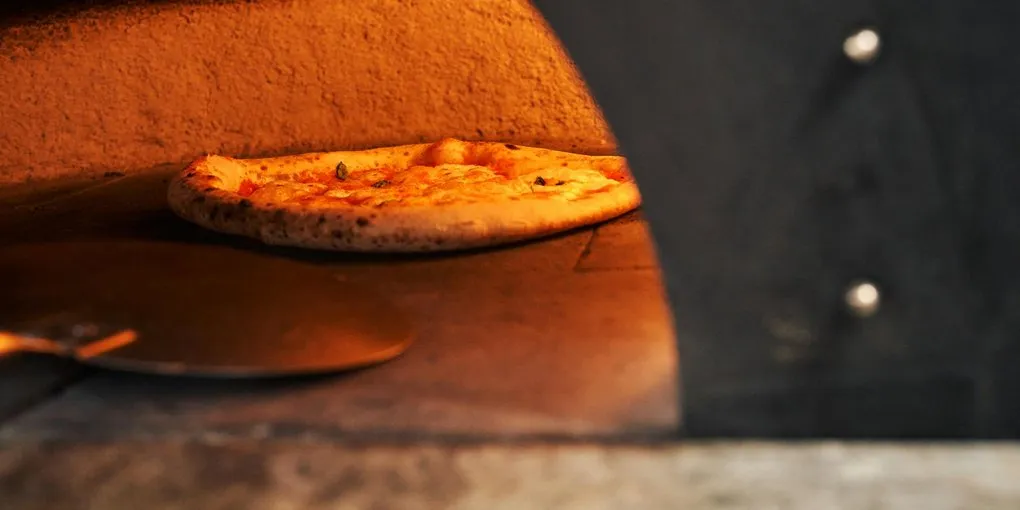
Your home oven at 500-550F takes 7-8 minutes to bake a pizza. A professional Neapolitan oven running at 905F finishes in 60-90 seconds. That is not a minor difference. Thermal radiation follows the T-to-the-fourth power law, which means a 400C oven produces 16 times more radiant heat than a 200C oven. You are not working with a slightly cooler pizza oven. You are working with fundamentally different physics.
The two-stage bake was developed to solve this mismatch. It decouples the crust from the cheese, giving each what it needs.
The Timing Mismatch Problem
Three things go wrong during a 7-8 minute bake that never happen in a 60-second bake.
More moisture loss. Seven minutes at 550F drives off far more water than 90 seconds at 905F. This is the fundamental reason home oven dough needs 65-70% hydration rather than the 55-60% used in wood-fired Neapolitan ovens. Without the extra water, your crust dries into a cracker.
Cheese overcooking. Fresh mozzarella is roughly 62-65% water. Drop it on a pizza at the start of a 7-minute bake and it melts, releases its water, begins to brown, then continues browning into oil separation and eventually burning. At 60 seconds, it barely finishes melting.
Slower Maillard browning on the crust. Your oven ceiling does not radiate nearly as much heat as a 430C refractory brick dome. The crust needs time to develop color. But by the time the crust is golden, the cheese has been cooking for the entire duration and has gone too far.
The result is the worst possible outcome: overcooked cheese sitting on undercooked crust. Cranking up the heat does not fix it. Putting the pizza on a lower rack does not fix it. The only structural fix is separating the two stages.
Iacopelli’s Two-Stage Method
This is the most proven home oven method, developed by a 4th-generation Neapolitan Maestro Pizzaiolo who understood the physics of what his viewers were dealing with.
Setup
- Baking steel on the top rack, positioned as close to the upper element as you can manage while still fitting a pizza peel underneath.
- Preheat oven at broil/max for 30-40 minutes after the oven reaches its target temperature. The oven beeps “ready” when the air hits target, but the steel takes much longer. Home oven air heats in 21 seconds while the walls and baking surfaces lag significantly. At 22 minutes, cold spots still remained on baking surfaces.
- Switch to static bake at max (250C/482F) just before launching.
Stage 1: Crust
Launch the pizza with sauce and olive oil only. No cheese. No toppings. Bake until the crust is golden and puffed.
What you are doing here is giving the dough a head start. The crust sets and develops structure, the sauce reduces slightly, and the starch gelatinizes without interference from a cool, wet cheese layer sitting on top. This directly addresses what Myhrvold calls the “gel layer” problem — the white, gummy line of undercooked starch between crust and sauce that forms when moisture from toppings condenses on rising dough.
Stage 2: Cheese and Toppings
Remove the pizza. Brush olive oil on the crust edges for color and flavor. Add mozzarella and any other toppings. Return to the oven until the cheese melts and bubbles.
The cheese now gets exactly the amount of heat it needs — enough to melt and spot-brown, but not so much that it overcooks. The crust underneath is already set, so the moisture from the cheese cannot create a gummy layer.
The 7-Minute Rule
Iacopelli is emphatic about total time: 7 minutes maximum across both stages. Beyond that threshold, pizza transitions from soft-and-crunchy to dry-and-hard. The water loss accelerates as the bake continues, and there is no recovering moisture once it is gone.
The Fresh Mozzarella Problem
Fresh mozzarella (fior di latte) contains roughly 65% water, while mozzarella di bufala runs 62-64%. In a 7-minute home oven bake, that moisture has nowhere to go except onto your pizza.
Cut the mozzarella the night before and drain it in a colander in the refrigerator. Overnight draining removes enough surface moisture that the cheese melts cleanly without flooding the base. This is not optional. It is the difference between a pizza with clean, spotted mozzarella and a pizza with a soggy center and separated cheese oil.
For low-moisture mozzarella (the block kind used for New York style), draining is not necessary. It contains less water by definition and melts differently — slower, more evenly, and with less weeping.
Forkish’s Steel + Broiler Protocol
Forkish built all of his home pizza recipes around a different approach that achieves similar results through continuous heat management rather than staged topping.
Setup
- Baking steel on the upper rack, 6-8 inches below the broiler element.
- Preheat oven to maximum (500-550F) for 45-60 minutes.
- Switch to broiler on high just before launching.
The Bake
- Launch pizza onto the preheated steel (fully topped).
- Bake 5-6 minutes with the broiler on high.
- Rotate 180 degrees with a metal peel.
- Finish 1-2 more minutes until the cornicione has dark brown char spots and the cheese is fully melted but not burned.
Total bake time: 7-8 minutes.
The FWSY Refinement
Forkish’s Flour Water Salt Yeast protocol adds a two-phase heat manipulation: after preheating at max for 30 minutes, switch to broil for 5 minutes to superheat the steel surface. Then switch back to bake at 525F, load the pizza, bake 5 minutes, and switch to broil for the final 2-3 minutes. This gives you a hotter steel at launch (better bottom char) and a broiler finish for top spotting.
The advantage of this method is simplicity — one load, no removing and reloading. The disadvantage is that it requires close monitoring during the broiler phase. The top can go from perfectly spotted to burnt in under 30 seconds.
Electric Oven Workaround
Many electric ovens disable the broiler element when the thermostat reads the temperature as “hot enough.” The fix: preheat at 450F (below the thermostat’s trigger point), then switch to broil. The broiler coils will fire immediately because the oven’s sensor reads the temperature as below the broiler’s threshold.
Gemignani’s Two-Stone Rotation
This is the method Gemignani calls his “favorite discovery for home pizza.” It requires two baking surfaces but produces the crispest bottom of any home oven approach.
Setup
- Stone or steel on the upper-third rack.
- A second stone or steel on the bottom rack.
- Preheat at 500F for a full hour.
The Bake
- Start the pizza on the top surface. Bake 6 minutes.
- Transfer to the bottom surface using a peel. Rotate 180 degrees during the transfer.
- Finish 5 more minutes on the bottom surface.
Total: approximately 11 minutes.
Why It Works
The bottom surface has been sitting at 500F undisturbed for the entire first bake. When you transfer the pizza to this fresh hot surface, it delivers a second wave of conductive heat that crisps the bottom dramatically. Between pizzas, the top surface recovers its temperature while you bake on the bottom, and vice versa. This rotation lets you bake continuous batches without quality loss.
Gemignani’s rules for this method: brush stones clean with a dry heatproof brush and towel between pizzas. Never use water or a damp towel on hot stones — thermal shock risk. Always return the pizza to the center of the stone after rotating, because edges near the oven walls bake unevenly.
The Contrast: Portable Oven Baking
It helps to understand why none of this is necessary in a portable oven running at 800-950F.
At those temperatures, the total bake takes 60-90 seconds. The crust base sets in 15-20 seconds — fast enough that you cannot even turn the pizza before that point without tearing it. Cheese melts in roughly the same window. The side facing the flame chars within 20-30 seconds, which is why turning every 15-20 seconds is mandatory.
In that 60-90 second window, moisture loss is minimal. The crust retains most of its original water, which is why portable oven doughs use lower hydration (60-62%) compared to home oven doughs (65-70%). Everything finishes together because everything happens fast.
The home oven’s 7-8 minute bake stretches those same processes across a much longer timeline, and different components finish at different rates. That is the mismatch the two-stage approach corrects.
Matching Hydration to Your Method
Regardless of which method you use, your dough hydration must match your bake time:
| Oven Type | Temp Range | Bake Time | Hydration |
|---|---|---|---|
| Portable (800-950F) | 60-90 sec | Low moisture loss | 60-62% |
| Home oven + steel | 500-550F | 7-8 min | 65-70% |
| Home oven pan pizza | 500-550F | 12-15 min | 70-75% |
The pattern is direct: longer bake equals more moisture loss equals higher starting hydration to compensate. Using a wood-fired hydration (58%) in a home oven produces stiff, dry crust. Using a home oven hydration (70%) in a portable oven turns the dough into soup when you try to turn it.
Flour Selection for Longer Bakes
Italian 00 flour (W220-270) was designed for 800F+ ovens where the bake finishes before structural weakness matters. In a 7-8 minute bake, the gluten network bears load much longer. Bread flour’s stronger scaffolding (13-14% protein, W300+) outperforms.
Additionally, Italian 00 is typically unmalted, because Maillard browning happens nearly instantly at 800F+. In a home oven at 500-550F, unmalted 00 produces pale, anemic-looking crusts. The fix: use Caputo Americana (which includes malt), Caputo Cuoco/red bag (W300-320, stronger gluten for longer bakes), or add 0.5-2% diastatic malt powder to any 00 dough. Gemignani uses 2% diastatic malt as standard in most of his formulas.
Practical Tips Across All Methods
Use an infrared thermometer. Your oven’s built-in gauge reads air temperature. The baking surface temperature is what actually cooks your pizza, and it can be 50-100F different from the air reading. Check the center of your steel before every pizza.
Rest on a cooling rack. After pulling the pizza, place it on a wire cooling rack for 30-60 seconds before moving to a cutting board. Steam from the hot dough condenses against a flat surface and turns a crisp bottom soggy within seconds. The cooling rack lets steam escape downward.
Never put cold dough in a hot oven. This is Gemignani’s Commandment #5. Dough must warm to 60-65F before baking. Cold dough produces oversized bubbles in the first 2-3 minutes of baking that displace toppings and create uneven thickness. Check with an instant-read thermometer.
Treat the first pizza as calibration. Even with precise preheating, your first pizza of the session reveals your oven’s actual behavior: hot spots, cold corners, how quickly the broiler chars. Adjust positioning, timing, and rotation for pizzas two through five based on what you learn from pizza one.
The Bottom Line
The home oven is not a limitation to apologize for. It is a different tool that requires different technique. The two-stage approach — whether Iacopelli’s remove-and-retop method, Forkish’s broiler cycling, or Gemignani’s two-stone rotation — works because it respects the physics of what a 500-550F oven actually does to dough, sauce, and cheese over 7-8 minutes. Stop fighting the longer bake time and start using it.
Some links in this article are affiliate links. If you purchase through them, we earn a small commission at no extra cost to you. We only recommend products we genuinely use and trust.
Frequently Asked Questions
- Why does my cheese burn before my crust is done in a home oven?
- Your home oven at 500-550F takes 7-8 minutes to bake a pizza, while a professional Neapolitan oven finishes in 60-90 seconds. In that extended time, cheese melts, releases moisture, browns, and eventually burns before the crust has finished developing structure. The two-stage bake solves this by pre-baking the crust with sauce only, then adding cheese for a shorter second stage.
- Do I need to drain fresh mozzarella before using it on pizza?
- Yes, if you are using fresh mozzarella (fior di latte) in a home oven. Fresh mozzarella contains roughly 65% water. In a 7-minute bake, that moisture pools on the pizza and creates a soggy center. Cut it the night before and drain in a colander in the refrigerator. Low-moisture block mozzarella does not need draining.
- How long should I preheat my baking steel?
- Minimum 30-40 minutes at broil/max after the oven reaches its target temperature. Home oven air heats in 21 seconds, but the steel takes much longer -- at 22 minutes, cold spots can still persist on baking surfaces. Use an infrared thermometer to verify the steel center is within 5-9F of your target before launching.
- Can I use a pizza stone instead of a steel for the two-stage bake?
- Yes, but steel performs better. Steel conducts heat 18-20 times faster than cordierite stone, resulting in better bottom char and more even browning. Both reach the same equilibrium temperature, but steel transfers stored heat into dough faster on contact. If you use stone, allow extra preheat time.
- What hydration should my dough be for home oven pizza?
- For a standard home oven bake on steel (7-8 minutes at 500-550F), target 65-70% hydration. The longer bake drives off significantly more moisture than a 60-second portable oven bake, so you need more water in the dough to compensate. Using a wood-fired hydration of 55-60% in a home oven produces stiff, dry crust.
- Why is 7 minutes the maximum bake time?
- Beyond 7 minutes, pizza transitions from soft-and-crunchy to dry-and-hard. Moisture loss accelerates as the bake continues, and once water is driven off it cannot be recovered. Iacopelli is emphatic about this threshold across both stages of his two-stage method.
- Should I use 00 flour in my home oven?
- Standard Italian 00 flour (W220-270) underperforms in home ovens for two reasons: its gluten network is too weak for a 7-8 minute bake, and it lacks malt so crusts come out pale at 500-550F. Use Caputo Cuoco (red bag, W300-320), Caputo Americana (includes malt), bread flour at 13-14% protein, or add 0.5-2% diastatic malt powder to any 00 dough.