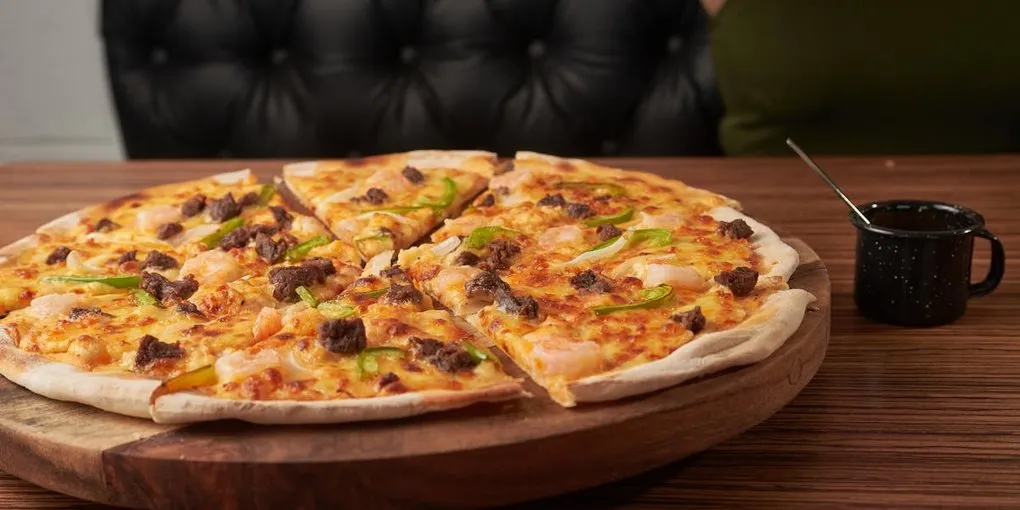
New Haven, Connecticut has arguably the best pizza in America, and most people outside the Northeast have never heard of it. Not New York. Not Chicago. A small stretch of Wooster Street in a mid-sized Connecticut city where three pizzerias — all within walking distance of each other — have been turning out coal-fired pies since the 1920s and 30s.
The style is called apizza (pronounced “ah-BEETS”), and it breaks almost every rule that American pizza culture takes for granted. No mozzarella by default. Thin, dense, heavily charred crust. Pecorino Romano instead of the low-moisture mozz you’d expect. Walk into Frank Pepe’s and order a “plain” pie, and you get tomato sauce and grated pecorino. That’s it. Mozzarella costs extra — and when you add it, the locals call it “mootz.”
This guide covers what makes apizza different, why it matters historically, and how to reproduce it in a home oven using a baking steel and the broiler method.
What Makes Apizza Different
Apizza diverges from other American pizza styles in four fundamental ways.
No mozzarella on the default pie. This is the single biggest shock for outsiders. A “plain” New Haven pie is tomato sauce, grated pecorino Romano, and maybe a dusting of dried oregano. The cheese is a seasoning, not a blanket. Mozzarella is an add-on — you specifically request it, and it gets its own name on the menu.
Thin, dense, dry crust. Where Neapolitan pizza aims for a soft, puffy cornicione and a tender center, apizza crust is thin throughout, crackling-crisp, with minimal rise at the rim. The dough uses very low salt — the opposite of Neapolitan’s typical 3% — and lower hydration, producing a crust that’s compact and dry rather than airy and moist.
Heavy char. The signature look of apizza is aggressive, near-black charring across the bottom and rim. This isn’t accidental and it’s not a sign of overcooking. Coal ovens running at roughly 600F produce a specific style of char that’s bitter at the edges but adds deep, smoky complexity when distributed across the crust. Apizza without char isn’t apizza.
Coal-fired ovens. The original New Haven pizzerias all use coal, not wood. Coal burns hotter and more consistently than wood, producing the intense radiant heat that creates the characteristic char. The oven temperature — around 315C/600F — is actually achievable in a home oven, which makes apizza one of the more reproducible regional styles for home bakers.
The Ancestral Pizza Theory
Myhrvold’s research suggests New Haven apizza may be the closest surviving relative of the original 19th-century Neapolitan street pizza — the pizza that existed before tomato-and-mozzarella became the assumed default.
Early Neapolitan pizza was a poor person’s food, sold from street carts. Mozzarella was expensive. The original pies were topped with whatever was cheap and available: lard, garlic, anchovies, maybe some hard grating cheese. Tomato sauce with a dusting of pecorino on a thin, charred crust — New Haven’s “plain” pie — maps almost exactly onto what those street vendors were selling.
The Italian immigrants who brought pizza to New Haven in the early 1900s may have been reproducing the pizza they actually grew up eating, before the Margherita myth and the mozzarella-tomato-basil standard took over. When Frank Pepe opened on Wooster Street in 1925, he wasn’t making a conscious decision to omit mozzarella. He was making the pizza he knew.
Whether or not the theory is precisely correct, it reframes apizza from “weird regional variation” to “possible original form.”
The Big Three — And the Old-School Problem
Three pizzerias define New Haven apizza, all on or near Wooster Street:
Frank Pepe’s Pizzeria Napoletana (1925). The original. Pepe emigrated from Maiori on the Amalfi Coast and started baking in coal-fired ovens on Wooster Street. The white clam pie, introduced later, became Pepe’s signature and arguably the most famous single pizza in Connecticut.
Modern Apizza (1934). Slightly off Wooster Street, Modern runs a bit hotter and produces a thinner, crispier pie than the other two. The Italian Bomb — sausage, pepperoni, bacon, mushroom, onion, pepper, garlic — is the signature order.
Sally’s Apizza (1938). Opened by Salvatore Consiglio, Frank Pepe’s nephew, literally down the street. Sally’s is known for a slightly more charred, more intensely flavored pie, and the tomato pie (plain, no cheese) is often considered the best expression of the style.
Now, here’s the uncomfortable truth. Myhrvold’s extensive testing across American pizzerias produced a finding he calls “old-school disease”: famous old pizzerias consistently produce worse pizza than newer innovators. This pattern holds in Naples, New York, and New Haven alike. The line “We haven’t changed anything from grandfather’s original recipe” gets treated as a badge of honor, but it means they haven’t improved anything either. Equipment degrades. Ovens develop hot spots. Recipes that were groundbreaking in 1925 get surpassed by operators who study the science and iterate.
This doesn’t mean Pepe’s or Sally’s make bad pizza. They’re good. But if you visit expecting a religious experience because of the name, you may find yourself underwhelmed compared to what a skilled modern pizzaiolo is doing with better technique.
For home bakers, this is encouraging. You’re not trying to recreate a specific legendary pizzeria. You’re trying to nail the style — and the style is well-defined and achievable.
Apizza Dough
This dough is deliberately different from Neapolitan dough. Lower hydration for a denser, crispier crumb. Very low salt to match the authentic apizza profile. High-protein bread flour for structure in an ultra-thin crust.
| Ingredient | Amount | Baker’s % |
|---|---|---|
| Bread flour (13-14% protein) | 500g | 100% |
| Water (75-80F) | 305g | 61% |
| Fine sea salt | 7.5g | 1.5% |
| Instant dry yeast (IDY) | 1.5g | 0.3% |
| Olive oil | 10g | 2% |
Yield: 4 dough balls at approximately 205g each, stretched to 12-13 inches.
Why bread flour: Apizza crust gets stretched very thin without tearing. High-protein bread flour (King Arthur Bread Flour at 12.7%, or a high-gluten flour at 13-14%) provides the tensile strength for an ultra-thin stretch. Italian 00 flour is too soft for this application — you’d get tears and blowouts at these dimensions.
Why low salt: Authentic apizza dough is remarkably low in salt. At 1.5%, the crust tastes almost plain on its own — the pecorino and sauce do the seasoning. For the white clam pie, the clam juices deliver the salinity that the crust deliberately lacks. If 1.5% feels too austere after your first bake, push to 2% — but try it low first. The restraint is the character.
Why 61% hydration: Apizza crust is thin, dense, and crispy — the opposite of high-hydration Neapolitan. Lower hydration in the 60-62% range produces a tighter crumb and a crust that snaps rather than folds.
Method
-
Mix: Combine flour and salt in a large bowl. Add water and olive oil. Mix by hand until no dry flour remains, about 2 minutes. The dough will be noticeably stiffer than Neapolitan dough — that’s correct.
-
Add yeast: Sprinkle IDY over the dough. Fold and pinch for 30 seconds to incorporate.
-
Knead: Turn out onto an unfloured surface. Knead 5-6 minutes until smooth and slightly tacky but not sticky. The dough should pass the windowpane test — a small piece stretched thin enough to see light through without tearing.
-
Bulk ferment: Place in a lightly oiled container, cover. Room temperature for 1.5-2 hours until roughly doubled.
-
Ball: Divide into 4 dough balls at approximately 205g each. Tuck edges under to form tight, smooth balls. Place in lightly oiled individual containers.
-
Cold ferment: Refrigerate 24-48 hours. This is not optional — the cold ferment develops the complex, slightly tangy flavor that defines good apizza dough. The low yeast amount means the dough won’t over-proof during this window.
-
Temper: Remove from fridge 1.5-2 hours before baking. Target 60-65F internal before stretching.
Sauce and Toppings: The Three Classic Orders
Apizza sauce is dead simple. Crushed San Marzano tomatoes (Bianco DiNapoli or Strianese), a pinch of salt, a small pinch of dried oregano. No cooking. Run the tomatoes through a food mill on medium screen, or crush by hand. Use the sauce thin — you should see dough through it in spots.
Plain (tomato pie): Sauce, grated pecorino Romano, dried oregano, drizzle of olive oil. No mozzarella. This is the default. The baseline that defines the style.
Mootz (with mozzarella): Sauce, pecorino Romano, plus fresh mozzarella torn into pieces. “Mootz” is local shorthand for mozzarella. This is what most out-of-towners order, thinking they’re ordering “regular” pizza. It’s excellent, but it’s not the purest expression of the style.
White clam pie: No tomato sauce. Olive oil base, fresh-shucked littleneck clams (or good-quality canned whole clams, well-drained), thinly sliced garlic, grated pecorino Romano, dried oregano. Finish with fresh parsley and black pepper after baking.
The White Clam Pie — Why It Works
The white clam pie deserves its own explanation because the pairing isn’t obvious until you understand the crust it sits on.
Myhrvold describes the concept as “actually quite brilliant,” and the reasoning holds up. That hard, dry, saltless, burnt crust is the ideal platform for briny, delicate clams. The clam juices provide exactly the moisture and salt that the crust lacks. A softer, wetter, more heavily seasoned crust would compete with the clams rather than support them. The aggressive char provides the bitter, smoky counterpoint. The pecorino provides concentrated umami. The garlic and oil tie everything together.
It’s a dish that could only have emerged from this specific style of pizza. Put fresh clams on a floppy Neapolitan crust or a thick Sicilian slab and the relationship falls apart. The crust makes the clams better and the clams make the crust better.
If using canned clams, drain them thoroughly but reserve the juice. Brush some clam juice onto the stretched dough before adding toppings — this delivers the briny moisture that fresh clams release naturally during baking. Fresh littleneck clams are better — shuck them raw, chop roughly, and distribute with their juice.
Home Oven Technique: Steel + Broiler for 600F Char
Apizza’s roughly 600F coal oven temperature is within striking distance of a home oven. The steel + broiler method gets you there.
Setup
- Place your baking steel on the upper rack, 6-8 inches below the broiler element. Steel conducts heat 18-20x faster than stone — for the aggressive bottom char that defines apizza, steel is the right surface.
- Preheat oven to 550F (or maximum) for a full 60 minutes. Do not cheat this.
- Switch to broil 5 minutes before launching the first pizza.
Stretch and Launch
Stretch thinner than Neapolitan — aim for 12-13 inches from a 205g dough ball. The center should be translucent-thin. There’s no puffy cornicione to preserve; the rim is thin too, just slightly thicker than the center.
Dust a wooden peel with bread flour or semolina. Place stretched dough on peel, shake to confirm it slides. Sauce and top immediately — thin dough sticks to peels fast.
Bake
-
Launch and bake: 7-8 minutes total. Rotate the pizza 180 degrees at the halfway point if your broiler has hot spots.
-
Push the char. This is the hardest mental adjustment for home bakers. Apizza should be darker than you think is right. The rim should have black spots. The bottom should be deeply browned to charred in spots. If it looks like “normal” pizza, it’s underdone by apizza standards.
-
Between pizzas: Crank back to max or broil for 3-5 minutes. The steel needs to recover heat after each bake.
What to Expect
The crust will be crisp, crackly, and dense — nothing like the soft, foldable center of a Neapolitan pie. The pecorino will be slightly browned and fragrant. The char will be aggressive. The overall effect is more austere than mozzarella-heavy American pizza — drier, sharper, with the tomato and pecorino doing more work.
The white clam pie will be the revelation. The clam juices soak into the dry crust during baking, creating pockets of briny moisture in an otherwise crisp shell. It’s a completely different eating experience from any other pizza you’ll make at home.
Tips
-
Pecorino Romano quality matters. Buy a wedge and grate it yourself. Pre-grated pecorino is dry and flavorless by comparison. Locatelli is the standard brand; genuine imported pecorino Romano (DOP) is sharply salty and tangy.
-
Don’t fear the char. Home bakers consistently undershoot on apizza char. If your first attempt looks like a normal pizza, leave the next one in 60-90 seconds longer. The line between “beautifully charred apizza” and “burnt” is wider than you think.
-
The dough will feel different. At 61% hydration, this dough is notably stiffer and less extensible than Neapolitan dough. It stretches by hand but resists more. Be patient — let the gluten relax if it springs back. Rest it for 5 minutes and try again.
-
No cornmeal on the peel. Use the same flour as the dough for dusting, or semolina. Cornmeal scorches and tastes bitter at these temperatures.
Sources: Myhrvold & Migoya, Modernist Pizza (New Haven apizza analysis pp. 258-264, old-school disease pp. 148-152, baking physics); Forkish, Flour Water Salt Yeast (steel + broiler method).
Frequently Asked Questions
- What is apizza?
- Apizza (pronounced 'ah-BEETS') is the pizza style native to New Haven, Connecticut, originating in the 1920s with Italian immigrants from the Naples region. It features a thin, dense, dry crust baked in coal-fired ovens at around 315C/600F, producing heavy charring across the bottom and rim. The default 'plain' pie has no mozzarella -- just tomato sauce, grated pecorino Romano, and olive oil. The three foundational pizzerias are Frank Pepe's (1925), Modern Apizza (1934), and Sally's Apizza (1938), all on or near Wooster Street.
- Why is there no mozzarella on a plain apizza?
- The default New Haven pie predates the American expectation that pizza means melted mozzarella. A 'plain' pie at Frank Pepe's or Sally's is tomato sauce, grated pecorino Romano, and olive oil. Mozzarella is an add-on that locals call 'mootz,' and you specifically request it. The hard, salty pecorino stands up to the aggressively charred crust in a way that mild mozzarella doesn't match. If Myhrvold's ancestral theory is correct, this is actually how pizza was originally eaten in 19th-century Naples -- before mozzarella became the default.
- What is a tomato pie versus apizza?
- In New Haven, 'tomato pie' is simply the plain apizza -- tomato sauce, grated pecorino Romano, olive oil, no mozzarella. It's the default order, the baseline pie. This is different from the Trenton-style tomato pie (a thick-crust, cheese-under-sauce pizza) or the generic use of 'tomato pie' in other parts of the Northeast.
- Can I make apizza without a coal oven?
- Yes. The gap between a coal oven (about 315C/600F) and a home oven (about 290C/550F) is significant but bridgeable. A baking steel positioned 6-8 inches below the broiler element, preheated for a full 60 minutes at maximum temperature, gets you close. Steel conducts heat 18-20x faster than stone, which handles the bottom char. The broiler handles top and rim charring. Total bake time is 7-8 minutes.
- What is mootz?
- 'Mootz' is New Haven shorthand for mozzarella -- derived from the Italian pronunciation. When you order a pie with mozzarella at a New Haven pizzeria, you're ordering 'mootz.' It's an add-on, not the default. A plain pie comes with tomato sauce and grated pecorino Romano only. Adding mootz gives you both cheeses.
- What flour works best for apizza dough?
- Bread flour at 13-14% protein, not Italian 00 flour. Apizza crust gets stretched very thin and needs to survive a 7-8 minute bake at high heat without tearing. King Arthur Bread Flour (12.7% protein) is a reliable starting point. A high-gluten flour in the 13-14% range is even better for the crispiest, most structurally sound crust.
- Is New Haven pizza better than New York pizza?
- They are different styles solving different problems. New Haven apizza is thinner, drier, more aggressively charred, lower in salt, and defaults to pecorino. New York pizza is wider, foldable, higher in salt, and built around mozzarella. Myhrvold's research shows that 'old-school disease' affects both cities -- the most famous pizzerias don't necessarily produce the best pizza anymore. Try both styles made well and decide for yourself.