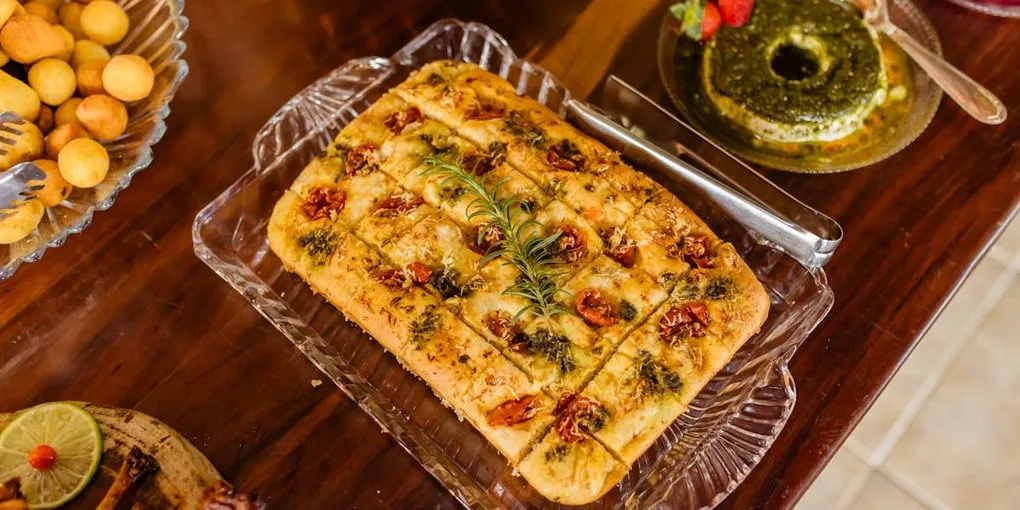
Focaccia is almost certainly the oldest form of pizza. Before Margherita, before the tomato even arrived in Europe, flatbreads pressed with oil and topped with whatever was available were being pulled from ovens across the Mediterranean. Nathan Myhrvold’s research traces the lineage back centuries, making focaccia less a cousin of pizza and more its direct ancestor.
The good news for home bakers: focaccia pizza is one of the most forgiving styles you can make. Myhrvold’s testing of his master focaccia recipe at 86.87% hydration found that varying the water content by plus or minus 10% produced “no meaningful differences” in the finished product. Try that with a Neapolitan dough and you will have either modeling clay or a puddle.
Here is how to make focaccia pizza that is genuinely excellent — dimpled, olive-oil-soaked, herb-fragrant, with a crumb that is open and airy without being hollow.
Why Focaccia Is the Easiest Pizza You Can Make
Every characteristic that makes other pizza styles difficult works in focaccia’s favor.
High hydration is the point, not a problem. Most pizza doughs target 60-70% hydration, and anything above 70% becomes progressively harder to handle. Focaccia dough sits at 80-87% hydration. You do not need to shape it into a round, toss it, or transfer it with a peel. You pour it into an oiled pan and let it spread.
No peel skills required. The dough goes straight into the pan it bakes in. This eliminates the most common failure point for home pizza makers — the launch.
Pan pizza forgiveness. Forkish specifically calls out pan pizza as having “fewer failure points than hearth pizzas” — you spread dough on a room-temperature pan on the countertop and bake. Focaccia takes this a step further because there is no complex topping sequence to execute before the dough sticks to the peel.
The oven temperature is standard. While Neapolitan demands 900F and New York works best with a steel at 550F, focaccia bakes at 425-450F — a temperature every home oven reaches without complaint. Myhrvold’s best-oven recommendation for focaccia is a pizza deck or impinger, explicitly NOT wood-fired.
The Dough: Gemignani’s Sicilian Base
Tony Gemignani uses his Sicilian dough formula for focaccia, which makes sense — both are high-hydration pan doughs built for a similar baking environment. Gemignani specifies the version without a poolish starter for focaccia specifically, though the starter version works equally well and adds complexity.
The Sicilian dough runs at 70% total hydration, using 13-14% protein flour (All Trumps high-gluten or Power Flour). For pure focaccia, Gemignani calls for 35 ounces of Sicilian dough in an oiled pan.
If you are working from Myhrvold’s master focaccia formula, the numbers are different: 86.87% hydration, 4.04% fat, and General Mills All Trumps high-gluten flour as the recommended choice.
Why high-gluten flour? At hydration levels above 75%, you need strong protein to maintain any structural integrity at all. All Trumps at 14.2% protein provides the scaffolding that keeps ultra-wet dough from becoming a batter. This is the same reason Gemignani insists on 12.5-14% protein for any long-fermented dough — weaker flour simply cannot withstand the enzymatic degradation that occurs over 24-48 hours.
The Baker’s Percentages
Here is the Sicilian dough formula with starter, from Gemignani’s complete baker’s percentages chart:
| Ingredient | Baker’s % | For 1.1kg dough |
|---|---|---|
| High-gluten flour (13-14% protein) | 100% | 578g |
| Water (total) | 66.8% | 386g |
| Poolish starter | 20% | 116g |
| Diastatic malt | 2.2% | 13g |
| Fine sea salt | 2.2% | 13g |
| EVOO | 1.2% | 7g |
| Active dry yeast | 0.5% | 3g |
The poolish should be prepared 18 hours before dough day: 47g flour + 47g water + 0.12g active dry yeast, fermented at room temperature, then cooled 30 minutes in the fridge.
Mixing and Fermentation
This dough is too wet to knead conventionally. Gemignani specifies the stretch-and-fold method instead. Mix the ingredients (oil added last, per Gemignani’s iron rule about fat timing), then use stretch-and-fold sets at 30-minute intervals during the first two hours.
Follow Gemignani’s two-phase cold ferment for the best results: 24 hours bulk in the fridge (expect only 25-50% rise, not a full double), then degas briefly in a mixer at lowest speed for 30 seconds, reball, and refrigerate another 24 hours. This 24+24 method “baked up lighter, crispier, and more flavorful, with a stronger structure” compared to a single 48-hour bulk ferment.
The Pan Setup
Oil the pan generously. Gemignani uses pure olive oil (not EVOO) for panning because EVOO has a lower smoke point and can burn during prolonged oven contact at 450F. For focaccia, the oil on the bottom of the pan is not just anti-stick — it fries the underside of the dough during baking, creating the golden, crispy base that separates good focaccia from mediocre bread.
Press the dough into the pan in stages. Gemignani’s Sicilian method calls for pushing the dough out, resting 30 minutes, then pushing again to the corners. The dough will resist at first. Let it relax and it will cooperate.
The Focaccia Build
Here is where focaccia diverges from standard Sicilian pizza. Gemignani’s focaccia method:
- 35 ounces of Sicilian dough in an oiled sheet pan
- Press olives into the surface — push them in so they are partially submerged. They will roast in the oven, concentrating their flavor
- Bake at 450F for 15 minutes until golden and puffed
- Finish immediately after baking with: EVOO, garlic, rosemary, red pepper flakes, honey, and fleur de sel
That finishing combination deserves attention. The honey is not sweetness for its own sake — it plays off the salt and red pepper, creating the kind of salty-sweet-spicy interplay that makes you reach for another piece before you have finished chewing the first. The fleur de sel provides textural crunch that fine sea salt cannot.
Baking Temperature and Surface
Focaccia bakes at 425-450F, which places it firmly in home oven territory. Myhrvold’s oven recommendation chart ranks pizza deck and impinger ovens as best for focaccia, with wood-fired and gas-fired ovens explicitly listed as “not recommended.” The reason is straightforward: focaccia needs even, moderate heat from all directions. The aggressive radiant heat of a wood-fired oven chars the top before the thick interior cooks through.
For home ovens, place the pan on the middle or lower-middle rack. If your oven has a convection setting, use it — the air circulation helps develop an even golden crust on the exposed surface. Unlike hearth pizza, there is no need for a steel or stone underneath the pan, though placing one on a lower rack as a heat sink can stabilize temperature during the bake.
Preheat for at least 30 minutes. This is a thick dough that needs consistent heat, and the oven walls need to be fully saturated — the “ready” beep on most home ovens indicates the air is hot but the walls are nowhere close.
The Ciabatta Variant
Gemignani also produces ciabatta from the same Sicilian dough base, with a few adjustments:
- 20 ounces of Sicilian dough WITH starter (the starter version adds complexity the bread benefits from)
- Slipper-fold technique: fold the dough like folding a letter, creating layers that translate to the characteristic open crumb
- Score the surface with a razor before baking — this controls where the bread splits during oven spring
- Bake at 425F (25 degrees lower than focaccia)
- Spray the loaf with water before and during the first few minutes of baking for a crispier crust
The lower temperature accommodates the thicker cross-section. The water spray is the opposite of what Myhrvold recommends for pizza — he tested steam injection and found it “harmful” for pizza, producing soft crust and reduced volume. But ciabatta is bread, not pizza, and bread benefits from surface moisture during the initial bake to delay crust formation and maximize oven spring.
Fat in the Dough: Why It Matters
Focaccia’s master recipe includes 4.04% fat. This is not high by pizza standards (deep-dish runs at 8.68%, Brazilian thin-crust at 9.76%), but it serves a specific purpose.
Myhrvold’s testing revealed a critical distinction between crystalline (solid) fats and liquid oils in dough. Solid fats — lard, butter, shortening — allow gas bubbles to expand more during baking because fat crystals physically adsorb onto bubble surfaces, preventing rupture. Liquid oils coat bubbles as a weak film that allows merging and rupture. At 1-5% solid fat, you get dramatically improved oven spring. Above 5%, any fat begins interfering with gluten development.
Focaccia traditionally uses EVOO (liquid oil), which means it sacrifices some potential volume for flavor. This is a reasonable tradeoff — focaccia is not trying to be a sourdough boule. If you wanted maximum rise, you could substitute a small portion of the oil with room-temperature butter. But the EVOO flavor after baking is central to what makes focaccia taste like focaccia.
One important note: EVOO loses its volatile flavor compounds when baked. The oil you mix into the dough provides fat functionality (moisture, texture, anti-sticking) but not much olive flavor. The olive flavor comes from the EVOO drizzled AFTER baking — this is why Gemignani’s finishing step is non-negotiable.
Hydration Tolerance: Why Focaccia Is So Forgiving
Myhrvold’s team tested every master recipe across a range of hydrations. The results for focaccia were remarkable: at the master hydration of 86.87%, adjusting up or down by 10 percentage points produced “no meaningful differences.” Compare that to Neapolitan, where a 5% swing takes you from “modeling clay” to “lost elasticity,” or New York, where plus or minus 10% makes the dough “hard to shape.”
The reason is structural. Focaccia is a thick pan dough supported on all sides by the pan walls. It does not need to hold its shape during shaping, launching, or turning. The pan does the structural work. The dough just needs to be wet enough to produce an open, airy crumb — and at 77-97% hydration, it consistently delivers.
This tolerance makes focaccia ideal for beginners. If your scale is slightly off, if your flour absorbs a bit more or less water than expected (a real variable — for every 1% increment in protein, water absorption increases by 1.5%), the finished product will still be excellent.
Toppings: Less Is More, But the Right Less
Focaccia pizza toppings follow the Neapolitan principle: quality over quantity. A few pressed olives, good olive oil, coarse salt, and fresh herbs will outperform a loaded sheet pan every time.
Traditional options that work beautifully on focaccia:
- Olives (pressed into the dough before baking) — Castelvetrano, Kalamata, or Gaeta
- Cherry tomatoes (halved, pressed in cut-side up) — they roast and concentrate during the bake
- Thinly sliced onions — caramelize against the dough surface
- Rosemary (fresh, pressed in before baking) — the stems anchor it so it does not blow off or burn
- Potato and rosemary — thinly sliced potato layered on top, classic Ligurian style
- Finishing only: flaky salt, fresh herbs, garlic, chili flakes, honey, high-quality EVOO
Avoid heavy toppings that release moisture. Fresh mozzarella on a 15-minute bake at 450F will weep water into the crumb. If you want cheese, use a grated hard cheese (Pecorino, Parmigiano) sprinkled in the last 3-4 minutes, or dollop ricotta cream after baking per Gemignani’s method — pipe it on after the pizza exits the oven, never before.
Timing and Serving
Focaccia is best within 30 minutes of baking. The crust goes from crisp to merely soft as it cools, and starch retrogradation begins almost immediately. Reheating helps temporarily, but a reheated focaccia stales again faster the second time.
Cut with a sharp knife or bench scraper. Scissors also work and are less likely to compress the crumb. Serve the finished pieces on a cutting board or cooling rack — not a plate, which traps steam and softens the bottom.
The Bottom Line
Focaccia pizza is the most forgiving, least equipment-dependent pizza you can make at home. The dough tolerates hydration swings that would ruin other styles. The baking temperature is standard. The pan eliminates peel anxiety. And Gemignani’s finishing combination of EVOO, garlic, rosemary, red pepper, honey, and fleur de sel transforms a simple flatbread into something that people will remember long after the meal.
If you are new to pizza making, start here. If you are experienced, make focaccia when you want something that takes minimal effort and delivers maximum satisfaction. It earned its place as the original pizza for a reason.
Frequently Asked Questions
- What hydration should focaccia dough be?
- Myhrvold's master focaccia recipe runs at 86.87% hydration, but testing showed that varying by plus or minus 10% produced no meaningful differences in the finished product. Gemignani's Sicilian base (which he uses for focaccia) runs at 70%. Either approach works -- focaccia is the most hydration-tolerant pizza style.
- What flour is best for focaccia pizza?
- High-gluten flour with 13-14% protein is recommended. Myhrvold specifically names General Mills All Trumps (14.2% protein), and Gemignani uses All Trumps or Power Flour for his Sicilian/focaccia doughs. The high protein provides structural support for the wet dough during its long fermentation.
- Can I make focaccia in a pizza oven like an Ooni or Roccbox?
- It is not recommended. Myhrvold's oven-to-style guide explicitly lists wood-fired and gas-fired pizza ovens as not recommended for focaccia. These ovens run too hot (800-950F) and deliver aggressive radiant heat that chars the top before the thick interior cooks through. A standard home oven at 425-450F is the ideal tool.
- Why does Gemignani add honey to focaccia after baking?
- The honey is part of a finishing combination (EVOO, garlic, rosemary, red pepper, honey, fleur de sel) applied immediately after baking. It creates a salty-sweet-spicy interplay. The honey would burn and become bitter if applied before baking at 450F.
- Should I use extra virgin olive oil in focaccia dough?
- You can, but it does not add much olive flavor. EVOO's volatile flavor compounds evaporate during baking. Cheaper pure olive oil is functionally equivalent when mixed into dough. Save the good EVOO for the finishing drizzle after baking -- that is where olive flavor actually comes through.
- How long does focaccia stay fresh?
- Focaccia is best within 30 minutes of baking. Starch retrogradation begins immediately as it cools, making the crumb progressively firmer. Reheating temporarily restores softness, but the focaccia will stale faster the second time around. For best results, bake just before serving.
- Can I use all-purpose flour for focaccia?
- Gemignani explicitly advises against all-purpose flour for most pizza styles, especially those with long fermentation. AP flour at 10-12% protein lacks the gluten strength to hold up during a 24-48 hour cold ferment. The dough will be slack and the crumb will be dense rather than open and airy.