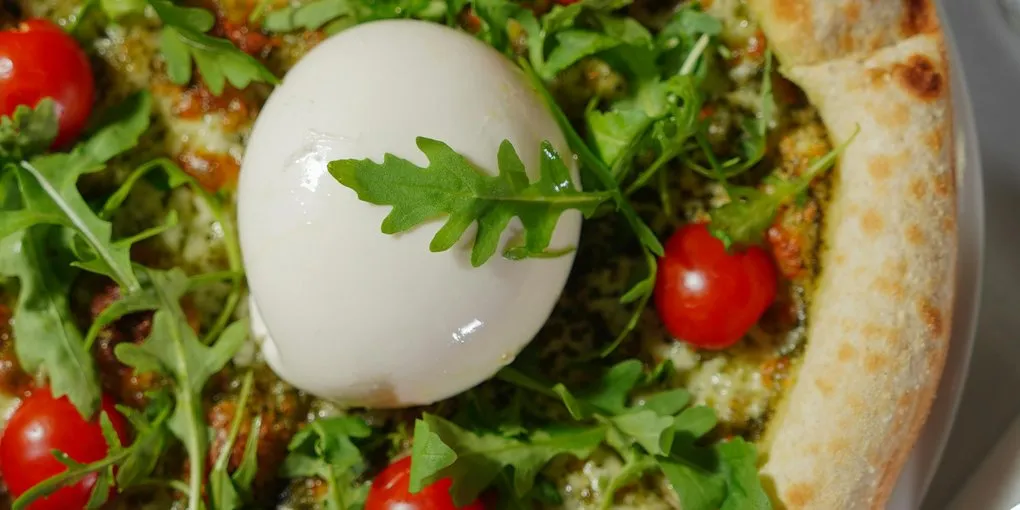
A whole burrata cut open over a hot pizza is one of the most photographed moments in restaurant cooking. The outer ball gives way, the runny stracciatella interior floods over the crust, and someone with a phone gets a fifteen-second video that does the work of an entire menu. The drama is real, and the cheese is genuinely good.
Then there is the question almost no one asks until they have spent a few weekends making this at home: why am I paying $14 for a single ball of burrata when the only part anyone actually eats is the cream filling, and that filling is sold separately, in a tub, for half the money?
Burrata and stracciatella are not two different cheeses. Stracciatella is what is inside a burrata. The mozzarella shell around it is a clever 1956 piece of food packaging from a single producer in Apulia, and once you understand the relationship, the choice between the two for pizza becomes much less mysterious — and quite a bit cheaper.
The 1956 Andria Invention
Burrata was invented in 1956 in Andria, in the Apulia region of southern Italy. The credit goes to Lorenzo Bianchino, working at the Piana Padura farm (also recorded as Masseria Bianchini, later Caseificio Chieppa). Like a lot of Italian cheese stories, the origin was practical: a heavy snowstorm hit the Murgia plateau that winter, transport routes shut down, and Bianchino had leftover pasta filata curd and fresh cream that needed to be used before they spoiled in an era when refrigerated transportation across southern Italy was unreliable.
His solution was to take a thin sheet of stretched mozzarella curd, form it into a small pouch, fill the pouch with shredded leftover curd mixed with cream, and tie the top closed. The Italian word for “buttery” is burroso, and the cheese got its name from how rich the cream filling tasted — like fresh butter trapped inside a mozzarella shell.
The genius of the design was preservation. The outer mozzarella ball acted as a sealed wrapper. As long as the burrata sat in its own brine, the cream inside stayed fresh longer than loose cream alone would have. The cheese was a way to ship a perishable product across a region that did not yet have cold-chain logistics. By the 1990s, refrigerated shipping had made the original problem irrelevant, but the cheese had become beloved on its own terms, and burrata started showing up in upscale restaurants well outside Apulia.
In November 2016, the European Union granted Burrata di Andria IGP status (Indicazione Geografica Protetta, the Italian Protected Geographical Indication). The designation is IGP rather than DOP — production must occur within Puglia and follow the registered method, but milk inputs do not have to originate inside the protected zone, which is the stricter DOP requirement. (The widely circulated “Burrata di Andria DOP” framing on US menus and import labels is technically wrong: it has always been IGP, and the application that resulted in the 2016 recognition was specifically for IGP status.)
Hand-tied burrata is genuinely labor-intensive — each ball is formed individually, filled by hand, knotted at the top, and packed in brine within a few days of consumption. A single 8-ounce ball typically retails between $8 and $15 at specialty grocers and Italian importers in the United States, depending on whether you are buying domestic (BelGioioso, Wisconsin-made) or imported (Italian IGP, often air-shipped).
What Stracciatella Actually Is
Here is where most home cooks get confused. The word “stracciatella” in Italian means “torn” or “shredded” — from the verb stracciare, to tear or rip. It refers to the way the filling is made: cooks pull a fresh mozzarella curd into long strips by hand, tear those strips into shorter pieces, and mix the pieces with heavy cream.
That mixture — torn curd plus fresh cream — is the inside of a burrata. It is not a separate cheese. When a burrata gets cut open and the contents flow out, you are eating stracciatella.
The name “stracciatella” is also used in Italian for two completely different foods: a Roman egg-drop soup (stracciatella alla romana) and a chocolate-shred ice cream flavor. Neither has anything to do with the cheese. This article is exclusively about the cheese stracciatella from Puglia — the cream-and-curd filling.
For most of its history, the cream-and-curd mixture inside a burrata was only available as the inside of a burrata. You had to buy the whole ball, slice it open, and eat what came out. About fifteen years ago, Italian and American producers started selling the filling on its own, packaged in small tubs without the mozzarella wrapper. Same recipe. Same texture. Same flavor. No knotted ball.
The result is that stracciatella is now sold as a standalone product — typically $8 to $10 for the same quantity of cheese-and-cream filling that would cost $12 to $15 hidden inside a burrata. You can find it at BelGioioso’s domestic version, Murray’s Cheese, Whole Foods, and an increasing number of grocery cheese counters carrying domestic and imported tubs. Once stracciatella started shipping by itself, the per-ounce math on burrata started looking different.
Why Both Are Strictly Post-Bake Toppings
The first rule of cooking with either burrata or stracciatella on pizza is the same: do not put them in the oven. Both cheeses are engineered to be eaten cold or at room temperature, and the cream-curd filling that defines them is destroyed by heat.
Fresh mozzarella, the kind you put on a Neapolitan pie, is roughly 60 to 65 percent water by weight. It bakes well because the casein protein network is intact — those proteins are aligned in long bundles from the pasta filata stretching process, and they hold their structure when water in the cheese turns to steam at the oven temperature. You get the bright white surface and the characteristic blistering of a properly baked pizza. This is covered in detail in our low-moisture vs fresh mozzarella comparison.
Burrata’s outer shell is the same kind of mozzarella, so technically the shell would survive heat. The problem is what is inside. Stracciatella is roughly 50 percent fresh cream and 50 percent torn mozzarella curd. The cream has somewhere around 35 percent fat. When that mixture hits a 500-degree oven for even a few minutes, the cream component breaks: butterfat separates and pools as oil, the casein proteins in the torn curd denature into a grainy texture, and the fresh aromatic notes of the cream burn off completely. What you get out of the oven is a greasy, broken topping that looks like a mistake. (Our companion piece on pre-cooking pizza toppings covers which toppings need heat treatment before they go on the pizza, and which — like burrata and stracciatella — must never see the oven at all.)
The Italian convention, and the convention every reputable pizzeria follows, is to add either cheese after the pizza comes out of the oven. The bake finishes, the pizza gets pulled, and within seconds the burrata gets torn open over the top or the stracciatella gets spooned across the surface. The residual heat from the crust is enough to soften the cheese without breaking it. By the time the slice gets to the table, the texture is exactly right — cool-warm and creamy against the still-hot crust.
This is also why burrata pizza often shows up on menus described as “served on” or “topped with” rather than “with” — the language is signaling that the cheese is a finishing element, not a baked one.
What Each Cheese Brings to a Pizza
Once you have decided to use one of these cheeses as a finishing topping, the next question is which one. This is where the practical case for stracciatella starts to get strong.
Burrata is theater. A whole ball lifted onto the center of a hot pizza, then sliced open with a knife so the runny interior cascades out, is unmistakably dramatic. Restaurants serve it this way for the visual moment, and at home it is a perfect dinner-party trick. Cost per pizza is $8 to $15, and you only get one piece of theater per ball — you cannot really cut a burrata into thirds and have it land the same way. The pour effect requires the whole intact pouch.
Stracciatella is practical. Spoon a tablespoon onto each slice’s worth of pizza, scatter it across the surface, and you get the same flavor profile — creamy, mildly tangy, milky-sweet — with much more even distribution. There is no single visual moment, but there is also no part of the pizza that gets nothing, which matters if you are sharing. Cost per pizza is $4 to $7 for the equivalent amount of cheese filling. You can portion an 8-ounce tub across two large pizzas with cream to spare.
Honest take: most home cooks who start with burrata end up switching to stracciatella once they understand the relationship. The drama is fun, but stracciatella is the same cheese without the upcharge for hand-tying a wrapper, and it portions across multiple pizzas in a way that burrata cannot.
The case for staying with burrata is mostly about presentation. If you are cooking for guests and want one centerpiece pizza with a single dramatic moment, burrata earns its keep. If you are making pizza on a regular Tuesday for two adults, the math points clearly at the tub.
Pairing Either With the Right Pizza
Both cheeses are mild and creamy, which means they need a pizza that gives them something to push against. Putting burrata or stracciatella on top of a pizza that is already loaded with melted cheese tends to read as one-dimensional — you get cream on cream, and the texture starts to feel like a cheese plate rather than a pizza. The full spectrum of which cheese belongs on which style is laid out in our best cheese for pizza guide.
The classic pairings work because they balance the creaminess with something contrasting:
White pizza with hot honey. A simple oiled-and-garlicked base, no tomato sauce, baked to leopard-spotted finish, then topped with burrata or stracciatella and finished with a thin drizzle of hot honey. The sweet-spicy honey cuts through the cream. This is the Brooklyn-pizzeria standard for a reason — see our hot honey pizza recipe and brand review for which bottles actually deliver.
Margherita with stracciatella spooned on top. A standard tomato-and-fresh-mozzarella pizza, baked normally, then a few spoonfuls of stracciatella scattered post-bake. The bright tomato acidity of the sauce meets the cream and they balance each other. The pizza already has the proper crust-cheese-sauce structure of a baked pie; the stracciatella becomes the luxurious finishing layer. The full canonical pizza is laid out in our Neapolitan margherita recipe.
Prosciutto and arugula. Bake a plain crust with light olive oil and a thin tomato base, finish with prosciutto strips, fresh arugula, a heavy drizzle of EVOO, and a torn burrata on top. The salt of the cured meat and the bitter pepper of the arugula keep the cream from becoming cloying.
Mortadella and pistachio. The current Italian and Italian-American trend pizza, where the dough is brushed with olive oil, baked plain, then finished with thin slices of mortadella, a ribbon of stracciatella across the top, and a generous scatter of crushed pistachios. The mortadella brings garlic-pepper-pork richness, the stracciatella brings cool cream, and the pistachios bring crunch and faint sweetness.
Simple anchovy and oregano. A plain tomato base, anchovies, dried oregano, a small drizzle of olive oil, baked traditional, then small dollops of stracciatella spaced across the top. The umami of the anchovies cuts the cream beautifully.
What does not work is doubling up the cream. A four-cheese pizza already loaded with mozzarella, fontina, gorgonzola, and parmesan does not get better when you add burrata. The stretchy, fatty, melted-cheese flavor profile is already maximally occupied; adding cool cream on top just dilutes the structure without contrasting against anything.
How to Buy and Store Either Cheese
Both cheeses are sold packed in liquid — burrata in its own brine, stracciatella in cream. Once a package is opened, both have very short shelf lives.
For burrata, the rule of thumb is to consume within 24 to 48 hours of opening, ideally within 24. The mozzarella shell starts breaking down once exposed to air, and the cream inside is genuinely fresh — there is no preservation step beyond cold storage. Many specialty cheese counters print “best by” dates that assume an unopened ball; once cut, the clock accelerates significantly.
Stracciatella in a tub is a little more forgiving because it is already exposed — the package is the only barrier. A sealed tub from a quality producer typically holds 5 to 7 days under refrigeration. Once opened, again, plan to use within 48 hours.
Best buying sources in the United States:
BelGioioso (domestic, Wisconsin). The most widely available domestic burrata and stracciatella in US grocery stores. BelGioioso ships their products with overnight cold-chain and frequently restocks at Whole Foods, Wegmans, and similar premium chains. For most home cooks, this is the practical default — fresh enough, available everywhere, priced fairly. Check price on Amazon →
Murray’s Cheese (mail-order or NYC retail). Carries multiple producers, both domestic and Italian IGP. Reliable cold-chain shipping for mail orders. Better selection than most grocery cheese counters, and the staff will tell you the production date when asked.
Whole Foods cheese counter. Most locations carry BelGioioso burrata and stracciatella, with frequent restocking. Check the production date on the label — Italian IGP imports can sometimes sit on shelves longer than you would want, even when air-shipped.
Italian importers and specialty grocers. Eataly (where it exists), regional Italian markets, and dedicated cheese shops typically carry both BelGioioso (domestic) and Italian IGP imports. Imported burrata tends to be more expensive due to air shipping, but the freshness of a recently-arrived shipment is real and worth the premium for a special occasion.
The honest signal of a good burrata or stracciatella is the smell when you open the package. Both should smell faintly milky-sweet, almost like fresh cream with a whisper of cultured tang. Anything that smells sour, sharp, or off is past its window. The cheese is not technically dangerous past 48 hours — it just is no longer good, and the texture starts breaking down even when refrigerated.
The Bottom Line
Burrata is a clever 1956 piece of Apulian food packaging that wraps stracciatella in a mozzarella shell. Stracciatella — the torn curd and fresh cream filling — is what you actually want on your pizza. Both must go on after the bake, never during. The mortadella-pistachio trend, the white-pizza-with-hot-honey standard, and the margherita-with-stracciatella combination all work for the same reason: cool creamy dairy hits hot bread, and the contrast carries the dish.
For a pure flavor experience, stracciatella in a tub gives you the same cheese for half the money and portions across multiple pizzas. For a dinner-party centerpiece moment, a whole burrata sliced open over a finished pie still earns its keep. Once you understand they are the same cheese with different packaging, you can make that choice deliberately rather than by default.
If you are working through cheese choice systematically, our guides on low-moisture vs fresh mozzarella, fresh mozzarella brands tested on pizza, and why cheese burns before the crust cooks cover the rest of the pizza-cheese decision tree. For the broader topping picture, the best cheese for pizza style-by-style breakdown ties it all together.
Some links above are affiliate links — if you buy through them, JayArr Pizza earns a small commission at no additional cost to you.
Frequently Asked Questions
- What is the actual difference between burrata and stracciatella?
- Stracciatella is the cheese filling that goes inside burrata. It is a mixture of torn fresh mozzarella curd and heavy cream — the word 'stracciatella' comes from the Italian stracciare, meaning 'to tear,' referring to how the curd is pulled into long strips and ripped before being mixed with cream. Burrata is stracciatella sealed inside a thin pouch made of stretched mozzarella curd, tied at the top, then packed in brine. They are not two different cheeses — one is the inside of the other. Until about fifteen years ago, the only way to eat stracciatella was to cut open a burrata and let it pour out. Now stracciatella is sold in tubs by itself, typically for half the price of an equivalent amount hidden inside a hand-tied burrata wrapper.
- Can I bake burrata or stracciatella on a pizza?
- No. Both cheeses must be added after the pizza comes out of the oven. The cream-and-curd filling that defines stracciatella (and the inside of burrata) breaks when heated above roughly 200F for more than a minute or two. The fat in the heavy cream separates and pools as oil, the casein proteins in the torn curd denature into a grainy texture, and the fresh aromatic notes of the cream burn off completely. What you get is a greasy, broken topping that looks like a mistake. The Italian convention, and what every reputable pizzeria does, is to slice open a burrata or spoon stracciatella across the surface within seconds of pulling the pizza from the oven. Residual heat from the crust softens the cheese without breaking it.
- How much does burrata cost compared to stracciatella for the same pizza?
- A single 8-ounce ball of hand-tied burrata typically retails between $8 and $15 at specialty grocers and Italian importers in the United States, depending on whether you are buying domestic (BelGioioso) or imported Italian IGP. An 8-ounce tub of stracciatella — which is the same cream-and-torn-curd filling without the mozzarella wrapper — typically costs $8 to $10. Per ounce of cheese filling actually on the pizza, stracciatella runs about half to two-thirds the price of burrata, because you are not paying for the labor of forming and tying individual mozzarella shells. For a single pizza topped post-bake, that translates to roughly $4 to $7 of stracciatella vs $8 to $15 of burrata.
- Why do restaurants serve burrata whole instead of stracciatella spooned across the top?
- Restaurants serve whole burrata for the visual moment. A ball lifted onto the center of a hot pizza, then sliced open with a knife so the runny interior cascades across the surface, is unmistakably dramatic. It works on social media, it works for the customer's first impression, and it justifies a higher menu price. Stracciatella spooned across a pizza tastes virtually identical and distributes more evenly, but there is no single dramatic moment. For a one-centerpiece presentation, burrata wins. For a Tuesday-night home pizza or any situation where you are sharing across multiple slices and want every slice to get some cream, stracciatella is the better tool.
- What pizzas pair best with burrata or stracciatella?
- The best pairings give the cream something to push against, rather than doubling up on richness. White pizza with hot honey is the Brooklyn-pizzeria standard — a simple oiled-and-garlicked base topped post-bake with cheese and a drizzle of spicy-sweet honey. Margherita finished with spoonfuls of stracciatella works because the bright tomato acidity cuts the cream. Prosciutto and arugula brings salt and bitter pepper to balance the fat. The current trend pizza is mortadella, pistachio, and stracciatella — garlic-pepper-pork richness from the mortadella, cool cream from the stracciatella, and crunch from the crushed nuts. What does not work is layering either cheese over an already cheesy pizza like a four-cheese or pesto-mozz pie. The stretchy melted-cheese flavor profile is already saturated, and adding cool cream on top just blurs the structure rather than contrasting against it.
- How long do burrata and stracciatella keep after I open them?
- Both have very short shelf lives once opened. For burrata, plan to consume within 24 to 48 hours of opening the package, ideally within 24. The mozzarella shell starts breaking down once exposed to air, and the cream inside has no preservation step beyond cold storage. Stracciatella in a tub is slightly more forgiving because it is already exposed — the package is the only barrier. A sealed tub from a quality producer typically holds 5 to 7 days unopened in the refrigerator, but once opened, again 48 hours is the practical window. The honest signal of a good burrata or stracciatella is the smell — both should smell faintly milky-sweet, almost like fresh cream with a whisper of cultured tang. Anything sour or sharp is past its window. The cheese is not dangerous beyond 48 hours, it just is no longer good, and the texture begins breaking down even under refrigeration.
- Is Burrata di Andria DOP or IGP?
- Burrata di Andria is IGP (Indicazione Geografica Protetta, Italian Protected Geographical Indication), recognized by the European Union in November 2016. It is not DOP. The difference matters: IGP requires the cheese to be produced within the protected area (the entire Puglia region) following the registered traditional method, but the milk inputs do not have to come from inside the protected zone. DOP is the stricter designation, requiring both production and milk origin within the protected zone. Burrata sold in US specialty stores or restaurants labeled 'Burrata di Andria DOP' is using the wrong term — the protected designation has always been IGP.