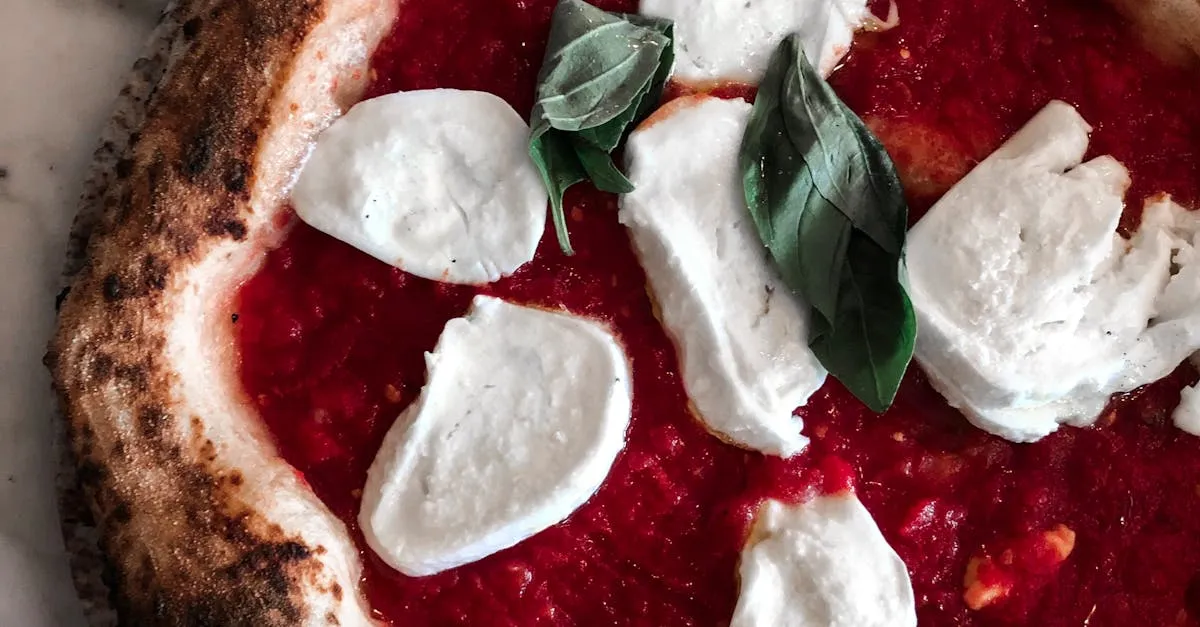
This recipe synthesizes the best home-oven techniques from Ken Forkish’s cold-retard dough, Vito Iacopelli’s two-stage bake, and Gemignani’s Napoletana sauce into a single, tested workflow. It’s designed specifically for a standard 550F kitchen oven with a baking steel — not a wood-fired oven, not a portable pizza oven. Those ovens require different approaches.
The key adaptations: 70% hydration (versus the AVPN’s 55-59%) to compensate for moisture loss during a 7-minute bake, and a two-stage baking method that prevents the cheese from burning before the crust finishes.
Dough
This is Forkish’s 24-48 Hour Cold Retard — his most-used recipe, perfectly suited for home Neapolitan.
| Ingredient | Amount | Baker’s % |
|---|---|---|
| 00 flour (Caputo red bag recommended) | 500g | 100% |
| Water (90-95F) | 350g | 70% |
| Fine sea salt | 13g | 2.6% |
| Instant dry yeast (IDY) | 1.5g | 0.3% |
Why Caputo red bag: At W300-320 and 13-13.5% protein, the red bag (Cuoco/Saccorosso) is engineered for longer ferments and lower oven temperatures. The traditional blue bag (W260-270, 12.5% protein) was designed for 800F+ ovens where the bake finishes before structural weakness matters. In a 7-minute home bake, the red bag’s stronger gluten network outperforms. If using blue bag, add 0.5-1% diastatic malt powder for better browning.
Dough Method
-
Mix: Combine flour and salt in a 6-quart tub. Add water (target 90-95F). Mix by hand using the pincer method — thumb-and-forefinger grip cuts through the mass, alternating with folding. About 2-3 minutes until no dry flour remains.
-
Add yeast: Sprinkle the 1.5g IDY over the dough. Pincer-mix for another 30 seconds to incorporate.
-
Rest and knead: Cover. Rest 15-20 minutes. Then knead briefly on the counter — 30 seconds to 1 minute until the dough is smooth and cohesive.
-
Bulk ferment: Return to tub, cover. Let rise at room temperature for 2 hours.
-
Ball: Divide into 3 dough balls, approximately 288g each. Tuck the edges underneath to form tight balls with a smooth top surface. Place in lightly oiled individual containers or on an oiled sheet pan with space between them. Cover tightly.
-
Cold ferment: Refrigerate 16-48 hours. The sweet spot is 24-48 hours — enzymatic activity during cold fermentation produces free amino acids and sugars that fuel Maillard browning and flavor complexity.
-
Temper: Remove from fridge 1-2 hours before baking. Target internal temperature of 60-65F before stretching. Cold dough produces large, uneven bubbles and resists stretching.
Sauce
Gemignani’s Napoletana sauce — the purest expression of pizza sauce.
| Ingredient | Amount |
|---|---|
| San Marzano tomatoes (Strianese or Bianco DiNapoli) | 2 cans (28 oz each) |
| Fine sea salt | to taste |
Pass the tomatoes through a food mill fitted with a fine screen. Add salt. That’s it. The sauce should be thin — you should be able to see the dough through it in places. No cooking required.
This makes enough for all 3 pizzas with some left over. Refrigerate extra for up to 5 days. Bring to room temperature before using — never put cold sauce on pizza dough.
Assembly and Bake
Iacopelli’s two-stage bake solves the fundamental home-oven problem: cheese burns before the crust finishes when everything goes on at once.
Setup
- Place baking steel on the top rack, 6-8 inches below the broiler element.
- Preheat oven to maximum (550F) for 45-60 minutes. See our home oven temperature guide for optimizing your specific oven.
- Switch to broil for 5 minutes to superheat the steel surface.
- Switch back to bake at maximum just before launching.
Per Pizza
-
Shape: On a floured surface, press the dough ball from center outward with fingertips, leaving the outer inch untouched for the cornicione. Gravity-stretch over your knuckles to 10-12 inches. Target: center thin enough to nearly see through, with a puffy 1-2cm rim.
-
Peel prep: Dust a wooden pizza peel with the same flour used in the dough. Place the stretched dough on the peel. Do a test shake to confirm it slides freely.
-
First bake: Spread a thin layer of sauce (60-80g) over the center, leaving the 3/4-inch border. Drizzle a thread of EVOO over the sauce. Slide onto the steel. Bake approximately 4 minutes, until the crust is golden and puffed and the rim is beginning to color.
-
Add cheese: Remove the pizza (use a metal peel or carefully slide onto a cutting board). Tear 80-100g of fior di latte mozzarella into pieces and distribute over the sauce. If using mozzarella di bufala, use slightly less — it’s wetter.
-
Second bake: Return to the oven. Bake 2-3 minutes more until cheese is melted and bubbling with light brown spots, and the cornicione has dark brown to black char splotches.
-
Finish: Remove. Scatter 5-6 torn fresh basil leaves over the surface. Drizzle a thin line of EVOO. Slice and serve immediately.
Total bake time: 6-7 minutes. Do not exceed 7 minutes — beyond that the crust dries out rather than staying soft and foldable in the center.
Timing Schedule
| When | What |
|---|---|
| Day 1, evening | Mix dough. Bulk ferment 2 hours. Ball. Refrigerate. |
| Day 2 or 3 | Pizza day. |
| Pizza day minus 2 hours | Remove dough from fridge to temper. |
| Pizza day minus 1 hour | Preheat oven with steel at max for 45-60 min. |
| Pizza day minus 5 min | Switch to broil for 5 min, then back to bake. |
| Pizza time | Shape, sauce, first bake, add cheese, second bake, finish. |
What to Expect
The cornicione will be poofy with visible air bubbles and dark brown to black char splotches. The center will be soft but fully baked — each slice should flop from rim to tip when held at the crust, like a real Neapolitan pizza. The underside will have dark brown leopard spots from the steel contact.
The crust will be crisper than a true 90-second Neapolitan from a wood-fired oven. That’s inevitable at 550F versus 905F. But the interior texture — soft, foldable, slightly charred at the edges — will be excellent.
The two-stage bake produces cheese that’s melted and bubbling without being overcooked or broken, and sauce that’s concentrated and sweet rather than burnt or dried out.
Tips
-
Mozzarella prep: If using fresh fior di latte, cut it the night before and drain in a colander in the fridge. Fresh mozzarella releases substantial water during a 7-minute bake. Undrained cheese is the number one cause of soggy home-oven Neapolitan.
-
Steel vs stone: Steel conducts heat 18-20x faster than cordierite. If you’re using a stone, it works — but expect lighter leopard spots on the underside and slightly longer bake times. Preheat a stone for at least 60 minutes.
-
Between pizzas: Crank the oven back to max or broil for 3-5 minutes before the next pizza. The steel loses significant heat on contact with dough and needs to recover.
-
No cornmeal on the peel. Use the same flour as the dough for dusting. Cornmeal scorches and tastes bitter. Semolina works if you prefer.
-
Flour choice alternative: If you can’t find Caputo red bag, King Arthur Bread Flour (12.7% protein) with 1% diastatic malt powder produces excellent results at 550F.
Frequently Asked Questions
- Why does this recipe use 70% hydration when AVPN specifies 55-59%?
- AVPN hydration is designed for a 905F oven where pizza bakes in 60-90 seconds. In a home oven at 550F, pizza bakes for 7 minutes — roughly 7x longer — and loses far more moisture through evaporation. At 58% hydration in a home oven, you'd get something closer to a cracker than a pizza. The extra water at 70% produces a crust that's soft and foldable in the center, like authentic Neapolitan, rather than stiff and dry.
- Why do you add the cheese partway through the bake instead of at the start?
- Home ovens cook slowly enough that cheese burns or overcooks before the crust finishes if everything goes on at once. Iacopelli's two-stage method — sauce first, then cheese after the crust has set — gives you both a properly baked crust and properly melted cheese. In a 905F wood-fired oven this isn't an issue because the whole pizza finishes in 90 seconds.
- Can I use Caputo blue bag flour instead of red bag?
- Yes, but add 0.5-1% diastatic malt powder to compensate. Blue bag (W260-270, 12.5% protein) was designed for 800F+ ovens where the bake finishes before structural weakness matters and Maillard browning happens almost instantly. Red bag (W300-320, 13-13.5% protein) has stronger gluten for the longer home bake and tolerates extended fermentation better. Without malt, blue bag produces a pale, anemic crust at 550F because Italian 00 flour is unmalted by design.
- How do I know when the dough balls are ready to use?
- Look for three signs: small bubbles visible on the surface, the ball feels soft and pliable when pressed, and the bottom shows gassy holes when flipped over. Press gently with a finger — the indentation should spring back slowly. If it snaps back fast, the dough needs more time. If it doesn't spring back at all, the dough is over-proofed. Internal temperature should be 60-65F after tempering from the fridge.
- Why is the Napoletana sauce just tomatoes and salt?
- Because that's what it is in Naples. Gemignani's Napoletana sauce is literally San Marzano tomatoes passed through a food mill plus salt — nothing else. At 900F in a wood-fired oven, 90 seconds of intense heat concentrates and caramelizes the tomato perfectly. In a home oven, the longer bake achieves a similar concentration. The sauce is intentionally thin — you should be able to see the dough through it. Any additional ingredients compete with the tomato rather than complement it.
- Do I need to drain the fresh mozzarella?
- For home ovens, yes. Fresh fior di latte contains significant moisture that releases during a 7-minute bake, turning the center soggy. Cut the mozzarella the night before and drain in a colander in the fridge overnight. Iacopelli specifically recommends this for home ovens. In a 90-second wood-fired bake, the cheese doesn't have time to release enough water to cause problems.
Some links above are affiliate links. If you buy through them, we earn a small commission at no extra cost to you. We only recommend products we’d actually use.