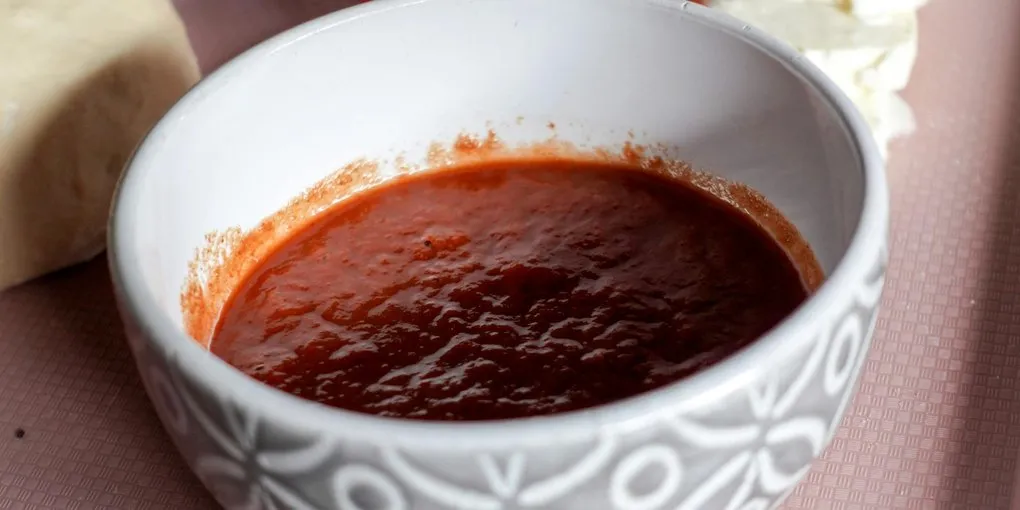
All three are uncooked: the sauce cooks once, on the pizza. Why that works, when a cooked sauce is the better choice, and how much sauce each style takes are covered in how to make pizza sauce. This page is the recipes.
A 28-ounce can holds 794 g. For the two Forkish sauces, the amounts below are calculated from the ingredient weights, not weighed after blending, and some sauce stays behind in the blender or mill. The portion counts assume 100 g of sauce per 12-inch pizza, the amount many of Ken Forkish’s 12-inch recipes use. Forkish’s own stated yields are lower, about 750 g for each sauce. The site’s Pizza Calculator suggests 60 to 90 g for a 12-inch Neapolitan-style pizza, so a lightly sauced pizza stretches a batch further. The Sicilian sauce’s yield is the figure printed with Gemignani’s recipe.
1. Smooth sauce (Forkish’s FWSY Sauce)
Forkish’s update of the “Smooth Red Sauce” from his earlier book Flour Water Salt Yeast. In The Elements of Pizza he dropped the old step of draining the tomatoes: the sauce stays thick enough as long as you don’t overblend it.
Makes: about 830 g by ingredient weight (827.7 g, calculated with a 5 g garlic clove), or roughly eight 100 g portions for 12-inch pizzas. Forkish gives this sauce’s yield as 750 g (3 cups), enough for five 12-inch pizzas. Time: 5 minutes, all of it active.
- 20 g (1½ tablespoons) extra-virgin olive oil
- 1 clove garlic (about 5 g), chopped
- 8 g (1½ teaspoons) fine sea salt
- 0.3 g (¼ teaspoon) dried oregano
- 0.4 g (¼ teaspoon) chile flakes
- 1 can (28 oz, 794 g) whole peeled tomatoes, with their juice
- Put the olive oil, garlic, salt, oregano and chile flakes in a blender with one spoonful of the tomatoes. Blend briefly, just until the garlic and oil come together.
- Add the rest of the tomatoes and pulse a few times, just until everything is combined. Stop before it turns thin.
- Don’t cook it. Refrigerate what you don’t use in a covered container for up to 1 week.
Notes. Long blending releases water from the tomato flesh, so pulse, look and stop early. Forkish suggests the best dried oregano you can find, and Calabrian oregano if you can get it. For a cooked, lightly sweetened New York sauce, simmer this batch with 15 g (1 tablespoon) of sugar; the method is in how to make pizza sauce.
2. Chunky sauce (food mill)
This is Forkish’s Basic Tomato Sauce made with a food mill rather than a blender. It’s only tomatoes and salt, the way Neapolitan pizzerias make their sauce. Forkish describes the milled version as slightly chunkier than the blended one.
Makes: about 800 g by ingredient weight (802 g, calculated: 794 g of tomatoes plus 8 g of salt), or roughly eight 100 g portions for 12-inch pizzas. Forkish gives the yield of his Basic Tomato Sauce as about 750 g (3 cups), enough for seven 12-inch pizzas. Time: 5 minutes, all of it active.
- 1 can (28 oz, 794 g) whole peeled tomatoes, with their juice
- 8 g (1½ teaspoons) fine sea salt
- Set a food mill fitted with its large-hole disk over a mixing bowl.
- Pour in half the can and crank until the tomatoes are ground. Scrape any mash left in the mill into the bowl. Repeat with the rest of the can.
- Stir in the salt with a large spoon.
- Don’t cook it. Refrigerate what you don’t use in a covered container for up to 1 week.
Notes. No food mill? Squeeze the tomatoes through your fingers into the bowl for a rougher, more rustic sauce. This is the sauce to use when the tomato is most of the flavor, as on a Neapolitan margherita, so it’s worth buying a can you like the taste of.
3. Gemignani’s Sicilian sauce
This is the sauce for “The Brooklyn,” the Sicilian-style square pizza in Tony Gemignani’s The Pizza Bible (Ten Speed Press, 2014). The recipe below follows the book’s excerpt that Andrew Zimmern reprints with the publisher’s permission. The method for the hand-crushed tomatoes comes from the book’s Crushed Tomatoes recipe, which Epicurious reprints. Three forms of tomato go in: ground tomatoes and paste puréed with the seasonings, then hand-crushed pieces stirred in. Like the other two sauces, it isn’t cooked before it goes on the pizza.
Makes: about 930 g (3¾ cups), the yield printed with the recipe. Gemignani’s Sicilian pizza in the same excerpt uses 370 g (1½ cups) of it on one 12 × 18-inch pan. Time: make it a day ahead, or at least a few hours before you need it, so the flavors come together. Cleaning the canned tomatoes for the hand-crushed portion is most of the work.
- 480 g (17 oz, 2 cups) ground tomatoes, preferably 7/11 or DiNapoli
- 225 g (8 oz, ¾ cup plus 3 tablespoons) tomato paste, preferably SuperDolce
- 1 g (1½ teaspoons) dried oregano
- 3 g (1 teaspoon) finely chopped garlic
- 5 g (1 teaspoon) fine sea salt
- 225 g (8 oz, 1 cup) hand-crushed tomatoes, from one 28-ounce (794 g) can of whole peeled tomatoes
- 1 large fresh basil leaf, torn
- Make the hand-crushed tomatoes. Set a strainer over a bowl, and keep a second bowl for scraps. Take each tomato from the can, pinch off the stem end and any unripe parts, open it up and remove the skin, seeds and any tough sections. Break the cleaned tomato into small pieces and drop them into the strainer. These pieces aren’t blended, so make them as small as you like. Press gently to drain off as much liquid as you can, then discard the liquid and the scraps.
- Put the ground tomatoes, tomato paste, oregano, garlic and salt in a deep bowl or container and purée with an immersion blender.
- Stir in the hand-crushed tomatoes and the basil.
- Don’t cook it. Cover and refrigerate for a day, or at least a few hours, so the flavors come together. It keeps in the refrigerator for up to 3 days.
- Let the sauce come to room temperature before you spread it.
Notes. The quantities are the book’s, unscaled. Gemignani says one 28-ounce can gives about 250 g of hand-crushed tomatoes, a little more than the 225 g you need. The brands are his preferences in this recipe; his Crushed Tomatoes recipe names Valoroso or DiNapoli for the whole tomatoes. His 370 g on a 12 × 18-inch pan is more than the Pizza Calculator’s starting range for a Sicilian-style pan, which is based on King Arthur Baking’s recipe, so use his amount when you’re making his pizza.
Which sauce for which pizza
Buying the tomatoes
Use whole peeled tomatoes you like straight from the can, and check the label for calcium chloride, a firming agent that keeps pieces from breaking down. Bianco DiNapoli is a California brand Forkish likes. For the Sicilian sauce you’ll also need ground tomatoes and tomato paste: Gemignani’s preferences are 7/11 or DiNapoli ground tomatoes and SuperDolce paste. The brands, what’s in each can and what the San Marzano labels mean are compared in canned tomatoes for pizza.
Frequently Asked Questions
- Should I drain the tomatoes first?
- Not for the smooth and chunky sauces. Forkish used to drain them but stopped once the importer Fred Mortati explained that the packing juice is cooked down during production and holds more tomato solids than the fruit. If your sauce comes out thin, blend it less: overblending releases water from the tomato flesh. The Sicilian sauce is different: Gemignani presses his hand-crushed tomatoes in a strainer and discards the liquid.
- Why aren't these sauces cooked?
- Canned tomatoes are already heated during processing, and the sauce cooks again on the pizza. Forkish's view is that cooking a sauce to thicken it removes the freshness of flavor. A cooked, lightly sweetened sauce is traditional for some New York pizzerias, and the method is in the site's guide to making pizza sauce.
- How far ahead can I make them?
- Forkish keeps his sauces in a covered container in the refrigerator for up to 1 week. Gemignani's Sicilian sauce is meant to be made a day ahead, or at least a few hours, and keeps in the refrigerator for up to 3 days.
- How much sauce goes on each pizza?
- Start with 60 to 90 g on a 12-inch Neapolitan-style pizza and 95 to 130 g on a 14-inch New York pizza. Those are the site's Pizza Calculator ranges. The EU specification for Pizza Napoletana uses 60 to 80 g of tomato on a pizza with mozzarella. Gemignani's Sicilian pizza uses 370 g of his sauce on a 12 by 18 inch pan.
Some links above are Amazon affiliate links. As an Amazon Associate, jayarr.pizza earns from qualifying purchases at no extra cost to you.
Sources
- Ken Forkish, The Elements of Pizza (2016): chapter 7, Basic Tomato Sauce, Two Ways, and FWSY Sauce (ingredients, methods and stated yields), with the New York Pizza Sauce variation; chapter 4, “Tomato Sauce,” on draining, overblending and Neapolitan practice.
- Tony Gemignani, The Pizza Bible (Ten Speed Press, 2014): Sicilian Tomato Sauce and “The Brooklyn” Sicilian-style pizza, reprinted with permission at Andrew Zimmern’s site, and Crushed Tomatoes, reprinted at Epicurious. Checked October 14, 2026.
- European Commission, Regulation (EU) No 97/2010, Annex II: tomato quantities for Pizza Napoletana.
- Per-pizza sauce ranges: jayarr.pizza Pizza Calculator, based on Forkish, Ooni’s New York-style pizza recipe and King Arthur Baking’s Sicilian pizza recipe.