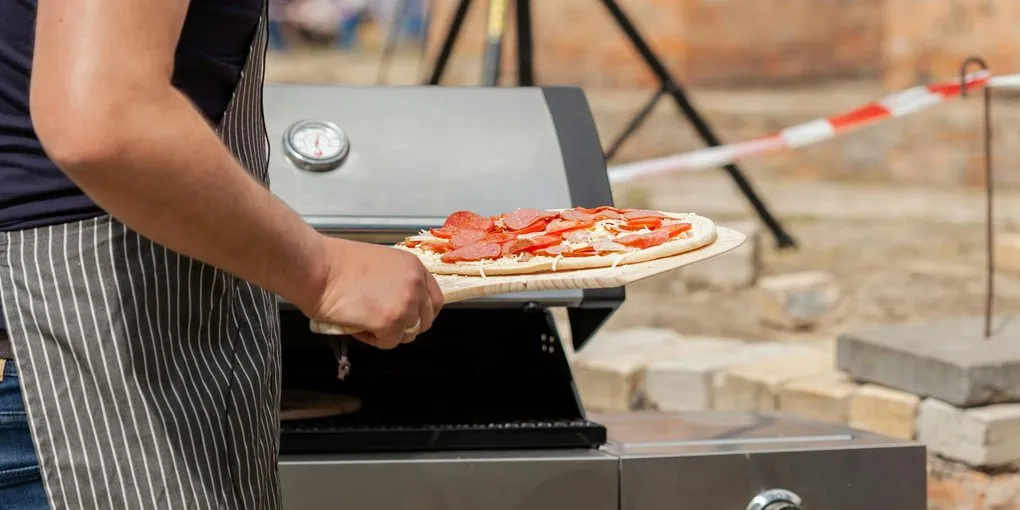
Grilled pizza started at Al Forno in Providence, Rhode Island in the 1980s, and it changed what backyard pizza could be. The restaurant put raw dough directly on grill grates, let it char on one side, flipped it, topped the grilled side, and finished it covered. The result had something that no oven method could replicate: distinct grill marks, a slightly smoky exterior, and a crust that was simultaneously charred and chewy.
The technique has been refined considerably since then. Gemignani dedicated an entire chapter of The Pizza Bible to grilled pizza, developing a specific dough formula, testing every grill type, and arriving at a clear recommendation for the best backyard setup. This is not an afterthought tacked onto an oven-pizza book. It is a fully developed approach with its own rules.
The Dough: Stripped Down on Purpose
Grilled pizza dough is deliberately minimalist. Gemignani’s formula removes both malt and oil from his standard Master Dough, using only 00 flour, water, salt, and yeast at 65% hydration.
Gemignani’s Grilling Dough
| Ingredient | Amount | Baker’s % |
|---|---|---|
| 00 flour (Caputo or San Felice) | 453g | 100% |
| Ice water | 210g | 46.3% |
| Warm water (80-85F) for yeast | 85g | 18.8% |
| Total water | 295g | 65.1% |
| Fine sea salt | 9g | 2.0% |
| Active dry yeast | 4.5g | 1.0% |
No malt. No oil. No starter.
Why no malt: Diastatic malt provides extra sugars for Maillard browning, which is useful in a 500F home oven where the crust struggles to develop color. On a grill running at 575-600F+ with direct radiant heat from the grate, browning happens aggressively on its own. Malt would cause burning.
Why no oil: Oil in dough weakens the gluten structure slightly. On a grill, the dough needs to hold together during the flip — the moment when it is most vulnerable to tearing. Removing oil keeps the dough a bit tighter and more handleable. Oil goes on the surface before grilling and as a finishing drizzle after.
Why 00 flour: The lower protein content of 00 flour (11-12.5%) produces a more tender, less chewy crust. Grilling creates enough structure through direct-heat charring that the dough does not need the scaffolding of a high-protein bread flour. Caputo Pizzeria (blue bag) or Molino San Felice 00 are both recommended.
Fermentation
Rest 1 hour at room temperature after mixing, then cold-ferment 24-48 hours in the refrigerator. Ball at 255g each for individual-sized pizzas. The cold ferment develops flavor complexity that the brief, high-heat grill cook would otherwise miss.
The Method: Roll, Dock, Flip, Top
Grilled pizza technique differs from oven pizza in several critical ways.
Step 1: Roll and Dock
Roll the dough out with a rolling pin rather than hand-stretching. Grilled pizza needs even thickness across the entire surface — thin spots will char through on the grate while thick spots stay raw. Hand-stretching produces the uneven thickness that is desirable in Neapolitan pizza but disastrous on a grill.
After rolling, dock the dough with a fork or docker. Poking holes prevents large bubbles from forming during the initial grill, which would create uneven charring and structural weakness when you flip.
Step 2: Dust with Flour Only
This is critical. Use flour for dusting, not semolina. Semolina burns at grill temperatures, producing an acrid, bitter residue that ruins the flavor of the crust. Flour toasts at these temperatures without burning. Use the same 00 flour from the dough.
This is the opposite of what works in a home oven or portable oven, where semolina grains act as miniature ball bearings on the peel surface. If you are used to the gas grill stone method where semolina works at lower effective surface contact, the direct-grate method requires a different approach.
Step 3: Grill the First Side
Place the dough directly on the hot grill grate. Let it cook until you see distinct grill marks on the bottom and the top surface has begun to set, dry slightly, and show some bubbling. This takes 1-2 minutes depending on grill temperature.
Do not touch it during this phase. The dough needs to set on the grate and release naturally. If you try to move it too early, it will tear.
Step 4: Flip and Top
Using tongs, a peel, or two spatulas, flip the dough over so the grilled side is now facing up. This grilled side — with its char marks and set surface — is where your toppings go.
Work quickly. Add sauce, cheese, and toppings onto the grilled surface. The raw side is now facing the heat and will cook during this phase.
Step 5: Cover and Finish
Close the grill lid to create a convection-oven effect. The trapped heat melts the cheese and finishes cooking the bottom. This takes 30 seconds to a few minutes depending on your grill temperature and how much thermal mass the lid retains.
Why covering matters: Without the lid closed, the bottom of the pizza gets direct heat from the grates but the top gets almost nothing. Cheese sits there unmelted while the bottom chars. The closed lid reflects heat downward, mimicking the dome effect of a pizza oven. This is the same thermodynamic principle that makes dome ovens so effective — radiant heat from above.
Grill Types Compared
Kamado (Big Green Egg, Kamado Joe): The Best Option
Gemignani is clear about his preference: the Big Green Egg is the best grill for pizza.
Why ceramic wins: A kamado grill is a thick-walled ceramic dome. When heated, that ceramic mass radiates heat from all directions — bottom, sides, and top. This is the closest any backyard grill comes to replicating the physics of a pizza oven, where the dome radiates enormous heat downward while the floor provides conductive heat from below.
Temperature and timing: Set the Big Green Egg to 575-600F with a pizza stone placed on the grate. At this temperature, pizza finishes in approximately 10 minutes. The ceramic dome generates enough radiant top heat that you get proper browning and cheese melt without the broiler gymnastics required in a home oven.
The dome difference: In a kamado, you do not need to flip the pizza. The radiant dome heat cooks the top while the stone cooks the bottom. This makes kamado pizza much closer to traditional oven pizza than to the flip-and-top technique used on flat grills. You can still use the flip method if you prefer grill marks, but the kamado gives you the option of a more conventional approach.
Charcoal Grill: The Classic Method
A standard charcoal kettle (Weber, etc.) is where most people start with grilled pizza. It works, but it requires the flip-and-top method because the lid does not retain or radiate heat the way a ceramic kamado does.
Setup: Build a two-zone fire. Bank all the charcoal on one side for a hot direct zone and leave the other side empty for indirect heat. Start the pizza on the hot side for grill marks, flip and top, then slide to the indirect side and close the lid to finish melting the cheese.
Temperature: A full chimney of charcoal produces grate temperatures around 500-600F in the direct zone. This is hot enough for good grill marks but not so hot that you cannot manage the cook.
The limitation: Charcoal grills have thin metal lids that absorb and radiate very little heat. The “dome effect” is minimal. Cheese melts slowly under a charcoal lid compared to a kamado, which means longer finishing time and more risk of overcooking the bottom.
Gas Grill: Convenient but Compromised
Gas grills work for grilled pizza with caveats.
Setup: Preheat all burners to high for 10-15 minutes, then reduce to medium-high for cooking. Or use a two-zone setup: high heat on one side for grilling, lower heat on the other for finishing.
The dome problem is worse. Gas grill lids are thinner and less insulated than charcoal kettle lids. Radiant heat from the top is minimal. The advantage is precise temperature control — you can dial burners to exactly the heat level you want without managing airflow and fuel.
For consistent results on gas: After flipping and topping, close the lid and resist opening it for at least 2-3 minutes. Every lid opening dumps heat. If cheese is not melting, crank the burners and give it more time with the lid sealed.
Three Grilled Pizza Recipes
Gemignani provides several recipes specifically designed for the grill. These use toppings that work with the flip-and-top method and the brief, intense cooking time.
Steak Lover’s Grilled Pizza
A meat-heavy combination that takes advantage of the grill’s smoky flavor.
Toppings (per pizza): Grilled steak slices (pre-cooked, sliced thin), mango salsa, fresh mozzarella, arugula (added after grilling). The mango salsa provides acidity and sweetness that cuts through the richness of the steak and the char from the grill.
The Dubliner
Gemignani’s riff on a Reuben sandwich, reimagined as pizza.
Toppings (per pizza): House-made corned beef (thinly sliced), Russian dressing as the sauce, coleslaw (added after grilling). This is a sandwich-meets-pizza concept that works because the grilled crust provides the crunch that bread would in a Reuben.
The Parisian
A French-inspired combination that demonstrates grilled pizza’s range beyond Italian flavors.
Toppings (per pizza): Truffle paste as the base (instead of tomato sauce), wild mushrooms (sauteed), Comte cheese, Saint Andre triple-cream cheese. The truffle paste and mushrooms create an umami-rich base, and the two French cheeses melt into something remarkably luxurious on a grilled crust.
Key Differences from Oven Pizza
Understanding what changes — and what does not — when you move from oven to grill:
Dough is simpler. No malt, no oil, no starter. The grill’s direct heat and smoke provide flavor that compensates for the stripped-down formula.
Roll, do not hand-stretch. Even thickness is non-negotiable on grill grates. Thin spots burn through.
Dock the dough. No docking in oven pizza (you want bubbles for cornicione). On a grill, bubbles create structural problems during the flip.
Flour only for dusting. Semolina, which is the standard for portable pizza ovens, burns at grill temperatures.
Cheese timing reverses. In an oven, cheese goes on first and potentially overcooks during a long bake. On a grill, cheese goes on last (after the flip) and may undercook if the lid is not trapping enough heat.
You are managing two sides. Oven pizza cooks from bottom and top simultaneously. Grill pizza cooks one side at a time. The flip is the pivotal moment — it requires confidence and speed.
Troubleshooting Grilled Pizza
| Problem | Cause | Fix |
|---|---|---|
| Dough tears during flip | Too thin, large bubbles, or not set enough | Roll thicker, dock before grilling, wait longer before flipping |
| Cheese will not melt | Lid not retaining enough heat | Close lid and leave it closed 2-3 min; consider kamado for dome heat |
| Bottom burns before top is done | Too much direct heat, not enough dome heat | Move to indirect zone after flipping; reduce burner temp |
| Dough falls through grates | Rolled too thin, grates too wide | Roll thicker (1/8 inch minimum); use a pizza stone on the grill |
| Bitter, acrid flavor | Used semolina for dusting (burns at grill temp) | Switch to flour only |
| Uneven charring | Uneven dough thickness | Use rolling pin for consistent thickness; dock evenly |
Using a Pizza Stone on the Grill
If you want to avoid grill marks and cook more conventionally, place a pizza stone or steel on the grill grate and preheat it with the grill. On a kamado at 575-600F, this produces results very close to a portable pizza oven — the stone provides even bottom heat while the ceramic dome provides radiant top heat.
This is Gemignani’s preferred kamado approach. The 10-minute cook time at 575-600F on a stone in a Big Green Egg is longer than a 60-90 second portable oven bake, but shorter than a home oven’s 7-8 minutes. You get proper leopard-spotting on the bottom, melted cheese with minimal browning, and a crust that is crisp outside and soft inside.
For gas and charcoal grills without ceramic domes, a stone on the grill still works but you lose the radiant top heat advantage. The bottom will cook well; the top will take longer to finish.
The Bottom Line
Grilled pizza is its own category with its own rules. The dough is leaner, the technique involves a flip, and the grill type matters more than most people realize. A kamado with a pizza stone is the backyard setup that comes closest to replicating pizza oven physics. A charcoal or gas grill with the flip-and-top method produces something different — charred, smoky, and rustic in a way that no oven can match. Both are worth doing.
Frequently Asked Questions
- Can I use regular pizza dough on the grill?
- You can, but a dedicated grilling dough performs better. Gemignani's grilling formula strips out malt (which burns at grill temperatures) and oil (which weakens the gluten structure needed for the flip). It uses 00 flour at 65% hydration with just flour, water, salt, and yeast. The leaner dough holds together during flipping and does not char excessively from residual sugars.
- Why can't I use semolina for dusting when grilling pizza?
- Semolina burns at grill temperatures, producing an acrid, bitter flavor that ruins the crust. Use flour only for dusting grilled pizza. This is the same 00 flour from the dough recipe. In a home oven at 500-550F, semolina is fine. On a grill at 575F+, it is not.
- What is the best grill for making pizza?
- A kamado-style grill (Big Green Egg, Kamado Joe) is the best option according to Gemignani. The thick ceramic dome radiates heat from all directions, closely replicating pizza oven physics. At 575-600F with a pizza stone, pizza finishes in about 10 minutes with proper browning on top and bottom. Charcoal and gas grills work but lack the radiant dome heat, requiring the flip-and-top method instead.
- Do I need to flip grilled pizza?
- On a charcoal or gas grill, yes. You grill the first side for 1-2 minutes until you see grill marks and the top begins to set, then flip, top the grilled side, close the lid, and finish. On a kamado grill with a pizza stone inside, flipping is optional because the ceramic dome provides enough radiant top heat to cook the pizza conventionally from both sides at once.
- Should I dock the dough before grilling?
- Yes. Poke holes across the surface with a fork or docker before placing on the grill. Large bubbles on a grill create structural weakness that can cause tearing during the flip and uneven charring. This is the opposite of oven pizza, where you want bubbles for a puffy cornicione.
- Why does my cheese not melt on grilled pizza?
- The grill lid is not trapping enough heat. Metal lids on charcoal and gas grills radiate far less heat downward than a ceramic kamado dome or a pizza oven. Close the lid and resist opening it for at least 2-3 minutes. Every opening dumps heat. If cheese still will not melt, your grill is not hot enough -- increase the heat and try again with the lid sealed.
- Can I use a pizza stone on my grill?
- Yes, and this is Gemignani's preferred method for kamado grills. Place a pizza stone on the grill grate, preheat with the grill to 575-600F, and bake directly on the stone. This avoids the flip entirely and produces more even bottom cooking. On gas and charcoal grills, a stone works for the bottom but you still lack adequate radiant top heat from the lid.