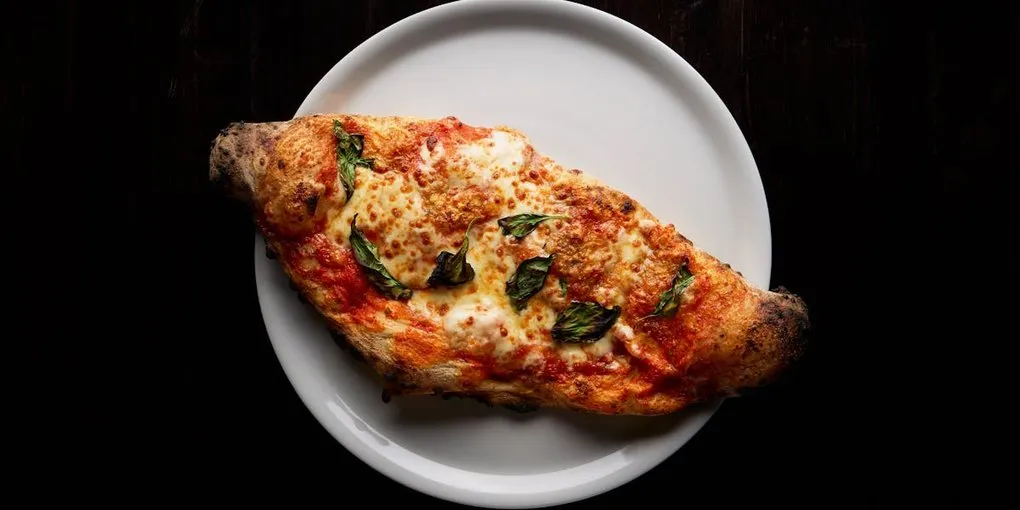
When Allied bombing damaged or destroyed wood-fired ovens across Naples in 1943-1944, Neapolitan pizzaioli leaned hard on a technique they already knew. Frying dough — in lard or oil — went back generations in Naples cucina povera, with smaller fried pockets called panzarotti sold by street vendors well before the war. Pizza was the city’s staple food, so when the brick ovens went, pizzaioli adapted: fold the dough into a sealed pocket, fill it with whatever cheese and pork fat were available, drop it into hot oil. The result — pizza fritta, fried pizza — became one of the defining street foods of post-war Naples and has stayed central to the city’s food culture ever since.
Today pizza fritta is sold throughout Naples’ Centro Storico from kiosks, putie, and dedicated shops. The basic structure has stayed remarkably stable: Neapolitan-style dough at moderate hydration, a filling of ricotta and smoked provola with optional ciccoli (pork lard), folded into a half-moon, sealed at the edge, and deep-fried at roughly 175°C / 350°F until golden and puffed. This is a different dish from the AVPN-certified Margherita that dominates the international image of Neapolitan pizza, but it is just as Neapolitan — and on most Naples streets, more visible.
This recipe will produce four pizza fritta the size you would actually be served in Naples — substantial pockets, eaten hot, that double as a quick meal or a generous appetizer for two. Like most fried foods, the technique matters more than the ingredient list. The two things that go wrong most often are dough that wasn’t properly fermented (resulting in heavy, leaden texture) and oil that wasn’t at the right temperature (resulting in greasy, undercooked fritta). Get those two right and the rest is mechanical.
If you are interested in the related Naples specialty that gets briefly fried then finished in the oven — pizza montanara — that is a different dish, distinguishable by being open-faced rather than folded. Montanara is a small disc of dough flash-fried in oil and then topped with sauce and cheese (sometimes briefly returned to the oven). Pizza fritta is filled, sealed, and fully cooked in the oil. They share an ancestor but live in different categories.
A Brief History: Necessity, Then Tradition
Pizza fritta as a street-food staple is a 20th-century phenomenon, but the technique of frying dough has older Neapolitan roots. According to historians of Naples cucina povera, bakers’ wives in the city were frying small filled dough pockets at least as far back as the 16th century — using leftover scraps of bread dough, lard or oil, and whatever modest filling was on hand. Before WWII, Naples had a tradition of fried pocket dough called panzarotti (sometimes called panzerotti, though that spelling is more associated with Apulia / Puglia). The pizza fritta of the 1940s and 1950s was an evolution of this tradition: bigger pockets, richer fillings, sold from carts and shopfronts as a primary meal rather than a snack.
The post-war version was deliberately economical. Wartime rationing had made cheese and meat scarce; ricotta — a byproduct of mozzarella production, made from leftover whey — was abundant and cheap. Smoked provola was a Campanian specialty cheese that held up to heat better than fresh mozzarella. Ciccoli (also spelled cicoli) is rendered pork lard with cracklings, another byproduct ingredient. The classic pizza fritta filling — ricotta + smoked provola + ciccoli + black pepper — emerged because those were the ingredients people had access to.
The cultural memory of this period is preserved in Vittorio De Sica’s 1954 anthology film L’Oro di Napoli (The Gold of Naples), in which Sophia Loren plays Sofia, a young woman frying pizzas with her husband from a Naples shopfront. The famous “Pizza on Credit” episode features the line “oggi a otto” — “eat today, pay in eight days” — referencing the genuine credit system that pizza fritta vendors used to keep working-class Neapolitans fed during weeks when wages had not yet arrived. The film, shot at Pizzeria Starita in Naples, is the most famous cinematic record of the dish at the height of its post-war moment.
Several Naples institutions trace the canonical version of the dish. The Sorbillo family’s main pizzeria was founded by Luigi Sorbillo and Carolina Esposito in 1935 on Via dei Tribunali; the eldest of their 21 children, Esterina Sorbillo, took on the family’s pizza-fritta tradition and became a neighborhood symbol of the dish. Antica Pizza Fritta da Zia Esterina Sorbillo, opened in 2015 by Gino Sorbillo (Esterina’s nephew), is a tribute to her recipe rather than a continuous post-war operation; the shop sources the same techniques and ingredient palette Esterina used after the war, including the Completa fillings (ricotta, provola, ciccoli, tomato).
La Masardona — another foundational name — was opened in 1945 on Via Giulio Cesare Capaccio in Naples by Anna Manfredi, who fried pizzas Sunday mornings outside her family’s home to supplement household income. La Masardona is now in its fourth generation under the Piccirillo family and is widely regarded as the “mother of fried pizza” in Naples. Other historic stops include Pizzeria di Matteo (operating since 1936; famously visited by then-US President Bill Clinton at the 1994 G7 Naples summit, who ate a pizza a portafoglio / “wallet pizza” rather than a pizza fritta specifically), and La Figlia del Presidente, opened by Maria Cacialli in honor of her father Ernesto Cacialli (the pizzaiolo who reportedly served Clinton during that 1994 visit and earned the nickname il pizzaiolo del presidente).
Pizza fritta in Naples is street food in the most literal sense — you eat it standing up, wrapped in waxed paper, walking from the shop to wherever you are going. It is not restaurant food. The version made at home for guests is typically slightly more refined (better cheese, more careful frying) but the essential character of the dish stays the same.
The Dough: 60-65% Hydration, Neapolitan-Style
The dough for pizza fritta is essentially a Neapolitan pizza dough at the lower end of the typical hydration range. The reason is mechanical: a dough at 70%+ hydration is too sticky and slack to fold into a sealed pocket without tearing or leaking. At 60-65% hydration, the dough is workable enough to form a clean half-moon shape with a pinched, sealed edge.
The ferment can be the same long cold ferment used for Neapolitan pizza, or a shorter same-day version with more yeast. The cold-fermented version produces better flavor and more reliable structure; the same-day version is faster and works fine when you don’t have 24 hours of advance notice.
Ingredients (for 4 pizza fritta, 250-300g each)
| Ingredient | Weight | Baker’s % |
|---|---|---|
| Bread flour (12.5-13.5% protein) or Italian 00 (W260+) | 600g | 100% |
| Water (cool, ~65°F / 18°C) | 380g | 63% |
| Fine sea salt | 15g | 2.5% |
| Instant dry yeast | 2g (cold ferment) or 5g (same-day) | 0.33% / 0.83% |
| Extra virgin olive oil (optional) | 12g | 2% |
Total dough weight: approximately 1,010g, divided into 4 balls of ~250g each (or 3 balls of ~335g each for larger Naples-style pieces).
For long fermentation, Caputo Pizzeria (W260, 12.5% protein) blue bag is the traditional Neapolitan flour. King Arthur Bread Flour (12.7% protein) works well as the American substitute. Avoid all-purpose — the gluten will be too weak to hold the filling without leaking.
Dough Method
-
Mix. In a large bowl or stand mixer, combine the flour and salt. Dissolve the yeast in 50g of the measured water. Pour the yeast water and the remaining water into the flour. Mix on low speed (or by hand with a wooden spoon) for 2-3 minutes until everything is hydrated and there is no dry flour. Add the optional olive oil and mix another 1-2 minutes.
-
Develop the gluten. Continue mixing on low speed for 6-8 minutes until the dough is smooth and elastic. By hand, knead 8-10 minutes on a lightly floured surface. The dough should pass a basic windowpane test — pull a small piece and it should stretch thin without tearing.
-
Bulk ferment. Transfer to a lightly oiled container with a lid.
- Cold ferment: Refrigerate 24 hours. Take out 1-2 hours before forming to bring to room temperature.
- Same-day: Rest at room temperature for 4-6 hours until roughly doubled.
-
Divide and ball. Turn the dough onto a clean surface. Divide into 4 equal pieces (~250g each) using a bench scraper. Form each piece into a tight ball by tucking the edges underneath repeatedly. Place each ball on a lightly floured tray, cover, and rest at room temperature 1-2 hours before forming.
The dough balls should be smooth on top and visibly puffy when ready to form — not deflated, not over-proofed. A finger pressed gently into the surface should rebound slowly but not fully.
The Filling: Ricotta + Smoked Provola + Pepper (and the Ciccoli Question)
The classic Sorbillo-style filling is ricotta, smoked provola, grated pecorino, black pepper, and (optional) ciccoli. The proportions are not strict, but the structure is consistent: roughly equal parts ricotta and provola by weight, with the pecorino and pepper as flavoring accents.
Filling Ingredients (per pizza fritta)
| Ingredient | Amount per fritta |
|---|---|
| Whole-milk ricotta (drained) | 30-40g |
| Smoked provola (provola affumicata), diced into ~1cm cubes | 30-40g |
| Grated pecorino Romano | 5g |
| Black pepper, freshly ground | generous pinch |
| Ciccoli (rendered pork lard with cracklings) | 10-15g (optional but traditional) |
| Tomato sauce (optional, see “Completa” version below) | 1 tablespoon |
For 4 pizza fritta, total filling needs are approximately: 130-160g ricotta, 130-160g smoked provola, 20g pecorino, generous black pepper, optional 40-60g ciccoli, optional 60g tomato sauce.
On smoked provola: This is a specialty Campanian cheese, increasingly available at American Italian importers and some Whole Foods cheese counters. If unavailable, substitute smoked mozzarella (mozzarella affumicata) or scamorza affumicata — both are pasta filata cheeses from the same family with similar smoke-and-salt flavor. Standard fresh mozzarella works at a pinch but lacks the smoke note that defines the dish.
On ricotta: Whole-milk ricotta is essential. Skim or part-skim turns watery during the fry and produces a soggy interior. The ricotta should be drained — if your ricotta is wet, set it in a fine-mesh strainer over a bowl in the refrigerator for 1 hour to release excess liquid before using. Buffalo-milk ricotta is the traditional Naples option; cow’s-milk works perfectly fine.
On ciccoli: This is the genuinely traditional filling component, but it is not widely available in the United States. Italian importers sometimes stock it. The closest substitute is small chunks (about 1cm) of rendered pork lard with crackling — if you have the patience, render your own from pork belly trimmings. Some American adaptations substitute small chunks of guanciale or pancetta, which are richer and less crispy but provide the pork-fat flavor. Skip if unavailable; the dish is still authentic without it.
”Completa” Variation (with Tomato + Salami)
The Completa al Salame (the classic completed version) adds tomato sauce and Neapolitan salami:
- 30-40g ricotta + 30-40g provola + 5g pecorino + black pepper + 1 Tbsp simple crushed-tomato sauce (raw or lightly cooked) + 4-5 small cubes of Neapolitan salami or hard salami.
The tomato adds moisture, so the dough must be sealed extra carefully. Skip the ciccoli if going Completa — the salami covers the meat note.
Forming the Pocket: The Sealing Move That Prevents Leaks
This is the technique that separates a clean pizza fritta from an oil-soaked disaster. A poorly sealed edge will burst during frying, dump filling into the oil, and produce a charred, deflated pizza that has lost its character. The seal must be both pressure-tight and structurally reinforced.
Forming Method
-
Stretch the ball to a 10-inch round. Lightly flour your work surface. Take one rested dough ball and gently press it flat with your fingertips, working from the center outward, leaving a slightly thicker rim (about 1cm border). Stretch it gradually to roughly 25cm / 10 inches in diameter — thin enough to fold, thick enough not to tear. Use the same technique you would for a Neapolitan pizza: press out from the center, rotate, press out again. Don’t roll with a pin; that knocks all the air out of the dough and produces a leaden fried pizza.
-
Place the filling on one half. Spoon the filling onto one half of the round, leaving a 2-2.5cm border around the curved edge. Don’t overstuff — a typical Naples-portion fritta has roughly 75-90g of filling, which is enough to be substantial without leaking.
-
Fold over. Lift the empty half of the dough and fold it over the filling. The edges should overlap by roughly 1cm.
-
Seal the edge. With your fingertips, press the curved edge firmly to seal. Then — and this is the move that prevents bursting — crimp the edge by either pressing with the tines of a fork (the diner-fork method) or rolling the edge over itself in small folds (the calzone method). Both create a thicker, double-layer seal that resists oil pressure during frying. The crimped edge should be visibly thicker than the rest of the dough.
-
Leak test. Gently lift the formed fritta to check the seal. Look for any thin spots or open seams. If you see a gap, pinch it closed and crimp again. The fritta should feel like a sealed pillow — pressure-tight, with no obvious weak points.
The formed fritta should rest for 5-10 minutes before frying. During this rest, the gluten network in the freshly stretched dough relaxes slightly, which helps the fritta puff cleanly during frying without bursting.
Frying: 350°F Oil, 5-6 Minutes Total
The fry is where most home cooks fail at this dish. Oil that is too cool produces a greasy, soaked exterior; oil that is too hot burns the surface before the interior cheese melts. The target is 350°F (175°C), measured with a thermometer (not by eye), and held within a 10-degree window throughout the cook. Italian recipe references typically cite 170-180°C as the working window; 175°C / 350°F is the centerline.
Frying Setup
| Equipment | Specification |
|---|---|
| Cooking vessel | Dutch oven, deep cast iron, or heavy-bottomed wide pot. 4-5” deep oil capacity. |
| Oil | Neutral high-smoke-point oil. Peanut, sunflower, or refined vegetable. NOT olive oil — smoke point too low for sustained 350°F frying. |
| Oil depth | 4-5 inches (deep enough to fully submerge the fritta) |
| Thermometer | Clip-on candy thermometer or digital probe. Essential. |
| Spider/skimmer | Wide flat strainer for removing fritta. |
| Drain rack | Wire rack over a sheet pan — NOT paper towels, which trap steam and turn the bottom soggy. |
Frying Method
-
Heat the oil. Bring the oil to 350°F (175°C). This typically takes 10-15 minutes on medium-high heat. Verify with a thermometer — visual estimation is not reliable.
-
Test fry (optional but recommended). Drop a small piece of leftover dough trimming into the oil. It should sizzle vigorously, float, and turn light golden in about 60 seconds. If it sinks and absorbs oil, the oil is too cold. If it browns too fast, too hot.
-
Lower the first fritta into the oil. Use the spider or your fingers (carefully, away from your body) to lower one fritta into the hot oil. Do not drop it from above — splashing oil is a burn hazard. Lower it gently and let it slide off the spider.
-
First side, ~2-3 minutes. The fritta will sink briefly, then float. It should puff visibly within 30 seconds — the steam from the dough and filling expanding inside the sealed pocket. Maintain the oil at 350°F by adjusting heat as needed. The first side is done when it is deeply golden and crisp — typically 2-3 minutes.
-
Flip. Use the spider to gently flip the fritta to the second side. Avoid spearing or piercing the dough — a puncture during cooking lets steam escape and deflates the pocket.
-
Second side, ~2-3 minutes. Continue until both sides are deeply golden brown. Total cook time should be 5-6 minutes. The internal temperature of a fully cooked pizza fritta reaches roughly 200°F, which means the cheese has melted, the dough is fully cooked through, and the filling is hot.
-
Drain. Lift the fritta out with the spider, holding it briefly above the oil to drain excess. Transfer to the wire rack to finish draining.
-
Recovery time between fritta. Let the oil return to 350°F before frying the next one (typically 60-90 seconds). Frying back-to-back without recovery causes the second fritta to absorb more oil and end up greasy.
-
Serve immediately. Pizza fritta is at its best within 5 minutes of leaving the oil. The exterior is crispiest, the interior is hottest, and the cheese is at peak melt. It does not hold well — 30 minutes later it is fine, but it is not the same dish.
Serving and Pairing
Traditional Naples service is simple: hot fritta wrapped in waxed paper, eaten standing up, paired with a cold beer or a glass of inexpensive red wine. The dish is salty, fatty, and dense; carbonation or acidity balances it.
For a more sit-down approach:
Wine pairing. A glass of light, slightly chilled red — Aglianico, Gragnano, or Lacryma Christi del Vesuvio (the local Campanian variety, made on the slopes of Mount Vesuvius). All three are bright, fruity, low-tannin reds that cut through the cheese and pork without overwhelming. White wine works too — a Greco di Tufo or Falanghina from the same region. Avoid heavy oaked reds.
Beer pairing. Italian lagers (Peroni, Moretti) are the traditional Naples choice. Czech-style pilsners or Belgian witbiers also work for the same reason — bright carbonation, light bitterness, no aggressive flavor.
Side dishes. Pizza fritta is a complete dish on its own, but a simple green salad with lemon and olive oil makes an excellent counter. Some Naples shops serve a small portion of marinated vegetables or olives alongside.
Sweet variation. The Naples pizza fritta dolce substitutes ricotta + sugar + cinnamon + vanilla for the savory filling, fries identically, and dusts the finished pocket with powdered sugar. A delicious dessert version that uses identical technique.
Timing Schedule
| When | What |
|---|---|
| 1 day before | Mix dough (cold ferment version). 24 hr in fridge. |
| Pizza fritta day, 2 hr before | Take dough out. Divide into 4 balls. Rest 1-2 hours at room temp. |
| 30 min before serving | Drain ricotta. Dice provola. Set up frying station. |
| 15 min before serving | Heat oil to 350°F. Form fritta. |
| Service time | Fry one at a time, 5-6 min each. Drain on rack. Serve immediately. |
What to Expect
The finished pizza fritta is dramatically larger than the unfried version — the steam from the dough and filling inflates the pocket during frying, producing a puffed, almost balloon-like piece that visibly thins as it cools. The exterior is deeply golden and crispy, with small bubbles and shatter-craquelure across the surface. Cut open, the interior is steaming hot, with the ricotta still distinct from the melted provola, the pecorino dissolved into the cheese mixture, and the black pepper fragrant against the fat.
The first bite should hit the crispy exterior, then immediately the molten cheese filling, with the salt-fat balance of the provola and ricotta dominating. The dish reads as both substantial and indulgent — an entire meal in one fold of dough.
Where to Eat the Real Thing in Naples
If you make it to Naples, four institutions cover the spectrum of pizza fritta — from neighborhood landmark to tribute shop, from Spaccanapoli to Forcella.
This is the pizza Naples invented when it had nothing else, and which it kept making once it had everything. For other Neapolitan techniques, see our Neapolitan pizza at home breakdown of the classic baked margherita, our Neapolitan margherita recipe for the canonical version, our AVPN standard explainer for what officially counts as Vera Pizza Napoletana, our Margherita 1889 history for the famous (and likely apocryphal) royal origin story, and our calzone vs stromboli comparison for the related folded-pizza family.
Frequently Asked Questions
- What's the difference between pizza fritta and a calzone?
- Both are folded, sealed dough pockets, but they are cooked entirely differently. A traditional calzone is baked in a hot oven (500°F+), where it browns from external dry heat over 8-12 minutes. Pizza fritta is deep-fried in 350°F neutral oil for 5-6 minutes total. The fried version puffs much more dramatically because steam pressure inside the sealed pocket has nowhere to escape against the hot oil, producing a balloon-like inflation that a baked calzone never achieves. The exterior is also different — pizza fritta has a deeply golden, crackled, shatter-crisp surface, while a calzone has a more bread-like, slightly leathery crust. The fillings are similar (ricotta + cheese + sometimes meat) but pizza fritta typically uses smoked provola where calzone uses fresh mozzarella, because smoked provola holds up better to the higher internal temperatures the steam-puffing produces. For more on the broader folded-pizza family, see our calzone vs stromboli breakdown.
- Why does the oil have to be exactly 350°F?
- Below 340°F, the dough doesn't sear quickly enough to form the crisp exterior crust — instead, the fritta absorbs oil for the first minute or two, becoming greasy and limp. Above 365°F, the exterior browns too fast, often charring before the cheese inside has fully melted, producing a fritta with a burnt outside and a cool center. The 350°F window (340-360°F is the practical range) is where steam pressure builds rapidly enough to puff the fritta cleanly, the dough cooks through to a fully baked interior, the cheese melts uniformly, and the exterior crisps without burning. Italian recipe references typically cite 170-180°C / 340-355°F as the working window. Use a thermometer — visual estimation of oil temperature is unreliable, especially for home cooks who don't fry frequently. The 5-6 minute total cook time at 350°F brings the internal temperature to roughly 200°F, which is the sweet spot for melted cheese and fully cooked dough.
- What is ciccoli, and do I really need it?
- Ciccoli (also spelled cicoli) is rendered pork lard with the small crackling pieces left in — essentially the byproduct of slowly cooking down pork fat to make lard, where the solid bits that didn't render fully get retained. It is a traditional Neapolitan ingredient that adds richness and small chewy-crispy bites to pizza fritta. The Sorbillo Completa ai Cicoli is built around this ingredient. In the United States, ciccoli is hard to find — specialty Italian importers sometimes carry it, but most American home cooks won't have access. Acceptable substitutes include guanciale or pancetta in small cubes (richer and less crispy than true ciccoli, but provides the pork-fat note), or rendering your own from pork belly trimmings if you have the patience. Skipping it entirely is fine — the dish is still authentic with just ricotta + smoked provola + pepper. The Completa al Salame version uses Neapolitan salami instead and is equally traditional.
- Can I use fresh mozzarella instead of smoked provola?
- Yes, but the dish will lose its defining smoke note. Smoked provola (provola affumicata) is the canonical pizza fritta cheese for two reasons: the smoke flavor cuts through the richness of the ricotta and pork fat, and the lower moisture content holds up better during the fry without weeping water and creating a steamy mess inside the pocket. Acceptable substitutes that preserve both qualities include smoked mozzarella (mozzarella affumicata) or smoked scamorza — both are pasta filata cheeses from the same family with similar smoke-and-salt profiles. Fresh unsmoked mozzarella works in a pinch but produces a milder, less interesting fritta and tends to release more water during cooking. Look for smoked provola at Italian importers, larger Whole Foods cheese counters, and specialty grocers like Eataly. If you go with fresh mozzarella, drain it overnight in the fridge to reduce moisture before dicing.
- Why does my pizza fritta keep bursting open during frying?
- Three usual causes. First, the seal isn't tight enough — the curved edge needs both pressure (firm finger-press) and structural reinforcement (fork-crimping or rolled-fold). A thin or single-layer seal will burst from internal steam pressure during the puff phase. Second, you may be overstuffing — a typical Naples-portion fritta has 75-90g of filling, not more. Too much filling inflates against the dough walls and finds the weakest point of the seal. Third, the dough is over-proofed or weak — if your dough has fermented past peak, the gluten network is too soft to hold the pressure. Use the leak-test before frying: lift the formed fritta and look for any thin spots or open seams. Pinch closed and re-crimp anywhere suspect. The crimped edge should be visibly thicker than the rest of the dough — this double-layer construction is what holds during the steam puff.
- How do they get the dough to puff up so dramatically in the oil?
- The puff comes from steam pressure inside a sealed pocket. As the cold dough hits 350°F oil, water in the dough and filling rapidly turns to steam — and because the fritta is sealed, that steam has nowhere to escape. The expanding gas inflates the dough from inside, much like a popover or Yorkshire pudding rising in a hot oven. The dough has to be elastic enough to expand without tearing, well-fermented enough to have a developed gluten network, and the seal has to be tight enough that the steam doesn't blow out the edge before it can do its work. The result is a fritta that looks substantially larger than the formed version going into the oil. Fresh, properly fermented dough at the right hydration (60-65%) is the key variable. Old or over-proofed dough won't puff — it just sits flat in the oil and absorbs grease. Properly hydrated, properly fermented dough produces the dramatic balloon shape that makes this dish feel almost magical the first time you make it.
- Is pizza fritta the same as a panzarotti?
- They are siblings but not the same dish. Panzarotti (sometimes spelled panzerotti, especially in Apulian dialect) is the older, smaller fried-pocket cousin — a tradition that goes back to at least the 16th century in Southern Italy. The Apulian / Pugliese panzerotto is typically smaller, often filled with simple mozzarella and tomato, and traces specifically to Bari. The Neapolitan pizza fritta is bigger, richer (ricotta + provola + pork fat is the canonical base, not mozzarella + tomato), and emerged as a primary meal rather than a snack — particularly during the lean post-WWII years when many of Naples' wood-fired ovens had been damaged or destroyed by Allied bombing. Both are deep-fried sealed pockets of dough, but the size, filling, and cultural register differ.
- Was pizza fritta really invented after World War II?
- Not exactly invented — popularized. The technique of frying filled dough pockets in Naples goes back to at least the 16th century, when bakers' wives would fry leftover dough scraps in lard with whatever modest filling was available. What changed after WWII was scale and prominence. Allied bombing in 1943-1944 damaged or destroyed many of Naples' wood-fired ovens, and traditional baked pizza became logistically harder for both pizzaioli and home cooks. Frying pizza in a pot of oil — already a known technique — became a practical alternative, and the dish's role shifted from snack to staple meal. Vendors began selling fritta on a credit system known as oggi a otto (eat today, pay in eight days), captured iconically in Vittorio De Sica's 1954 film L'Oro di Napoli with Sophia Loren. So the post-war period is when pizza fritta became one of the defining street foods of Naples, but the cooking technique itself is much older.
Some links above are affiliate links. If you buy through them, we earn a small commission at no extra cost to you. We only recommend products we’d actually use.