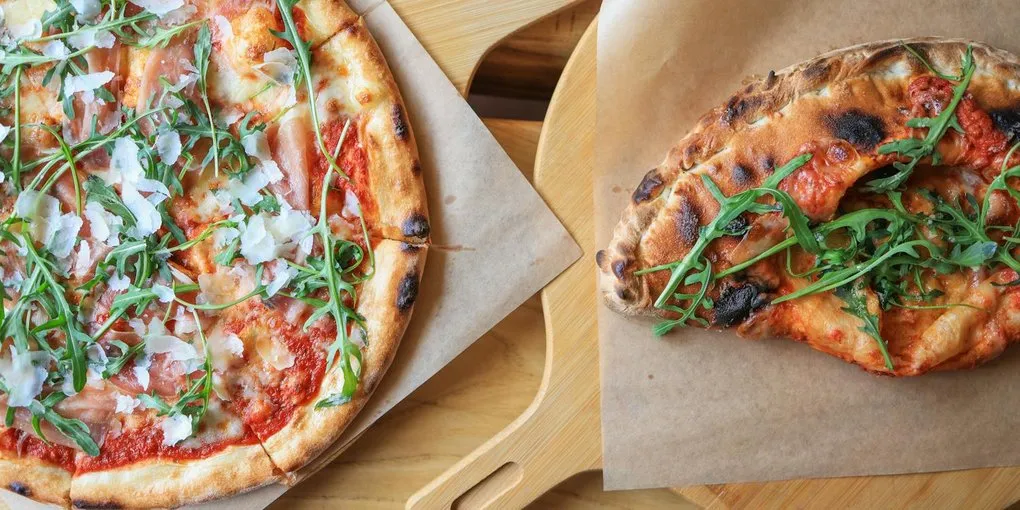
If your mental model of Italian pizza is the soft, pillowy, slightly charred Neapolitan, you’re working with half the picture. The other half lives in Rome, where pizza tonda — the round dinner pizza served at Roman pizzerias — takes the same ingredients in a completely different direction: thinner, crisper, lighter, and with a texture range that runs from cracker-crisp edges to a barely soft center.
Roman tonda uses roughly half the dough weight of a Neapolitan pizza at the same diameter. Where a Neapolitan is a study in puff and softness, a Roman tonda is a study in lightness and crunch. It’s not trying to be Neapolitan-minus-the-poof. It’s a fundamentally different approach to what a round pizza can be.
And outside of Italy, almost nobody makes it at home.
What Makes Roman Tonda Different
The defining characteristics of pizza tonda are easy to state and surprisingly difficult to replicate without understanding why each one exists.
Ultra-thin. The finished crust is dramatically thinner than Neapolitan — thin enough that you can practically see light through it at the thinnest points. This is not achieved by aggressive rolling (though Romans use rolling pins more freely than Neapolitans) but by using less dough and stretching to the same 12-inch diameter.
Crisp. Not cracker-crisp necessarily (though that’s one end of the spectrum), but with an audible crunch when you bite through. The interior texture ranges from crisp all the way through to cracker edges with a soft, slightly chewy center — determined by hydration, how thin you’ve gone, sauce moisture, and cheese moisture.
Light. Pick up a slice of Roman tonda and it’s noticeably lighter than a Neapolitan slice of the same size. Less dough, less moisture retained, more structural crispness.
Minimal border. The cornicione is barely there — about 1/4 inch, just enough to contain the toppings. Where Neapolitan pizza has that dramatic puffed rim, Roman tonda has a thin, crispy edge that almost blends into the topped area.
Simple, excellent toppings. Roman pizza tonda favors quality over quantity. Good tomatoes, olive oil, anchovies, dried oregano, fior di latte. Seasonal cherry tomatoes — fresh or semidried — are popular. The toppings are applied lighter than on American-style pizza because the thin crust can’t support heavy loads.
The Rest-of-Italy Default
Here’s something worth understanding about Italian pizza culture: the soft, leopard-spotted, slightly charred Neapolitan that dominates international attention is actually the regional exception. What most Italians outside Naples eat on a typical weeknight is crispier, more browned, less leoparded, and baked at a lower temperature than the AVPN standard.
Myhrvold calls this “Rest-of-Italy Neapolitan” or “classico” — and he found it at the majority of top-rated Rome pizzerias. It has more in common with the best artisan pizzerias in the United States than with Da Michele in Naples.
The AVPN marketing slogan — “If you hear a crunch, it’s not authentic” — was a direct shot at this broader Italian tradition. But the tradition predates the AVPN by centuries. Most Italians actually prefer some crunch in their crust. Roman tonda is the purest expression of that preference.
This matters for home bakers because it means Roman tonda is perfectly suited to home oven temperatures. You don’t need 900F to make an excellent Roman pizza. Your 550F home oven with a baking steel produces the moderate, sustained heat that this style was designed for.
Gemignani’s Romana Dough: A World Championship Formula
Tony Gemignani won the Pizza Romana category at the 2011 World Championships of Pizza Makers in Naples — the first American to do so. His winning entry was a quattro regioni: four quadrants representing Rome (carbonara with pancetta and scrambled eggs), Naples (caprese with bufala, tomatoes, basil), Puglia (burrata, white anchovies, lemon), and Calabria (diavola with soppressata piccante and Calabrese peppers).
His Romana dough formula is distinctive among his 14 published dough recipes. Several of its parameters push to the extremes of his range:
| Ingredient | Amount | Baker’s % |
|---|---|---|
| Flour (13-14% protein) | 453g | 100% |
| Ice water | 237g | 52.3% |
| Warm water (80-85F) for yeast | 70g | 15.5% |
| Total water | 307g | 67.8% |
| Poolish | 23g | 5.1% |
| Fine sea salt | 14g | 3.1% |
| Diastatic malt | 9g | 2.0% |
| Active dry yeast | 1g | 0.22% |
The total hydration with the poolish contribution comes to 68.5%. Three things stand out immediately:
The highest salt percentage of any Gemignani formula: 3.1%. Tied only with his multigrain dough. Neapolitan tradition uses high salt (the AVPN spec is 3%) to slow fermentation in ambient-temperature proofing, and Gemignani carries that principle into his Roman formula. The salt also strengthens gluten, providing structure that the ultra-thin crust needs.
The lowest yeast percentage of any formula: 0.22%. This is less than half the yeast in his Napoletana dough (0.5%) and a fraction of his Master Dough without starter (1.0%). Tiny yeast amounts mean long, slow fermentation — and Romana dough gets a full 8-hour room temperature rise after shaping.
High-protein flour. Not Italian 00, but 13-14% protein American bread flour — preferably Pendleton Flour Mill’s Power or Giusto’s High-Performer. The stronger gluten network is necessary because the dough will be stretched extremely thin, and weak flour would tear before reaching the target diameter.
Making the Dough
The method follows Gemignani’s standard approach with one critical difference in the shaping stage:
Day 1: Mix and Refrigerate. Mix flour and diastatic malt. Add ice water, then the warm water with activated yeast, then the poolish. Mix about 1 minute on the lowest speed of a stand mixer with dough hook, scrape, add salt, mix 1-2 more minutes. Knead on an unfloured surface for 2-3 minutes until smooth.
Form into a ball. Wrap tightly. Cold ferment in the refrigerator for 24-48 hours.
Day 2: Shape and Rise. Remove from fridge. Shape into a football or oval (not a round ball — this is the difference). Pat to approximately 8x4 inches on a half sheet pan. Cover with a damp towel and let rise at room temperature for 8 hours. Re-dampen the towel if it dries.
The oval shape and the long room-temperature rise are both specific to this formula. The low yeast amount means 8 hours is needed to reach proper fermentation. The oval shape determines the final pizza shape — Roman tonda is often slightly oval rather than perfectly round.
Day 2 (evening): Stretch and Bake. The dough should be relaxed, airy, and easy to handle. Shape by pressing from center outward, leaving a minimal border of about 1/4 inch. The target is ultra-thin — thinner than you think is right for the first few attempts. You can use a combination of hand stretching and a rolling pin (Romans have no prohibition against rolling pins the way Neapolitans do).
The Pomodoro Method: Cheese After Baking
One of the most distinctive Roman pizza traditions is the pomodoro variation: the crust is baked with only tomato sauce and olive oil, and cheese is grated on top after it comes out of the oven.
This is not a cost-saving measure. It produces a fundamentally different flavor and texture experience. The baked tomato sauce concentrates and caramelizes slightly on the ultra-thin crust. The freshly grated cheese — typically pecorino or caciocavallo — sits on top unmelted, providing sharp, room-temperature dairy flavor against the hot, crisp base.
The practical benefit is significant for home bakers: removing cheese from the baking equation means the crust can brown and crisp without the thermal insulation that melting cheese creates. Myhrvold’s research showed that mozzarella actually becomes whiter as it bakes (opposite of most foods), absorbing less heat as it cooks. By skipping the cheese during baking, you let all the radiant and conductive heat go directly into crisping the crust.
If you’ve never tried it, the pomodoro approach is a revelation. It also makes Roman tonda one of the fastest pizzas to assemble and bake — sauce, oil, oven, grate cheese, eat.
Baking Roman Tonda at Home
Roman tonda is one of the most home-oven-friendly pizza styles because it actually benefits from the moderate heat and longer bake time of a 550F kitchen oven.
Steel on upper rack, 6-8 inches below the broiler. Preheat for at least 45 minutes at maximum temperature. The ultra-thin dough needs aggressive bottom heat to crisp before it dries out — steel’s thermal conductivity (18-20x higher than cordierite stone) is particularly advantageous here. For a deeper comparison of baking surfaces, see our steel vs stone guide.
Bake time: approximately 7 minutes. The thin profile means the pizza cooks relatively quickly even at home oven temperatures. Watch for the bottom to develop dark brown spots (check by lifting an edge with a metal peel). The top should show bubbling and slight char on the thinnest areas.
Broiler finish. A minute under the broiler after the initial bake drives top browning and creates the characteristic bubbled texture on the surface. This compensates for the relatively low radiant heat in a home oven compared to a professional Roman deck oven (which runs at 520-595F).
Gemignani’s two-stone method. For the crispest possible bottom, use his “favorite discovery for home pizza” — a steel on the upper rack and a second on the bottom rack, preheated for a full hour at 500F. Start the pizza on the top steel for 6 minutes, then transfer to the bottom steel (which hasn’t been cooled by contact with dough) for 5 more minutes. Total: about 11 minutes of progressive crisping. For more on home oven baking techniques, we have a dedicated guide.
Expected Results
When you nail Roman tonda at home, here’s what you’re looking for:
Appearance. 12 inches or larger when stretched. Sauce spread almost to the edge with only a 1/4-inch border. Very thin, with visible bubbling at the rim and across the surface. Light golden to medium brown coloring with darker spots where the crust is thinnest.
Texture. Crisp. Audibly so at the edges, potentially with a slight softness in the very center if you’ve used higher moisture toppings. Very light to pick up — you should notice the weight difference from Neapolitan immediately.
Structure. Slices may not flop (depending on topping moisture level). A properly baked Roman tonda slice holds its shape when picked up, with a stiffness that Neapolitan never achieves.
Underside. Spotted dark brown or even black leopard marks from the steel contact. This is desirable — the dark spots indicate Maillard browning and direct contact charring.
Toppings That Work on Thin Crust
The thin, crisp base of Roman tonda means topping strategy matters more than with sturdier styles. Less is more, and moisture management is critical.
Tomato sauce: thin. Spread a thin layer — you should be able to see the dough through the sauce. Gemignani’s Napoletana sauce (San Marzano processed through a food mill with just salt) works perfectly: it’s intentionally thin because you see dough through it.
Cheese: restrained. If baking with cheese (not using the pomodoro method), use fior di latte sliced thin or torn into small pieces. Add it partway through the bake (4 minutes into a 7-minute home oven bake) to prevent overcooking.
Classic Roman combinations. Marinara (tomato, garlic, oregano, oil — no cheese). Capricciosa (artichokes, ham, mushrooms, olives). Fiori di zucca (zucchini flowers, anchovy, mozzarella). Cacio e pepe (pecorino, black pepper, no tomato). Potato and rosemary (thinly sliced potato, rosemary, oil — a Roman classic that translates perfectly to home ovens).
Post-bake additions. Brushstrokes of good olive oil after baking. Freshly grated hard cheese (pecorino, caciocavallo, Grana Padano). Fresh arugula. Prosciutto laid on after slicing (Gemignani’s Commandment #9: slice before adding finishing ingredients).
Why You Should Be Making Roman Tonda
Three reasons this style deserves more attention from home pizza makers:
It matches your equipment. Home ovens at 500-550F are in the ideal temperature range for Roman-style crispness. You’re not fighting your oven’s limitations — you’re working with them. Professional Roman deck ovens run at 520-595F, almost exactly where your home oven sits.
It’s fast once the dough is ready. The ultra-thin profile means assembly takes seconds (sauce, oil, maybe cheese), the bake takes 7 minutes or less, and the result is immediately ready to eat. No resting period. No racing-stripe sauce application. Stretch, top, bake, eat.
It expands your range. If you’ve been making only Neapolitan-style pizza at home, Roman tonda is a different experience that uses largely the same ingredients and equipment. The shift in technique (thinner stretch, less dough, crispier bake, cheese-after-baking option) opens up a whole category of pizza you may never have considered. And if you want to explore Rome’s other signature style, see our guide to Roman pizza al taglio.
The fact that Roman tonda is what most Italians actually eat most of the time — not the AVPN-certified Neapolitan that dominates Instagram — should tell you something about its staying power as a style. It’s been refined over generations to be exactly what it is: thin, crisp, light, and deeply satisfying.
The Bottom Line
Roman tonda is the crisp, light counterpoint to Neapolitan’s soft puff. Same diameter, half the dough, dramatically different eating experience. Gemignani’s championship Romana formula — 68.5% hydration, 13-14% protein flour, 3.1% salt, 0.22% yeast, 8-hour room temperature rise — produces an ultra-thin crust that crisps beautifully in a standard home oven.
The pomodoro method (cheese grated on after baking, not before) is the key technique to try first. It eliminates the thermal insulation of melting cheese, lets the crust achieve maximum crispness, and produces a flavor combination that changes how you think about pizza.
If you’ve been chasing Neapolitan perfection in a 550F oven and wondering why your results never quite match the benchmark, consider that you might be making the wrong style for your equipment. Roman tonda was built for this temperature range. The crunch is the feature, not a defect.
Frequently Asked Questions
- What is Roman tonda pizza?
- Roman tonda (also called pizza tonda Romana) is Rome's round dinner pizza -- ultra-thin, crisp, and light, using roughly half the dough weight of a Neapolitan pizza at the same diameter. It features a minimal 1/4-inch border, a crust that ranges from cracker-crisp to lightly crunchy, and a restrained approach to toppings that emphasizes quality over quantity.
- How is Roman pizza different from Neapolitan pizza?
- The key differences are thickness (Roman is much thinner), texture (Roman is crisp vs Neapolitan's soft center), border size (1/4 inch vs a puffed cornicione), and baking temperature (Roman bakes at 520-595F vs Neapolitan at 905F). Roman tonda often uses higher-protein flour and allows rolling pins for shaping, both of which are prohibited under Neapolitan AVPN rules.
- Can I make Roman tonda in a regular home oven?
- Yes -- Roman tonda is one of the most home-oven-friendly pizza styles. Professional Roman deck ovens run at 520-595F, which is almost exactly the range of a standard home oven at maximum temperature. Use a baking steel on the upper rack, preheat for 45+ minutes, and bake for about 7 minutes with a broiler finish.
- What flour should I use for Roman pizza dough?
- Gemignani's championship Romana formula calls for 13-14% protein bread flour (not Italian 00). The stronger gluten network is necessary because the dough will be stretched extremely thin and needs to hold together. Recommended brands include Pendleton Power Flour and Giusto's High-Performer.
- What is the pomodoro method for Roman pizza?
- The pomodoro method involves baking the pizza with only tomato sauce and olive oil, then grating cheese on top after it comes out of the oven. This allows the crust to achieve maximum crispness without the thermal insulation of melting cheese. Typical cheeses for the post-bake grating include pecorino and caciocavallo.
- How long does Roman pizza dough need to rise?
- Gemignani's Romana formula uses an extremely low yeast percentage (0.22% -- the lowest of his 14 dough formulas), which requires a 24-48 hour cold ferment followed by an 8-hour room temperature rise after shaping. The long, slow fermentation develops complex flavor while the low yeast and high salt (3.1%) prevent over-proofing.
- What is rest-of-Italy classico pizza?
- Myhrvold uses this term to describe the crispier, more browned, less leoparded pizza found at the majority of top-rated pizzerias outside Naples. This style -- which Roman tonda represents -- is what most Italians actually eat most of the time. It has more in common with the best American artisan pizzerias than with traditional Neapolitan pizza.