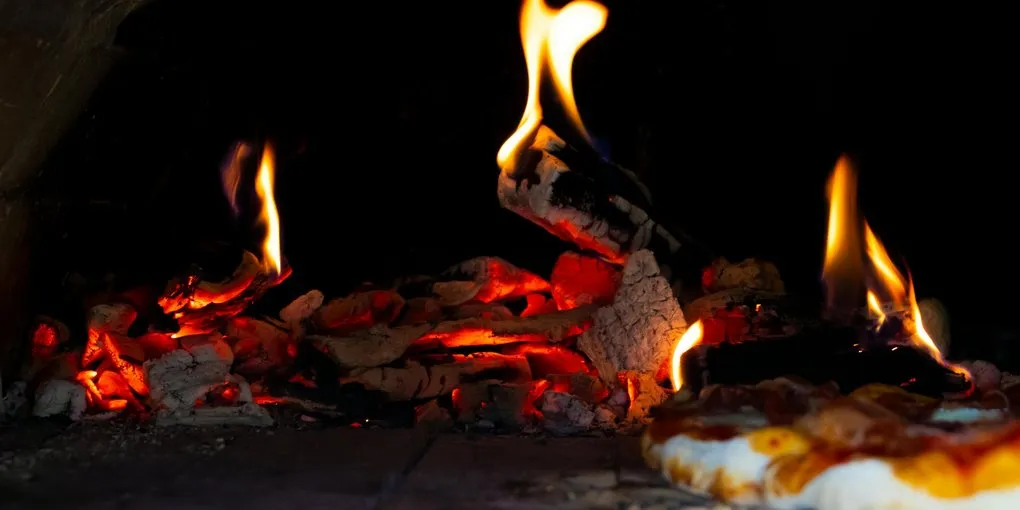
Every home pizza maker has been told the same thing: keep your stone clean. Brush it. Flip it. Run it through a self-clean cycle. A spotless baking surface is supposed to be the mark of a careful cook. The measurements say the opposite. A clean firebrick floor is more likely to scorch the underside of your pizza than a sooty, blackened one. And the explanation is a single number — emissivity — that almost nobody talks about outside the physics literature.
This isn’t a hack or a folk belief. It comes out of Nathan Myhrvold’s instrumented testing in Modernist Pizza and gets independently confirmed by working Neapolitan pizzaioli in Tokyo and Naples. A black, well-used floor bakes pizza more uniformly than a freshly scrubbed stone. The reason runs against intuition, but once you see the physics, you’ll change how you maintain your home setup — and probably stop scrubbing entirely.
For the full thermodynamics framework — the three heat transfer modes, the T⁴ radiation law, why a 500F home oven is not a 500F wood oven — see pizza oven thermodynamics. This piece zooms in on one specific finding from that framework: the surface emissivity of your oven floor, and what that means in practice.
The Emissivity Numbers
Emissivity is a dimensionless measure of how efficiently a surface radiates and absorbs thermal radiation, expressed as a decimal between 0 (perfect reflector) and 1 (perfect blackbody emitter). It’s the single number that tells you how a surface “trades” infrared energy with everything around it.
Here are the values that matter for pizza:
- Clean firebrick floor: approximately 0.68
- Sooty, blackened firebrick floor: approximately 0.95
- Refractory dome (working oven, matt finish): approximately 0.93
- Raw white dough: approximately 0.1 (reflects 90% of incident radiation)
- Browned crust as it darkens: approaches 0.9
- Bare or lightly seasoned baking steel: roughly 0.3–0.5 (well below true polished steel at ~0.07–0.14, but well below an oxidized, well-darkened steel at ~0.85+)
The clean stone reflects about a third of the radiant energy hitting it from the dome. The sooty stone absorbs almost all of it. That difference, ~0.27, doesn’t sound dramatic. In practice, it changes everything about how the floor behaves during a bake.
Why “Sooty = Gentler” Sounds Wrong But Isn’t
The intuitive reading goes: “Higher emissivity means the sooty stone radiates MORE heat upward into the bottom of the pizza, so it should burn MORE, not less.” That’s where most people stop. The full picture has two parts.
Part one — sooty surfaces also absorb more. Emissivity isn’t just about emission. By thermodynamic symmetry — Kirchhoff’s law of thermal radiation, which states that at thermal equilibrium a surface’s spectral emissivity equals its spectral absorptivity — a surface’s ability to absorb radiation equals its ability to emit it at the same wavelength. The clean firebrick at 0.68 is reflecting roughly 32% of the radiant energy coming down from the dome and the embers. That reflected energy bounces back into the oven cavity rather than entering the stone. The sooty stone at 0.95 absorbs nearly all of it.
Part two — what happens to the absorbed energy. When you reflect heat instead of absorbing it, the energy doesn’t disappear — it goes back into the oven cavity, where the dome absorbs it. So the dome runs slightly hotter, and now the dome (a powerful radiator) is dumping even more T⁴-scaled radiation back down. The clean floor and the dome end up in a feedback loop, with the floor sitting at a higher equilibrium temperature than the sooty floor for the same fire input.
In other words: the clean firebrick floor reaches a higher temperature than the sooty one, even though it’s a less efficient radiator. Myhrvold’s measurements confirm this directly [Myhrvold pp. 384-385]. The result is that conduction from a clean stone is more aggressive at the contact point, while the sooty stone delivers a more even radiative load combined with gentler contact heat. Pizzas on the clean stone scorch in spots; pizzas on the sooty stone bake uniformly.
This is also why surface condition matters on home equipment. A darkened, well-seasoned pizza steel outperforms a brand-new shiny one for the same reason a sooty stone outperforms a clean one. Pristine surfaces look better and bake worse.
The Tokyo Datapoint
Tokyo has somewhat improbably become a great pizza city, and that makes it a useful real-world test of the emissivity finding. The Neapolitan-style pizzeria scene in Tokyo runs deep — multiple AVPN-certified rooms, several Italian pizzaioli running flagship operations, and a high concentration of gas-fired (not wood-fired) ovens running daily on the same equipment for years. Modernist Pizza singles out Tokyo as one of its regional deep-dive cities for exactly this reason.
Two characteristics make Tokyo a useful natural experiment:
Most ovens are gas, not wood. The fuel cost economics in central Tokyo make wood-fired operation difficult, so many of the city’s celebrated Neapolitan pizzerias run dome ovens on gas at the same surface temperatures as Naples. This already aligns with what the physics predicts — gas and wood produce similar pizzas if the dome and floor temperatures match, since the flame itself is “optically thin” and the pizza only “sees” heated surfaces — but the kicker is the floor condition.
Floors blacken naturally with high-volume operation. A pizzeria running dozens of pies a night for years accumulates carbon on its baking floor. Some of that carbon comes from flour dusted off pizza skins; some comes from cheese drips and topping char. Tokyo pizzaioli generally don’t aggressively scrub their floors. Many will tell you the oven gets better with age, and they specifically point to the darkened floor as part of why.
The qualitative report from working Neapolitan pizzaioli is consistent with the Myhrvold finding: a pizza launched onto a black, well-used floor bakes slowly and uniformly, while a pizza on a freshly cleaned stone scorches in spots. This is folk wisdom in Naples too — old-timers will tell you not to scour the oven floor — but Tokyo gives you a high-volume, gas-fired version of the same datapoint, which is harder to dismiss as romanticism.
The accumulated soot is a functional part of the oven’s thermal behavior. It’s part of the equipment, not contamination of it.
How Home Cooks Approximate the Sooty-Floor Effect
A home oven floor is not a Neapolitan dome and never will be. The peak surface temperatures are too low, the radiant geometry is wrong, and there’s nothing equivalent to a refractory dome above your pizza. But you can borrow the principle — better-distributed radiant load instead of concentrated conductive heat — to improve a home bake.
Use the broiler aggressively for top-down radiation. This is the single most important move. Position your pizza steel on the upper rack, ideally 6-8 inches below the broiler element. Preheat for at least 45 minutes with the oven set to maximum temperature. About 5 minutes before launch, switch to BROIL to superheat the steel surface and to put the broiler element near peak emission. Switch back to BAKE just before sliding the pizza in, so the heating element doesn’t kick off mid-bake. Then re-engage broil for the final 2-3 minutes to drive top-down char. This protocol is the home-oven equivalent of having a hot dome — the broiler “pretends” to be the radiating surface that an aged sooty floor would otherwise contribute.
Don’t scrub a darkened steel. Surface darkening on a baking steel is a feature, not a defect. Carbon accumulation raises emissivity, which means the surface absorbs and re-radiates heat more efficiently — exactly the same physics as the sooty firebrick floor. Brush off loose flour and char between bakes, but don’t return your steel to bare metal. If it’s lightly seasoned and dark, leave it.
For ceramic stones, accept the patina. A new cordierite stone will scorch pizza bottoms more aggressively than the same stone after 30-50 bakes. The white spots will fade, the surface will pick up dough sugars and flour residue, and the pizza will brown more evenly. Do not run the stone through a self-clean cycle to “renew” it — you’ll reset the seasoning and reintroduce the spotty-scorch problem. If you have a biscotto stone, this matters even more, since biscotto’s lower thermal conductivity is part of why it bakes so gently to begin with.
Calibrate your broiler approach. The right distance to the broiler depends on your specific oven. Too close and the cornicione blackens before the bottom sets; too far and you lose the radiant punch. An infrared thermometer pointed at the steel surface will tell you whether you’re hitting the temperature profile you want. A note on the IR reading itself: emissivity changes the answer. A thermometer calibrated for stone (preset around 0.95) will read a bare or lightly seasoned steel surface (0.3-0.5) inaccurately — sometimes by 100F or more. If your gun has adjustable emissivity, set it to match. If not, treat steel readings as relative, not absolute.
Don’t aggressively dust the steel between pizzas with a damp cloth. Some recipes call for this. A damp cloth pulls heat from the steel and creates micro-cool zones — exactly the opposite of what you want. Use a dry brush only, and only between bakes when the surface needs cleaning.
For a full home oven setup walkthrough — rack position, preheat times, hydration adjustments — see home pizza oven temperature guide.
When to Clean Your Stone
The “don’t scrub” rule has a limit. There’s a point at which accumulation becomes a problem rather than a feature, and recognizing that point matters.
Burnt sugar deposits taint flavor. Cheese drips and topping char that don’t burn off can sit on the stone and re-volatilize on subsequent bakes, putting acrid notes into the bottom of your pizza. This is different from carbon patina — sugar deposits look glossy and char-spotted rather than evenly black, and they smell bitter when the stone is hot. If you can smell burnt sugar coming off your stone during preheat, it’s time to clean that section.
Smoke point matters. Soot is fine; smoldering organic matter is not. If your stone is producing visible smoke during preheat, you’ve crossed the line from useful patina to active off-gassing, and that smoke will land on the bottom of your pizza. Clean it.
Practical maintenance: After every bake, while the stone is still warm (not hot), brush off loose char and flour with a dry, stiff brush. Once a month or so, run the oven empty at maximum for 30-45 minutes to burn off accumulated residue. The carbon patina survives this; sugar deposits and proteins don’t. Don’t wash with water — thermal shock can crack a hot stone, and any soap residue you leave behind will get into your dough.
Never use water on a hot stone or steel. This is the rule even Tony Gemignani repeats in his master class. Water will crack ceramic by thermal shock and rust unprotected steel. If the stone needs deep cleaning, let it cool fully first, scrape with a metal blade, and dry it completely before the next use.
The goal is a black, dry, dusty surface — not a glossy, sugared, smoky one. Aged sooty floors in Naples and Tokyo manage this distinction by sheer volume; high-volume pizzerias burn off any sugar deposits within a single shift. Home setups bake less often, so the discipline is yours to enforce.
The Bottom Line
The lesson from the emissivity number is that surface condition matters, and the direction of the effect is the opposite of what most home cooks assume. A clean stone is not a better stone. A dark stone bakes more evenly, more gently, and more like a Neapolitan oven floor than a freshly scrubbed one ever will. Stop scrubbing. Start watching the patina build. Your pizzas will get better with the same equipment.
Related reading:
- Pizza oven thermodynamics — the parent pillar covering all three heat transfer modes
- Pizza stone vs pizza steel — material science of baking surfaces
- Biscotto stone pizza oven — why traditional Neapolitan clay bakes gentler
- Pizza oven flame guard / heat diffuser — the equivalent fix for portable-oven temperature gradients
- Home pizza oven temperature guide — full home setup walkthrough
Sources: Myhrvold & Migoya, Modernist Pizza Vol 1 (2021), pp. 384-385 (clean vs sooty floor emissivity), p. 397 (raw dough vs browning crust emissivity); Masi, Romano & Coccia, The Neapolitan Pizza: A Scientific Guide (2015), p. 85 (refractory brick dome at 0.93); Gemignani, The Pizza Bible (2014), Master Class on stone care; ASTM E408 and E1933 emissivity measurement standards; published infrared emissivity tables for refractory and metal surfaces (IFRF, ThermoWorks, Cole-Parmer); Kirchhoff’s law of thermal radiation (Kirchhoff, 1860).
Frequently Asked Questions
- Should I clean my pizza stone before every bake?
- No. Brush off loose flour and char with a dry, stiff brush, but don't scour back to bare ceramic. A darkened, well-used stone bakes pizza more evenly than a freshly cleaned one because higher surface emissivity (~0.95 for a sooty stone vs ~0.68 for a clean one) translates to a more uniform radiative load and a lower equilibrium floor temperature. The clean stone reaches a higher temperature for the same heat input and is more likely to scorch the bottom of your pizza in spots.
- Why does emissivity affect pizza bottom char?
- Emissivity controls both how efficiently a surface absorbs incoming radiation from the oven dome and how efficiently it re-radiates that energy. By Kirchhoff's law, absorptivity equals emissivity at the same wavelength. A sooty surface (emissivity ~0.95) absorbs nearly all incoming radiation and reaches a moderate, stable equilibrium temperature. A clean surface (emissivity ~0.68) reflects about a third of incoming radiation back into the oven cavity, which heats the dome further, which sends more T⁴-scaled radiation back down — driving the clean floor to a higher equilibrium temperature than the sooty one. The result is more aggressive conduction at the contact point and spotty scorch marks on the underside of the pizza.
- Can I scrub my pizza stone in a self-clean cycle?
- Don't. A self-clean cycle returns the stone to bare ceramic and removes the accumulated carbon patina that improved its baking behavior. Patina is a feature, not a defect. The first 30-50 bakes after a deep clean will scorch more aggressively than they did before, until the surface darkens again. The exception is if your stone has burnt-sugar deposits that are smoking or smelling bitter during preheat — those need to come off, but a single 30-45 minute empty preheat at maximum temperature will usually burn them off without resetting the carbon patina.
- Does the same emissivity rule apply to a baking steel?
- Yes. A bare or lightly-seasoned steel surface has emissivity around 0.3-0.5, depending on finish (a true mirror-polished steel is even lower, around 0.07-0.14). As the steel darkens with seasoning and accumulated carbon, emissivity climbs above 0.85 and the steel behaves more like a Neapolitan dome floor. Don't scrub a darkened steel back to bare metal. Brush off loose char and flour, but leave the patina in place. This is also why dark or 'blued' pizza steels are recommended over shiny stainless — they start with higher emissivity and absorb the dome's radiant energy more efficiently from day one.
- Why do Naples and Tokyo pizzaioli leave their oven floors black?
- Because the floors bake better that way. Working pizzaioli in both cities — including the gas-fired Neapolitan-style operators in Tokyo, which is one of the world's best pizza cities despite running mostly on gas — confirm the qualitative finding from Myhrvold's instrumented testing: pizza on a black, well-used floor bakes slowly and uniformly, while pizza on a freshly scrubbed stone scorches in spots. Tokyo is a particularly clean test because the city's high-volume gas-fired Neapolitan-style ovens accumulate carbon naturally over years of operation, and the resulting darkened floors are part of why those operations produce such consistent results.
- How does emissivity affect my infrared thermometer reading?
- Significantly. An infrared thermometer assumes a particular emissivity value (most pizza-marketed guns are preset for stone at 0.9-0.95). If you point it at a bare or lightly-seasoned baking steel (emissivity 0.3-0.5), the reading can be off by 100F or more. If your thermometer has adjustable emissivity, match it to the surface you're reading. If not, treat steel readings as relative trend information rather than absolute temperatures, and verify stone-style readings only on stone.