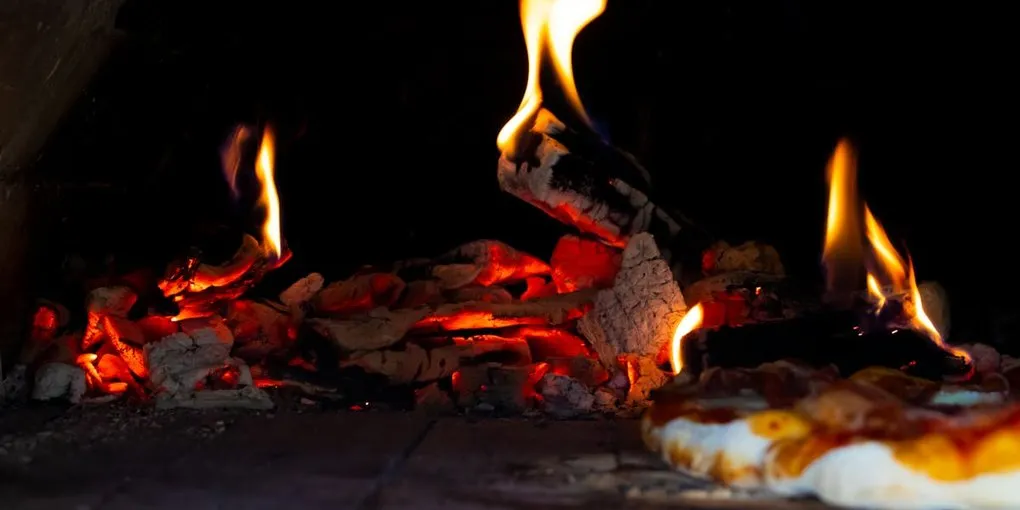
The number one complaint from Ooni Koda 16 owners is not about temperature, fuel, or build quality. It is about uneven heat. The L-shaped rear burner creates a temperature gradient of 200F or more from the back-left hot zone (850-950F) to the front-right corner (around 700F). The result: the back of your pizza chars while the front stays pale. You compensate by turning every 15-20 seconds, but even with diligent rotation, one side is always slightly more done than the other.
Flame guards and heat diffusers solve this problem directly. In terms of cost-to-improvement ratio, they are the single best upgrade for any portable pizza oven — the #1 rated mod in the Ooni community.
The Temperature Gradient Problem
To understand why flame guards matter, you need to understand what is happening inside your oven.
Ooni Koda 16: The 29,000 BTU L-shaped gas burner runs along the back and wraps around the left side. This design creates a rolling flame across the ceiling of the oven, which is how the oven reaches 932F. But the flame intensity is highest near the burner and diminishes toward the front opening. The back-left zone (where the L-burner elbows) typically reads 850-950F on an infrared thermometer. The front-right zone, nearest the mouth, reads approximately 700F. That is a 200-250F gradient across a 16-inch surface.
Gozney Roccbox: The gas burner sits at the rear with a patented baffle plate that creates turbulence, spreading flame laterally across the dome to simulate a wood-fire rolling effect. It is better engineered than the Koda 16’s raw burner, but a 200-250F gradient still exists from back (800-850F) to front (around 600F).
Why this matters for pizza: Thermal radiation follows the T-to-the-fourth power law (Stefan-Boltzmann). At 900F, the rear of the oven produces dramatically more radiant heat than the front at 700F. This is not a linear difference — it is exponential. The pizza crust facing the burner receives vastly more energy per second than the side facing the mouth. Without rotation every 15-20 seconds, that differential produces one-sided charring. For the full physics of how oven thermodynamics affect your bake, that guide covers radiation, conduction, and convection in detail.
What Flame Guards Do
A flame guard (also called a heat diffuser or flame tamer) is a metal barrier that sits between the burner and the pizza, intercepting direct flame and redistributing it. The guard absorbs radiant heat from the burner, heats up, and re-radiates more evenly. Some designs also redirect airflow to push heat toward the front of the oven — the zone that is chronically underheated.
The two primary products for Ooni and Gozney ovens are the 222Steel flame guard and the NU2U Flame Tamer. Both address the same problem through slightly different engineering.
222Steel Flame Guard (Ooni Koda 16)
The 222Steel is a 2-piece stainless steel set — a 14-inch piece and an 11-inch piece, approximately 3.25 inches tall — designed specifically for the Ooni Koda 16. Retail price is approximately $60. Available on Etsy and Amazon.
The set positions between the L-shaped burner and the baking stone. It blocks direct flame from reaching the pizza and instead forces heat to travel across the ceiling of the oven before descending onto the pizza surface. This eliminates the most aggressive hot spot (the back-left corner where the L-burner elbow sits) and creates a more uniform temperature distribution across the stone.
The community consensus on the 222Steel is remarkably consistent. The phrase that appears repeatedly across pizza forums, Reddit, and the Ooni Facebook groups is “total game changer.” Specifically:
- Prevents crust catching fire — direct flame can no longer contact the pizza surface or cornicione
- Reduces rotation frequency — instead of turning every 15-20 seconds, users report turning every 30-45 seconds
- More consistent leopard spotting — the even heat distribution produces more uniform char patterns instead of one burnt side and one pale side
A 222Steel set is also available for the Ooni Koda 12.
NU2U Flame Tamer (Ooni, Roccbox, Dome)
The NU2U Flame Tamer takes a different approach. Built from 1/4-inch carbon steel (laser-cut, CNC-bent), the Flame Tamer for the Ooni Koda 16 retails at approximately $74.
Where the 222Steel primarily blocks and redistributes flame, the NU2U acts as both a heat sink and a heat redirector. The 1/4-inch carbon steel absorbs substantial thermal energy from the burner. That stored energy then radiates in all directions, including forward — toward the front of the oven where temperatures are chronically low.
Users report two specific improvements with the NU2U that the 222Steel does not deliver as strongly:
The front of the oven gets meaningfully hotter. Users report the front of the Koda 16 reaching 600F or higher for the first time with the NU2U installed. This addresses the chronic cold-front problem that causes the mouth-facing edge of pizza to be undercooked.
Preheat time reportedly decreases. Some users report the oven reaching target temperature faster with the flame tamer installed — community reports suggest warm-up time cut by as much as half — because the carbon steel mass acts as a secondary heat source that continues radiating after it is saturated.
The NU2U is also available for the Ooni Koda 12, Gozney Roccbox ($74, 3/8-inch low-carbon steel), and Gozney Dome ($74-80). For the Roccbox specifically, the NU2U prevents hot spots, blocks wind from blowing out the flame (a real issue for the Roccbox in breezy conditions), and redirects flame into the dome for a better rolling flame effect.
How Much Difference Does It Actually Make?
The honest answer: substantial, but not miraculous. Here is what changes and what does not.
What improves:
The temperature gradient across the stone narrows significantly. Instead of 200-250F from back to front, users consistently report 100-150F gradients with a flame guard installed. This is still a meaningful difference — you still need to rotate — but the rotation timing becomes much more forgiving.
The bottom of the pizza and the top cook at a more similar rate. Without a flame guard, direct burner flame hitting the cornicione can char the top of the rim before the bottom is done. With a guard, the heat arrives as reflected radiation rather than direct flame, which cooks the top more gently and evenly.
Recovery between pizzas remains good. The flame guard absorbs heat during the cook, and when you crank the burner to high between pies, the guard’s stored thermal energy actually helps re-charge the stone faster.
What does not change:
The oven still has a hot zone and a cool zone. Physics does not allow a single rear burner to heat a rectangular space uniformly. The gradient is reduced, not eliminated.
You still need to rotate. Less frequently, but you cannot set-and-forget a pizza in a portable oven with a flame guard. The guard buys you extra time between turns, which reduces stress and improves consistency, but it does not turn a portable oven into a conveyor.
The learning curve still exists. Flame management (pizza in/flame down, pizza out/flame up) is still the golden rule, and you still need to learn your oven’s behavior. The guard makes that learning curve shorter and more forgiving. If you are still working on the fundamentals of launching and rotating, a flame guard makes every session less stressful.
Doors and Windshields: The Related Upgrade
Flame guards address heat distribution. Doors and windshields address heat retention. Some owners install both.
Third-party doors for the Ooni Koda 16 (BBQ Future at approximately $30-50 on Amazon; Etsy custom doors at $40-80 from makers like Twinsovens) reduce heat loss through the open mouth. The claimed benefits include faster preheat and better temperature stability, especially in wind and cold weather.
There is a safety consideration. Ooni officially warns that doors on gas Koda models block airflow, which can cause gas buildup and dangerous temperature spikes. This warning is real and should not be dismissed. However, most aftermarket doors include ventilation holes specifically to address this concern, and practical user experience suggests that doors with ventilation holes work without safety issues. The warning may be conservative — Ooni has liability reasons to discourage modifications — but “works for most people” is not the same as “guaranteed safe for everyone.”
A safer alternative to a full door is a half-height baffle, which reduces wind intrusion without fully blocking airflow. This compromise approach is less effective for heat retention but eliminates the gas-buildup concern entirely.
Choosing Between the 222Steel and NU2U
Both products work. The differences are in emphasis.
222Steel ($60, stainless) is primarily a flame shield. It excels at preventing direct flame contact with the pizza and evening out the worst of the back-to-front gradient. It is lighter, less expensive, and easier to install and remove. Choose this if your main complaint is the crust catching fire or one-sided charring.
NU2U Flame Tamer ($74, carbon steel) is a flame shield plus heat sink plus heat redirector. It excels at improving front-of-oven temperatures and overall thermal distribution. It is heavier, which means it absorbs and radiates more heat. Choose this if your main complaint is the front of the oven being chronically undercooked — the 600F+ front temperature that users report is a specific NU2U advantage.
For the Gozney Roccbox, the NU2U is the primary aftermarket flame tamer option. It addresses hot spots, wind protection (the Roccbox flame can blow out in wind), and dome flame distribution in a single product. For a full comparison of Ooni vs Roccbox vs home oven, see our dedicated guide.
Installation
Both the 222Steel and NU2U are designed for drop-in installation. No drilling, no permanent modification, no voided warranties (the oven itself is not altered). You place the guard inside the oven in the correct position relative to the burner, preheat as normal, and bake.
The guard does change your preheating dynamics. The metal mass of the guard absorbs heat during preheat, which means the stone may take slightly longer to reach full saturation. Add 3-5 minutes to your preheat routine when first using a flame guard, and always verify center stone temperature with an IR thermometer before launching.
After baking, the guard is extremely hot. Do not remove it until the oven has cooled completely. Stainless steel (222Steel) cleans easily. Carbon steel (NU2U) will develop a patina over time, which is normal and does not affect performance.
The Complete Portable Oven Upgrade Stack
For Ooni Koda 16 owners who want the best possible results, the upgrade priority based on impact-per-dollar:
- Flame guard / heat diffuser ($60-74) — Best cost-to-improvement ratio. Solves the temperature gradient problem that causes the most failed pizzas.
- Biscotto di Sorrento stone ($129-175 depending on source) — Solves bottom scorching at high temperatures. The lower thermal conductivity of Biscotto clay releases heat more gently than cordierite, virtually eliminating bottom burns at 900F+. Combined with a flame guard, these two upgrades transform the oven. For the physics of why different baking surfaces perform differently, see our full guide.
- IR thermometer ($25-50) — Not optional. Verifying center stone temperature before every pizza is the single most important habit for consistent results. ThermoWorks IND is the best (full circle laser, adjustable emissivity) at $99. Our infrared thermometer guide covers emissivity settings and usage.
- Turning peel ($35-45) — A dedicated 7-inch perforated aluminum turning peel is far more effective than trying to turn with your launch peel. See our pizza peel guide for recommendations.
Total cost for upgrades 1, 3, and 4: approximately $120-170. This is a fraction of the oven’s purchase price and addresses the three most common sources of frustration for new portable oven owners. For a deeper look at home pizza oven temperatures, preheat protocols, and optimal temperature targets by pizza style, see our complete guide.
The Bottom Line
A $60-74 flame guard addresses the fundamental design limitation of every single-burner portable pizza oven: the temperature gradient that produces uneven baking. The 222Steel and NU2U Flame Tamer both deliver measurable improvement in heat distribution, reduced rotation frequency, and more consistent results. If you own a portable pizza oven and find yourself fighting one-sided charring, a flame guard is the first thing to buy — before a new stone, before a door, before any other accessory. The price-to-performance ratio is the best in the entire pizza equipment category.
Sources: Myhrvold & Migoya, Modernist Pizza Vol 1 (2021); Masi et al., The Neapolitan Pizza: A Scientific Guide (2015); Iacopelli, YouTube (2019-2023); community IR thermometer measurements from PizzaMaking.com, r/pizza, and OONi HACK Facebook Group.
Frequently Asked Questions
- Do I need a flame guard for my Ooni Koda 16?
- If you are experiencing one-sided charring, uneven leopard spotting, or the crust catching fire on the burner side, a flame guard directly solves these problems. The Ooni Koda 16's L-shaped burner creates a 200-250F temperature gradient from back to front. A flame guard reduces this to approximately 100-150F, making rotation less frantic and results more consistent.
- What is the difference between the 222Steel and the NU2U Flame Tamer?
- The 222Steel ($60, stainless steel, 2-piece) primarily blocks direct flame from reaching the pizza. The NU2U Flame Tamer ($74, 1/4-inch carbon steel, CNC-bent) acts as both a flame shield and a heat redistributor, absorbing heat and radiating it forward toward the oven mouth. Users report the NU2U specifically improves front-of-oven temperatures, with the front reaching 600F or higher for the first time.
- Will a flame guard slow down my preheat time?
- Slightly. The metal mass of the guard absorbs heat during preheat, which may add 3-5 minutes before the stone reaches full saturation. Always verify center stone temperature with an infrared thermometer before launching your first pizza.
- Are flame guards available for the Gozney Roccbox?
- Yes. The NU2U Flame Tamer is available for the Roccbox at approximately $74. It uses 3/8-inch low-carbon steel and addresses hot spots, blocks wind from blowing out the burner flame, and redirects flame into the dome for better rolling flame distribution.
- Is it safe to put a door on my Ooni Koda 16?
- Ooni officially warns that doors block airflow and can cause gas buildup in gas-fired Koda models. Most aftermarket doors include ventilation holes to address this concern, and practical user experience suggests they work without safety issues when properly ventilated. However, a half-height baffle is a safer alternative that reduces wind intrusion without fully blocking airflow.
- Do I still need to rotate pizza with a flame guard installed?
- Yes. A flame guard reduces the temperature gradient but does not eliminate it. Physics prevents a single rear burner from heating a rectangular space uniformly. You will still need to rotate, but less frequently -- approximately every 30-45 seconds instead of every 15-20 seconds.
- Can I use a flame guard and a Biscotto stone together?
- Absolutely. These are complementary upgrades. The Biscotto stone addresses bottom scorching (heat transfer from stone to dough), while the flame guard addresses temperature gradient (heat distribution from burner to air and surfaces). Together, they transform a stock portable oven into a significantly more forgiving pizza-making tool.