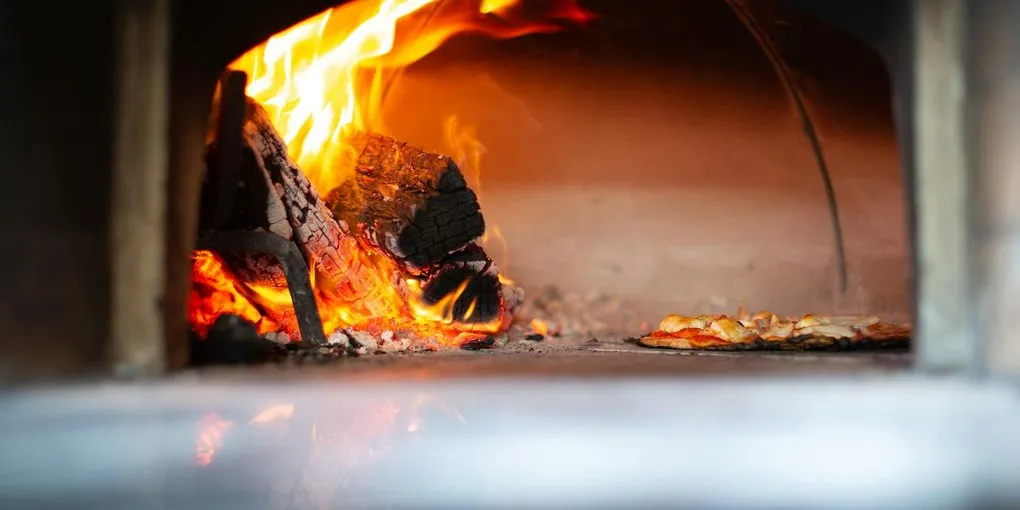
This page is about what to burn once you own a wood-burning oven. Whether to choose wood or gas in the first place is covered in wood-fired vs. gas pizza ovens. Below, maker instructions and food safety come first, then the differences between species, then the flavor question.
Start with your oven’s manual
Pizza ovens differ in what they’re built to burn, and the maker’s instructions govern. As published by each maker, checked October 14, 2026:
| Oven | Fuel it takes | What the maker says about wood |
|---|---|---|
| Ooni Karu 2 Pro | Wood or charcoal; gas with a separate burner | Dry, untreated hardwood, pieces up to 9 in (23 cm) long and 3 in (7.5 cm) across; at most 1.1 lb (0.5 kg) added at a time and 2.2 lb (1 kg) in the tray |
| Ooni Karu 2 (formerly Karu 12G) | Wood or charcoal; gas with a separate burner | Dry, untreated hardwood, pieces up to 5.9 in (15 cm) long and 1.5 in (4 cm) across |
| Gozney Dome Gen 2 | Gas, wood or charcoal, one at a time | Kiln-dried hardwood at 10–20% moisture, ideally 16%; small pieces about 5.5 in (14 cm) long and ¾ to 2 in (2–5 cm) across |
| Ooni Fyra 12 | Pellets only | Dry, food-safe pellets approved by Ooni, not wood chunks |
| Gas ovens (Koda, Arc, Roccbox as supplied) | Gas | None; Gozney’s optional Roccbox wood burner has its own manual |
Two details are worth knowing. Ooni’s Karu 2 Pro overview page gives a shorter length than its manual, logs no longer than 8 inches (20 cm), so pieces no longer than 8 inches and no thicker than 3 inches (7.5 cm) satisfy both. Length isn’t the whole instruction: keep to the manual’s load limits and first-fire steps too. And Ooni says not to use pellets in place of wood or charcoal in the Karu 2 Pro.
Which hardwoods give the most heat
Gozney’s Dome Gen 2 manual names ash, alder, oak, beech, hickory and fruitwoods such as apple and pear as good choices. Ooni sells oak for its Karu ovens. Beyond being hardwood and dry, the main difference between species is how much heat a load holds, and that follows density. As Utah State University Extension puts it, denser wood contains more heat per volume.
| Species | Density (specific gravity at 12% moisture) | Heat per cord of dry wood |
|---|---|---|
| Shagbark hickory | 0.72 | Not listed |
| White oak | 0.68 | 29.1 million BTU |
| Pecan | 0.66 | Not listed |
| American beech | 0.64 | 27.5 million BTU |
| Northern red oak | 0.63 | 24.6 million BTU (red oak) |
| Sugar maple | 0.63 | 25.5 million BTU (maples other than silver) |
| White ash | 0.60 | 24.2 million BTU |
| Black cherry | 0.50 | 20.4 million BTU (cherry) |
| Apple | Not listed | 27.0 million BTU |
Densities are from the USDA Forest Products Laboratory’s Wood Handbook; heat values are from Utah State University Extension’s firewood table. Other charts give somewhat different figures, depending on moisture and on whether they count total or recoverable heat, so read the table as a ranking rather than exact values.
In practice:
- Oak is the dependable default: dense, widely sold as kiln-dried pizza-oven wood, and named by both Gozney and Ooni.
- Hickory is the densest wood here, so a load gives a little more heat than oak.
- Beech, ash and maple sit close to red oak, and are good choices where they’re cheaper locally.
- Cherry is about a quarter less dense than white oak, so you’ll add pieces more often for the same heat.
- Apple and other fruitwoods, which Gozney lists, burn well if dry.
Kiln-dried oak pizza-oven wood and hickory are widely sold online. Check the piece size against your manual before you buy.
Dry wood matters as much as species
Freshly cut wood can be up to 50% water, according to University of Maryland Extension, and it needs to dry to below 20% to burn efficiently. Above that, it’s harder to light, gives off less heat and leaves more creosote. Gozney’s 10–20% range, ideally 16%, sits inside that limit, and the EPA’s archived Burn Wise guidance also puts the line at 20%.
- Buy kiln-dried, or season it yourself if your manual allows. Gozney’s Dome Gen 2 manual and Ooni’s Karu 2 Pro overview both ask for kiln-dried hardwood. For seasoning, the EPA’s archived guidance says at least six months and Maryland Extension says six to nine, but time alone doesn’t prove the wood is dry.
- Check it. A moisture meter is the surest test. Dry wood is darker or grayer, lighter in the hand, has cracks at the ends and sounds hollow when knocked against another piece.
- Store it well. Outdoors and off the ground, with only the top covered; covering the sides traps moisture.
What never to burn
Both makers and the EPA are clear:
- Softwoods and sappy wood. Gozney rules out pine, fir, cedar, redwood, spruce and fatwood, because sappy and soft woods produce creosote that builds up in the burner and oven. Ooni says to avoid high-resin woods.
- Anything painted, stained, coated or treated. That includes pressure-treated lumber, plywood, particle board and any wood with glue in or on it, which the EPA says can release toxic or harmful chemicals when burned.
- Ocean driftwood, and wet, rotted, diseased or moldy wood (EPA).
- Freshly cut wood (Gozney).
- Lighter fluid or petrol to start or boost the fire. Use the firelighters your manual allows.
If you can’t be sure what a piece of wood is or what it has been treated with, as with pallets and building offcuts, don’t burn it.
Charcoal and pellets
Charcoal. Where your oven allows it, Gozney recommends restaurant-grade lumpwood charcoal made from hardwood, or binchotan, in pieces about 2 to 4 inches (5–10 cm) across and completely dry. It rules out briquettes, which contain additives, self-lighting charcoal, damp or reclaimed charcoal and softwood charcoal. Ooni likewise says to use lump charcoal rather than briquettes, and not to cook until the charcoal has a coating of ash.
Pellets. Only in ovens designed for them, such as the Ooni Fyra 12, and only the pellets the maker approves.
Does the wood flavor the pizza?
No, according to Modernist Pizza. Wood smoke can flavor other foods, but in a wood-fired pizza oven the smoke rises to the top of the dome and leaves through the vent. The authors go further: if the wood is flavoring the pizza, something is wrong with the pizza maker’s technique or the oven’s cleanliness.
Fruit and nut woods such as cherry, apple, hickory and pecan can give off a pleasant aroma when burned, as Maryland Extension notes for fireplaces. Enjoy that around the oven, but choose the wood for dryness, heat and what your manual allows.
Buying and measuring
- Cords. A full cord is a stack 4 × 4 × 8 feet, 128 cubic feet. A face cord is 8 feet long and 4 feet high, but only one log-length deep, so it’s a fraction of a cord. Compare prices on the same measure.
- Size. The oven manuals above ask for pieces of 9 inches or less, far shorter than the 16 to 20 inches Maryland Extension suggests for a typical wood stove, so pizza-oven wood or small splits save cutting.
- Buy local. Maryland Extension advises against moving firewood long distances, because it can carry invasive pests such as the emerald ash borer.
Once the fire is going, readiness is about the floor, not the flames. The oven guide’s Neapolitan-style range for a portable wood-fired oven is 750 to 850°F (400 to 450°C) on the floor, checked with an infrared thermometer at three spots.
Frequently Asked Questions
- What is the best wood for a pizza oven?
- Dry, untreated hardwood of the size your oven's manual specifies. Oak is the dependable default; it is named by Gozney and sold by Ooni for its ovens. Denser hardwoods such as hickory give a little more heat per load, and lighter woods such as cherry give less. Kiln-dried wood at 10 to 20% moisture, as Gozney recommends, matters as much as the species.
- Can you taste the wood in wood-fired pizza?
- Modernist Pizza says no: in a wood-fired pizza oven the smoke rises to the top of the dome and leaves through the vent, so it doesn't flavor the pizza. If it does, the authors say, the technique or the oven's cleanliness is at fault.
- Why can't I burn pine or other softwoods?
- Gozney's Dome Gen 2 manual rules out pine, fir, cedar, redwood, spruce, fatwood and other sappy woods because they produce creosote that builds up in the burner and oven. Ooni says to avoid high-resin woods. Use hardwood only.
- How dry does pizza-oven wood need to be?
- Below 20% moisture. Gozney recommends 10 to 20%, ideally 16%, and University of Maryland Extension and the EPA both put the limit for efficient burning at 20%. Kiln-dried wood is easiest, and some manuals ask for it; where yours allows seasoned wood, season split wood for at least six months, off the ground with only the top covered, and check it with a moisture meter.
- Can I burn pallet wood or scrap lumber?
- No. The EPA says not to burn coated, painted or pressure-treated wood, plywood, particle board or anything with glue, and the oven makers call for untreated hardwood. With pallets and offcuts you usually can't know what the wood has been treated with or exposed to.
- Can I use pellets or charcoal instead of logs?
- Only if your oven's manual allows it. The Ooni Fyra 12 runs on Ooni-approved pellets, while Ooni says not to use pellets in place of wood or charcoal in the Karu 2 Pro. Where charcoal is allowed, use hardwood lump charcoal, not briquettes or self-lighting charcoal.
Sources
- Ooni: Karu 2 Pro oven manual, lighting instructions (wood size and amounts, charcoal, ash), and Karu 2 Pro US overview (kiln-dried logs no longer than 8 inches, high-resin and treated fuels, lump charcoal); Karu 12G / Karu 2 manual, lighting instructions; Karu 2 tools and fuel guide (oak logs, lumpwood charcoal); Fyra setup and fuel guide (pellets). Checked October 14, 2026.
- Gozney: Dome Gen 2 Series US/Canada manual, pages 8 and 51–53 (fuel safety, wood and charcoal to use and avoid, moisture, piece size); Roccbox product page (optional wood burner). Checked October 14, 2026.
- US Forest Products Laboratory, Wood Handbook: Wood as an Engineering Material (FPL-GTR-190, 2010), Table 5–3a, pages 5–4 to 5–6: specific gravity at 12% moisture content.
- Michael Kuhns and Tom Schmidt, Utah State University Extension, “Wood Heating”, Table 1 (heat per cord of dry wood; density and heat). Checked October 14, 2026.
- University of Maryland Extension, Buying and Storing Firewood and Pellets (FS-937, 2012): moisture, seasoning, species aroma, cord measures, moving firewood.
- US EPA Burn Wise, “Best wood-burning practices” (moisture, seasoning, storage, what not to burn). Archived program guidance: EPA says the program ran through 2025 and the content is no longer updated. Checked October 14, 2026.
- Nathan Myhrvold and Francisco Migoya, Modernist Pizza (2021), volume 1, printed page 388: wood smoke does not flavor pizza baked in a wood-fired oven.