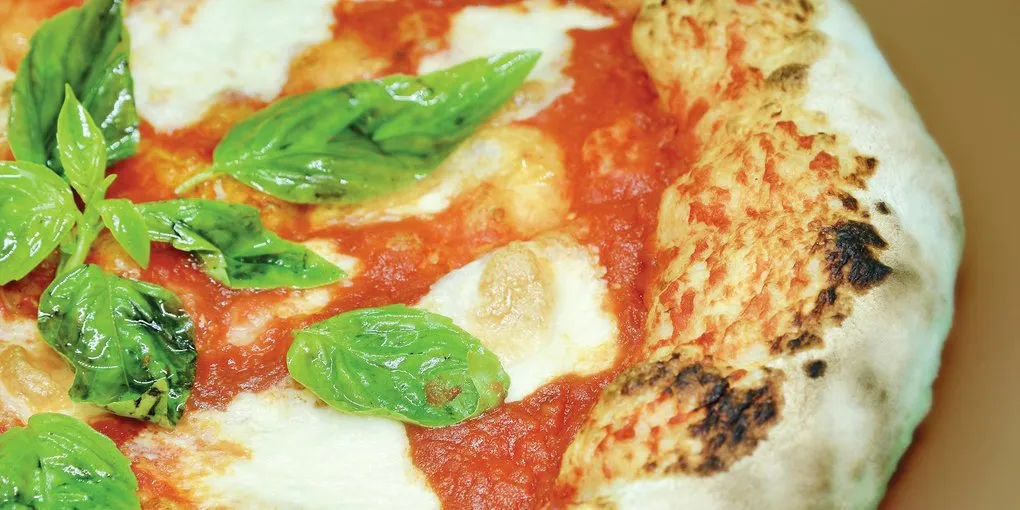
A montanara is a pizza that is fried first and baked second. You stretch a Neapolitan dough ball, drop the bare disc into 350°F oil for roughly thirty seconds just long enough to puff and lightly color it, lift it out, top it open-faced like a Margherita, and finish it under high oven heat for sixty to ninety seconds to melt the cheese. What comes out is a pizza with the crisp-yet-airy texture of a beignet, the structural integrity of a baked Neapolitan, and a flavor that is closer to Margherita than to fried dough.
It is not pizza fritta. Pizza fritta is folded, sealed, and fully fried — a calzone-like pocket cooked entirely in oil, filled with ricotta and smoked provola before sealing. Montanara is open, briefly fried, then oven-finished. The technique reads as a fussy mash-up the first time you encounter it, but it has a long history in the Neapolitan countryside, where home cooks who didn’t have access to a 905°F wood-fired oven could approximate the result by frying first and finishing in whatever oven they had.
The dish’s American breakout is generally traced to Don Antonio by Starita at 309 West 50th Street in Manhattan, opened in 2012 as a partnership between Roberto Caporuscio and Antonio Starita — the third-generation owner of Pizzeria Starita a Materdei in Naples (founded 1901 by Alfonso Starita). Caporuscio’s daughter, Giorgia Caporuscio, worked the Don Antonio oven from the day the restaurant opened and won the Caputo Cup Classic Pizza category in Naples in 2013 with the Starita montanara at age 22 — the second woman ever and the youngest ever to win that category at the time. She formally took over ownership of Don Antonio in early 2024, by which point she had already been running the kitchen for years.
If you are coming to this from the related recipe-pizza-fritta-naples — and the two are easy to confuse — read the next section carefully. They share a dough and a fryer but produce two completely different finished pizzas.
Montanara vs Pizza Fritta vs Standard Neapolitan
The first sentence on the topic is the simplest one: montanara is briefly fried open-faced and then finished in the oven, while pizza fritta is fully fried, folded shut, and never sees the oven, and standard Neapolitan is baked from raw at 905°F and never sees oil at all. Three different dishes from the same family of dough.
The texture differences are dramatic. Montanara has a puffy, slightly oil-tinged exterior with an interior crumb that is closer to a yeasted doughnut than a baked pizza — the brief fry gelatinizes the surface and creates a sealed crust that the oven finish then crisps. Pizza fritta has the dense, deeply fried texture of a sealed pocket, with cheese filling that has been steam-cooked rather than baked. Standard Neapolitan is the lightest of the three — chewy, leoparded, with the open hole structure that an 60-90 second 905°F bake produces in 65-70% hydration dough.
The cooking time and temperature regime differs by an order of magnitude:
Why Flash-Fry Then Bake
The Neapolitan-region countryside that gave the dish its name — montanara derives from the Italian montagna, “mountain,” and is variously linked either to mountain workers (montanari) eating filled bread on field breaks, or to housewives selling fried dough topped with leftover ragu and grated cheese as a way to supplement household income. Both etymological traditions point at the same constraint: the people who first made the dish did not have access to a proper 905°F wood-fired pizza oven. They had access to a pot of oil and to whatever lower-temperature oven was at hand.
When you drop a stretched, room-temperature pizza dough into 350°F oil, three things happen in the first few seconds:
- The surface starch gelatinizes immediately, sealing the dough and trapping moisture inside.
- Steam pressure inside the dough builds rapidly — the dough puffs into a beignet-like pillow.
- A thin crisp shell develops on both sides, golden but not deeply browned.
You pull the disc out before the interior cooks through. At this stage, you have a fried but not done pizza base — puffed, sealed, partially set, waiting for its real bake. Top it as you would a Margherita (thin sauce, sliced fior di latte, basil, EVOO, optional grated parmesan), then return it to a 700°F+ oven (or under a home broiler) for 60 to 90 seconds to melt the cheese and finish the interior bake.
The result has properties neither cooking method alone produces. The fry seals the surface, so the dough’s interior stays remarkably moist after the high-heat finish. The oven finish drives off the residual surface oil — a properly executed montanara isn’t greasy, despite the fry — and concentrates the topping flavors. The cheese gets the melt-and-light-brown character it needs, and the basil and oil keep their volatile aromatics intact because they are not exposed to oil heat.
Roberto Caporuscio frames the technique in interviews as a two-stage construction: the brief fry is for texture and seal, and the oven finish is for the topping integrity. Skip either step and you have a different dish.
Don Antonio, Starita, and the New York Story
The dish’s American breakout happened at Don Antonio by Starita at 309 West 50th Street in Manhattan’s Hell’s Kitchen, opened in 2012 as a partnership between Roberto Caporuscio and Antonio Starita.
Antonio Starita — known professionally as “Don Antonio” — is the third-generation owner of Pizzeria Starita a Materdei in Naples. The original pizzeria was opened in 1901 at Via Materdei 27/28 by his ancestor Alfonso Starita, initially as a wine cellar that gradually evolved into a friggitoria (fry shop) and then a full pizzeria. In 1954 the shop was used as a filming location for Vittorio De Sica’s L’Oro di Napoli, the anthology film that contains the most famous cinematic record of Naples-era fried pizza tradition (Sophia Loren’s “Sofia” character runs the pizza shop in the Pizze a credito episode, although in the film she sells pizza fritta on credit, not montanara). Antonio Starita has been a founding member of the Associazione delle Pizzerie Centenarie and was actively involved in the long lobbying effort that secured EU Traditional Speciality Guaranteed status for Pizza Napoletana in 2010 — the framework now codified in the AVPN standard.
Roberto Caporuscio apprenticed under Antonio Starita in Naples, then immigrated to the United States in 1999 and built his New York reputation through Kestè in Greenwich Village before partnering with Starita on Don Antonio. Giorgia Caporuscio worked the Don Antonio oven from opening day. In 2013, at age 22, she traveled with her father to the Caputo Cup competition in Naples and entered the Classic Pizza category with the Starita montanara. She won, becoming the second woman ever to take first place in that category and — by the public record at the time — the youngest. She has since accumulated additional honors (50 Top Pizza USA’s Pizza Maker of the Year in 2024 among them) and formally assumed ownership of Don Antonio NYC in early 2024.
The Don Antonio menu now lists more than sixty pizza options, but the montanara has been the restaurant’s defining dish from day one and is what new servers consistently recommend to first-time customers. The signature topping is the Starita-tradition smoked buffalo mozzarella, finished with grated Parmigiano and basil.
In Naples itself, Pizzeria Starita a Materdei — still at the original Via Materdei 27/28 address in the Materdei working-class district — remains the canonical reference for the Starita montanara. Other contemporary Naples pizzaiolos including Enzo Coccia at La Notizia (Via Michelangelo da Caravaggio, opened 1994) and Salvatore Salvo have their own approaches to fried pizza, but the Starita montanara is the version that travels best internationally because of the Caporuscio NYC pipeline.
For a different Neapolitan baseline — same dough family, oven-only — see recipe-neapolitan-margherita and neapolitan-pizza-at-home. For the sealed-and-fried sister dish, see recipe-pizza-fritta-naples.
The Recipe
This recipe makes four 8-inch montanara. The dough is a 65% hydration Neapolitan formula with a long cold ferment. Total active time after dough is mixed: about 15 minutes per pie.
Dough (makes four ~290g balls)
| Ingredient | Weight | Baker’s % |
|---|---|---|
| Tipo 00 flour (Caputo Pizzeria or San Felice) | 700g | 100% |
| Water (cool, 65°F) | 455g | 65% |
| Fine sea salt | 18g | 2.6% |
| Instant dry yeast | 1g | 0.14% |
Method:
- Whisk flour and yeast in a large bowl.
- Add the cool water and mix by hand until no dry flour remains. Let rest 20 minutes (autolyse).
- Add the salt and mix until incorporated. The dough should feel cohesive but slightly tacky.
- Cover and rest 30 minutes. Wet your hands and perform three sets of stretch-and-folds, 20 minutes apart.
- Cover tightly and refrigerate 18-24 hours.
- Tip out, divide into four 290g balls, and ball tightly. Cover and rest 60-120 minutes at room temperature until pliable. Cold dough fries badly — let them warm.
Topping (per pie)
- 60-70g San Marzano DOP tomatoes, hand-crushed, lightly salted (no cooking)
- 70-80g sliced fior di latte — or smoked buffalo mozzarella for the Starita signature
- 3-4 fresh basil leaves
- 1 tsp grated Parmigiano Reggiano (optional)
- Drizzle of extra-virgin olive oil
- Pinch of flaky sea salt
Oil Setup and Oven
- 3 inches (7.5 cm) of neutral high-smoke-point oil — peanut, refined sunflower, or canola — in a wide, deep pot. A 5-quart Dutch oven works.
- Frying thermometer (essential — the oil temperature window is narrow).
- A spider strainer or slotted skimmer for lifting the pizza out.
- A plate lined with paper towels for transitional drainage.
Oven setup: Preheat to 550°F (or your oven’s max) with a baking steel on the upper-middle rack at least 45 minutes ahead. If your oven has a working broiler, plan to use it for the finish — preheat under broiler for the last 5 minutes before launching the pizza, then switch back to bake-mode (or leave broiler on if you’re attentive). The closer you get to 700-800°F at the steel surface, the more authentic the bake. See the home oven broiler protocol in our neapolitan-pizza-at-home guide.
If you own an Ooni or Roccbox, this is a great use case — they hit 800-950°F easily and finish a topped montanara in 45-60 seconds.
Method
- Bring oil to 350°F (175°C). Confirm with thermometer. The window is 350-365°F. Below 340°F you get greasy soggy dough; above 370°F you brown too fast and the interior doesn’t puff properly.
- Stretch one dough ball. On a lightly floured surface, press out from the center to a roughly 8-inch round. Try to keep it relatively even; a thicker rim will puff harder during the fry.
- Slide carefully into the oil. Lower it in by hand or with a slotted spatula — never drop it from above (oil splash is a burn hazard). The dough will sink, then rapidly rise as it puffs.
- Fry approximately 30 seconds total. Use the spider to gently flip after 15 seconds or once the underside is lightly golden. The dough should be lightly golden and visibly puffed, not deeply browned. Pull it before it darkens. (Recipe references vary — America’s Test Kitchen recommends 1.5-2 minutes per side at 350°F for a thicker, more set fry; Saveur cites 1-2 minutes total; the Starita-tradition technique at 8-inch diameter is closer to 30 seconds total.)
- Drain briefly on paper towels (5 seconds) and transfer to a peel dusted with semolina.
- Top open-faced. Spoon the hand-crushed tomato in a thin layer, leaving a small border. Add the sliced fior di latte. Tear a few basil leaves over. Light dust of Parmigiano if using. Drizzle with EVOO.
- Launch into the hot oven. Slide the topped pizza onto the preheated steel. If broiling, the heat source should be 4-6 inches above the pizza.
- Bake 60-90 seconds at maximum temperature with broiler assist. The cheese should melt and just start spotting; the rim should crisp further. Pull when cheese is fully melted and the rim has a few darker spots. Do not overbake — overbaked montanara loses the puff and ends up tough.
- Finish with a final drizzle of EVOO, a pinch of flaky salt, and fresh basil if you held some back.
Practical Notes
Oil temperature is the entire game. Below 340°F: greasy, heavy, won’t puff properly. Above 370°F: browns too fast, interior stays raw. Use a thermometer. Re-check between pizzas — the dough drops the oil temp by 10-15°F each time, and you need to wait for it to recover before the next disc.
The home oven adaptation is the broiler. A 550°F home oven without broiler is too slow to finish a montanara properly — the dough’s interior will dry out before the cheese melts. Run the broiler for the last 5 minutes of preheat to superheat the steel, then bake under the broiler for the entire 60-90 seconds. Watch closely. Modern Neapolitan-style countertop ovens (Ooni Karu, Roccbox, Gozney Dome) all hit higher temperatures and finish in 45-60 seconds.
Don’t skip the oven finish. Eating a flash-fried disc topped with melted cheese after only the fry is technically possible but the texture is wrong — the dough doesn’t fully cook through, and the cheese melts unevenly because there’s no top heat. The oven step is what makes it pizza, not fritto misto.
Use fior di latte, not fresh buffalo mozzarella with high water content. The brief 60-90 second oven bake doesn’t give buffalo mozzarella’s water enough time to evaporate, which can leave a watery topping. Drain buffalo mozzarella aggressively (60+ minutes on paper towels) if you’re using it, or substitute fior di latte (lower-moisture cow milk) for cleaner melt. Smoked buffalo mozzarella, the Starita standard, splits the difference — the smoking process drives off some moisture.
The Roman-Naples variant uses red tomato sauce only (no cheese) on the fried disc, finished with grated pecorino after the oven step. Some white-pizza variations skip the tomato entirely, building on cream and lardo. Both are legitimate; the Margherita-style version above is the canonical Starita-tradition build.
What Goes Wrong
The most common failure is greasy dough. The fix is oil temperature. Use a thermometer. Don’t lower the temp by frying too many at once; do one at a time and let the oil recover between pies.
The second-most-common failure is dough that doesn’t puff. This is almost always under-fermentation. An 18-24 hour cold ferment is the minimum; the gluten needs time to relax so it can stretch easily during the puff. If your dough fights you when you stretch it, it isn’t fermented enough.
The third is overcooked tops. Watch the broiler. The whole point of the oven finish is short — 60 to 90 seconds. If you walk away from the oven, you’ll come back to a black topping. Stay at the oven door.
For a deeper Naples-fried-pizza counterpart that goes into the oil and never comes out for an oven finish, see our recipe-pizza-fritta-naples — the sealed-pocket sister dish that emerged from the same post-WWII Naples context. For the broader folded fried-pizza family, our calzone-vs-stromboli breakdown covers the cousins.
Frequently Asked Questions
- Why fry first and then bake? Why not just do one or the other?
- Because each step does a job the other can't. The flash-fry seals the dough's surface, gelatinizes its surface starch instantly, and traps steam inside the dough — that's what produces the beignet-like puff. A baked-only Neapolitan doesn't get this kind of sealed, puffed exterior; the steam escapes more gradually through a porous baked crust. The oven finish, in turn, melts and properly chars the cheese topping, drives off any residual surface oil, and finishes cooking the dough's interior. A fried-only montanara would have raw dough at the center and undermelted cheese. The two-step process is engineered to give you the texture of a beignet with the topping integrity of a wood-fired Margherita. Skip either step and you get a different, lesser dish.
- What is the difference between montanara and pizza fritta?
- Pizza fritta is closed and fully fried; montanara is open and only briefly fried before the oven finish. Pizza fritta is shaped into a disc, filled with ricotta and smoked provola (and traditionally cicoli or pork lard), folded shut, sealed at the edges, and submerged in 350°F oil for several minutes until cooked through. The result is a sealed pocket — closer to a fried calzone or a sealed empanada — with the filling steam-cooked inside. Montanara is left open, fried for roughly 30 seconds total just to puff and seal the surface, then topped Margherita-style and finished in a hot oven. They share a dough family and a fryer but produce two completely different finished products. A Naples pizzeria with a fryer is likely making both — see our pizza fritta recipe for the sealed-pocket sister dish.
- Can I make this without a steel or stone?
- Yes, but the result is closer to a baked Neapolitan than a true montanara. Without a preheated thermal mass, the bottom of the topped pizza won't get the bottom heat needed to balance the broiler-cooked top. You'll end up with melted cheese over a slightly soft underneath. If you don't have a steel, two workarounds: (1) use a cast iron skillet inverted on the rack, preheated for 30 minutes — it has enough mass to be passable; (2) skip the oven finish and use a kitchen blowtorch to melt and lightly char the cheese after frying. Option 2 isn't traditional but it produces an acceptable approximation when you can't get the oven hot enough.
- What kind of oil should I use for the fry?
- Use a refined neutral oil with a high smoke point — peanut, refined sunflower, canola, or grapeseed. Avoid extra-virgin olive oil for the fry; it has too low a smoke point (about 375°F refined, lower if unfiltered) and too much flavor for this step. Save the EVOO for finishing. Frying oil at 350°F can be reused 4-6 times if you strain it through a fine mesh after each use and store it in a sealed container in a cool dark cabinet. Oil that smells off, looks dark, or smokes below 360°F should be discarded.
- Why does my dough not puff during the fry?
- Almost always because the dough hasn't fermented long enough. An 18-24 hour cold ferment is the minimum for a Neapolitan-style dough that will puff cleanly during a flash-fry. Under-fermented dough has tight, organized gluten that resists the puff; properly fermented dough has the relaxed, extensible gluten and the gas-cell structure that lets it inflate quickly when it hits hot oil. If your dough fights you during stretching, it isn't ready. The other failure mode is oil temperature — below 340°F the dough sits in oil too long without rapid steam generation, so it absorbs grease instead of puffing. Use a thermometer; the 350-365°F window is narrow and matters.
- How long should I actually fry the disc — 30 seconds or 1-2 minutes?
- It depends on the disc thickness and diameter, and recipe references vary intentionally. The Starita-tradition technique at Don Antonio NYC is approximately 30 seconds total for an 8-inch puffed disc that will then be finished in a 700°F+ oven. America's Test Kitchen, working with home equipment and a 10-inch disc, recommends 1.5-2 minutes per side at 350°F for a more deeply set fry. Saveur cites 1-2 minutes total. The shorter, hotter-finish technique produces a lighter, more beignet-like crumb because the bake is split between fry and oven. The longer fry produces a more set, less open crumb. If you have a high-temperature countertop oven (Ooni, Roccbox, Gozney) that finishes the topping in 45-60 seconds, lean toward the shorter 30-second fry. If you have a 550°F home oven and need the broiler to do more work, lean toward 60-90 seconds total fry.
- Was montanara invented after World War II like pizza fritta?
- Both dishes share the same post-war Naples context — the period when Allied bombing in 1943-44 damaged or destroyed many of the city's wood-fired ovens and frying pizza became a practical alternative — but neither was strictly invented then. Frying dough goes back centuries in Naples cucina povera, and montanara as a regional countryside form (mountain workers' filled bread or housewives' fried-dough-with-leftovers) predates the post-war street-food explosion. What changed in the post-war period was scale and prominence: pizza fritta as a sealed-pocket street food and montanara as an open flash-fried form both became visible commercial categories. The modern Don Antonio NYC version is a refinement of the Starita Naples tradition rather than a wartime invention.
- Can I just use my pizza fritta dough for montanara?
- Effectively yes — the dough family is the same. Pizza fritta and montanara both work with Neapolitan-style dough at 60-65% hydration, long cold ferment, low yeast, and 00 flour at W260 or higher. Pizza fritta is sometimes pushed to the lower end of that range (60-63%) because the dough has to fold and seal cleanly without tearing under the weight of the filling; montanara works fine at 65% because it stays open. If you have leftover pizza fritta dough, use it for montanara without changes. If you have leftover Margherita dough at 70% hydration, drop it to 65% next time you mix specifically for montanara — at 70% the dough is too slack to stretch consistently for the fry-and-flip.
Some links above are affiliate links. If you buy through them, we earn a small commission at no extra cost to you. We only recommend products we’d actually use.