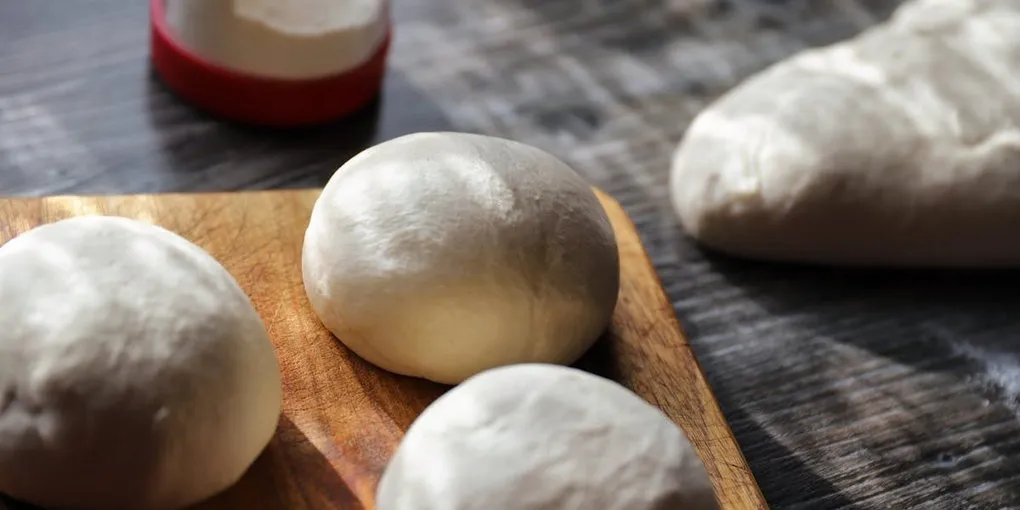
You set your dough to proof two hours ago and now it looks wrong. It has spread out flat in the container, the surface has a slightly boozy smell, and when you poke it, the indentation just sits there. The dough you shaped into a taut ball is now a slack, saggy puddle.
This is over-proofed dough, and it is one of the most common problems in home pizza making. The good news: unless it is severely degraded, you can rescue it. The better news: understanding why it happens makes it largely preventable.
What Over-Proofing Actually Is
Fermentation is a biological process with a natural arc. Masi describes it in four distinct phases:
-
Lag phase: Yeast synthesizes new cellular components and acclimates to the dough environment. No visible change in volume. This is the quiet period right after mixing.
-
Exponential phase: Yeast divides rapidly at a constant rate. This is where the biggest volume increases happen — the dough is visibly growing, bubbles are forming, the surface is alive.
-
Stationary phase: Growth stops. The number of viable yeast cells plateaus because new division is balanced by cell death. Volume plateaus. This is the sweet spot — the dough has risen fully but still has structural integrity.
-
Decline phase: Nutrients are depleted, toxic metabolites (alcohol, acids) accumulate. The yeast population crashes. The dough begins losing structure. Volume decreases as the gluten network weakens and can no longer hold the gas.
Over-proofing means you have pushed past the stationary phase into decline. The dough has consumed too much of its available sugar, produced too much alcohol and acid, and the gluten network — weakened by both protease enzymes and the acidity of the dough — can no longer retain the gas it has generated.
The Critical Benchmark: 3/4 of Maximum Volume
Optimal leavening occurs at three-quarters of maximum dough volume, not at maximum volume. This guideline from Masi is the single most useful benchmark for fermentation timing.
Stopping fermentation while the dough still has room to grow means it retains enough gas for good oven spring, enough residual yeast activity for a final burst in the oven, and enough structural integrity to handle shaping and stretching. If you let it reach 100% of its potential volume, you have already entered the stationary phase and are approaching decline.
The practical challenge: you do not know what “maximum volume” is until you have overshot it. This is why experienced bakers develop an eye for dough — they have seen enough batches to recognize the 75% point by look and feel rather than by measuring.
For a reference point: Iacopelli describes properly proofed dough as having reached approximately 1.25x its original size — not doubled. Small light bubbles should be visible on the surface, and the dough should feel “full of air” and “light” when gently lifted.
Visual and Tactile Cues: How to Tell
The poke test is the most reliable single indicator of proofing status. Press a floured finger about half an inch into the dough and watch what happens.
Properly Proofed Dough
- Volume has increased to roughly 1.25x original (not doubled)
- Small, light bubbles visible on the surface
- Feels “full of air” and light when handled
- Poke test: indentation slowly springs back (2-3 seconds)
- Surface is smooth, slightly domed, taut
Under-Proofed Dough
- Volume has not increased much
- Surface is tight, no visible bubbles
- Poke test: springs back immediately (too elastic, insufficient gas)
- Feels dense and resistant
- Will snap back aggressively during stretching
Over-Proofed Dough
- Too loose and saggy — has lost its shape
- Flat or collapsed rather than domed
- Poke test: indentation stays (no spring-back) — the gluten is too weak to push back
- Alcoholic or strongly yeasty smell
- Surface may appear bubbly and rough rather than smooth
- Handles like a wet rag — no resistance, no elasticity
- Dough balls may have merged or spread into each other on the tray
Properly proofed dough slowly springs back because the gluten has enough strength to push the gas back into shape, but slowly, indicating the network has relaxed enough for extensibility. Over-proofed dough does not spring back at all because the gluten network has degraded beyond its elastic limit.
Why It Happens
Over-proofing is almost always a temperature or timing issue — not a recipe issue.
A warm kitchen is the most common cause. A 1 degree Celsius increase accelerates fermentation by 8-12%. A recipe tested at 70 degrees Fahrenheit that you are making in an 82-degree kitchen will over-proof in roughly 60-70% of the stated time. Summer is peak over-proofing season.
Forgetting about the dough is the second most common cause. You set the dough for a 2-hour bulk ferment, got distracted, and came back 4 hours later. The dough did not wait for you.
Too much yeast narrows your window. More yeast means faster fermentation and a shorter gap between properly proofed and over-proofed. Recipes with tiny yeast amounts (Forkish uses as little as 0.1g per 500g flour) have wide timing windows precisely because the fermentation is slow. Recipes with 1-2% yeast have narrow windows — perhaps 30 minutes between perfect and over-proofed.
A cold ferment that went too long. Even in the refrigerator, yeast retains roughly 10% of its room-temperature activity. Pushing cold fermentation past 72 hours risks structural degradation as protease enzymes continue breaking down gluten even while yeast is sluggish. (For a safer schedule, see overnight pizza dough or the recipe overnight dough.)
The Rescue: Re-Ball and Rest
Over-proofed dough is not garbage. It can be rescued.
Iacopelli’s technique is straightforward: gently re-ball the dough and let it rest for approximately 1 hour. The re-balling releases the excess gas (which is causing the slack, saggy texture) and gives the gluten network a chance to partially recover its structure during the rest period.
The key word is “gently.” The dough has already been through extended fermentation — the gluten is weakened, and rough handling will tear it further. Fold it over itself a few times to release gas and form a new ball, then leave it alone.
Gemignani describes a similar approach using a stand mixer for larger batches: degas in the mixer for 30 seconds on the lowest speed, then re-ball, pinch the seams tightly (gas leaks through weak seams create structural problems), and allow a fresh rest period. His 24+24 cold ferment method actually builds this degassing step into the process deliberately — after the first 24 hours of bulk cold fermentation, he degasses, re-balls, and refrigerates for a second 24 hours. The degassing promotes new yeast reproduction and further fermentation.
What the rescue cannot fix: severely degraded gluten (dough tears when you try to fold it), strong off-flavors from excessive alcohol production, or dough that has been over-proofed at warm temperatures for many hours. If there is no elasticity whatsoever, use it for focaccia or flatbread where structural demands are lower.
Why Warm Over-Proofing Is Worse Than Cold
Fermentation and maturation are distinct processes that happen simultaneously. Fermentation is yeast producing gas. Maturation is enzymes (amylase, protease) breaking down starches and proteins. In ideal conditions, both finish at the same time. But protease enzymes do not stop working when the dough reaches peak volume — they keep degrading gluten regardless.
At room temperature, both yeast and enzymes run at full speed, so over-proofing happens fast and hits hard. In the refrigerator, yeast drops to 10% activity while enzymes retain 40-50%. Cold over-proofing is slower and more forgiving — you might push a cold ferment from 48 to 60 hours and still have usable dough. Push a room-temperature proof from 3 to 5 hours and the gluten may be too far gone.
Prevention: Widening Your Window
The window between “properly proofed” and “over-proofed” varies enormously depending on your process. Here is how to make it wider.
Use less yeast. Forkish’s recipes use 0.1-0.5g of instant dry yeast per 500g of flour. These tiny amounts produce slow fermentation with a wide timing window — a dough that is ideal at 8 hours might still be usable at 10. By contrast, a dough with 1-2% yeast has a narrow window of perhaps 30 minutes between perfect and over-proofed.
Use colder temperatures. Cold slows everything. Moving your proofing from room temperature to the refrigerator gives you a window measured in days rather than hours. This is the fundamental advantage of cold fermentation for home bakers — you do not need to babysit the dough.
Use stronger flour. Higher-protein flour (13-14%) forms a more robust gluten network that takes longer to degrade. Gemignani insists on 12.5-14% protein flour specifically because it withstands extended enzymatic degradation during long cold ferments. Weaker flour (all-purpose at 10-12%) will over-proof faster because its gluten network is thinner.
Use higher salt. Salt slows fermentation and tightens gluten. Neapolitan pizzerias use 3% salt partly because their dough proofs at room temperature all day — the salt extends the viable window. For cold-fermented dough, 2-2.5% is usually sufficient.
Set a timer. Simple but effective. If your recipe says 2 hours of bulk fermentation, check at 90 minutes. Start watching early rather than hoping it will be fine when you remember.
The Bottom Line
Over-proofed pizza dough is a timing and temperature problem, not a death sentence. If you catch it early — slack, saggy, non-responsive poke test — a gentle re-ball and a 1-hour rest will recover enough structure for usable pizza. The dough will not be as good as if you had caught it at peak, but it will be far better than throwing it away.
Prevention is about widening the window: less yeast, colder temperatures, stronger flour, and attention. The single best preventive tool is cold fermentation, which stretches your timing window from hours to days. And the single best diagnostic tool is the poke test — a finger pressed into the dough that slowly springs back means you are in the sweet spot. No spring-back means you have gone past it. Spring-back that is too fast means you are not there yet.
Learn to read your dough, not just your recipe, and over-proofing becomes a fixable mistake rather than a batch-ending disaster.
Sources: Masi et al., The Neapolitan Pizza: A Scientific Guide (2015); Forkish, The Elements of Pizza (2016); Forkish, Flour Water Salt Yeast (2012); Gemignani, The Pizza Bible (2014); Iacopelli, YouTube (2019-2023).
Frequently Asked Questions
- Can over-proofed pizza dough be saved?
- Yes, in most cases. Gently re-ball the dough to release excess gas, then let it rest covered for about 1 hour. The gluten network will partially recover its structure. The result will not be as good as dough caught at peak proofing, but it will still make usable, tasty pizza. The only exception is severely degraded dough that tears when you try to fold it -- use that for focaccia or flatbread instead.
- How do I know if my pizza dough is over-proofed?
- The most reliable test is the poke test. Press a floured finger into the dough about half an inch deep. If the indentation stays and does not spring back at all, the dough is over-proofed. Other signs include a flat or collapsed shape (no longer domed), a saggy texture, visible rough or bubbly surface, and an alcoholic or strongly yeasty smell.
- What causes pizza dough to over-proof?
- The most common cause is a kitchen warmer than the recipe was designed for. A 1 degree Celsius increase in temperature speeds fermentation by 8-12%, which compounds significantly over hours. Other causes include too much yeast, leaving the dough longer than intended, using weak flour that degrades quickly, or pushing cold fermentation past 72 hours.
- How long can pizza dough sit before it over-proofs?
- It depends on temperature and yeast amount. At room temperature (70 degrees Fahrenheit) with moderate yeast, most doughs have a usable window of 2-4 hours. In the refrigerator, that window extends to 2-3 days. With very low yeast amounts (under 0.5g per 500g flour), same-day doughs can last 8-10 hours at room temperature.
- What is the difference between over-proofed and over-fermented dough?
- They are closely related but technically distinct. Over-proofing refers to gas production exceeding the gluten's ability to contain it -- a volume and structure problem. Over-fermentation refers to excessive enzymatic and yeast activity producing off-flavors, too much acid, and degraded gluten -- a chemistry problem. In practice, they happen together.
- Can I prevent over-proofing by using more salt?
- Salt does slow fermentation and tighten gluten, which widens your proofing window somewhat. Neapolitan pizzerias use 3% salt partly for this reason. However, salt is primarily a flavor ingredient -- adjust yeast amount or temperature to control timing rather than changing salt levels, which would alter the taste of your pizza.
- What should I do with pizza dough that is too far gone to rescue?
- If the dough tears when you try to fold it and has a strong alcohol smell, it is past the point of rescue for hand-stretched pizza. But it can still work for focaccia, flatbread, or pan pizza where the structural demands are lower. Spread it in an oiled pan, let it rest briefly, and bake with simple toppings.