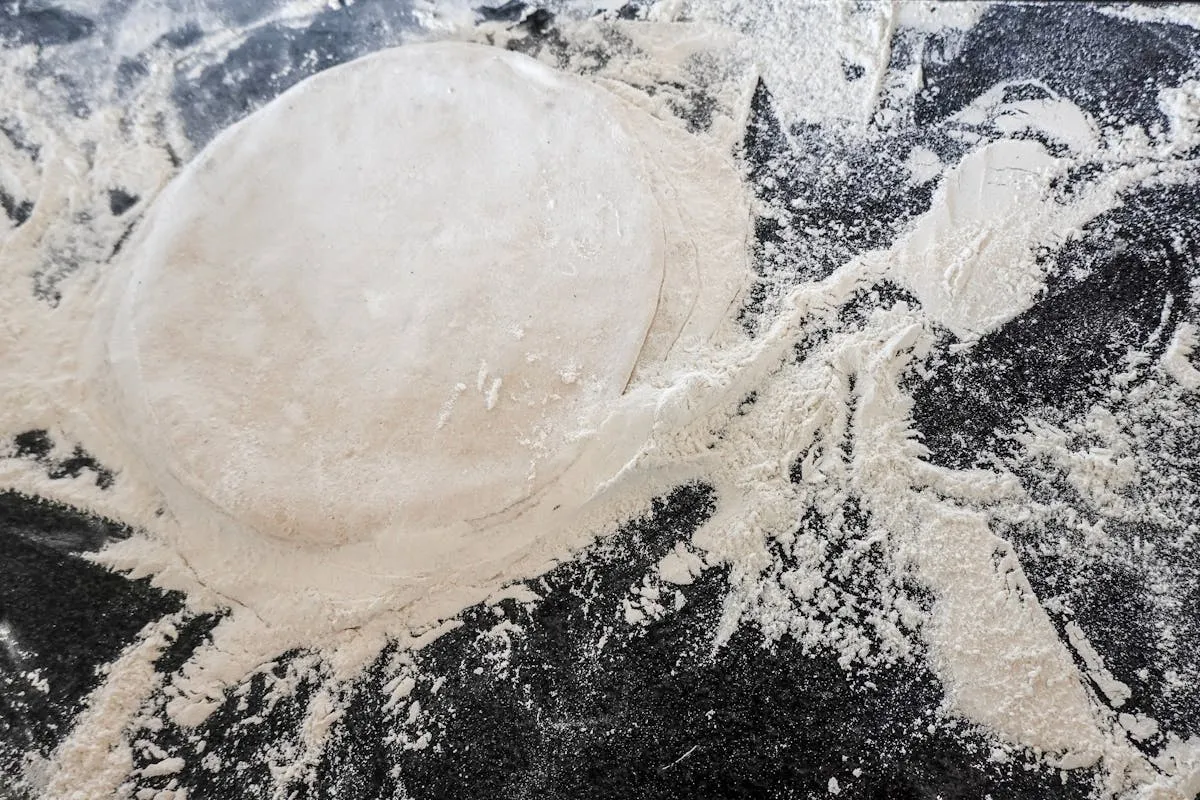
This is the recipe Ken Forkish uses more than any other. It appears in The Elements of Pizza as the 24-48 Hour Pizza Dough, and it is the backbone of his entire home pizza philosophy: mix four ingredients, let the fridge do the work, and bake pizza a day or two later.
If you’ve read about overnight dough and want the specific, tested, source-accurate version from one of the best pizza minds in the country — this is it. Not an adaptation, not a simplification. The actual recipe, with the reasoning behind every number.
Why This Recipe Works
Cold fermentation exploits a fundamental asymmetry between yeast and enzyme activity at low temperatures. At refrigerator temperature (38-40F), yeast drops to roughly 10% of its room-temperature activity, but the enzymes naturally present in flour — amylase, protease, lipase — retain 40-50% of their activity. Enzymes are working 4-5 times harder relative to yeast than they would at room temperature.
Over 24-48 hours, amylase converts starch into simple sugars (better browning, more complex flavor). Protease degrades the gluten network gently (the dough becomes extensible rather than elastic, stretching easily without snapping back). Lipase breaks fats into fatty acids (subtle flavor depth). The result: over 50 distinct flavor compounds that don’t exist in same-day dough, dramatically easier stretching, and better Maillard browning at home oven temperatures.
This is why Forkish calls time an ingredient. It isn’t idle waiting — it is an active biochemical process producing acids, esters, glutamates, and gases that cannot be replicated by kneading harder or adding more yeast.
The Recipe
Yield: 3 dough balls (about 288g each), making three 12-inch pizzas.
| Ingredient | Amount | Baker’s % |
|---|---|---|
| 00 flour | 500g | 100% |
| Water (90-95F) | 350g | 70% |
| Fine sea salt | 13g | 2.6% |
| Instant dry yeast (IDY) | 1.5g | 0.3% |
Total dough weight: about 865g
Why These Numbers
00 flour. Forkish specifies 00 flour for this recipe — Caputo blue bag (Pizzeria, W260-270) or red bag (Cuoco, W300-320). The 70% hydration compensates for the longer home oven bake time, producing a soft, foldable center despite the 7-8 minute exposure. If you’re using a home oven at 500-550F and find the crust pale, consider adding 0.5-1% diastatic malt powder (2.5-5g) — 00 flour is unmalted, which matters at lower temperatures. Alternatively, Caputo Americana (W360-380, contains malt) is designed specifically for home oven use.
70% hydration. This is Forkish’s standard for home oven pizza. The logic: a 7-8 minute bake at 550F evaporates far more moisture than a 60-second bake at 905F. Extra water compensates for that loss, producing a crust that’s soft and foldable in the center rather than dry and stiff. For comparison, AVPN Neapolitan spec is 55-59% hydration — but that’s calibrated for a wood-fired oven. Using 58% dough in a home oven produces a cracker. For more on matching hydration to your oven, see the hydration guide.
2.6% salt. Higher than standard bread (2%) but moderate for pizza. Neapolitan pizzerias use up to 3% because higher salt slows fermentation and extends the working window. Forkish uses 2.6% here for flavor and moderate fermentation control.
0.3% instant dry yeast (1.5g). This is tiny — less than half a teaspoon. You need a precision scale that reads to 0.1g. The small dose is calibrated so the dough peaks between 24 and 48 hours in the fridge, giving you a full-day window of flexibility. Too much yeast and the dough over-proofs by hour 30. Too little and it isn’t ready until hour 40.
Baker’s Percentage Breakdown
For scaling to any batch size:
| Component | Baker’s % |
|---|---|
| Flour | 100% |
| Water | 70% |
| Salt | 2.6% |
| IDY | 0.3% |
To make 5 pizzas: use 833g flour, 583g water, 22g salt, 2.5g IDY.
Step-by-Step Method
Evening (Day 1) — 10 minutes of work
-
Measure 350g water at 90-95F in a large bowl or 6-quart dough tub. Use a probe thermometer — guessing water temperature is the most common source of inconsistency in home pizza dough. Forkish targets a final dough temperature of 80-82F after mixing.
-
Sprinkle 1.5g IDY over the water. Let it sit 1 minute, then stir briefly to dissolve.
-
Add 500g 00 flour. Mix with your hand or a wooden spoon until all flour is hydrated. The dough will be shaggy and rough. This takes about 1 minute.
-
Add 13g salt. Use the pincer method — thumb and forefinger grip cutting through the dough mass repeatedly — alternating with folding. Continue for 30-60 seconds until the salt is evenly distributed and the dough is a single cohesive mass.
-
Let the dough rest 15-20 minutes in the bowl, covered. This is not an autolyse in the technical sense (since yeast is already in), but it serves the same purpose: the flour fully absorbs the water, and initial gluten bonds begin forming without mechanical intervention.
-
Brief knead. Turn the dough out onto an unfloured surface and knead lightly for 30 seconds to 1 minute. You’re not developing heavy gluten — you’re creating a smooth, cohesive ball. The long fermentation will do the rest.
-
Return the dough to the bowl. Cover tightly and leave at room temperature.
Bulk Ferment — 2 hours at room temperature
Leave the covered dough on the counter for 2 hours. It may not rise much visibly in this time — that’s fine. The brief room-temperature period gives the yeast an initial burst of activity before the cold slows everything down.
Shape Dough Balls
After 2 hours of bulk fermentation:
-
Turn the dough onto a lightly floured surface. The dough should feel slightly puffy and more relaxed than when you first mixed it.
-
Divide into 3 equal pieces (about 288g each). Use a bench scraper or knife — no tearing.
-
Shape each piece into a tight ball. Pull the edges toward the center, pinching the seam closed. Flip seam-side down and use cupped hands to drag the ball gently toward you on the counter, tucking the bottom under to create surface tension. Gemignani emphasizes: pinch the seam tight. Gas leaks through loose seams create weak spots.
-
Place each ball in an individual container (lightly oiled deli containers work well) or on a sheet pan spaced well apart. Cover tightly with lids or plastic wrap.
Cold Ferment — 16 to 48 hours in the refrigerator
Put the covered dough balls in the fridge. They’re ready to use after 16 hours and peak between 24 and 48 hours. The dough improves steadily across this window as enzyme activity accumulates. For more on the science behind this process, see cold fermentation explained.
What to look for when the dough is ready:
- The ball has expanded noticeably (50-75% larger)
- Small bubbles are visible on the surface
- The bottom of the ball, if turned over, shows gassy holes
- It feels soft, pliable, relaxed — what Forkish describes as “delicate and structurally sound at the same time”
Bake Day — 30 minutes before pizza
-
Remove dough balls from the fridge. Let them sit covered at room temperature for 30-60 minutes. This temper step is critical. Cold dough is tight, elastic, and fights stretching. You need the dough to reach approximately 60-65F before shaping. Gemignani’s fifth commandment: “Never put cold dough in a hot oven.” Cold dough produces large, uneven bubbles in the first minutes of baking. For more on knowing when dough is ready, see how long to proof pizza dough.
-
Preheat your oven to its maximum temperature (500-550F) with a pizza steel or stone positioned on an upper rack, no more than 8 inches below the broiler element. Start preheating at least 45 minutes before you plan to bake — the oven beeping “ready” only means the air is hot. The steel needs much longer to saturate.
-
Stretch each ball on a floured surface. Press from the center outward with your fingertips, leaving a 3/4-inch rim untouched for the cornicione. Use gravity stretching over your knuckles to reach 10-12 inches in diameter. The dough should stretch willingly — if it fights you, let it rest 5 more minutes and try again.
-
Transfer to a floured wooden peel. Top with sauce and toppings. Work quickly — wet dough on a peel will stick within 60 seconds. Give the peel a test shake before launching.
-
Bake for approximately 7 minutes at 550F. For the last 1-2 minutes, switch to the broiler for top browning and leopard-spot char on the cornicione. Watch closely under the broiler — the transition from perfectly browned to burnt takes seconds.
Timing Schedule
| Time | Action | Duration |
|---|---|---|
| Day 1, 8:00 PM | Mix dough | 10 min |
| Day 1, 8:15 PM | Rest | 15 min |
| Day 1, 8:30 PM | Brief knead, return to bowl | 2 min |
| Day 1, 8:30-10:30 PM | Bulk ferment (counter) | 2 hr |
| Day 1, 10:30 PM | Shape balls, refrigerate | 10 min |
| Day 2, 5:00 PM | Remove from fridge, temper | 30-60 min |
| Day 2, 5:00 PM | Preheat oven + steel | 45 min |
| Day 2, 5:45 PM | Stretch, top, bake | 7-8 min/pizza |
Total active time: about 35 minutes across two days.
What to Expect
The crust: Poofy rim with visible air bubbles and dark brown to black char splotches (leopard spots). The center should be soft but fully baked — each slice flops from rim to tip when you lift it, Neapolitan-style. The underside should show dark brown leopard spots from contact with the hot steel.
The texture: Delicate and light. Forkish describes his best results as “ethereal” and “weightless.” The long cold ferment breaks down the gluten network enough that the crust is tender rather than chewy. Hand mixing (rather than a stand mixer) contributes to this — less mechanical gluten development means a more delicate finished product.
The flavor: Noticeably more complex than same-day dough. Slightly tangy from acetic acid production — cold fermentation favors acetic over lactic acid, producing a sharper character (the biochemistry, explained). Sweet undertones from enzyme-liberated sugars. A clean wheat flavor with depth.
Browning: At 500-550F, browning depends on available sugars and amino acids. The 24-48 hour ferment liberates substantially more of both compared to same-day dough. If your crust is still pale, add 0.5-1% diastatic malt to your next batch or switch to Caputo Americana (which contains malt).
Tips
This recipe is Forkish’s workhorse for a reason. It’s the most convenient of his formulas — mix at night, bake the next evening — with better flavor than any same-day recipe. Gemignani’s core prescription aligns perfectly: “From today on, I want you to make pizza dough that rises in the refrigerator for at least 24 hours — preferably 48 hours.”
The 48-hour option is better than 24. If your schedule allows it, let the dough go the full 48 hours. The additional enzyme activity deepens flavor, improves extensibility, and enhances browning. Diminishing returns set in around 72 hours, and beyond that you risk structural degradation and off-flavors.
Water temperature matters. Forkish targets 90-95F water for a final dough temperature of 80-82F. If your kitchen is cold (below 68F), use warmer water. If it’s hot (above 78F), use cooler water. The goal is consistent dough temperature at the start of fermentation.
Don’t skip the room-temperature temper. The 30-60 minutes after removing balls from the fridge is where the dough transitions from stiff and elastic to relaxed and extensible. Trying to stretch cold dough results in tearing, snap-back, and frustration.
If plans change, the dough survives. Forgot to bake on Day 2? The dough is almost certainly still usable on Day 3 at this yeast level. Cold-fermented dough is forgiving in a way that room-temperature dough is not.
Sources: Forkish, The Elements of Pizza, Ch6 (24-48 Hour Pizza Dough — his most-used recipe); Forkish, Flour Water Salt Yeast (pincer method, autolyse, broiler protocol); Gemignani, The Pizza Bible (cold-ferment prescription, ten commandments, diastatic malt); Masi, Romano & Coccia, The Neapolitan Pizza (enzyme science, maturation vs. fermentation); Myhrvold & Migoya, Modernist Pizza Vol 1 (cold ferment enzyme ratios, yeast by fermentation strategy).
Frequently Asked Questions
- What's the difference between this recipe and a generic overnight dough?
- This is the exact formula from Ken Forkish's The Elements of Pizza — his most-used recipe. The specific numbers matter: 70% hydration is calibrated for home ovens at 500-550F (compensating for moisture loss during a 7-8 minute bake), 0.3% instant dry yeast is calibrated to peak between 24 and 48 hours in the fridge, and 2.6% salt provides flavor while moderately slowing fermentation. Many overnight recipes online are approximations of formulas like this one. The original is reliable precisely because every ratio was tested.
- Can I use bread flour instead of 00?
- Yes, and for home ovens it may actually perform better. Italian 00 flour (W220-270) was designed for 800F+ ovens where the 60-90 second bake finishes before the weaker gluten structure becomes a liability. In a 7-8 minute bake at 500-550F, bread flour's stronger gluten network (13-14% protein) holds up better, and its malt content produces better browning. If you substitute bread flour, reduce hydration to 65% (325g water per 500g flour) — bread flour absorbs water differently than 00. Caputo Americana (00 with malt, W360-380) is designed specifically for this crossover.
- My dough over-proofed — it's been 60 hours and looks deflated. Can I save it?
- Possibly. If the dough has collapsed and smells sour or alcoholic, it's past peak. You can still bake it, but expect a denser crumb, less oven spring, and a tangier flavor. The structure won't be as good because protease has degraded the gluten network beyond the sweet spot. Prevention: at this yeast level (1.5g IDY per 500g flour), keep it under 48 hours. If you need a longer window, reduce yeast to 0.8-1.0g for a comfortable 48-72 hour range.
- Why does the recipe call for 90-95F water? Doesn't hot water kill yeast?
- Yeast dies at about 114F (46C), so 90-95F is safe with a wide margin. Forkish targets 90-95F water to produce a final dough temperature of 80-82F after mixing. This gives the yeast an active start during the 2-hour room-temperature bulk ferment before the cold slows everything down. If your kitchen is warm (above 78F), use cooler water (80-85F). If it's cold (below 65F), you might go up to 95F. The principle: target 80-82F dough temperature after mixing, and adjust water temperature to get there.
- Do I need to do the 2-hour bulk ferment, or can I go straight to the fridge?
- The 2-hour room-temperature bulk ferment is part of the recipe and serves a purpose. It gives the yeast an initial burst of activity and allows the gluten to begin organizing before the cold slows everything. Skipping it won't ruin the dough, but it may need a few extra hours in the fridge to compensate.
- How do I know when the dough is properly tempered and ready to stretch?
- After 30-60 minutes on the counter, the dough should feel noticeably softer and more relaxed than when you pulled it from the fridge. It should yield when you press a finger into it, with the indentation slowly springing back rather than snapping back sharply. If you have an instant-read thermometer, target 60-65F. The practical test: try to stretch a small section. If it stretches willingly without snapping back, it's ready. If it fights you, give it 10 more minutes.