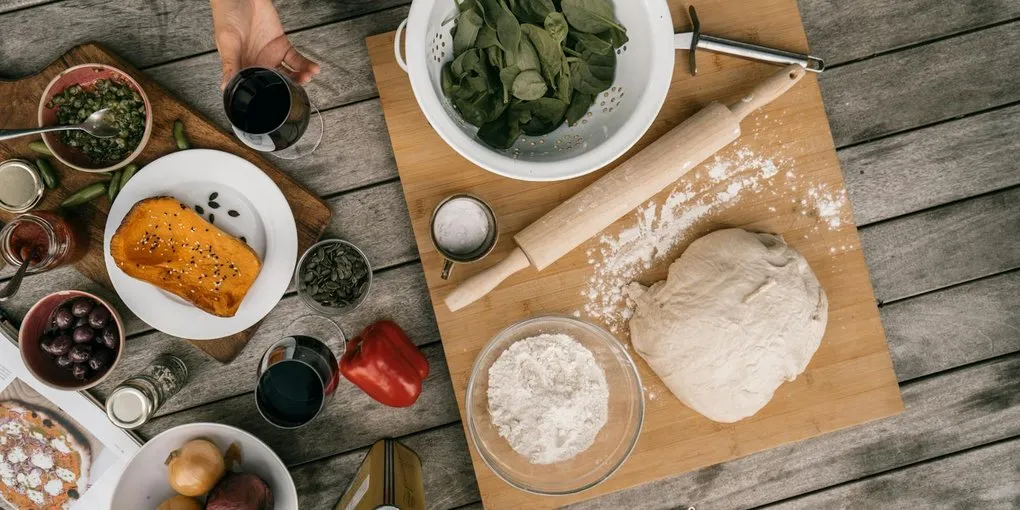
The simplest pizza dough is four ingredients: flour, water, salt, yeast. No fat at all. The AVPN specification for Neapolitan pizza explicitly excludes oil from the dough — and many of the world’s best pizzas are made without a drop of it. Ken Forkish’s FWSY pizza recipes deliberately contain no olive oil, and he notes the result is crispier crust with more open holes.
So why does Gemignani add olive oil to his Master Dough? Why does his deep-dish formula call for both butter and lard? And why did Myhrvold’s research team discover that solid fats dramatically outperform liquid oils for oven spring?
The answer is that fat in pizza dough is not a simple question of “add some for richness.” Different fats behave differently at the molecular level, and the form of the fat — crystalline (solid) versus liquid — changes the fundamental structure of your crust. Understanding this distinction is the difference between adding fat that helps and adding fat that doesn’t.
The Crystalline vs. Liquid Fat Discovery
This is one of the most significant findings in Nathan Myhrvold’s Modernist Pizza research, based on baking 12,000 pizzas across 1,800 recipes.
Solid fats (lard, butter, shortening) allow gas bubbles to expand more. Here’s the mechanism: fat crystals physically adsorb onto the surfaces of gas bubbles in the dough. These crystals act as structural reinforcement, preventing the bubbles from rupturing during baking. The result is more, smaller, uniform bubbles — and significantly increased oven spring and volume.
Liquid oils (olive oil, vegetable oil) coat bubbles as a weak film. The liquid oil layer has far less structural integrity than crystalline fat. Bubbles coated in liquid oil merge and rupture more easily during the violent expansion of baking. The result is fewer, larger, irregular bubbles and reduced volume.
The practical difference is measurable: 1-5% solid fat dramatically improves oven spring. Above 5%, any fat begins to interfere with gluten development, but in that 1-5% range, the effect of solid fat is unambiguously positive for crust structure.
This finding has enormous implications for home bakers. If you’re adding olive oil to your dough thinking it helps with oven spring, it doesn’t — liquid oil actually reduces it. If you want the structural benefit of fat, you need it in crystalline (solid) form at the time of mixing.
Fat Percentages by Style
Not every pizza style uses the same amount of fat, and some use none at all. The range across published master recipes is striking:
The pattern: lean styles (Neapolitan, Roman dinner) use zero fat. American hearth styles (NY, artisan) use moderate oil. Pan and deep-dish styles use significantly more fat, often in solid form.
Gemignani’s Master Dough includes just 1.1% olive oil — barely any, and he’s clear about why it’s there: a small amount of oil at the end of mixing lubricates the dough and contributes to a slightly more tender crumb without compromising structure. His deep-dish formula, by contrast, calls for 4.2% lard plus 4.2% butter — solid fats that create the flaky, pie-like crust character that defines Chicago deep-dish.
Why EVOO Loses Its Point in Dough
Here’s a fact that saves you money: extra virgin olive oil loses its distinctive flavor when baked. The volatile aromatic compounds that make good EVOO taste fruity, peppery, and complex evaporate during the bake. Myhrvold’s team found that a cheaper pure olive oil is functionally equivalent to premium EVOO when mixed into dough — the end result tastes the same.
Masi’s research on EVOO during Neapolitan baking confirms this from a different angle. Even in a 60-90 second bake at 380-400 degrees Celsius, approximately 30% of phenolic compounds are lost. Bitter phenols migrate to the liquid phase, and complex phenols hydrolyze in the acidic pizza environment. Only part of the fruity aroma of fresh oil remains post-bake.
The practical takeaway: if you want olive oil flavor on your pizza, drizzle it after baking, not before. Use cheap olive oil (or any neutral oil) in the dough if your recipe calls for it. Save the good EVOO for finishing.
Gemignani makes this distinction explicitly. He recommends Filippo Berio or Corto EVOO for finishing and garnishing, but notes that pure olive oil (not extra virgin) is appropriate for sauteing and for any application where the oil will be cooked.
When to Use Each Fat
Olive Oil (or Any Liquid Oil)
Best for: Slight tenderness and moisture in New York, artisan, and pan-style doughs where you want a marginally softer crumb without the flavor contribution of butter or lard.
Typical range: 1-4% of flour weight.
Key technique: Gemignani is emphatic — add oil at the END of the mixing process, not at the beginning. If added too early, fat forms a barrier that impedes flour absorption and hydration. The flour needs to absorb water and begin forming gluten before fat enters the picture.
His analogy: “Making dough is like building an engine. You put all the parts together and then you add oil at the end to start it up.” This aligns with professional bread-baking technique and contradicts many home recipes that dump everything in at once.
What it won’t do: Improve oven spring. Liquid oil coats gas bubbles with a weak film that provides minimal structural reinforcement.
Butter
Best for: Deep-dish, pan pizza, and any style where you want richness and a flaky, pastry-like quality in the crust.
Typical range: 4-8% of flour weight (deep-dish territory).
Why it works: Butter is approximately 80-82% fat and 16-18% water, with the fat portion crystalline at room temperature and below. Those fat crystals provide the structural benefit Myhrvold identified — they physically reinforce gas bubbles during baking, producing better oven spring and more uniform crumb structure.
Gemignani’s deep-dish dough specifies European-style unsalted butter with 82%+ butterfat, at room temperature. The higher butterfat content means less water in the butter, which means less interference with your hydration calculation and more crystalline fat doing structural work.
Temperature note: The butter must be at room temperature when added to the dough, not cold and not melted. Cold butter won’t incorporate properly. Melted butter has lost its crystalline structure and behaves like liquid oil — you lose the structural benefit.
Lard
Best for: Deep-dish and styles where you want maximum flakiness and a savory, rich crust.
Typical range: 4-8% of flour weight, often combined with butter.
Why it works: Lard is 100% fat with a crystalline structure at room temperature. It’s the purest delivery mechanism for the crystalline-fat-on-bubble-surface effect Myhrvold documented. Lard also has a higher melting point than butter, which means the fat crystals persist longer during the early phases of baking — providing structural reinforcement for a longer window during oven spring.
Gemignani’s deep-dish formula uses lard and butter together (4.2% each), and his cast-iron skillet pizza also uses lard plus EVOO in the pan. The combination gives both the flakiness of lard and the richness of butter.
For vegetarians, substitute vegetable shortening for lard at a 1:1 ratio. Shortening is also crystalline at room temperature and provides the same structural benefit, though the flavor contribution is neutral rather than savory.
No Fat at All
Best for: Neapolitan, Roman dinner pizza, and any style where maximum crispness and the most open, delicate crumb are the goal.
Forkish’s FWSY pizza recipes deliberately omit oil. His reasoning: no oil produces crispier crust with more open holes. The olive oil is drizzled after baking, where its flavor actually registers. The AVPN Neapolitan specification also excludes fat from the dough entirely.
Myhrvold’s testing confirmed that Neapolitan dough performs best at 0% fat, with quality declining noticeably above 5%. The style depends on a lean, extensible dough that puffs dramatically in a high-heat oven — fat interferes with the extreme oven spring that defines a proper cornicione.
The 5% Threshold
Across all the research, a consistent finding emerges: above 5% total fat, any fat begins to interfere with gluten development. Fat molecules coat gluten strands, preventing them from bonding with each other to form the interconnected web that gives dough its structure and gas-retention ability.
Below 5%, fat is a tool you can use to modify texture and flavor. Above 5%, you’re entering deep-dish and Brazilian thin-crust territory where the character of the crust is fundamentally changed — flakier, more tender, more pastry-like, and dependent on a pan for structure rather than a strong gluten network.
For hearth-style pizzas (Neapolitan, NY, Roman, artisan), keeping total fat under 5% preserves the gluten network you need for hand-stretching, proper oven spring, and a crust that can support itself when you hold a slice.
Fat in the Pan vs. Fat in the Dough
There’s an important distinction between fat in the dough and fat under the dough. Pan-style pizzas often use generous amounts of oil or fat to coat the pan — olive oil, duck fat, bacon fat, lard — and this fat fries the bottom of the crust during baking, adding flavor and crispness.
This is a different mechanism entirely. Fat in the pan doesn’t interfere with gluten development because it never contacts the dough during mixing. It’s a cooking medium, not a dough ingredient. Gemignani uses butter plus EVOO to coat his Detroit pans, and pure olive oil (not EVOO — lower smoke point concerns) for his Sicilian pans.
You can make a completely lean dough (0% fat) and bake it in a heavily oiled pan and get the best of both worlds: strong gluten network from the lean dough, plus a fried-crisp bottom from the pan fat.
Practical Recommendations
If you’re making Neapolitan or Roman dinner pizza: No fat in the dough. This is the traditional approach and the science supports it. Drizzle good EVOO after baking.
If you’re making New York style: 1-3% olive oil (any grade) is standard. Add it at the end of mixing per Gemignani’s technique. Don’t expect it to help with oven spring — it’s there for slight tenderness.
If you’re making deep-dish or pan pizza: Use solid fats. Butter and/or lard at 4-8% each produce the flaky, rich crust that defines these styles. Room temperature, added at the end of mixing. The crystalline-fat advantage is real and measurable.
If you want maximum oven spring from any recipe that calls for fat: Replace liquid oil with the same percentage of room-temperature butter or lard. The structural benefit of crystalline fat on gas bubbles produces noticeably better volume and more uniform crumb.
Save the good olive oil for after the bake. EVOO flavor volatiles evaporate during baking. Your expensive bottle of single-estate Tuscan oil is wasted in dough — use it where it shines, drizzled over the finished pizza.
The Bottom Line
Fat in pizza dough is not a binary question of “add some or don’t.” The type of fat matters as much as the amount. Myhrvold’s discovery that crystalline (solid) fats dramatically outperform liquid oils for oven spring is one of the most actionable findings in modern pizza science. If your recipe calls for fat and you want the structural benefit, reach for butter or lard — not the olive oil bottle. And if you’re making Neapolitan or Roman, skip the fat entirely. Some of the best pizza in the world has no fat in the dough at all.
Sources: Myhrvold & Migoya, Modernist Pizza Vol 1 (crystalline vs liquid fat pp. 350-356, fat percentages by style pp. 316-317, EVOO flavor loss p. 354); Gemignani, The Pizza Bible (oil-at-end technique, Master Dough 1.1% EVOO, deep-dish 4.2% butter + 4.2% lard, cast-iron skillet fat method, EVOO brand recommendations); Forkish, Flour Water Salt Yeast (lean dough approach, crispier crust without oil); Masi, Romano & Coccia, The Neapolitan Pizza (EVOO phenolic compound loss during baking pp. 94-95).
Frequently Asked Questions
- Does olive oil help pizza dough rise better?
- No. Liquid oils like olive oil actually reduce oven spring compared to solid fats. Myhrvold's research found that liquid oils coat gas bubbles with a weak film that ruptures easily during baking. Solid fats like butter and lard provide crystalline reinforcement that helps bubbles expand without bursting. If oven spring is your goal, solid fat outperforms liquid oil.
- Should I use expensive extra virgin olive oil in my pizza dough?
- No. EVOO's distinctive volatile aromatics evaporate during baking, so a premium bottle of oil performs identically to cheap pure olive oil once it's baked into a crust. Save good EVOO for drizzling after the pizza comes out of the oven, where its flavor actually registers.
- Why does Gemignani say to add oil at the end of mixing?
- Fat forms a barrier that impedes flour hydration and gluten development if added too early. The flour needs to absorb water and begin forming the gluten network before fat enters the picture. Gemignani compares it to building an engine and adding oil last to start it up. This aligns with professional bread-baking technique.
- How much fat is too much for hand-stretched pizza?
- Above 5% total fat, gluten development starts to suffer. Fat molecules coat gluten strands and prevent them from bonding properly. For any hearth-style pizza you plan to hand-stretch (Neapolitan, NY, Roman), keep total fat under 5%. Above that threshold, you're in deep-dish territory where the pan provides structure instead of gluten.
- Can I substitute butter for olive oil in a pizza recipe?
- Yes, but the results will be different. Butter adds richness and a slightly flaky quality. Its crystalline fat structure also improves oven spring compared to liquid olive oil. Use room-temperature butter (not melted) to preserve the crystalline structure. A 1:1 substitution by weight works, though butter contains about 16-18% water, so your dough may be very slightly wetter.
- Why do some great pizza recipes use no fat at all?
- The AVPN Neapolitan specification and Forkish's FWSY recipes deliberately exclude fat because lean dough produces the crispiest crust with the most open, delicate crumb. Forkish notes that omitting oil results in crispier crust and more open holes. Fat is not necessary for great pizza -- some of the world's best is made with just flour, water, salt, and yeast.
- What fat should I use for deep-dish pizza?
- Gemignani's deep-dish formula uses both butter (4.2%) and lard (4.2%) -- European-style unsalted butter with 82%+ butterfat, plus lard, both at room temperature. The combination produces the flaky, pie-like crust that defines Chicago deep-dish. For a vegetarian version, substitute vegetable shortening for the lard at a 1:1 ratio.