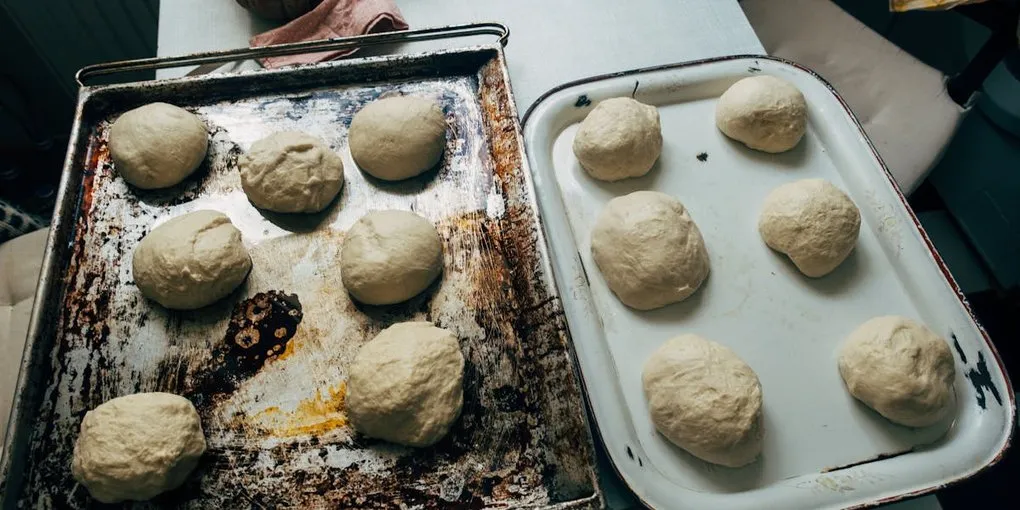
Sometimes you didn’t plan ahead. No dough fermenting in the fridge since yesterday, no poolish bubbling on the counter from last night. You just want pizza tonight. These two recipes from Ken Forkish are designed exactly for that situation — good pizza dough that’s mixed in the morning and ready by dinnertime.
They won’t have the complexity of a 48-hour cold ferment. There’s no way around that — the enzymatic flavor development that happens over days in the fridge produces over 50 distinct flavor compounds that can’t be replicated in hours. But what they will have is far more character than any quick-rise recipe that calls for a tablespoon of yeast and 90 minutes of proofing. The trick: very small amounts of yeast and a full day of patient, room-temperature fermentation.
Two Variants, One Philosophy
Both recipes use the same flour, the same hydration, and the same method. The only differences are salt percentage, yeast quantity, and timing — tuned to fit your schedule.
Saturday Pizza Dough (approximately 8 hours)
Mix at 10 AM, pizza at 6 PM. Forkish’s most relaxed same-day recipe.
| Ingredient | Amount | Baker’s % |
|---|---|---|
| 00 flour | 500g | 100% |
| Water (90-95F) | 350g | 70% |
| Fine sea salt | 15g | 3% |
| Instant dry yeast (IDY) | 0.3g | 0.06% |
The 3% salt is intentional. Neapolitan pizzerias use up to 3% salt to control fermentation rate in dough that proofs all day at room temperature. Higher salt tempers fermentation and prevents the dough from over-proofing during an 8-hour window. You need a precision scale (0.1g resolution, about $13) to measure 0.3g of yeast.
”I Slept In” Dough (approximately 6 hours)
Mix at noon, pizza at 6 PM. For when the morning got away from you.
| Ingredient | Amount | Baker’s % |
|---|---|---|
| 00 flour | 500g | 100% |
| Water (90-95F) | 350g | 70% |
| Fine sea salt | 10g | 2% |
| Instant dry yeast (IDY) | 0.5g | 0.1% |
Lower salt (2%) and more yeast (0.5g) accelerate fermentation to fit a shorter window. The reduced salt means slightly less fermentation control — this dough is more time-sensitive. If dinner gets pushed back an hour, the Saturday version is more forgiving.
Method (Same for Both)
The process is identical for both variants. Only the fermentation times differ.
-
Mix: Combine flour and salt in a 6-quart dough tub. Add the water (target 90-95F — slightly warm to jump-start fermentation in the absence of long cold time). Mix by hand using the pincer method for 2-3 minutes until no dry flour remains.
-
Add yeast: Sprinkle the tiny amount of IDY over the dough surface. Pincer-mix for another 30 seconds to distribute.
-
Rest and knead: Cover. Rest 15-20 minutes for initial gluten relaxation. Then knead briefly on the counter — 30 seconds to 1 minute until smooth.
-
Bulk ferment: Return to tub. Cover. Let rise at room temperature.
- Saturday: 2 hours
- “I Slept In”: 1.5 hours
-
Ball: Divide the dough into 3 balls, approximately 288g each. Tuck edges underneath to form tight balls with smooth tops. Place on a lightly floured surface or tray, cover with plastic wrap or a damp towel.
-
Ball ferment: Leave at room temperature until pizza time.
- Saturday: 6 hours after balling
- “I Slept In”: 4 hours after balling
-
Bake: Preheat oven with steel at maximum for 45-60 minutes. Bake using your preferred home-oven method (steel + broiler, two-stage, or skillet-broiler). Target 7 minutes total.
What to Expect
Same-day dough produces a crust that Forkish’s testers universally described as “delicate.” It’s lighter and more ethereal than overnight cold-fermented dough, with a slightly simpler flavor profile. The crumb will have smaller, more uniform air pockets compared to a 48-hour cold ferment, which develops larger, more irregular holes.
The crust will be crisp on the exterior with a soft, tender interior. Browning will be moderate — if you want deeper color, add 0.5-1% diastatic malt powder to the flour. Same-day dough hasn’t had the extended enzymatic starch-to-sugar conversion that gives cold-fermented dough its Maillard advantage.
The cornicione will puff nicely. These recipes use 70% hydration — the same as Forkish’s overnight dough — so the oven spring and rim character are similar. The difference is in flavor depth, not structure.
What to Watch For
Room temperature matters. These recipes assume a 70F (21C) room. Every 1 degree Celsius increase in temperature speeds fermentation by 8-12%. If your kitchen runs significantly warmer (75F+), the dough will ferment faster. You may need to bake earlier than planned or the dough risks over-proofing. If your kitchen is cool (65F or below), fermentation will lag — give it extra time or place the tub in the oven with just the light on (oven off) for warmth.
Check the dough balls before baking. Mature dough balls show small bubbles on the surface and feel soft, pliable, and relaxed. Turn one over — the bottom should show gassy holes. When you press the dough gently, the indentation should spring back slowly. If it snaps back quickly, it needs more time.
Over-proofing risk: The “I Slept In” version is more time-sensitive because of its lower salt. If dinner gets delayed by 2+ hours, the Saturday version holds better. An over-proofed ball feels slack and sticky, won’t hold its shape, and the indentation from a poke doesn’t spring back at all.
Tips
-
Precision scale is mandatory. You cannot measure 0.3g or 0.5g of yeast with measuring spoons. A 0.1g-resolution scale costs about $13 and is essential for any pizza recipe that uses small yeast quantities.
-
Water temperature: Target 90-95F. Same-day dough needs a warmer start than overnight dough because there’s no long fermentation period to build heat. Use a digital probe thermometer.
-
This dough works for any style. Neapolitan, Roman dinner, pan pizza (increase hydration to 75%), or bar pizza. The recipes are style-agnostic — it’s the shaping and baking method that determines the style.
-
If you have more time: Forkish’s 24-48 Hour Cold Fermented Dough (same flour, same hydration, 13g salt, 1.5g IDY, refrigerated overnight) produces measurably better flavor. Plan ahead when you can.
-
Leftover dough balls: Wrap tightly and refrigerate. They’ll continue fermenting slowly and can be used the next day with even better flavor — you’ve accidentally made overnight dough.
-
Understanding the numbers: If the baker’s percentages in the tables above are unfamiliar, every ingredient is expressed as a percentage of the flour weight. Salt at 3% means 15g salt for 500g flour.
Frequently Asked Questions
- What's the difference between the Saturday and 'I Slept In' versions?
- Two things: salt and yeast. The Saturday version uses 15g salt (3%) and 0.3g yeast for an 8-hour timeline. The 'I Slept In' uses 10g salt (2%) and 0.5g yeast for a 6-hour timeline. Higher salt slows fermentation, giving the Saturday dough a wider usable window. The 'I Slept In' version ferments faster but is more time-sensitive.
- Why does the Saturday recipe use 3% salt? That seems like a lot.
- Neapolitan pizzerias use up to 3% salt specifically to control same-day fermentation. When dough proofs at room temperature all day, higher salt tempers the fermentation rate and prevents over-proofing. At 3%, the dough can sit for the full 8-hour window without blowing out.
- Is same-day dough as good as overnight cold-fermented dough?
- No. Cold fermentation for 24-72 hours produces enzymatic flavor development -- free amino acids, free sugars, organic acids, esters -- that cannot happen in 6-8 hours at room temperature. But same-day dough is still far better than any quick-rise recipe calling for a tablespoon of yeast and 90 minutes of proofing. The tiny yeast amounts and full-day fermentation produce a light, delicate crust with real character.
- I don't have a precision scale. Can I measure the yeast with a measuring spoon?
- No. 0.3g and 0.5g of instant dry yeast are too small to measure by volume. A precision scale with 0.1g resolution costs about $13 and is essential for any serious pizza recipe. Without it, you'll either add too much yeast (over-proofing, yeasty flavor) or too little (dense crust).
- My kitchen is really warm (78-80F). Should I adjust anything?
- Yes. Every 1 degree Celsius increase in temperature speeds fermentation by 8-12%. At 80F versus the assumed 70F baseline, your dough could be ready 1-2 hours earlier. Watch the dough, not the clock. Check for maturity signs: small surface bubbles, soft and pliable feel, gassy holes on the underside. You could also reduce the yeast by 20-30% or use slightly cooler water (80-85F).
- Can I refrigerate leftover dough balls?
- Yes, and they'll actually improve. Wrap tightly and refrigerate. The balls will continue fermenting slowly in the fridge, developing more complexity overnight. Use within 24-48 hours. You've essentially converted same-day dough into cold-fermented dough.