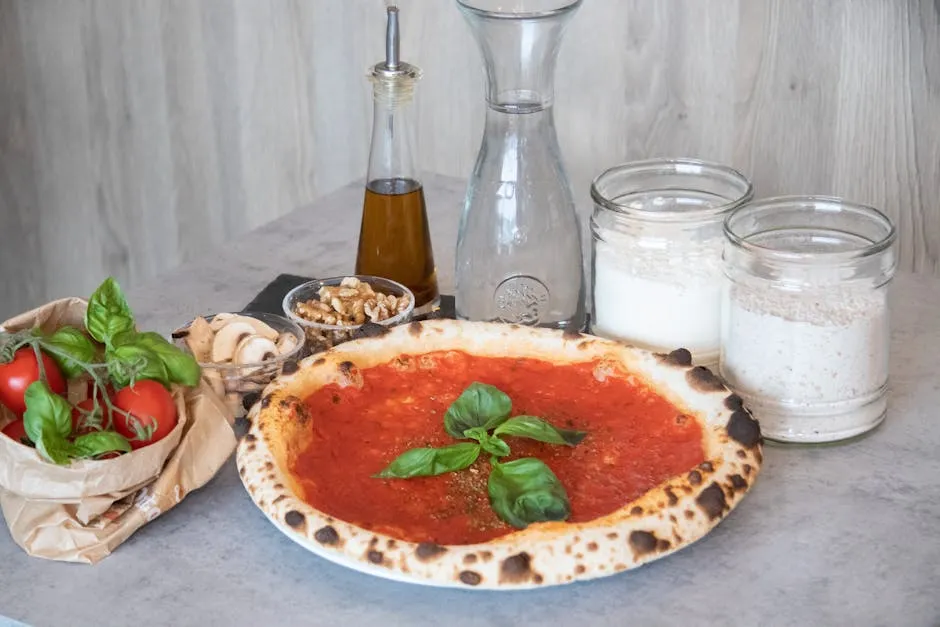
Yes. Bread flour makes perfectly good Neapolitan-style pizza at home, and for most home ovens it actually outperforms the traditional 00 flour that Neapolitan pizzerias use. The catch is that bread flour behaves differently than 00 — it’s stronger, more elastic, and produces a chewier crust — so you need to adjust your process to compensate. Here’s exactly what changes and why.
Why 00 Flour Is the Neapolitan Standard
Traditional Neapolitan pizza uses Italian 00 flour with a protein content of 11-12.5% and a W value (gluten strength index) of 220-270. The “00” designation refers to ash content (how much bran and germ remain after milling — 0.55% or less), not grind fineness. That’s a common misconception. Myhrvold’s lab tests confirmed that 00 flour isn’t even the most finely ground category.
Caputo blue bag (“Pizzeria”), the flour used in roughly 90% of Neapolitan pizzerias, sits at about 12.5% protein with a stated W of 260-270 (Myhrvold’s lab testing measured it higher at 332 — Caputo’s published specs are conservative). It produces extensible gluten — dough that stretches easily without fighting back. Da Michele’s pizzaiolos can finish stretching with just three turns because of that extensibility. In an 800-900F wood-fired oven, where the pizza bakes in 60-90 seconds, this flour works perfectly. The gluten doesn’t need to hold structure for long.
What Bread Flour Does Differently
American bread flour runs 13-14% protein with W values in the 300-350 range. That higher protein creates a stronger, more elastic gluten network. Where 00 stretches willingly, bread flour pushes back.
The practical effects:
- More elastic dough. It resists stretching and wants to snap back to a smaller size. You’ll fight the dough more during shaping.
- Chewier crust. Stronger gluten = more structural integrity in the finished pizza. The bite is heartier, less delicate.
- Better structural hold. Slices stay rigid when you pick them up. Less flop.
- Longer fermentation required. Higher-protein flour needs more time for protease enzymes to break down the gluten network and make the dough extensible. Gemignani’s rule: 13-14% protein flour needs a 36-48 hour rise. At 12.5-13%, you can get away with 36 hours.
Why Bread Flour Actually Works Better in Home Ovens
Here’s the part most people don’t explain: the flour that’s ideal for a 60-second bake at 900F is not ideal for a 7-8 minute bake at 550F.
In a home oven, the pizza sits on the baking surface much longer. The gluten network bears load for minutes, not seconds. Weaker 00 flour (W220-270) was designed for conditions where the crust sets almost immediately. Give it seven minutes in a home oven and the crust can turn out dry, stiff, and structurally fragile rather than tender and pliable.
Bread flour’s stronger scaffolding holds up to that longer bake. It keeps the crust from drying out into a cracker and maintains the kind of soft, foldable interior that makes Neapolitan pizza what it is — just with a bit more chew.
There’s a second problem with 00 in home ovens: browning. Italian 00 flour is unmalted. At 900F, the Maillard reaction happens almost instantly — there’s more than enough heat. At 500-550F, unmalted flour produces pale, anemic crusts that look and taste underdone. Bread flour handles this better, and if you add 0.5-1% diastatic malt powder (which Gemignani uses as a standard ingredient at 2% in his Master Dough), you solve the browning problem entirely.
The Best of Both Worlds: Caputo Americana
If you want a flour specifically engineered to bridge the gap between 00 and bread flour, Caputo Americana exists for exactly this purpose. It’s a 00-classified flour with 14.25% protein and a W of 360-380. Critically, it contains malt — unlike every other Caputo 00 product. It was designed for American home ovens baking at 500-700F.
Myhrvold’s lab-tested W values for reference:
| Flour | W (Lab-Tested) | Protein | Best For |
|---|---|---|---|
| Caputo Pizzeria (blue bag) | 332 | 12.5% | Portable/wood-fired ovens (800F+) |
| Caputo Cuoco (red bag) | 300-320 | 13-13.5% | Home oven, longer ferments |
| Caputo Americana | 360-380 | 14.25% | Home oven 500-700F, contains malt |
| King Arthur Bread Flour | ~300-350 | 12.7% | Home oven, widely available |
Caputo Americana is more expensive and harder to find than bread flour. If you’re using a home oven and already have bread flour in the pantry, you’re in good shape.
How to Adjust Your Process for Bread Flour
If you’re swapping bread flour into a recipe written for 00, make these changes:
1. Increase hydration by 2-3%. Higher protein absorbs more water — roughly 1.5% more water for every 1% increase in protein. A recipe calling for 65% hydration with 00 should go to 67-68% with bread flour. Without this adjustment, the dough will feel stiff and dry.
2. Extend fermentation. Give bread flour dough a minimum 24-hour cold ferment, ideally 48 hours. The extra time allows protease enzymes to degrade the stronger gluten network, making the dough extensible enough to stretch without tearing. This is not optional — under-fermented bread flour dough will spring back aggressively when you try to shape it.
3. Rest before stretching. After pulling dough balls from the fridge, temper them to 60-65F (1-2 hours at room temperature) before attempting to stretch. Gemignani’s Commandment #5: never put cold dough in a hot oven. Cold bread flour dough is nearly impossible to shape.
4. Consider adding diastatic malt. If your bread flour doesn’t already contain malted barley (check the ingredients), add 0.5-1% diastatic malt powder to improve browning. This is especially important at home oven temperatures where the Maillard reaction needs a nudge.
5. Be gentler during stretching. Bread flour dough is more elastic, so aggressive stretching causes snap-back. Use Iacopelli’s flat-palm pressing technique rather than aggressive pulling. Press air from center to edges, rotate, repeat. Let gravity do more of the work.
When 00 Is Still the Better Choice
If you own a portable pizza oven (Ooni, Gozney Roccbox) that reaches 800-950F, traditional 00 flour is the right call. At those temperatures, the bake finishes in 60-90 seconds. Bread flour’s extra strength becomes a liability — the crust is chewier than it needs to be and the stronger gluten can make the cornicione dense rather than airy.
For portable ovens, use Caputo blue bag or equivalent 00 (W220-270) at 60-62% hydration. The rapid bake retains enough moisture that you don’t need the higher hydration required for home ovens.
The Verdict
Bread flour is not a compromise for Neapolitan pizza at home — it’s an adaptation that respects how home ovens actually work. The crust will be slightly chewier and less delicate than what you’d get from 00 in a wood-fired oven, but it will hold together better, brown more evenly, and deliver the soft-foldable-center-with-crisp-underside combination that defines great Neapolitan pizza. Match it with a 48-hour cold ferment, proper hydration adjustment, and adequate tempering before stretching, and you’ll produce pizza that’s better than most 00 attempts in a home oven.
Gemignani himself doesn’t even use 00 for most of his non-Neapolitan pizzas. His go-to is 13.5% protein Power Flour from Pendleton. He actively warns against all-purpose flour for long-fermented doughs. Between 00 and bread flour for home oven pizza, bread flour is the stronger choice — literally.
This article is part of a series on pizza flour. For the complete guide to flour types, W values, protein percentages, and which flour to use for every oven and style, see our Best Flour for Pizza Dough pillar article.
Frequently Asked Questions
- Is bread flour the same as 00 flour?
- No. They're classified by different systems entirely. Bread flour is categorized by protein content (13-14%) -- an American convention. Italian 00 flour is categorized by ash content (0.55% or less) -- a measure of how much bran and germ remain after milling. A 00 flour can have anywhere from 11% to 15% protein depending on the specific product. Caputo Pizzeria 00 (12.5% protein) and Caputo Americana 00 (14.25% protein) are both 00 flours with very different behavior.
- Will bread flour make my pizza crust too chewy?
- It will be chewier than 00 flour in a wood-fired oven, yes. But in a home oven baking at 500-550F for 7-8 minutes, that extra chew is actually an advantage -- it prevents the crust from becoming dry and cracker-like. The key is a long cold ferment (48 hours minimum). Protease enzymes degrade the stronger gluten network over time, making the dough more extensible and the finished crust more tender.
- Can I mix bread flour and 00 flour together?
- Absolutely. Many pizzerias blend flours to hit a target strength. A 50/50 blend of bread flour (13-14% protein) and Caputo blue bag (12.5% protein) gives you roughly 12.75-13.25% protein -- right in the sweet spot for home oven Neapolitan. This is a legitimate strategy for dialing in your preferred texture.
- Do I need to change the hydration when switching from 00 to bread flour?
- Yes. Higher protein flour absorbs more water -- roughly 1.5% more water for every 1% increase in protein. If your 00 recipe uses 65% hydration, bump it to 67-68% for bread flour. Without this adjustment, the dough will feel noticeably stiffer and drier, and it will resist stretching more aggressively.
- What's the best bread flour for Neapolitan pizza at home?
- King Arthur bread flour (12.7% protein) is widely available and performs well. For higher-protein options, King Arthur Sir Lancelot (14.2%) or General Mills All Trumps (14.2%) are professional-grade choices. Gemignani's personal favorite is Pendleton Power Flour (13.5%). If you want a purpose-built option, Caputo Americana (14.25%, includes malt) was designed specifically for American home ovens.
- Should I use bread flour or 00 in my Ooni or Roccbox?
- Use 00. Portable pizza ovens reach 800-950F and bake pizza in 60-90 seconds. At those temperatures, bread flour's extra strength produces a chewier, denser crust than necessary. Traditional 00 (Caputo blue bag, W260-270) at 60-62% hydration is the right match for fast, hot bakes. Bread flour's advantages only kick in when bake times extend beyond 3-4 minutes.