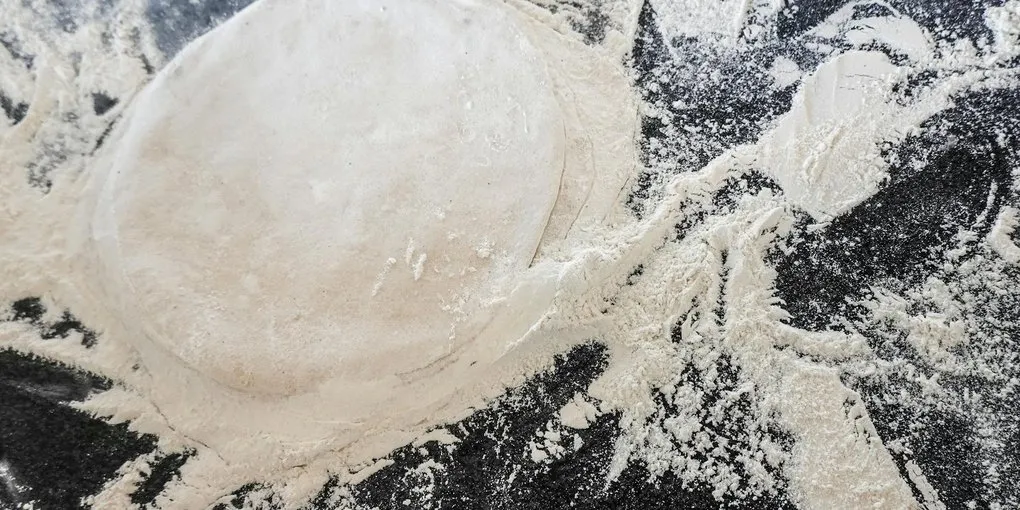
Tony Gemignani is a 13-time World Pizza Champion. His Master Dough with Starter is the foundation recipe in The Pizza Bible — the dough he uses for his competition pizzas, his restaurants, and the majority of recipes in the book. It is not the simplest pizza dough you can make. It requires a starter built 18 hours in advance, a two-phase cold ferment, ice water, diastatic malt, and precise timing. What it produces is a crust with more flavor complexity, better structure, and a lighter crumb than any straight dough can achieve.
If you’ve already mastered a basic overnight dough and want to take the next step — the step that separates good home pizza from genuinely impressive home pizza — this is the recipe.
The Tiga Starter
“Tiga” is Gemignani’s name for his personal biga variant. Traditional Italian biga is a stiff pre-ferment at 50-60% hydration. Gemignani’s Tiga is wetter — 70% hydration — making it easier to mix by hand while still producing the deeper flavor and superior crumb structure that pre-fermented dough delivers.
The starter needs 18 hours at room temperature before it goes into the final dough. You build it the morning before your dough day, or the evening before if you plan to mix dough the next afternoon.
Tiga Recipe
| Ingredient | Amount |
|---|---|
| Active dry yeast (ADY) | 0.14g |
| Cold tap water (not warm) | 39g |
| Flour (same type as final dough, 13-14% protein) | 55g |
Yield: Approximately 90g of Tiga starter.
Method:
- Sprinkle 0.14g ADY into 39g of cold tap water. Stir to dissolve. Cold water is deliberate — it slows yeast activity for a longer, more complex fermentation.
- Add 55g flour. Mix until a shaggy dough forms.
- Cover and leave at room temperature for 18 hours.
- After 18 hours, refrigerate for 30 minutes to cool and firm the starter slightly before use.
The Tiga can be stored in the refrigerator for up to 8 hours after it finishes its room-temperature ferment. Beyond that, it loses potency.
Measuring 0.14g yeast: You need a precision scale that reads to 0.01g (about $15-20 for a jewelry scale). If your scale only reads to 0.1g, measure 0.1g and understand you’re slightly under. The amount is tiny for a reason — 18 hours of slow fermentation at low yeast concentration produces maximum flavor complexity.
Why not poolish? Gemignani also offers a poolish formula (100% hydration: 0.12g ADY + 47g water + 47g flour, same 18-hour method). Both work. He uses Tiga more frequently — the drier starter produces a slightly different flavor profile and crumb character. Use the same flour in the starter as in your final dough.
The Master Dough
This is the complete formula for Gemignani’s Master Dough WITH Starter, exactly as specified in The Pizza Bible.
Ingredients
| Ingredient | Amount | Baker’s % |
|---|---|---|
| Flour (13-14% protein) | 453g | 100% |
| Ice water (38-40F) | 210g | 46.4% |
| Warm water (80-85F) for yeast | 70g | 15.5% |
| Total water | 280g | 61.8% |
| Tiga starter | 90g | 19.9% |
| Diastatic malt powder | 10g | 2.2% |
| Fine sea salt | 10g | 2.2% |
| Extra-virgin olive oil | 5g | 1.1% |
| Active dry yeast (ADY) | 2.2g | 0.49% |
Yield: Approximately 820g of dough, enough for 2 pizzas at 370g per ball (13-inch pizzas in a home oven).
Why These Numbers
Flour: 13-14% protein, not 00. Gemignani is explicit: “A lot of cookbooks will tell you that all-purpose flour is good for pizza making. For most pizzas, I disagree.” He insists on higher-protein flour because the strong gluten network withstands the extended enzymatic degradation of a 24-48 hour cold ferment. His named flour picks: All Trumps (14.2%), Pendleton Power Flour (13.5%), Sir Lancelot (14.2%), Giusto’s High Performer (13-13.5%), or Tony’s California Artisan (13-13.5%).
61.8% hydration (total). This sits squarely in Gemignani’s recommended 60-70% sweet spot — “optimized for texture, performance, and workability.” He explicitly rejects hydration above 70%: “Some recipe writers call overhydrated pizzas ‘rustic.’ I call them a mess.” The split between ice water and warm water is deliberate.
Ice water (210g at 38-40F). Most of the water is ice-cold. This keeps the dough temperature low during mixing (target: 65-72F after mixing), which slows the yeast from the start and prevents over-fermentation during the long cold retard. This technique contradicts most home recipes that use a single uniform water temperature.
Warm water (70g at 80-85F) for yeast. The small warm portion activates the ADY. Gemignani prefers starting the yeast slowly — never exceeding 85F for activation.
Diastatic malt (10g, 2.2%). This is not optional in Gemignani’s system. Diastatic malt powder — made from sprouted barley — contains maltose (feeds yeast, adds flavor, promotes browning) plus active enzymes that break down flour starches into yeast-available sugars. It’s a standard ingredient, not an additive. Available at beer-brewing supply stores or online. If baking above 650F (wood-fired, grill, broiler), omit the malt — unnecessary at those temperatures.
Fine sea salt (10g, 2.2%). Always fine sea salt — it dissolves and disperses more evenly than coarse. Avoid iodized salt (bitter, chemical taste). Salt is added after the yeast has begun working, not at the start — adding salt too early impedes flour absorption.
EVOO (5g, 1.1%). Added last, at the end of mixing. Fat forms a barrier that impedes flour hydration if added too early. Gemignani’s analogy: “Making dough is like building an engine. You put all the parts together and then you add oil at the end to start it up.”
ADY (2.2g, 0.49%). Half the yeast of his Master Dough without starter (which uses 4.5g). The Tiga supplies additional yeast and fermentation products, so less commercial yeast is needed. Gemignani uses active dry yeast (Red Star brand) for all recipes except Neapolitan — he explicitly avoids instant yeast for pizza: “It defeats the whole purpose of keeping the proofing process as slow as possible.”
Method
Day 1 — Mix the dough (15 minutes of active work):
-
Combine flour and diastatic malt in a large bowl or stand mixer. Whisk briefly to distribute the malt evenly.
-
Add ice water (210g). Mix briefly — the dough will be dry and shaggy. This is just initial hydration.
-
Dissolve 2.2g ADY in 70g warm water (80-85F). Let bloom for 2-3 minutes until slightly foamy.
-
Add the yeast-water to the bowl. Mix to combine.
-
Add 90g Tiga starter. Break the starter into small pieces and work it into the dough.
-
Add 10g fine sea salt. Mix until incorporated.
-
Add 5g EVOO. This goes in last. Mix until the oil is absorbed and the dough is cohesive.
-
Knead 2-3 minutes — either by hand on the counter or in a stand mixer on low speed. The dough should be smooth but not necessarily silky. Don’t over-knead.
-
Cover and rest 20 minutes at room temperature.
-
Divide and ball. Cut the dough into 2 pieces (approximately 370g each). Shape into tight balls, pinching the seam closed. A loose seam leaks gas and creates weak spots in the finished crust.
-
Wrap each ball tightly in plastic wrap or place in sealed containers.
-
Refrigerate 24-48 hours. The dough improves steadily across this window.
The Optional Degas Step (For Advanced Bakers)
Gemignani’s two-phase cold ferment method — tested directly against a single long cold ferment and found superior:
After 24 hours in the fridge, briefly degas each ball. Remove from the fridge, let sit 5 minutes to soften slightly, then press down gently with your palm and re-form into a tight ball. Return to the fridge for another 24 hours.
His assessment: “Baked up lighter, crispier, and more flavorful, with a stronger structure (slices held shape rather than flopping over).” Degassing promotes yeast reproduction and triggers a second round of fermentation. The total cold ferment becomes 48 hours (24 + degas + 24).
This step is optional but measurably improves the result. It is the same principle behind his Master Dough without starter, which explicitly includes a “degas in mixer 30 sec, reball, refrigerate 24hr more” step.
Bake Day
-
Remove dough balls from the fridge 1-2 hours before baking. Temper to 60-65F. Check with an instant-read thermometer. Cold dough in a hot oven produces large, uneven bubbles — Gemignani’s fifth commandment.
-
Preheat oven to 500F with two pizza stones or steels — one on the upper third rack, one on the bottom rack. Preheat for a full hour.
-
Shape. Dust your work surface with a 50/50 blend of flour and fine semolina (Gemignani’s recommended dusting mix — semolina acts as “mini ball bearings”). Press the dough starting 3/4 inch from the edge, all the way around, leaving the outer rim untouched to form the cornicione. Stretch to 12-13 inches for a 370g ball.
-
Build the pizza on a floured peel. Sauce first (spiral from center, 3/4-inch border). Cheese (center outward, less in the center — cheese melts back to the middle during baking). Other toppings.
-
Bake. Start pizza on the top stone. Bake 6 minutes. Lift onto peel, rotate 180 degrees, transfer to the bottom stone. Bake 5 more minutes. Total: approximately 11 minutes.
-
Finish. Slice first, then add finishing ingredients (garlic oil, grated cheese, oregano) — Gemignani’s ninth commandment.
Timing Schedule
| Time | Action | Duration |
|---|---|---|
| Day 0 (morning) | Build Tiga starter | 5 min |
| Day 0, 18 hours later | Tiga ready. Chill 30 min. | — |
| Day 1 | Mix final dough | 15 min |
| Day 1 | Rest 20 min, ball, wrap | 25 min |
| Day 1 to Day 2 | Cold ferment | 24-48 hr |
| Day 2 (optional) | Degas and reball at 24hr mark | 5 min |
| Day 3 | Temper 1-2 hr | — |
| Day 3 | Preheat oven (two stones, 1 hr) | — |
| Day 3 | Shape, top, bake | Approximately 15 min/pizza |
Total active time: Approximately 45 minutes spread across 3 days.
What to Expect
The crust: A richly and uniformly browned cornicione, puffed with even holes resembling ciabatta. The structure supports toppings without excessive flop. Slices hold their shape — they may bend but shouldn’t fold in half. The bottom is evenly browned with no pale or burned spots.
The crumb: More open and irregular than straight dough. The Tiga starter contributes fermentation products that create larger, more varied air pockets. The two-stone method crisps the bottom without drying the interior.
The flavor: Noticeably more complex than dough without a pre-ferment. The 18-hour Tiga develops organic acids, esters, and glutamates that a straight dough — even a 48-hour cold-fermented one — cannot fully replicate. Gemignani’s starters produce “more complex flavor, better aroma, nicer crumb, better texture.”
If it doesn’t look right: Check the competition judging criteria Gemignani uses — flexibility (edge folds without breaking), no “gum line” (raw-looking dough in the cross-section), cheese perfectly melted and slightly brown.
Tips
The Tiga is worth the extra day. It adds 5 minutes of work and 18 hours of waiting, and the difference in the finished pizza is unmistakable. If you’ve been making straight cold-fermented dough and wondering what the next level looks like — this is it.
Diastatic malt is available at beer-brewing supply stores. If you can’t find it locally, it’s readily available online. Get diastatic (enzyme-active), not nondiastatic (which is just a sweetener). Store in the freezer for maximum shelf life.
Use the same flour in the Tiga as in the final dough. Gemignani specifies this. The starter and the dough should have consistent gluten characteristics.
Weigh the ice water, don’t measure by volume. Ice displaces water differently depending on how much ice vs. liquid is in the measuring cup. Weigh 210g of water, then chill it (or add ice cubes and let them melt to the target).
The two-stone bake method is Gemignani’s “favorite discovery for home pizza.” The second stone hasn’t been cooled by dough contact — it acts as a fresh hot surface. Between pizzas, brush stones clean with a dry heatproof brush. Never use water or a damp towel on hot stones.
Sources: Gemignani, The Pizza Bible (Master Dough with Starter, Tiga starter, two-phase cold ferment, two-stone baking method, Ten Commandments, competition judging criteria, flour guide, diastatic malt, ice water technique); Myhrvold & Migoya, Modernist Pizza Vol 1 (crystalline vs. liquid fat, ADY glutathione effect); Forkish, The Elements of Pizza (pre-ferment flavor development, biga science).
Frequently Asked Questions
- What is Tiga, and how is it different from regular biga?
- Tiga is Tony Gemignani's personal biga variant. Traditional Italian biga is a stiff pre-ferment at 50-60% hydration. Tiga is wetter at 70% hydration (39g water to 55g flour), which makes it easier to mix by hand while still producing the flavor depth and crumb improvement of a pre-fermented dough. The formula: 0.14g active dry yeast + 39g cold tap water + 55g flour (same as your final dough). Mix and leave at room temperature for 18 hours, then chill 30 minutes before using. It yields 90g, enough for one batch of master dough (two 370g pizza balls). You can store it refrigerated for up to 8 hours after the 18-hour ferment.
- Why does this recipe use both ice water and warm water?
- Gemignani splits the water into two portions with different temperatures, each serving a specific purpose. The large portion (210g) is ice-cold (38-40F) to keep the overall dough temperature low (65-72F after mixing), which prevents the yeast from racing during the long cold ferment. The small portion (70g) is warm (80-85F) solely to activate the active dry yeast. ADY needs warm water to rehydrate and begin working. This two-temperature technique contradicts most home recipes that use a single water temperature but is standard in competition-level dough making. Never exceed 85F for yeast activation.
- What is diastatic malt, and can I leave it out?
- Diastatic malt powder is made from sprouted barley and contains both maltose sugar and active enzymes. The enzymes break down flour starches into simpler sugars that yeast can consume, producing more fermentation activity, more flavor, and better browning. Gemignani uses it as a standard ingredient at 2.2%, not an optional additive. If baking above 650F (wood-fired or portable oven), you can omit it since the intense heat produces plenty of Maillard browning on its own. But in a home oven at 500-550F, diastatic malt is a significant contributor to crust color and flavor. Available at beer-brewing supply stores or online. Get diastatic (enzyme-active), not nondiastatic (which is just a sweetener with no enzymatic function).
- Why does Gemignani use active dry yeast instead of instant?
- Gemignani explicitly says to avoid quick-rise/instant yeast for pizza: 'It defeats the whole purpose of keeping the proofing process as slow as possible.' He uses active dry yeast (Red Star brand) for all recipes except Neapolitan (which traditionally uses fresh yeast per AVPN specification). ADY activates more slowly than instant, which aligns with his emphasis on long, cold fermentation. If you want to substitute instant dry yeast, use 75% of the ADY amount (1.7g instead of 2.2g) and add it directly to the flour without blooming.
- What flour should I use if I can't find the brands Gemignani recommends?
- Gemignani names specific flours: All Trumps (14.2% protein), Pendleton Power Flour (13.5%), Sir Lancelot by King Arthur (14.2%), Giusto's High Performer (13-13.5%), or Tony's California Artisan (13-13.5%). If none are available, use King Arthur Bread Flour (12.7%), the most widely accessible flour in the 12.5-14% range. Avoid all-purpose flour for this recipe. Gemignani's protein-to-rise-time rule: 12.5-13% protein supports a 36-hour rise; 13-14% protein supports 36-48 hours. Weaker flour degrades faster during long cold ferment.
- What's the difference between the Master Dough with starter and without starter?
- The version without starter doubles the yeast (4.5g vs 2.2g) to compensate for the missing pre-ferment, increases total water to 295g (65.1% hydration), and adds an explicit degas-and-reball step at the 24-hour mark. It produces good pizza but lacks the flavor complexity and crumb character the Tiga provides. Gemignani uses starters in almost every dough. If you have the extra 18 hours, the version with starter is measurably better.
Some links on this page are affiliate links. If you purchase through them, we may earn a small commission at no extra cost to you.