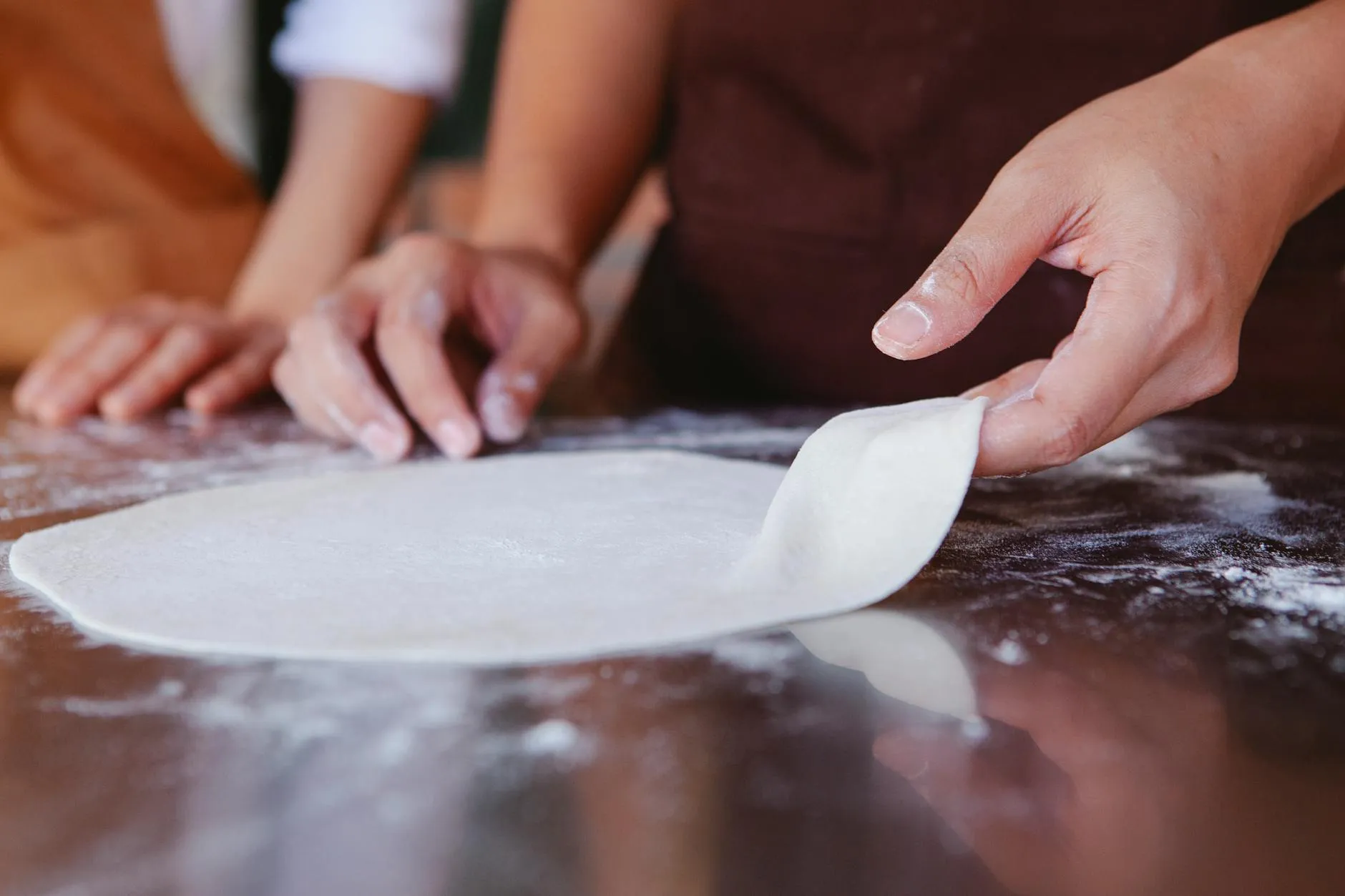
Your dough is under-proofed. When pizza dough snaps back to a smaller size every time you try to stretch it, the gluten network is too tight and hasn’t been relaxed enough by fermentation. The fix is almost always more time — either a longer proof, a rest period before stretching, or warming the dough to the right temperature before you touch it. Here’s the full explanation and the specific fixes.
The Gluten Mechanics: Elastic vs Extensible
Pizza dough contains two key proteins: glutenin and gliadin. When they hydrate and link together, they form gluten — the structural web that holds your pizza together. But these two proteins have opposite jobs:
- Glutenin controls tenacity (resistance to deformation). It’s connected by disulphide bridges — strong covalent bonds that make the network rigid.
- Gliadin controls extensibility (the ability to stretch and flow). It interacts with the gluten network through weaker, non-covalent bonds.
Fresh, under-proofed dough is glutenin-dominant. The disulphide bridges are intact, the network is tight, and the dough fights your hands. As Forkish puts it, “elastic is not a happy word in the pizza maker’s lexicon.” Elastic dough snaps back. Extensible dough stays where you put it.
The key enzyme that shifts the balance is protease. During fermentation, protease gradually breaks down gluten proteins into smaller peptides. It preferentially weakens the tight glutenin bonds, making the dough progressively more extensible over time. This is why time is the single most important ingredient in pizza dough — not just for flavor (though that improves too), but for texture and workability.
Masi draws a critical distinction between fermentation and maturation:
- Fermentation = yeast producing CO2, expanding the dough.
- Maturation = enzymatic processes (protease, amylase) breaking down complex structures.
A dough can be adequately fermented (enough gas) but insufficiently matured (gluten still too tight). This is exactly what causes snap-back: the dough has risen, it looks ready, but the gluten network hasn’t been degraded enough to allow stretching. You need both fermentation and maturation to complete before the dough is truly ready.
The Four Causes of Snap-Back (and Their Fixes)
1. Insufficient Proofing Time
This is the most common cause. The dough simply hasn’t fermented and matured long enough for protease to do its work.
Strong flour (high protein, high W value) takes longer to mature than weak flour. Masi is explicit: strong flour (high W) needs low temperatures and 24-48 hours for full maturation. Weaker flour needs only 8-12 hours. If you’re using bread flour (13-14% protein, W300-350) with a same-day recipe designed for all-purpose flour (10-12% protein, W180-220), the dough will snap back aggressively because the stronger gluten network hasn’t had enough time to relax.
Gemignani’s protein-to-rise-time rule provides clear guidance:
- 12.5-13% protein flour: needs a 36-hour rise
- 13-14% protein flour: needs a 36-48 hour rise
His two-phase cold ferment (24 hours bulk in the fridge, then degas, re-ball, and 24 more hours) consistently produces dough that stretches easily because the extended timeline allows complete maturation.
The fix: Give it more time. If you’re using a same-day recipe and the dough fights you, ball it back up, cover it, and wait 2-3 more hours. If you’re using a cold-fermented dough that still snaps back after the prescribed time, your flour is probably stronger than the recipe assumed. Next time, extend the cold ferment by 12-24 hours (try an overnight pizza dough schedule) or reduce the protein level of your flour.
2. The Dough Is Too Cold
Cold gluten is stiff gluten. A dough ball pulled straight from the refrigerator will snap back even if it’s fully matured, because the cooled proteins are less flexible and the fat components (if any) have solidified.
Gemignani is emphatic about this — it’s his Commandment #5: never put cold dough in a hot oven. Cold dough produces large bubbles in the first 2-3 minutes of baking (gas pockets that expand violently when they hit oven heat). But before it even gets to the oven, cold dough is nearly impossible to shape. The tight network at fridge temperature resists every stretch.
The fix: Temper your dough balls to 60-65F before stretching. For most home kitchens, this means pulling them from the fridge 1-2 hours before you plan to bake. Gemignani recommends checking with an instant-read thermometer. Iacopelli suggests 20 minutes minimum at room temperature, though for large dough balls (370g), 1-2 hours is more realistic.
The difference is dramatic. A dough ball at 40F fights you. The same ball at 62F practically stretches itself.
3. No Rest After Shaping
Even well-matured, room-temperature dough benefits from a rest after the initial shaping attempt. When you press and stretch dough, you’re mechanically deforming the gluten network. Some of those bonds resist, creating elastic tension. If you keep fighting that tension, you’ll either tear the dough or work it into a stressed, irregular shape.
A 15-20 minute rest allows the gluten to relax. The mechanical stress dissipates, disulphide bonds reorganize, and the dough becomes willing to stretch further. This is essentially a mini-autolyse — giving the proteins time to settle into their new configuration.
Iacopelli’s three-structure experiment demonstrates this beautifully. Using the exact same 70% hydration dough, he produced three completely different crumb structures just by varying the rest time before balling:
- No rest: dense, small regular air cells (tight gluten)
- 20-minute rest: balanced, larger pockets (relaxed gluten)
- 20-minute rest, re-ball, 20-minute rest, ball again: ultra-light, very large holes (maximally relaxed gluten)
No extra ingredients. No extra fermentation time. Just resting.
The fix: If the dough snaps back during stretching, stop. Cover it with an inverted bowl or plastic wrap and walk away for 15-20 minutes. When you come back, it will stretch significantly farther before resisting. If it still snaps back, rest it again. You can repeat this cycle 2-3 times.
4. Over-Mixing or Over-Kneading
Aggressive mixing organizes gluten strands into a tight, highly elastic network. This is what bread bakers want — maximum volume requires maximum gluten organization. But pizza wants the opposite. Forkish explicitly states that hand mixing produces a more delicate crust because it creates less gluten organization and therefore less chewiness.
If you kneaded your pizza dough in a stand mixer for 5-10 minutes (a bread-appropriate duration), you likely built more elastic structure than pizza needs. The dough will fight you.
The fix: For next time, mix pizza dough by hand (Forkish’s pincer method: 2-3 minutes) or use a stand mixer on the lowest speed for no more than 90 seconds. For the current batch, the fix is the same as #1 and #3: more time. Extended fermentation and resting will gradually undo the over-organized gluten through protease degradation.
The Quick-Fix Decision Tree
If your dough is snapping back right now and you want to make pizza tonight:
- Is the dough cold (below 60F)? Temper for 1-2 hours at room temperature.
- Has it been out of the fridge for over an hour and still snaps back? Rest it under a bowl for 15-20 minutes between stretching attempts.
- Still fighting after two rests? It’s under-matured. You can either wait longer (2-3 more hours at room temp) or stretch it slightly smaller than planned and accept a thicker pizza.
- Did the dough tear instead of snap back? It’s over-matured. The gluten is too weak. Re-ball it gently and rest for 1 hour — the network partially recovers.
Masi’s troubleshooting guide confirms: insufficient maturation produces dough that is too elastic, resists shaping, springs back, and results in a center that’s too thick. Excessive maturation weakens the gluten so much that the dough tears and develops holes. The target is the middle ground — dough that stretches willingly without tearing.
Maturity Signs: How to Know It’s Ready
Forkish’s readiness cues for properly matured dough:
- The dough ball has expanded and shows small bubbles of fermentation gas
- The bottom of the ball shows gassy holes when turned over
- It feels soft, pliable, and relaxed — stretches easily without snapping back
- It’s “both delicate and structurally sound at the same time”
Iacopelli’s visual check: the ball is roughly 1.25x its original size (not doubled), has small light bubbles on the surface, feels “full of air” and “light,” and a poke indentation slowly springs back. If it springs back immediately and aggressively, it’s not ready. If it doesn’t spring back at all, it’s over-proofed.
The poke test is your best friend. Press a floured finger about 1/2 inch into the dough ball. If the indentation fills back slowly (2-3 seconds), the dough is ready. If it snaps back instantly, wait longer. If it stays dented, you’ve gone too far.
For the complete guide to stretching technique including Gemignani’s counter-stretch method and Iacopelli’s slap technique, see How to Stretch Pizza Dough. For the science behind gluten behavior, see How Gluten Works in Pizza Dough. For proofing schedules and the poke test in detail, see How Long to Proof Pizza Dough.
Frequently Asked Questions
- How long should I let pizza dough rest before stretching?
- After pulling dough balls from the fridge, temper them at room temperature for 1-2 hours until they reach 60-65F. Then, if the dough still resists during stretching, rest it under an inverted bowl for 15-20 minutes and try again. You can repeat this rest cycle 2-3 times. Gemignani recommends checking dough temperature with an instant-read thermometer -- cold dough (below 55F) will fight you regardless of how well it was fermented.
- Does over-kneading cause dough to shrink back?
- Yes. Over-kneading organizes gluten into a tight, highly elastic network that resists stretching. Pizza dough should be mixed gently -- Forkish recommends hand mixing for 2-3 minutes using his pincer method, or stand mixer on lowest speed for no more than 90 seconds. Bread-style kneading (5-10 minutes) builds more elastic structure than pizza needs. If you've over-kneaded, the fix is extended fermentation (24-48 hours cold) to allow protease enzymes to degrade the over-organized gluten.
- Can I re-ball dough that keeps shrinking back?
- Yes, and you should. If the dough fights you during stretching, gently reshape it into a ball (without aggressive kneading), cover it, and rest for 15-20 minutes. The gluten relaxes and the dough becomes more cooperative. Iacopelli demonstrated that even two rounds of re-balling and resting (20 minutes each) dramatically changed the crumb structure of the finished pizza -- producing larger, more irregular air pockets from the same dough recipe.
- Why does my dough stretch fine at first and then start snapping back?
- You're hitting the elastic limit of the gluten network at its current state of relaxation. The first few inches of stretching use up the available extensibility, then the elastic (glutenin) component takes over and fights back. The fix: stop stretching, rest the dough 10-15 minutes (cover it so it doesn't dry out), then continue. The rest allows the stressed gluten bonds to reorganize. This stop-and-rest approach often gets you to full diameter in 2-3 stretching sessions.
- Does higher hydration dough snap back less?
- Generally yes. Higher hydration (more water relative to flour) produces a softer, more extensible dough because the additional water lubricates gluten strands and allows them to slide past each other more easily. Forkish uses 70% hydration for home-oven Neapolitan specifically because it produces soft, stretchy dough. However, higher hydration also makes dough stickier and harder to handle. The sweet spot for most home bakers is 65-70% -- enough extensibility to prevent snap-back, without being unmanageably wet.
- What flour is easiest to stretch for pizza?
- Lower-protein flour is more extensible and snaps back less. Italian 00 flour (11-12.5% protein) with a low P/L ratio (0.50-0.70, meaning more extensibility relative to tenacity) is the easiest to stretch. Caputo blue bag is the standard -- Da Michele's pizzaiolos finish stretching in just three turns because of its extensibility. Bread flour (13-14% protein) has stronger, more elastic gluten that requires longer fermentation (48+ hours) to become cooperative. If snap-back is a recurring problem and you're using bread flour, try switching to a 00 or blending 50/50.