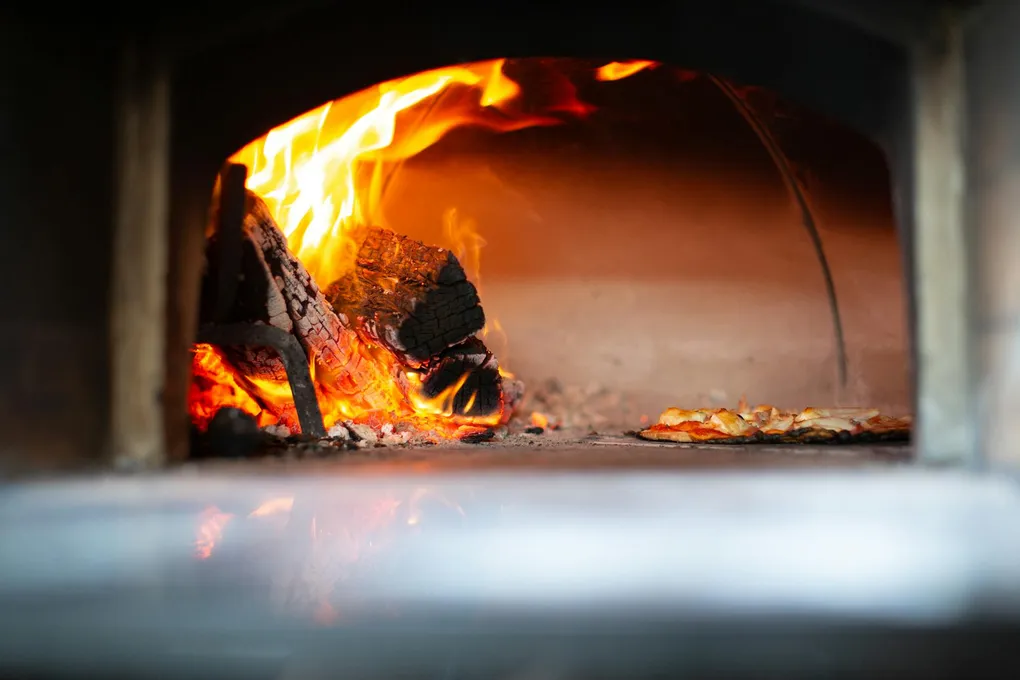
The wood-fired pizza oven is the most romanticized piece of cooking equipment on the planet. The flame, the smoke, the ancient craft of it. Gas ovens, by contrast, are utilitarian — turn a knob, wait, cook. No one writes poetry about propane.
But romance does not bake pizza. Physics does. And the physics of wood-fired and gas-fired pizza ovens are more similar than most people realize — with a few critical differences that matter for your actual results at home.
What Actually Heats Your Pizza
Before comparing wood and gas, you need to understand what is really doing the work inside any pizza oven. There are three heat transfer mechanisms at play simultaneously:
-
Conduction — heat flowing from the oven floor directly into the pizza base through contact. This is what sets the bottom crust, creates leopard spots, and determines how crispy your underside gets.
-
Radiation — heat energy emitted from the dome, walls, and any hot surfaces, proportional to the fourth power of their temperature (the Stefan-Boltzmann law). At 400C, your pizza receives 16x more radiant heat than at 200C. This is the dominant force in high-temperature pizza baking and the reason a 900F oven produces qualitatively different results, not just faster ones. [Myhrvold]
-
Convection — hot air circulating around the pizza. The least significant of the three for pizza, though it contributes to topping cooking and cheese browning.
Here is the key insight: in both wood-fired and gas-fired ovens, the pizza “sees” only the temperature of heated surfaces. The flame itself — whether from burning oak or burning propane — creates negligible radiation for heat transfer. Myhrvold’s team measured this directly, and it was confirmed by French wildfire scientists studying flame radiation. Flames are what physicists call “optically thin” — they do not emit significant thermal radiation in the infrared spectrum that matters for cooking. [Myhrvold pp. 386-387]
What this means practically: the flame heats the dome and walls, and the dome and walls heat your pizza. The flame is an intermediary, not a direct actor. For a deeper look at these thermal dynamics, see our guide to pizza oven thermodynamics.
The Wood Flavor Question
This is where things get controversial. The widespread belief is that wood-fired pizza tastes different — better — because of smoke flavor imparted by the burning wood.
Two of our seven sources directly contradict this.
Myhrvold is unequivocal: “If the wood is flavoring the pizza, there’s something wrong with either the technique or oven hygiene.” In a properly functioning wood-fired oven, smoke rises to the top of the dome and exits through the vent. The pizza sits on the floor, below the smoke path. The only meaningful effect of wood fire, Myhrvold argues, is “the marketing effect.” [Myhrvold p. 418]
Masi agrees independently: “The concept of a particular aroma from wood to the pizza is FALSE” — there is no transfer of aromas from wood to pizza during the 60-90 second Neapolitan bake. [Masi p. 86]
This does not mean wood-fired pizza tastes identical to gas-fired pizza. It means the taste difference — if you detect one — is coming from factors other than smoke absorption:
- Temperature patterns. Wood fires create uneven heating with a pronounced hot spot near the embers, which produces more aggressive charring in some areas and less in others. This randomness creates textural and flavor variation across the pie.
- Embers vs. no embers. Live embers can reach 1,200-1,500C and radiate enormous heat toward anything in their line of sight. Gas ovens have no equivalent. This matters for leopard-spotting and cornicione char. [Myhrvold pp. 386-387]
- Operator behavior. Wood-fire pizza requires constant attention — rotating every 15-30 seconds, managing flame height, reading the floor temperature. This active engagement often produces a more carefully baked pizza simply because you cannot walk away.
Wood-Fired: What It Actually Offers
Advantages
Higher peak temperatures. A well-built masonry wood-fired oven reaches floor temperatures of 400-485C (750-905F) and dome temperatures of 430-470C. This is the domain of true Neapolitan pizza — 60-90 second bakes with explosive oven spring, dramatic leoparding, and a wet, foldable center. No gas portable oven matches a full masonry dome’s radiant heat output. [Masi p. 85]
Radiant dome pattern. The semispherical brick dome of a traditional wood-fired oven radiates heat downward relatively uniformly (with emissivity around 0.93 for refractory brick). Combined with the T^4 radiation law, this dome-radiated heat is what makes Neapolitan pizza baking so distinctly different from any other cooking method. [Masi pp. 86-88]
The embers. Nothing in a gas oven replicates the 1,200-1,500C radiant heat from live wood embers. This extreme localized radiation is what creates the most dramatic char patterns.
Aesthetic and experience. There is genuine value in the ritual of building and managing a fire. For outdoor entertaining, a wood-fired oven is a centerpiece.
Disadvantages
Fuel management is real work. You need quality hardwood — oak and olive are the traditional Neapolitan choices, requiring less than 20% moisture content, compact structure, high heat of combustion, and a constant burn without crackling. [Masi p. 85] Sourcing, storing, and seasoning wood is an ongoing commitment. A cord of oak costs $250-400 depending on your region.
Temperature control is difficult. You are managing a live fire, which means the heat is constantly changing. Too much wood and you scorch; too little and the floor cools. The learning curve is steep.
Long preheat. A masonry oven can take 1-2 hours to reach proper temperature throughout the dome and floor mass. Portable wood-pellet ovens (like the Ooni Fyra) are faster but still require more attention than turning a dial.
Cleanup. Ash management, soot buildup, and the occasional need to pyrolyze residue off the floor.
Gas-Fired: What It Actually Offers
Advantages
Consistent, repeatable temperature. Turn to your target setting, verify with an infrared thermometer, and the temperature stays there. Between pizzas, crank the flame and the stone recovers predictably. This consistency makes gas ovens dramatically easier to learn on.
Faster heat-up and recovery. The Gozney Roccbox, for example, reaches full stone saturation in 30-60 minutes on gas and recovers between pizzas in 1-3 minutes — significantly faster than recharging a wood fire. [Synthesis: Roccbox guide]
No fuel management. A 20-pound propane tank yields roughly 10 pizzas in a portable oven, costs under $20 to refill, and requires zero curing, splitting, or seasoning.
Lower learning curve. The flame management protocols for gas ovens are straightforward: flame up to preheat, flame down when the pizza goes in, flame up between pies. You can focus on dough and toppings instead of fire.
Disadvantages
No embers. Gas flames are, as Myhrvold puts it, “spotlights shining on the ceiling” — they heat surfaces indirectly. The absence of 1,200C+ ember radiation means gas ovens produce less aggressive charring unless you deliberately seek it with proximity to the burner.
Temperature ceiling. Most portable gas ovens top out around 932-950F at the stone surface near the burner, with significant temperature gradients (200-300F from front to back in an Ooni Koda 16). A full masonry wood-fired dome delivers more uniform extreme heat.
Less temperature variation across the pie. This is simultaneously an advantage (consistency) and a disadvantage (less of the random char-and-blister texture that wood-fire enthusiasts prize).
The Honest Comparison Table
| Factor | Wood-Fired | Gas-Fired |
|---|---|---|
| Peak floor temp | 850-905F (masonry) | 850-950F (portable, near burner) |
| Dome radiation | Superior (refractory brick, embers) | Good (heated ceiling, no embers) |
| Temperature consistency | Variable (fire management) | Excellent (dial control) |
| Preheat time | 60-120 min (masonry), 25-30 min (pellet) | 30-60 min (full stone saturation) |
| Recovery between pizzas | 3-8 min (add wood, rebuild heat) | 1-5 min (crank to high) |
| Fuel cost per session | $5-15 (hardwood) | $2-4 (propane) |
| Learning curve | Steep | Moderate |
| Smoke flavor | Negligible per Myhrvold/Masi | None |
| Embers | Yes (1,200-1,500C) | No |
| Maintenance | High (ash, soot, wood storage) | Low (occasional burner cleaning) |
Below 800F, Most People Cannot Tell the Difference
Here is the honest takeaway that neither camp wants to hear: at the temperatures most home pizza ovens actually operate — 550F to 800F — the differences between wood and gas are minimal in the finished pizza.
The dramatic advantages of wood-fired baking emerge at the extreme upper end of the temperature range, in full masonry domes, with trained operators managing the fire actively. In a portable oven operating at 700-800F stone temperature, the fuel source matters far less than your dough formulation, your hydration level, your flour choice, and your bake timing.
If you are baking at home oven temperatures (500-550F), the fuel source is irrelevant. Your baking surface (steel vs. stone), your preheat duration, and your broiler technique matter infinitely more.
The Multi-Fuel Compromise
The market has arrived at a sensible middle ground: dual-fuel and multi-fuel ovens that let you choose wood or gas depending on the occasion.
Gozney Dome ($1,700-2,000) is the flagship example. It runs gas and wood simultaneously or independently, with a 30mm cordierite stone for superior heat retention. Use gas for convenience on weeknights, add wood for weekend sessions when you want the experience. The Gen 2 includes a digital dock thermometer that reads both ambient and stone temperature, taking the guesswork out of readiness.
Gozney Roccbox ($499) offers a detachable Wood Burner 2.0 accessory ($100) that converts the gas burner to wood-pellet fuel and back. The v2 wood burner has a 27% larger hopper, built-in secondary combustion, and a removable ash tray.
Ooni Karu 2 Pro ($849) is Ooni’s multi-fuel flagship — gas, wood, or charcoal. At 16 inches and roughly 62 lbs, it is a serious piece of equipment.
The dual-fuel approach gives you the practical answer to the wood vs. gas debate: use both, and let the occasion dictate the fuel.
Matching Oven to Style
Not every pizza style benefits from the highest possible temperature. Myhrvold’s style-by-oven analysis provides clear guidance:
| Style | Ideal Temp Range | Best Oven | Avoid |
|---|---|---|---|
| Neapolitan | 850-900F | Gas-fired pizza oven, wood-fired masonry | Home oven, convection |
| New York | 550-600F | Pizza deck, bread deck | — |
| Detroit | 480-525F | Pizza deck, impinger | Wood-fired, gas-fired |
| Deep-Dish | 480-550F | Pizza deck, bread deck | Wood-fired, gas-fired |
| Al Taglio | 480-600F | Pizza deck, bread deck | — |
Notice that Myhrvold explicitly recommends against wood-fired and gas-fired pizza ovens for Detroit and deep-dish styles. Those pan-baked styles need sustained moderate heat with strong bottom conduction — the exact opposite of what a 900F dome delivers. [Myhrvold pp. 410-412]
What Should You Buy?
If you are starting from zero and want one oven that covers the widest range of pizza styles with the least frustration:
A gas portable pizza oven (Ooni Koda 16 or Gozney Roccbox) paired with a baking steel in your home oven is the most versatile two-oven setup you can build for under $800. Gas portable for Neapolitan and high-temp styles, home oven with steel for New York, pan pizza, Detroit, and everything that benefits from a 7-12 minute bake.
If budget and space are unlimited and you entertain regularly, a Gozney Dome gives you the dual-fuel flexibility to go wood when you want the experience and gas when you want simplicity.
If you already own a gas portable oven and are considering adding wood capability, the Roccbox Wood Burner 2.0 at $100 is the most cost-effective way to experiment with wood-fired baking before committing to a masonry build.
And if you are convinced you need a full masonry wood-fired oven in your backyard — build it. They are extraordinary. Just know that the flavor advantage you are chasing is, according to the most rigorous testing available, not coming from the smoke.
Sources: Myhrvold & Migoya, Modernist Pizza Vol 1 (2021); Masi, Romano & Coccia, The Neapolitan Pizza: A Scientific Guide (2015); Forkish, The Elements of Pizza (2016); Portable oven operational data from manufacturer specs and field testing.