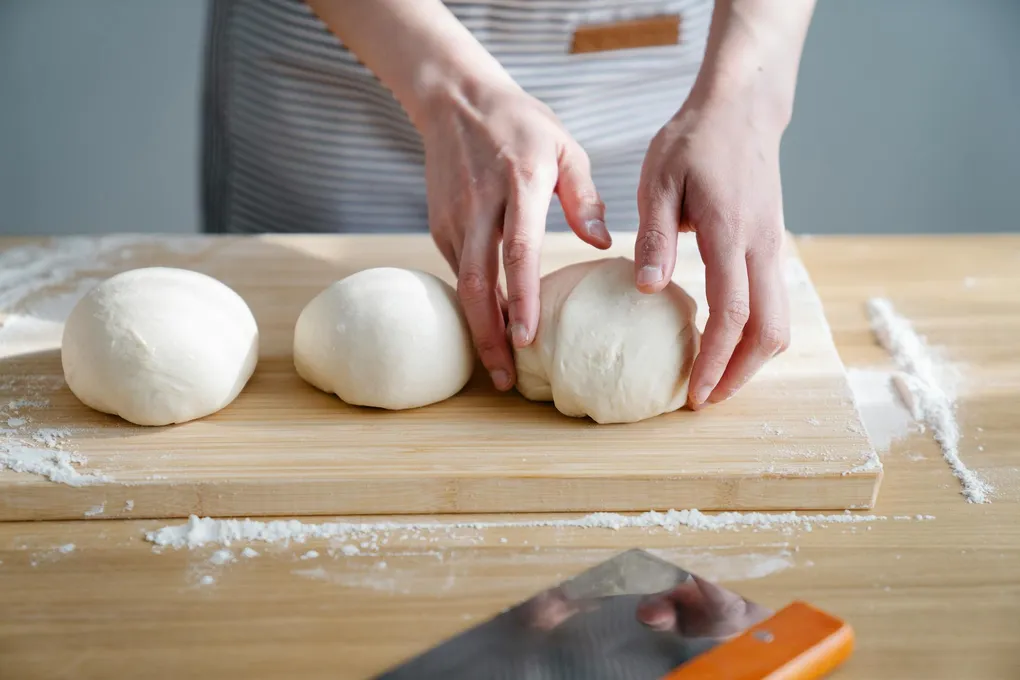
Your dough has been sitting on the counter for three hours and it looks exactly the same as when you mixed it. No bubbles, no expansion, no life. Before you scrap it and order delivery, know this: flat dough almost always has a fixable cause. Most of the time, it comes down to one of ten common problems — and once you understand the biology and chemistry behind dough rising, the solutions become obvious.
Dough rises because yeast (Saccharomyces cerevisiae) ferments sugars and produces carbon dioxide gas. That gas gets trapped by the gluten network, and the dough expands. If something kills the yeast, starves it, blocks it, or ruptures the network holding the gas in, your dough stays flat. Let’s diagnose what went wrong.
1. Your Yeast Is Dead (Before You Even Start)
This is the most common cause and the easiest to fix. Yeast is a living organism, and it dies on the shelf.
Active dry yeast loses viability after 6-12 months. Instant yeast lasts longer (up to 2 years sealed) but degrades once opened. Fresh compressed yeast has the shortest window — just 2-3 weeks refrigerated. If you can’t remember when you bought it, it’s probably the problem.
The fix: Proof your yeast before committing it to dough. Dissolve it in warm water (80-85F) with a pinch of sugar. Within 5-10 minutes, you should see foaming and bubbling. No activity? New yeast. For a full breakdown of yeast biology, see our guide to how yeast works in pizza dough.
Storage note: Keep opened yeast in the refrigerator in an airtight container. Despite some advice to freeze yeast, Gemignani warns against it — freezing can expand moisture inside yeast cells and rupture the cell walls, killing the organism. Myhrvold’s team and Masi note that freezing at -18C for up to 3 months can work with compressed yeast, but for home bakers, fresh refrigerated yeast is the safest bet.
2. Your Water Killed the Yeast
This one is silent and devastating. Yeast has a narrow comfort zone when it comes to temperature:
| Water Temp | Effect |
|---|---|
| Below 70F (21C) | Yeast barely active; very slow fermentation |
| 78-85F (26-29C) | Optimal activation range |
| 95-105F (35-40C) | Yeast stressed; fermentation fast but sloppy |
| Above 114F (46C) | Yeast begins dying |
| 130F+ (54C) | All yeast dead on contact |
Masi’s yeast biology research confirms that 50-60C (122-140F) is the lethal range for all yeasts. Forkish targets 80-82F final dough temperature for most pizza doughs and recommends water at 90-95F to achieve that after mixing friction cools the dough slightly.
The fix: Use a digital probe thermometer every single time. Water that feels “warm” to your hand can easily be 120F+ — well into the kill zone. Target 80-85F for yeast activation water, and use Masi’s formula for larger batches: T_water = 75 - T_ambient - T_flour - 9 (all in Celsius) to hit a final dough temp of 24C. For a deeper dive into how water temperature affects your dough, see our dedicated guide.
3. Salt Touched Yeast Directly
Salt is essential in pizza dough — it tightens gluten, controls fermentation speed, and makes the crust taste like something. But salt in direct contact with yeast is toxic to those cells. At high concentrations, salt increases osmotic pressure around yeast, causing the cells to release their internal water and dehydrate.
Masi’s research shows that chloride ions directly affect gluten composition and slow gas development. That’s the point — salt controls fermentation. But if you dump salt directly onto undissolved yeast, you can kill a significant percentage of cells before they ever start working.
The fix: There are two safe approaches. The Italian method dissolves salt in water first, then adds yeast (also dissolved in water) separately. Gemignani’s method adds salt after the yeast has had time to begin working. Either way, salt and yeast should never sit together undiluted.
4. Not Enough Yeast (or Too Much Salt)
Sometimes the dough is alive — it’s just moving so slowly you think nothing is happening.
Pizza recipes use dramatically less yeast than bread recipes. AVPN Neapolitan spec calls for just 0.17% yeast relative to flour. Forkish uses as little as 0.1g instant dry yeast in some recipes. At those levels, visible rising might take 8-10 hours rather than 2.
Meanwhile, Neapolitan-style recipes often use 3% salt (compared to 2% for bread) specifically to slow fermentation for room-temperature proofing without refrigeration. If you accidentally used 3% salt with a quick-rise yeast amount, you’ve essentially hit the brakes and the gas at the same time.
The fix: Check your recipe’s baker’s percentages against the timeline. For same-day dough (ready in 4-8 hours), you need roughly 0.2-0.5% instant dry yeast. For 24-48 hour cold ferments, 0.25-0.5% is typical. And don’t adjust salt to control fermentation speed — Myhrvold tested this extensively and concluded that salt is a flavor ingredient with a fixed ideal percentage. Adjust yeast quantity or temperature instead.
5. Your Room Is Too Cold
Yeast’s metabolic rate is extremely sensitive to temperature. Masi’s research quantifies this precisely: each 1C increase between 20C and 35C produces an 8-12% increase in fermentation speed. That compounds fast.
At 65F (18C), fermentation crawls. At 80F (27C), it’s vigorous. A kitchen that’s 60F in winter will make a recipe designed for a 72F room look completely broken.
The fix: Find or create a warm spot. The classic trick: place your covered dough container in the oven with just the light on (oven off). The bulb generates enough gentle warmth to create a ~78-82F environment. Alternatively, place it on top of the refrigerator (rising warmth from the compressor) or near a radiator. An instant-read thermometer pressed against the dough surface tells you the truth.
If you can’t warm the dough, extend the timeline. A recipe that says “2 hours at room temperature” might need 4-5 hours in a cool kitchen. The dough will get there — it just needs patience.
6. Your Flour Can’t Hold the Gas
Yeast might be doing its job perfectly, but if the gluten network is too weak to trap the CO2, the gas escapes and the dough stays flat.
This happens with weak flours (W value below 160, or protein below 10%). Masi’s classification shows that flours with W up to 160 are suited for biscuits and crackers, not bread or pizza. All-purpose flour at 10-11% protein is marginal — it works for short ferments but collapses during long ones because enzymes (protease) gradually degrade the already-thin gluten network.
Gemignani is emphatic: for long cold ferments (24-48 hours), use flour with 12.5-14% protein. He maps it precisely — 12.5-13% protein supports a 36-hour rise, 13-14% supports 36-48 hours.
The fix: Match your flour to your fermentation plan. For same-day dough, all-purpose (11-12% protein) works. For overnight or multi-day cold ferments, use bread flour (13-14%) or strong 00 like Caputo red bag (W300-320). If you want to use lower-protein flour for a longer ferment, add 1-3% vital wheat gluten to shore up the network.
7. You Under-Mixed the Dough
Gluten doesn’t form by magic — it requires hydration plus mechanical energy (or time). If you mixed your ingredients together for 30 seconds and immediately set the dough to rise, you might have flour that never fully hydrated and proteins that never linked up into a coherent network.
Forkish prefers hand mixing for pizza (using his pincer method — thumb-and-forefinger cuts through the dough, alternating with folding), noting that even 2-3 minutes of active mixing is enough for most pizza doughs. He then recommends a 15-20 minute rest followed by a brief 30-second to 1-minute knead to produce a smooth, cohesive ball.
The fix: If your dough is a shaggy, uneven mess after sitting for an hour, it wasn’t mixed enough. You can rescue it: knead for 2-3 minutes on a clean surface, then let it rest 20 minutes, then knead briefly again. The autolyse approach (letting flour and water sit 20-30 minutes before adding salt and yeast) also helps — Forkish notes it allows flour to more completely absorb water and enzymes to begin building the gluten network passively.
8. The Dough Already Rose and Fell (Over-Proofing)
Here’s a sneaky one: maybe your dough did rise beautifully while you weren’t looking, then collapsed. Over-proofed dough loses its structure as the gluten network weakens beyond repair.
Masi describes four phases of leavening: lag (no visible change), exponential (rapid rising), stationary (plateau), and decline (collapse). If you catch your dough in the decline phase, it looks flat, feels loose and saggy, might smell boozy, and a poke test shows the indentation stays without springing back at all.
Forkish puts it memorably: “Too much time is sometimes like too much to drink: the dough expands too much, loses its integrity, and gets too full of hot air.”
The fix: The optimal moment to use dough is at roughly three-quarters of its maximum volume. If you’ve over-proofed, you can sometimes rescue it — Iacopelli recommends gently reshaping over-fermented dough into a ball and letting it rest again. The gluten network partially recovers. It won’t be as good as properly proofed dough, but it’s far better than throwing it out.
To prevent it: set a timer. Check your dough at the halfway point of the recipe’s suggested fermentation time. And remember the visual readiness cues Iacopelli describes — properly proofed dough has expanded to about 1.25x its original size (not doubled), shows small light bubbles on the surface, feels “full of air,” and a poke slowly springs back.
9. You Refrigerated Without Adjusting Yeast
Cold fermentation is the single best thing you can do for pizza dough flavor. At fridge temperature (4C/39F), yeast drops to roughly 10% of its room-temperature activity while enzymes retain 40-50% activity. This means flavor compounds develop 4-5x faster relative to rising speed.
But here’s the catch: if your recipe uses a same-day yeast amount (say 0.5-1% of flour), the dough will rise rapidly in the first hour or two before the cold fully penetrates, then slow dramatically. You might open the fridge 24 hours later expecting puffed dough and find it barely changed since hour two.
The fix: For cold fermentation, increase yeast to 0.25-0.5% of flour weight. Gemignani’s two-phase method uses 1% yeast for bulk dough without a starter, expecting only 25-50% rise (not doubling) during the 24-hour cold phase. After removing from the fridge, you need 1-2 hours at room temperature for the dough to warm up and the yeast to reactivate. Cold dough will not finish rising in the oven — you need that room-temperature tempering.
10. Your Container Is Holding the Dough Back
This one sounds trivial but genuinely fools people. If you placed your dough ball in a narrow, tall container, it might be rising upward rather than outward — and you’re not seeing the volume change because you’re looking at the diameter rather than the height. Conversely, dough in a wide, flat container spreads laterally and looks like it hasn’t risen when it actually has.
The fix: Use a straight-sided, clear container (Forkish recommends a 6-quart dough tub with a lid). Mark the starting level with tape or a rubber band. You’re looking for a total volume increase of about 50% for Neapolitan-style dough (per Masi’s TSG standard) or roughly doubling for same-day bread-style recipes.
The Diagnostic Flowchart
When your dough isn’t rising, run through this sequence:
- Was the yeast alive? Proof it next time.
- Was the water too hot? Check with a thermometer.
- Did salt contact yeast directly? Separate them.
- Is there enough yeast for the timeline? Match yeast % to hours.
- Is the room warm enough? Find a warm spot or extend time.
- Is the flour strong enough? Match protein to fermentation length.
- Was the dough mixed adequately? Knead and rest.
- Did it already over-proof? Re-ball and rest.
- Is the fridge too cold without enough yeast? Increase yeast for cold ferments.
- Are you measuring volume correctly? Use a clear, marked container.
Nine times out of ten, the problem is one of the first four items. Temperature kills more dough than anything else — get a thermometer, use it every time, and your rising problems will largely disappear.
The beautiful thing about pizza dough is that yeast wants to work. Given flour, water, the right temperature, and enough time, it will produce gas. Your job is simply to stop killing it, stop blocking it, and give it a structure strong enough to hold what it makes.