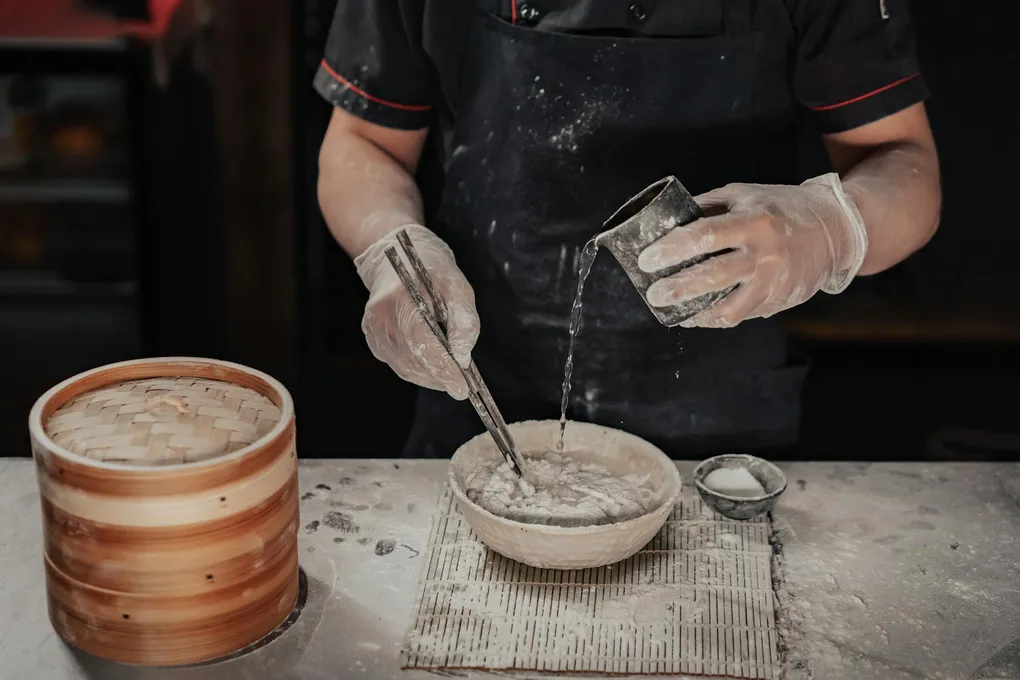
Water is the second-largest ingredient in pizza dough by weight. It constitutes 55-75% of the flour weight in most formulas. And yet, no ingredient generates more unfounded anxiety among home pizza makers. Should you use filtered water? Spring water? Bottled Italian water? Does chlorine kill yeast? Does hard water ruin gluten?
Nathan Myhrvold’s team at Modernist Pizza answered these questions definitively. They tested tap water, distilled water, filtered water, hard mineral water (2,488 ppm total dissolved solids), and water chlorinated to the maximum legal limit (4 ppm) across every one of their master dough recipes — over 100 pizzas baked and evaluated. No source has published a more rigorous water experiment for pizza.
The short answer: tap water is fine. If you can drink it, you can make pizza with it.
The longer answer involves some real science about how minerals and chemicals interact with dough — and one scenario where water quality genuinely matters.
The Experiment
Myhrvold’s team used five water types:
| Water Type | TDS (ppm) | Key Characteristic |
|---|---|---|
| Tap water | Varies by municipality | Standard municipal water |
| Filtered water | Low mineral | Carbon-filtered, chlorine removed |
| Distilled water | ~0 | All minerals removed |
| Hard mineral water | 2,488 | Extremely high calcium and magnesium |
| Max-chlorine water | 4 ppm Cl | Legal maximum chlorine concentration |
Each water type was used to make every master dough in the Modernist Pizza database. Pizzas were baked, evaluated for volume, crust texture, leoparding, flavor, and crumb structure, then compared side by side.
Results
Tap water consistently preferred. In blind evaluations, tap water doughs performed as well or better than filtered or distilled across all styles. No taster could reliably distinguish tap from filtered.
Chlorinated water had no negative effect. The maximum-legal-chlorine doughs showed excellent volume, proper leoparding, and — this surprised the team — slightly enhanced crispiness in the Neapolitan tests. Chlorine at concentrations found in municipal water does not impair yeast activity in any measurable way. Yeast is far more resilient than home baking advice suggests.
Distilled water performed slightly worse. Doughs made with distilled water were marginally slacker and had slightly less structure. The complete absence of minerals left the gluten network slightly less organized — calcium and magnesium ions normally contribute to ionic cross-linking between gluten proteins.
Hard mineral water consistently produced lower volumes. This was the only water type that showed a clear negative effect. At 2,488 ppm TDS, the excessive calcium and magnesium ions formed too many ionic bonds with gluten proteins, tightening the network excessively. Dough was stiffer, less extensible, and produced visibly lower rise. This aligns with Masi’s chemistry: hard water creates an “overly structured gluten network” that reduces yeast activity and increases leavening time.
The Verdict
Myhrvold’s conclusion: “Don’t fetishize water. If you can drink it, you can use it in your dough.”
This directly contradicts Forkish, who recommends filtered or non-chlorinated water for pizza dough. The experimental evidence does not support that recommendation.
What the Italian Standard Says
Masi provides a more detailed framework for water chemistry in Neapolitan pizza dough, using the French degree scale for water hardness.
Ideal range: 5-20 French degrees.
| Hardness | French Degrees | Effect on Dough |
|---|---|---|
| Very soft | < 5 | Dough becomes too sticky — insufficient mineral interaction with gluten proteins |
| Ideal | 5-20 | Proper gluten formation, good extensibility, normal yeast activity |
| Hard | > 20 | Dough too rigid — Ca2+ and Mg2+ form excessive ionic bonds with amino acids, creating overly structured gluten. Reduces yeast activity, increases fermentation time |
Most municipal tap water in the US falls within the 5-20 range. A few regions (parts of the Southwest, Midwest, and Florida) have hard water exceeding 20 French degrees. If you are in one of those areas and notice your dough is consistently tighter, stiffer, and slower to rise than recipes suggest, hard water is a plausible culprit.
How to check: Your local water utility publishes an annual water quality report (Consumer Confidence Report). Look for total hardness, usually reported in mg/L of calcium carbonate. Divide by 10 to get approximate French degrees. Under 200 mg/L (20 French degrees) and you are fine.
The Role of Water in Dough
Water does far more than hydrate flour. Masi identifies two critical mechanical roles:
1. Gluten network formation. Water allows gliadin and glutenin proteins to interconnect, forming the viscoelastic gluten web that gives pizza dough its structure. Without sufficient water, these proteins cannot link — the dough stays crumbly. With too much water, the network is diffuse and weak — the dough is slack and sticky. Understanding this balance is central to pizza dough hydration.
2. Enzymatic regulation. Water hydrates starch granules, dissolves sugars for yeast metabolism, and creates the medium in which amylase and protease enzymes operate. During baking, water converts to steam (expanding 1,600x by volume), driving oven spring and creating the bubble structure that becomes your crumb.
The proportion of water matters enormously — this is what hydration percentage controls. The quality of water, within normal municipal ranges, does not.
Water Temperature: The Variable That Actually Matters
While water source barely affects pizza quality, water temperature affects it dramatically. Temperature controls the speed of fermentation and the quality of gluten development.
The Neapolitan Water Temperature Formula
Masi provides a precise calculation for water temperature in Neapolitan dough:
T_water = 75 - T_ambient - T_ingredients - 9
Where:
- Target final dough temperature: 24 +/- 2C (75 +/- 4F)
- The constant 9 represents the friction factor from mixing
- All temperatures in Celsius
Example on a hot day: Ambient 31C, flour/ingredients 30C: T_water = 75 - 31 - 30 - 9 = 5C (ice-cold water needed)
Example on a cool day: Ambient 20C, flour/ingredients 20C: T_water = 75 - 20 - 20 - 9 = 26C (room temperature water is fine)
This formula targets a final dough temperature of approximately 24C (75F) — the Neapolitan standard. Forkish targets slightly warmer: 80-82F (27-28C). The difference reflects their different fermentation approaches — Neapolitan room-temp proofing benefits from a cooler start, while Forkish’s shorter bulk ferments benefit from a warmer, more active dough.
Gemignani’s Ice Water Approach
Gemignani uses a split water approach that most home recipes do not mention. Of his total water (typically 295g), most of it (225g) is ice-cold, 38-40F. Only the small yeast activation portion (70g) is warm (80-85F). The cold water slows yeast during mixing, keeping the final dough temperature low (65-72F after mixing). This is critical for his 24+24 cold ferment method — if the dough starts warm, the first 24 hours in the fridge begins with several hours of overly active fermentation before the dough cools down.
The ice water technique contradicts most home recipes that specify one uniform water temperature. It is, however, standard practice among competition-level pizza makers.
pH and Acidity
Water pH has a modest effect on dough. Slightly acidic water (pH 6-7) is ideal for yeast activity — yeast’s optimal pH range is 4-6, and dough naturally acidifies as fermentation produces organic acids. Alkaline water (pH > 8) can slightly inhibit yeast and produce a different gluten character.
In practice, municipal water in the US typically falls between pH 6.5 and 8.5. The variation within this range has minimal effect on pizza dough. Long-fermented doughs quickly establish their own pH through acid production, overwhelming any minor influence from the starting water.
If you are using well water with a pH above 8.5 — possible in some regions — the alkalinity could noticeably slow fermentation and produce denser dough. A water filter or a small addition of citric acid (a pinch per 500g water) would correct this, but the scenario is uncommon.
Chlorine and Chloramine
Municipal water treatment uses either free chlorine (Cl2) or chloramine (NH2Cl) to kill bacteria. The persistent belief that chlorine kills yeast and ruins pizza dough is not supported by evidence.
Myhrvold’s chlorine test: Water at 4 ppm chlorine (the maximum legal concentration for US municipal water) produced doughs with excellent volume and proper fermentation. At concentrations encountered in tap water, chlorine does not meaningfully inhibit Saccharomyces cerevisiae.
Why the myth persists: In bread baking, some professional bakers with very long bulk ferments (12-24 hours at room temperature) report that chloramine can slow wild yeast activity in sourdough starters. This may be real for wild fermentation — wild yeast strains are less robust than commercial Saccharomyces cerevisiae. But for pizza dough using commercial yeast, chlorine and chloramine at municipal concentrations are irrelevant.
If you maintain a sourdough starter and notice sluggish activity, filtered water is a reasonable precaution for your starter feedings. For dough made with commercial yeast, tap water is fine.
When Water Quality Actually Matters
There is one scenario where water quality genuinely affects pizza:
Very hard water (>300 ppm TDS, >30 French degrees). Myhrvold’s testing showed consistent volume reduction with 2,488 ppm water. Masi’s chemistry explains why: excessive Ca2+ and Mg2+ ions form too many ionic bonds with gluten proteins, creating a rigid network that resists expansion.
If you live in a hard-water area and your dough is consistently:
- Stiffer and tighter than recipes suggest
- Slower to rise than expected for your yeast quantity
- Producing lower volume with less oven spring
Try making one batch with filtered or bottled spring water (not distilled — you want some minerals). If the dough is noticeably more relaxed and rises better, hard water is your issue. A basic carbon filter (Brita, PUR) removes some hardness. A reverse osmosis filter removes most of it.
For everyone else: turn on your tap, measure the temperature, and make pizza.
Quick Reference
| Water Question | Answer |
|---|---|
| Tap water OK? | Yes. Myhrvold: 100+ pizzas, tap consistently preferred. |
| Filtered necessary? | No, unless you have very hard water (>300 ppm). |
| Does chlorine hurt? | No. Tested at max legal concentration. No effect. |
| Does distilled work? | Yes, but slightly worse — no minerals for gluten structure. |
| Mineral water? | Avoid for dough. Very hard water reduces volume. |
| Temperature matter? | Yes — this is the variable that actually matters. |
| Ice water why? | Keeps dough cool for cold ferment. Standard competition technique. |
| Bottled Italian water? | Not necessary. Marketing, not science. |