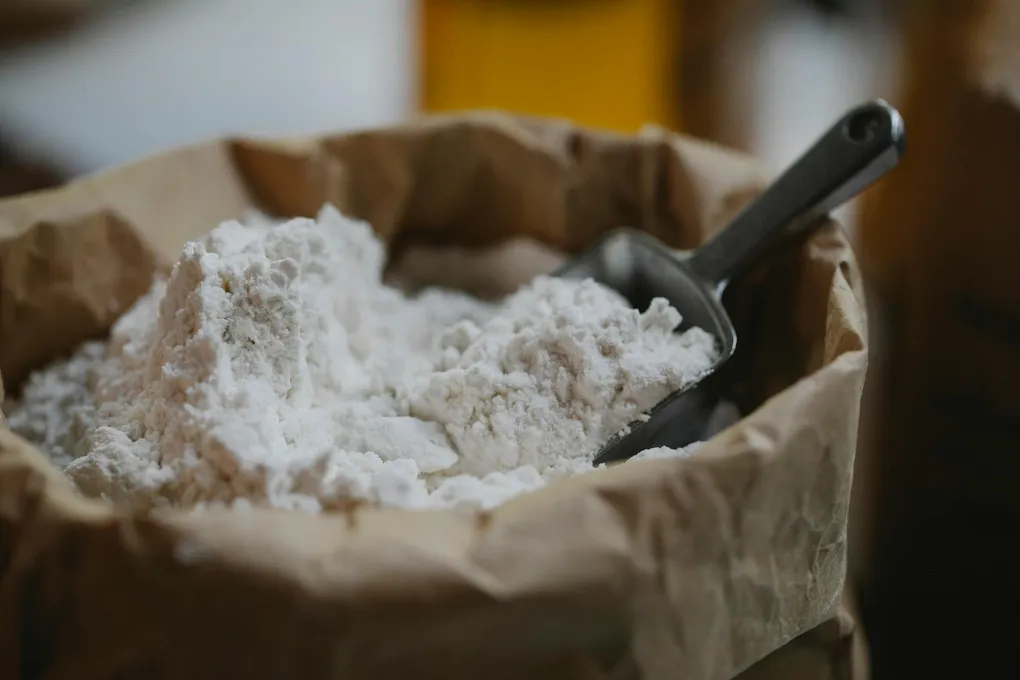
Protein percentage is the metric American bakers know. It’s printed on every bag, discussed in every recipe, and used as shorthand for flour strength. But protein percentage is a blunt instrument. A 12% protein flour can have a W-value anywhere from 200 to 320 depending on wheat variety and milling — producing dramatically different dough behavior despite identical protein numbers.
Italian bakers have access to a sharper tool: the Chopin Alveograph, an instrument that inflates a thin disk of dough like a bubble and measures how it resists and stretches before bursting. Two numbers from this test — W and P/L — tell you more about how flour will perform in pizza dough than protein percentage ever could.
If you’ve ever wondered why imported Italian 00 flour behaves differently from American bread flour at the same protein content, or why some flours make extensible dough while others snap back like rubber bands, the alveograph is the answer.
What the Alveograph Actually Measures
The Chopin Alveograph was invented in 1920 by Marcel Chopin and remains the standard flour-testing instrument in Italy and much of Europe. The test is mechanical and intuitive: a standardized disk of dough is clamped over an opening, then air is blown underneath it. The dough inflates into a bubble. Sensors track the pressure inside that bubble as it expands until it bursts.
From that single inflation, three measurements emerge:
P (Overpressure) — The maximum pressure reached during inflation, measured in millimeters of water. This represents the flour’s tenacity: its resistance to deformation. High P means the dough pushes back hard when you try to stretch it.
L (Abscissa at Rupture) — The length of the curve at the moment the bubble bursts, proportional to how far the dough stretched before failing. This represents extensibility: how far the dough can stretch before tearing.
W (Deformation Energy) — The total area under the pressure-extension curve, measured in units of 10⁻⁴ joules. This is the single number that represents overall flour strength. A higher W means the flour absorbs more energy before the dough bubble bursts — it’s both resistant and extensible.
Think of W as the total capacity of the flour. Think of P/L as how that capacity is distributed between resistance and stretch.
W-Value: The Flour Strength Index
W is the number that matters most for pizza. It determines how much punishment your dough can take during fermentation and handling while still holding gas and producing good oven spring.
W-Value Classes
The scientific literature (Masi et al., The Neapolitan Pizza) classifies flour by W into four categories:
| W Range | Class | Water Absorption | Best For |
|---|---|---|---|
| Up to 160 | Weak | ~50% | Biscuits, crackers, crumbly cakes |
| 160–250 | Medium | 55–65% | French bread, rolls, some pizza |
| 250–310 | Strong | 65–75% | Pizza, egg pasta, brioche, baba |
| Over 310 | Special | Up to 90% | Strengthening weaker flours, very long ferments |
For Neapolitan pizza specifically, the EU’s Traditional Specialty Guaranteed (TSG) regulation (97/2010) requires flour with W between 220 and 380. That’s a wide range — and where within it you land determines fermentation strategy.
W-Value and Fermentation Duration
This is the practical connection most sources miss: W determines how long your dough can ferment before the gluten network degrades beyond usefulness.
- W 220–260: Short to medium ferments (8–24 hours). Gluten network is adequate but not overbuilt. Extended cold fermentation will weaken it past the point of usability.
- W 260–300: The Neapolitan sweet spot. Handles 24–48 hour cold ferments comfortably. Strong enough for overnight retarding with excellent extensibility the next day.
- W 300–350: Long ferments (48–72 hours). The extra strength withstands extended enzymatic degradation from protease activity during cold storage. Required if you want a 3-day ferment without structural collapse.
- W 350+: Blending flour or ultra-long ferments. These are “Manitoba” strength flours — too strong for direct use in most pizza applications but valuable for mixing with weaker flour to hit a target W.
Masi notes that strong flour (high W) requires low-temperature storage to slow fermentation without stopping maturation. The enzymes that break down starch and protein into flavor compounds continue working in the cold; yeast slows to a crawl. This is why cold fermentation and high-W flour are a natural pairing.
P/L Ratio: The Tenacity-Extensibility Balance
If W tells you how strong the flour is, P/L tells you what kind of strong. Two flours can have identical W values but dramatically different handling characteristics based on P/L.
The Neapolitan TSG specification requires P/L between 0.50 and 0.70.
Below 0.40: Dough is too extensible — sticky, floppy, hard to shape, tears under its own weight. It stretches easily but won’t hold its shape.
Between 0.50 and 0.70: The Neapolitan target. Dough stretches willingly without excessive snap-back, holds gas well during fermentation, and produces a balanced cornicione with good oven spring.
Above 0.70: Dough is too tenacious — it resists stretching, snaps back aggressively, and requires either very long fermentation or mechanical relaxers to become workable.
Why P/L Matters for Home Bakers
When American home bakers report that their dough “keeps snapping back” during stretching, the usual advice is “let it rest longer.” That’s often correct — rest allows protease enzymes to degrade some of the gluten network, reducing tenacity. But if the flour itself has a high P/L ratio (above 0.80), no amount of resting will fully solve the problem. The flour’s protein composition — specifically the ratio of glutenin (tenacity) to gliadin (extensibility) — is working against you.
This is why experienced Italian pizzaioli choose flour by W and P/L, not by protein percentage alone. Molecular weight distribution of proteins is the primary factor determining whether dough is tenacious versus extensible — more important than total protein percentage (Masi).
The Full Alveograph Panel: TSG Requirements
The Neapolitan TSG standard includes additional rheological measurements beyond W and P/L:
| Parameter | Required Range | Instrument | What It Measures |
|---|---|---|---|
| W (strength) | 220–380 | Chopin Alveograph | Total energy before dough bursts |
| P/L (tenacity/extensibility) | 0.50–0.70 | Chopin Alveograph | Balance of resistance vs. stretch |
| Absorption | 55–62% | Brabender Farinograph | Water uptake capacity |
| Stability | 4–12 min | Brabender Farinograph | Time dough maintains peak consistency under mixing |
| Tolerance index (E10) | ≤ 60 BU | Brabender Farinograph | Drop in consistency after 10 min of mixing |
| Falling number (Hagberg) | 300–400 | Falling Number apparatus | Amylase activity |
The Falling Number is worth noting: higher values mean less amylase activity, which means less risk of excessive browning. For home oven bakers who want more browning (since home ovens can’t reach Neapolitan temps), lower Falling Number flour — or the addition of diastatic malt — compensates.
Lab-Tested W Numbers: What’s Actually in the Bag
Here is where theory meets reality. Myhrvold’s team at Modernist Pizza lab-tested common pizza flours and published their W values — numbers that no other published source has verified independently:
| Flour | Lab-Tested W | Ash |
|---|---|---|
| Le 5 Stagioni Pizza Napoletana 00 | 299 | 0.55% |
| Caputo Pizzeria 00 (blue bag) | 332 | 0.5% |
| Caputo Nuvola 00 | 342 | n/a |
| Caputo Americana 00 / Manitoba 0 | 360 | 0.55% |
| Polselli Classica 00 | 376 | 0.55% |
| Tony Gemignani California Artisan 00 | 386 | 0.65% |
Notice something unexpected: Caputo Pizzeria (blue bag) tested at W 332 — significantly higher than the W 260–270 that Caputo’s own marketing and many pizza sources cite. Whether this reflects batch variation, testing methodology differences, or evolving formulation is unclear. But it demonstrates why published W values should be treated as approximate.
The Caputo key flour lineup with their stated W ranges:
| Flour | Bag Color | W Range | Protein % | Designed For |
|---|---|---|---|---|
| Classica | — | W 220–240 | 11.5% | Same-day / short ferment (under 8 hr) |
| Pizzeria | Blue | W 260–270 | 12.5% | Neapolitan, 800°F+ ovens |
| Nuvola | — | W 260–280 | 12.5% | Airier, open crumb |
| Cuoco / Saccorosso | Red | W 300–320 | 13–13.5% | Home ovens, longer ferments |
| Nuvola Super | — | W 320–340 | 13.5% | High hydration, 48+ hr ferment |
| Pizza A Metro | — | W 310–330 | 13.25% | Al taglio / pan pizza |
| Americana | — | W 360–380 | 14.25% | Home ovens 500–700°F (contains malt) |
| Americana Super | — | W 380+ | 15.25% | NY, Detroit, Sicilian |
For a detailed comparison of these flours in practice, see our Caputo flour comparison.
W-to-Protein Mapping: The American Baker’s Translation Table
American flour bags rarely print W values. You have to work backward from protein percentage — an imperfect but necessary proxy. This mapping applies to hard wheat (the dominant type in American/Canadian milling):
| W Range | Protein % | American Flour Category |
|---|---|---|
| W 90–170 | 8–10% | Cake / pastry flour |
| W 180–220 | 10–11.5% | All-purpose (lower end) |
| W 220–260 | 11.5–12.5% | All-purpose (higher end), Italian 00 Pizzeria |
| W 260–300 | 12.5–13% | Strong AP, light bread flour |
| W 300–350 | 13–14% | Bread flour |
| W 350–400+ | 14–15%+ | High-gluten flour |
Critical caveat: This mapping works for hard wheat (American/Canadian). For soft wheat (European 00), the same protein percentage can yield very different W values because soft wheat gluten quality varies more. A 12.5% protein European 00 and a 12.5% protein American bread flour are not interchangeable — the European flour will be more extensible and less tenacious, making it stretch more easily but hold structure less aggressively during long bakes.
The Practical Note: Italian vs. American Flour Shopping
Italian flour bags routinely print W and P/L values. Walk into an Italian supermarket and you can comparison-shop by alveograph numbers. American bakers have no such luxury.
This creates a real disadvantage. As Myhrvold notes: “A 12% protein flour can have W from 200-320 depending on wheat variety and milling.” Two bags of bread flour from different brands, both reading 13% protein, may behave completely differently in your dough.
Practical workarounds:
-
Stick with tested brands. Once you find a flour that works, don’t switch. King Arthur Bread Flour, for example, is milled to tight specifications. If it works for your 48-hour cold ferment, keep using it.
-
Learn the W of your flour empirically. If your dough survives a 48-hour cold ferment with good extensibility and no structural collapse, your flour is at least W 280. If it falls apart at 36 hours, it’s probably below W 250.
-
When in doubt, go stronger. A flour that’s slightly too strong (high W) can be tamed with longer fermentation. A flour that’s too weak cannot be strengthened after mixing.
-
Blending works. Italian pizzerias routinely mix weak (W ~150) supermarket 00 flour with strong Manitoba flour (W ~400) to hit their target of W 200–280. You can do the same: blend all-purpose with bread flour to approximate a W 260–280 target for Neapolitan-style at home.
The Protein Absorption Rule
One final connection between W, protein, and your recipe: for every 1% increment in protein, water absorption increases by approximately 1.5% (Masi). When you switch from a 12% to a 13.5% protein flour, you may need to add roughly 2% more water to achieve the same dough consistency. This is separate from starch damage effects — damaged starch (from aggressive milling) absorbs 2–4x more water than intact starch and is preferentially attacked by amylase, feeding yeast faster.
The takeaway: when you change flour, you change everything — hydration, fermentation timing, extensibility, and browning behavior. W and P/L explain why. Protein percentage alone does not.
Matching W to Your Oven
The final practical application ties flour strength to bake time:
| Oven Type | Bake Time | W Range | Why |
|---|---|---|---|
| Portable (800–950°F) | 60–90 sec | W 220–270 | Short bake = gluten doesn’t need to hold structure long |
| Home oven + steel | 7–8 min | W 280–320 | Extended bake demands stronger network |
| Home oven pan | 12–15 min | W 300–380 | Longest bake = strongest flour needed |
Shorter bake = weaker flour is fine. Longer bake = you need the structural reinforcement of high-W flour because the gluten network bears load for minutes, not seconds. This is exactly why Caputo blue bag (designed for 800°F+ ovens with 60-second bakes) can underperform in a 550°F home oven with a 7-minute bake — the gluten scaffolding isn’t built for that duration. For more on optimizing your home oven setup, see our baking guide.
For home oven bakers, Caputo’s red bag (Cuoco, W 300–320) or an American bread flour in the 13–13.5% protein range gives you the structural overhead to handle a full 7-8 minute bake without compromise.