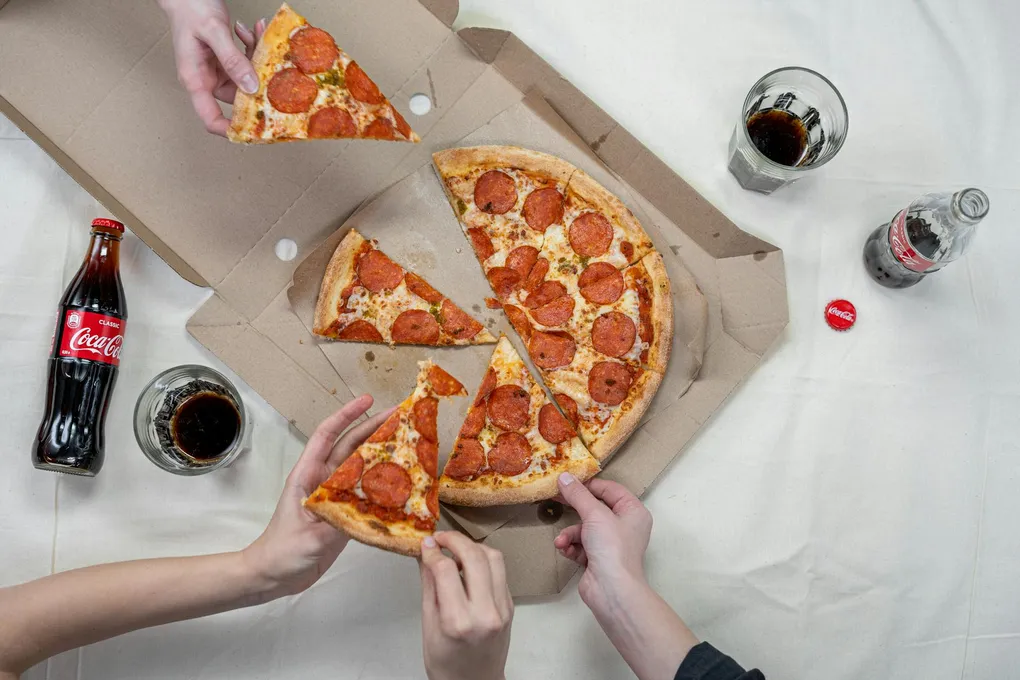
Making pizza for two people is technique. Making pizza for twenty people is logistics. The dough science does not change when you scale up. Everything else does.
The critical failure mode — the one that ruins most pizza parties — is predictable: all your dough balls are ready at the same time, but your oven can only bake one pizza every 3-6 minutes. By the time you finish the last pie, the first dough balls have over-proofed into slack, gassy mush, and half your guests have been standing around hungry for an hour.
This article is about preventing that.
The Math: How Many Pizzas, How Much Dough
Before anything else, figure out how many pizzas you need and how much total dough that requires.
Estimating Pizza Count
For a pizza party where pizza is the main course:
| Group Size | Pizzas Needed | Assumption |
|---|---|---|
| 4-6 people | 4-5 pizzas | ~1 pizza per person, some sharing |
| 8-10 people | 7-9 pizzas | Slightly less than 1 per person (variety means people eat less of each) |
| 12-16 people | 10-14 pizzas | Allow 2/3 pizza per person when there are many varieties |
| 20+ people | 15-20 pizzas | Consider pan styles for efficiency |
These assume 12-inch pizzas with moderate toppings. Heavy toppings (meat-loaded, deep-dish) are more filling — you need fewer. Light toppings (Margherita, white pie) are less filling — plan on more.
Dough Ball Weight by Style
The weight of each dough ball depends on the style and your oven opening:
| Oven/Style | Pizza Diameter | Ball Weight | Source |
|---|---|---|---|
| 12” portable oven (Ooni Fyra, Roccbox) | 10-12” | 250-280g | Size down to leave peel margin |
| 16” portable oven (Ooni Koda 16, Karu) | 12-14” | 300-350g | Do not make 16” pizzas in a 16” oven — no room to turn |
| Home oven on steel | 12-13” | 370g | Gemignani standard |
| Home oven pan (deep-dish) | Pan-sized | 770g | Gemignani deep-dish |
| Home oven pan (Sicilian) | 12x18” sheet | 990-1000g | Gemignani Sicilian |
[Gemignani, various dough formulas; Ooni/Gozney operational guides]
Scaling with Baker’s Percentages
Baker’s percentages make scaling trivial because every ingredient is expressed as a ratio to flour weight. To scale any recipe:
- Determine total dough weight needed: (number of pizzas) x (ball weight per pizza)
- Add 10% for losses (dough that sticks to containers, cutting waste)
- Back-calculate flour weight from total dough weight
Example: 12 pizzas at 370g each = 4,440g total dough + 10% = ~4,884g total dough.
For Gemignani’s Master Dough with Starter (65% total hydration, 2.2% salt, 2.2% malt, 1.1% oil, 0.5% yeast, 20% starter):
Total dough = flour x (1 + 0.65 + 0.022 + 0.022 + 0.011 + 0.005 + 0.20) = flour x 1.91
So flour = 4,884 / 1.91 = 2,557g flour
From there, every ingredient scales proportionally:
- Flour: 2,557g
- Total water (ice + warm): 2,557 x 0.65 = 1,662g
- Salt: 2,557 x 0.022 = 56g
- Diastatic malt: 56g
- EVOO: 28g
- Active dry yeast: 13g
- Starter: 511g
This yields approximately 4,870g of dough — enough for 13 balls at 370g each (the extra ball accounts for loss).
The Timing Problem
Here is where parties go wrong. A typical home pizza maker’s mental model:
“I’ll make all the dough, ball it, let it proof, and then bake everything.”
The problem: dough balls do not pause. Once they reach room temperature and hit their fermentation window, they continue proofing whether you are ready or not. A perfectly proofed ball at hour 2 is over-proofed at hour 4. If you have 15 balls and can bake one every 5 minutes, the last ball waits 75 minutes past the first — an eternity in fermentation time on a warm day.
Oven Recovery Time: The Real Bottleneck
The interval between pizzas is not just bake time — it includes recovery time for your baking surface to return to proper temperature after each pie.
| Oven Type | Bake Time | Recovery Time | Total Interval |
|---|---|---|---|
| Ooni Koda 16 (gas) | 60-90 sec | 2-5 min | 3-6 min |
| Gozney Roccbox (gas) | 60-90 sec | 1-3 min | 2-4 min |
| Home oven + 1/4” steel | 7-8 min | 5-8 min | 12-16 min |
| Home oven + 3/8” steel | 7-8 min | 3-5 min | 10-13 min |
| Home oven + two steels | 7-8 min | 1-3 min | 8-11 min |
For a portable gas oven, you can realistically produce one pizza every 3-6 minutes — 10 pizzas in 30-60 minutes. Manageable.
For a home oven with a single steel, one pizza every 12-16 minutes means 10 pizzas takes 2 to 2.5 hours. That is not a party. That is a shift.
Solutions to the Recovery Bottleneck
Thicker steel. The jump from 1/4” to 3/8” is the most impactful upgrade for party baking. The additional thermal mass stores more heat, so the surface recovers faster between pies. See our baking steel thickness guide for the full analysis.
Two steels (double-steel setup). One steel on the top rack near the broiler, one on the bottom rack. Bake on the bottom steel, and when you pull a pizza, the top steel has been absorbing heat continuously — no recovery needed. Alternate between steels. Documented to produce 20 pizzas in 1 hour. [Synthesis: Baking Steel method]
Two ovens. If you have a second oven (outdoor grill with a pizza stone, neighbor’s oven, portable pizza oven in addition to your home oven), run them in parallel. This is the simplest way to double throughput.
Staggered Proofing: The Key to Not Over-Proofing
The solution to the “all dough ready, one oven” problem is staggered proofing — pulling dough balls from cold storage in batches timed to your baking rate.
The Stagger Method
-
Make all dough on the same day (Day 1). Mix, bulk ferment, divide into balls, and refrigerate all of them. Cold ferment 24-48 hours as usual.
-
On bake day (Day 2 or 3): Separate your dough balls into groups of 3-4.
-
Pull Group 1 from the fridge 1.5-2 hours before you plan to start baking. These balls temper to 60-65F and enter their prime proofing window.
-
Pull Group 2 from the fridge 30-45 minutes after Group 1. They will reach ideal proofing temperature as you finish baking Group 1.
-
Pull Group 3 as you begin baking Group 2. And so on.
The fridge is your pause button. Dough balls at 38-40F are in near-suspended animation — yeast activity drops to roughly 10% of room-temperature levels. As long as they have been cold-fermenting for at least 24 hours, they have already developed excellent flavor. The only variable is letting them warm enough to stretch without tearing.
Temperature Targets
Gemignani’s Commandment #5: “Thou shalt not put cold dough in a hot oven.” Cold dough produces large, irregular bubbles in the first 2-3 minutes of baking as trapped gas expands unevenly. Target 60-65F for the dough ball before stretching. An instant-read thermometer poked into the center of the ball gives you a definitive answer. [Gemignani, Master Class]
On a warm summer day, dough may need only 45-60 minutes out of the fridge. On a cool day, 1.5-2 hours. Adjust your stagger accordingly.
The Pan Pizza Party Strategy
If the math above sounds stressful — if you are feeding 15 people and the idea of hand-stretching and launching 12 individual pizzas while managing oven recovery makes your eye twitch — consider switching formats entirely.
Gemignani’s Sicilian parbake method is the best party hack in the entire Pizza Bible. [Gemignani, Sicilian method]
The method:
- Push Sicilian dough (70% hydration, 990-1000g per pan) into oiled 12x18” sheet pans
- Let rise 1.5-2 hours
- Parbake at 450F for 14 minutes — no toppings, just the crust
- Remove from oven. Rest minimum 30 minutes.
- The parbaked crust holds for up to 10 hours at room temperature.
- When ready to serve: add toppings, bake again for 13 minutes at 450F
This changes the logistics completely:
- Parbake in the morning. Stack the cooled parbaked crusts with parchment between them. They sit on the counter all day.
- At party time: Top and bake. Each pan takes 13 minutes and feeds 6-8 people (cut into 12 squares).
- Three pans (3,000g of dough, roughly 6 lbs flour) feeds 20 people comfortably.
- No stretching, no launching, no peel skills required. Build directly in the pan.
The parbake absorbs the gel-layer risk (Myhrvold’s identified flaw in wet-topped pizza), solves the timing problem entirely, and produces excellent thick-crust pizza with a crispy bottom and soft, airy interior.
Adapting Other Doughs for Pan
Forkish provides a simple formula for converting any pizza dough into pan pizza dough:
- Increase water to 75% of flour weight (375g water per 500g flour)
- Form one large dough ball instead of individual balls
- Do not put dough on the oiled pan until 90 minutes before baking — if it sits longer, the oil absorbs into the dough and causes sticking
- Let cold dough come to room temperature before stretching on the pan
[Forkish Ch6]
This means you can take your favorite Neapolitan or NY dough recipe, increase the hydration to 75%, and use it for pan pizza at a party. The character will be different — more focaccia-like, lighter crumb — but it will work.
Mise en Place: The Topping Station
Professional pizzerias prep all toppings before service in standardized containers, arranged in a consistent order. You should do the same.
Topping Prep Checklist (Day Before or Morning Of)
| Task | Timing |
|---|---|
| Shred/slice all cheeses | Day before. Bag and refrigerate. |
| Make sauce | Day before. Refrigerate in squeeze bottles or containers. |
| Slice pepperoni, salami | Day before. Bag and refrigerate. |
| Pre-cook sausage, bacon, ground meat | Morning of. Crumble, cool, refrigerate. |
| Roast peppers, mushrooms, onions | Morning of. Cool, container, refrigerate. |
| Wash and dry fresh toppings (arugula, basil, etc.) | Morning of. Keep dry in paper towels. |
| Prepare finishing items (EVOO in cruet, flaky salt in pinch bowl, grated Parm) | 30 min before baking. |
Station Layout
Set up an assembly line in this order, left to right:
- Dough ball station — floured surface or board with tempered dough balls and flour for dusting
- Stretching/shaping area — clean counter space or second floured board
- Sauce station — sauce in squeeze bottle or ladle-ready container
- Cheese station — shredded/sliced cheeses in bowls
- Toppings station — pre-cooked and raw toppings in separate containers
- Peel/launch station — dusted peel ready for loading (for hearth pizza) or pan station (for pan pizza)
- Finishing station — EVOO, flaky salt, fresh herbs, post-bake toppings
The assembly line approach means you can stretch one pizza while the previous one bakes. When the oven pizza comes out, the next one is ready to launch.
The Party Timeline
Here is a complete timeline for a 12-pizza party using a portable gas oven (Ooni Koda 16) with staggered proofing:
Day 1 (Evening)
- Mix dough: 4,500g total (12 balls at 370g + loss)
- Bulk ferment 1-2 hours
- Divide and ball into 12 balls
- Refrigerate all balls
Day 2 (Morning/Afternoon)
- Prep all toppings (see checklist above)
- Make sauce if not done on Day 1
- Set up topping station
Day 2 (2 Hours Before Guests Arrive)
- Pull Group 1 (balls 1-4) from fridge
- Begin preheating oven 45 minutes before first bake
Day 2 (1 Hour Before Guests)
- Pull Group 2 (balls 5-8) from fridge
- Verify stone temperature with IR thermometer
Day 2 (30 Minutes Before Guests)
- Pull Group 3 (balls 9-12) from fridge
- Begin baking Group 1
Day 2 (Guests Arrive)
- Baking is underway. Fresh pizza every 4-5 minutes.
- Group 2 reaches temp as Group 1 finishes (~20-30 min)
- Group 3 reaches temp as Group 2 finishes (~20-30 min)
- Total baking window: 50-70 minutes for 12 pizzas
The First Pizza Rule
Make the first pizza of the session a sacrificial calibration pizza. Use it to verify stone temperature, test your flame management, and dial in your timing. If it turns out perfect, great — someone eats it. If it burns or comes out uneven, you have adjusted before the guests are watching.
Scaling for Portable Ovens vs. Home Ovens
| Factor | Portable Gas Oven | Home Oven + Steel |
|---|---|---|
| Throughput | 1 pizza / 4-5 min | 1 pizza / 10-15 min |
| 12 pizzas takes | 50-60 min | 2-3 hours |
| Best strategy | Staggered proofing, hearth-bake all | Staggered proofing OR switch to pan |
| Realistic max per session | 15-20 (propane check at 10) | 6-8 before fatigue/over-proofing |
| Party recommendation | Hearth-bake with assembly line | Pan/Sicilian parbake method |
For home oven parties, the Sicilian parbake method is almost always the better choice. You trade the spectacle of individual stretching and launching for the reliability of feeding everyone hot pizza within a reasonable window.
The Dough Calculator Shortcut
Rather than doing batch math by hand every time, use the Dough Calculator at jayarr.pizza. Input your style, number of pizzas, and ball weight — it outputs the complete recipe with all ingredients scaled in grams, plus a timeline for mixing, fermenting, and baking.
For party-specific planning, input a count 10% higher than your estimated need. Extra dough balls refrigerate well for 1-2 additional days, and running short at a pizza party is worse than having leftovers.
Sources: Gemignani, The Pizza Bible (2014) — ball weights, Sicilian parbake method, Ten Commandments; Forkish, The Elements of Pizza (2016) — pan pizza adaptation; Ooni/Gozney operational guides — recovery times; Myhrvold & Migoya, Modernist Pizza Vol 1 (2021) — gel layer analysis.