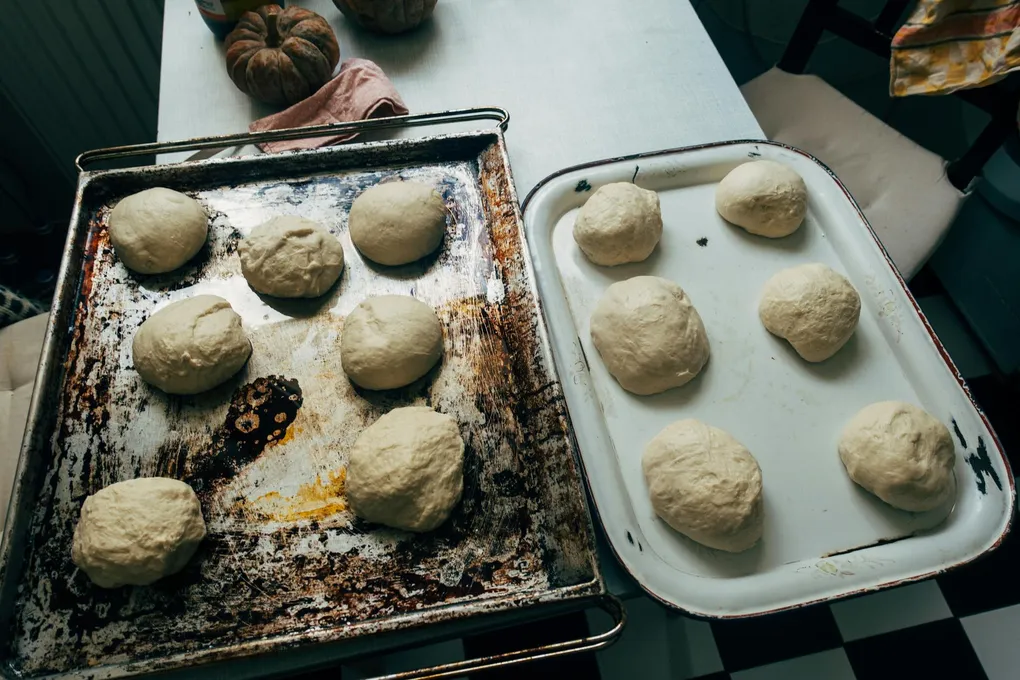
A preferment is a portion of the final dough’s flour and water, mixed with a small amount of yeast, and fermented hours before you make the dough itself. When this fermented mixture gets incorporated into the main dough, it brings along developed flavors, organic acids, and an established yeast culture that a straight dough (everything mixed at once) simply cannot produce in the same timeframe.
Every serious pizza authority uses preferments. Forkish builds his favorite dough (Overnight Levain) around one. Gemignani puts a preferment in nearly every formula he publishes — only his deep-dish, Detroit, St. Louis, and Grandma doughs skip it. Iacopelli starts all three of his home dough recipes with a poolish. The question isn’t whether to use one. It’s which type, and why.
The Three Preferment Families
All preferments share the same basic ingredients — flour, water, yeast — but the ratio of water to flour creates fundamentally different fermentation environments that produce different results.
Poolish (100% Hydration — Equal Parts Flour and Water)
A poolish is a liquid preferment: equal weights of flour and water mixed with a tiny amount of yeast and left to ferment for 8-18 hours. The result looks like a thick, bubbly batter — more pancake batter than dough.
What happens during poolish fermentation: The high water content creates a permissive environment for both yeast and bacterial activity. Yeast reproduces rapidly in the liquid medium. Amylase enzymes break starch into fermentable sugars. Protease enzymes begin degrading gluten proteins into amino acids. The poolish develops organic acids (acetic and lactic) that contribute tang and complexity, plus esters and higher alcohols that create aromatic depth.
What poolish brings to the final dough:
- Enhanced extensibility (the dough stretches more easily with less snapback)
- More complex, slightly tangy flavor
- Improved Maillard browning (more free amino acids available)
- Longer shelf life of the baked crust (acids slow staling)
- A head start on fermentation that reduces the yeast needed in the final mix
Gemignani’s Poolish Formula:
| Ingredient | Amount |
|---|---|
| Flour (same as final dough) | 47g |
| Cold tap water | 47g |
| Active dry yeast | 0.12g |
Ferment 18 hours at room temperature, then 30 minutes in the fridge to cool. Store up to 8 hours refrigerated. Yield: ~90g.
Forkish’s Poolish (from FWSY):
| Ingredient | Amount |
|---|---|
| White flour | 500g |
| Water (80F) | 500g |
| Instant dry yeast | 0.4g |
Ferment 12-14 hours overnight. This is a much larger batch — it becomes the majority of the final dough, not a small addition.
The difference in scale reveals two philosophies. Gemignani uses poolish as a flavor booster added to a conventional dough. Forkish uses it as the structural foundation of the entire recipe.
Biga (50-65% Hydration — Stiff Preferment)
A biga is a firm, bread-like ball of pre-fermented dough. Much less water relative to flour, which creates a drier, tighter environment that fundamentally changes the fermentation character.
What happens during biga fermentation: The low water content restricts yeast mobility and bacterial growth. Fermentation is slower and more controlled. The stiff environment favors acetic acid production (sharper, more vinegar-like) over lactic acid (milder, creamier). Protein degradation happens more slowly, preserving more gluten structure.
What biga brings to the final dough:
- More complex, nutty, wheaty flavor (deeper than poolish)
- Better gas retention during baking (stronger remaining gluten structure)
- More pronounced oven spring
- Superior crumb structure — larger, more irregular holes
- Slightly drier, crispier crust texture
Forkish’s Biga Formula (from Elements of Pizza):
| Ingredient | Amount |
|---|---|
| Bread flour | 250g |
| Water | 165g (65% hydration) |
| Instant dry yeast | 0.2g |
Mix until combined (it will be a stiff, craggy mass). Ferment 12-14 hours at 68F. It should roughly triple in size.
Gemignani’s Tiga (Tony’s Biga — 70% Hydration):
| Ingredient | Amount |
|---|---|
| Flour (same as final dough) | 55g |
| Cold tap water | 39g |
| Active dry yeast | 0.14g |
Ferment 18 hours at room temperature, then 30 minutes in the fridge. Store up to 8 hours refrigerated. Yield: ~90g.
Note that Gemignani’s “Tiga” is wetter than a traditional biga (70% vs the classic 50-60%). He designed it as a compromise — easier to mix than a true biga while retaining some of the stiff preferment’s flavor advantages. It’s his more frequently used starter.
Sourdough / Levain (Wild Yeast + Lactic Acid Bacteria)
A sourdough starter (levain) is the most complex preferment. Instead of commercial yeast, it relies on wild yeast strains and lactic acid bacteria (LAB) that colonize a flour-water mixture maintained through regular feeding over days or weeks.
What makes levain different: The symbiotic community of wild yeast and LAB produces a broader spectrum of organic acids and aromatic compounds than any commercial yeast preferment. LAB generate lactic and acetic acid in ratios determined by hydration, temperature, and feeding schedule. Wild yeast strains (various Saccharomyces and Candida species) produce different flavor metabolites than commercial S. cerevisiae.
What levain brings to pizza dough:
- The most complex flavor profile of any preferment
- Significant acidity that enhances gluten extensibility
- Natural dough conditioning from organic acids
- Extended shelf life
- Phytase activity that increases mineral bioavailability (a genuine nutritional benefit of long-fermented dough)
Forkish’s Overnight Levain (his personal favorite pizza dough):
| Component | Ingredient | Amount |
|---|---|---|
| Starter | Mature sourdough culture | 50g |
| Water | 100g | |
| Flour | 100g |
Feed 6-8 hours before making final dough. The result: 250g of active levain incorporated into the pizza dough.
Myhrvold’s Shortcut — Second-Chance Levain: Freeze unused or overripe levain in ice cube trays. Freezing kills the yeast and bacteria, but flavor compounds survive for up to 2 months. To use: thaw the cubes, add 0.4-0.5% instant dry yeast to the final dough. You get sourdough flavor without maintaining a living starter. This contradicts the purist approach of Forkish and most sourdough advocates, but Myhrvold tested it extensively and found the flavor difference was minimal.
Head-to-Head: Poolish vs. Biga
Vito Iacopelli ran a direct comparison that’s the most useful head-to-head test available from any source. Same flour, same yeast, same fermentation schedule (1 hour room temp + 24 hours refrigerated), same final dough. The only variable: poolish (100% hydration) vs. biga (50% hydration).
| Poolish | Biga | |
|---|---|---|
| Hydration | 100% (equal flour + water) | 50% (double flour to water) |
| Mixing difficulty | Easy — liquid batter | Difficult — stiff, crumbly mass |
| Texture during mixing | Pours, easy to incorporate | Must be broken apart by hand |
| Crumb result | Airy, slightly smaller and more regular air pockets | Large, irregular honeycomb pockets |
| Score (judge Salvatore Susta) | 9/10 | 10/10 |
| Home baker verdict | Easier — Iacopelli calls poolish “a liquid biga” | Better crumb structure but harder to work with |
The takeaway: biga produces marginally superior crumb, but poolish is dramatically easier and scores nearly as high. For home bakers, poolish is the clear choice unless you’re chasing the last 10% of crumb quality.
Forkish’s own rankings align: his Overnight Levain is his favorite (wild fermentation complexity), but his most-recommended recipe for home bakers is the 24-48 Hour Cold Retard, which is a straight dough. His biga dough (48-72 Hour) is positioned as the advanced option for bakers willing to plan further ahead.
Fermentation Chemistry: Why Preferments Work
The flavor advantage of preferments comes from three categories of compounds that accumulate during the preferment’s long fermentation:
Organic acids: Acetic acid (sharp, vinegar-like) and lactic acid (mild, creamy) are produced by both yeast metabolism and bacterial activity. These acids lower the dough’s pH, which enhances gluten extensibility and contributes to the tangy complexity that separates good pizza from forgettable pizza. Stiff preferments (biga) favor acetic acid; liquid preferments (poolish) produce more balanced acid profiles.
Alcohols and esters: Yeast produces ethanol and higher alcohols as fermentation byproducts. These react with organic acids to form esters — volatile aromatic compounds responsible for the “perfume” of well-fermented dough. Over 50 distinct flavor compounds form during extended preferment fermentation that don’t exist in quick doughs.
Free amino acids and sugars: Protease enzymes break proteins into free amino acids. Amylase enzymes break starch into simple sugars. Both accumulate in the preferment and carry into the final dough. These are the raw materials for Maillard browning — more free amino acids and sugars mean deeper, more complex crust color and flavor.
Timing Tables
Poolish Ripening by Yeast Quantity
Myhrvold’s research produced the most precise timing table for poolish management:
| Desired Poolish Ferment Time | IDY (% of flour in poolish) |
|---|---|
| 3-4 hours | 0.4-0.5% |
| 6-8 hours | 0.2-0.33% |
| 12-16 hours | 0.05-0.2% |
| 16-18 hours | 0.01-0.09% |
How to read this: If you want your poolish ready in 8 hours (mix before bed, use in the morning), use 0.2-0.33% instant dry yeast relative to the flour in the poolish. For a 500g-flour poolish, that’s 1.0-1.65g of IDY.
Gemignani and Iacopelli both target 18-hour poolish fermentation, which corresponds to the lowest yeast range (0.01-0.09%). Their approach: mix the poolish the evening before the evening before pizza day. Day 1 evening: make poolish. Day 2 evening: make dough with poolish, refrigerate. Day 3: bake. The long timeline means maximum flavor development from minimal yeast.
Signs of a Ripe Preferment
Poolish is ready when:
- Surface covered with small bubbles
- Volume has at least doubled (risen and possibly started to fall back slightly)
- Smells pleasantly alcoholic and slightly tangy, not aggressively sour
- Consistency is still loose and pourable but noticeably more airy
Biga is ready when:
- Roughly tripled in volume
- Surface shows cracks from gas expansion
- Interior is spongy when pulled apart
- Smells wheaty and slightly acidic
Both are past peak when:
- They’ve collapsed and show a concave surface (fallen back after maximum rise)
- They smell strongly of alcohol or acetone
- A poolish looks watery on top (separation)
Past-peak preferments still work — they just contribute more acidity and less gas. Use them within a few hours of peaking for best results, or refrigerate to slow the decline.
Converting a Straight Dough Recipe to Use a Preferment
Any pizza dough recipe can be adapted to include a preferment. The principle: you’re not adding ingredients — you’re pre-fermenting a portion of what’s already in the recipe.
Step 1: Take 20-30% of the recipe’s total flour and an equal weight of water (for poolish) or half the water weight (for biga). These amounts come out of the final dough’s flour and water — you’re not adding extra.
Step 2: Add a tiny amount of yeast (0.1-0.2% of the preferment flour) and mix. Ferment 12-18 hours.
Step 3: Reduce the yeast in the final dough by 40-50%. The preferment brings an active yeast culture, so you need less additional yeast.
Step 4: Incorporate the ripe preferment when you mix the final dough. Add it with the water, then proceed as normal.
Example conversion (for a 500g flour dough):
| Original Straight Dough | With Poolish | |
|---|---|---|
| Poolish flour | — | 100g |
| Poolish water | — | 100g |
| Poolish yeast | — | 0.15g IDY |
| Final dough flour | 500g | 400g |
| Final dough water | 350g (70%) | 250g |
| Final dough yeast | 1.5g IDY | 0.8g IDY |
| Final dough salt | 13g | 13g |
Total flour, water, and salt remain identical. You’ve just pre-fermented 20% of the flour for 12-18 hours before making the dough.
Which Preferment for Which Style?
| Style | Best Preferment | Why |
|---|---|---|
| Neapolitan | Poolish or levain | Extensibility + delicate flavor. Gemignani uses poolish for his Napoletana dough. Forkish’s favorite is levain. |
| New York | Tiga/biga or poolish | Structure + complexity. Gemignani’s NY Master Dough uses his Tiga starter. |
| Roman (tonda or al taglio) | Poolish | Gemignani’s Romana uses a small poolish (5% of flour). |
| Sicilian | Poolish | Gemignani’s Sicilian w/ starter uses poolish at 20% of flour. |
| Chicago cracker-thin | Poolish | Gemignani’s cracker-thin uses poolish at 21% of flour. |
| Detroit | None (or optional) | Direct dough is traditional. Gemignani’s Detroit uses no starter. |
| Deep-dish | None | Fat-driven flavor, not fermentation-driven. |
The Practical Decision
If you’re new to preferments: Start with a poolish. It’s the easiest to mix (liquid batter), the most forgiving of timing mistakes, and delivers 90% of the flavor benefit of a biga. Iacopelli calls it “a liquid biga” — the same principle, dramatically less effort.
If you want maximum crumb quality: Use a biga. The stiff fermentation produces larger, more irregular holes and slightly better gas retention during baking. But it’s harder to mix by hand, harder to incorporate into the final dough, and requires more planning.
If you want the most complex flavor: Use a sourdough levain. Nothing else produces the breadth of aromatic compounds that a wild fermentation culture generates. The trade-off: you need to maintain a living starter, and the acidity requires more careful dough management.
If you want convenience without compromise: Gemignani’s Tiga — his 70% hydration hybrid between poolish and biga — threads the needle. Easier than a true biga, slightly more structured than a poolish. It’s his most-used starter across 14 dough formulas for a reason.
Whichever you choose, the improvement over a straight dough is immediate and unmistakable. The crust will have more flavor, more complexity, better color, and a more open crumb. The 18-hour wait is the best investment in pizza quality you can make.