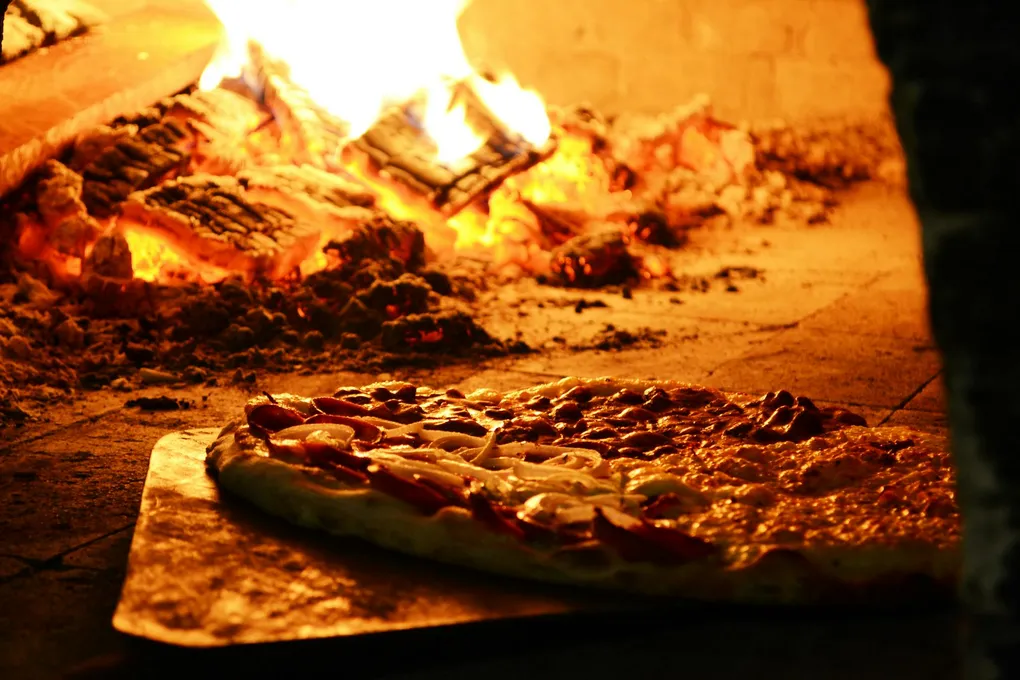
A 500F home oven and a 500F wood-fired oven produce completely different pizzas. The home oven takes 7-8 minutes and dries the crust out. The wood-fired oven finishes in 90 seconds with a soft, blistered, leopard-spotted result. Same temperature. Entirely different physics.
The reason is that oven temperature — the single number on your dial or display — tells you almost nothing about how heat actually reaches your pizza. Three distinct heat transfer mechanisms operate simultaneously during every bake, and the balance between them determines everything: crust texture, moisture retention, char pattern, oven spring, and whether your cornicione puffs up or sits flat.
Understanding these mechanisms is not academic. It is the key to optimizing whatever oven you actually own.
The Three Heat Transfer Modes
Every pizza oven transfers heat through three simultaneous pathways: conduction, radiation, and convection. Their relative contributions change dramatically depending on oven type, and that is what produces such different results at the same indicated temperature.
Conduction: Floor to Base
Conduction is direct heat transfer through physical contact — your pizza sitting on a hot surface. The baking floor (stone, steel, or brick) transfers stored thermal energy into the dough base on contact.
A few critical facts about conduction in pizza:
The base never exceeds 100C while water is present. As long as the dough contains moisture, the base temperature is pinned at or below the boiling point of water. Heat drives off moisture, and evaporative cooling prevents the base from scorching — up to a point. Once the surface dries, it rapidly climbs toward floor temperature. This is when leopard spots form.
Material matters enormously. A baking steel conducts heat 18-20x faster than a cordierite stone (45-58 W/m-K for carbon steel vs 2-3 W/m-K for cordierite). Both reach the same equilibrium temperature during preheat, but steel dumps that heat into your dough much faster on contact. That faster transfer produces better bottom char and more even browning. It is why Myhrvold, Forkish, and Iacopelli all recommend steel over stone for home ovens.
Biscotto clay (1-2 W/m-K) conducts even more gently than cordierite. This is the traditional Neapolitan baking surface — volcanic clay from Sorrento. In a 900F+ portable oven where stock cordierite scorches bottoms before tops finish, Biscotto’s gentler heat release solves the problem. In a 550F home oven, you want more conductive energy, not less — so steel wins at home, clay wins in Ooni/Roccbox territory.
Radiation: The T-to-the-Fourth Power Law
Radiation is heat transferred through electromagnetic waves — infrared energy emitted by hot surfaces. In pizza baking, radiation comes from the oven dome, walls, ceiling, and (in home ovens) the broiler element.
This is where the physics gets dramatic. Thermal radiation follows the Stefan-Boltzmann law, which states that radiant heat output is proportional to the fourth power of absolute temperature (T^4).
What does T^4 mean in practice?
A Neapolitan wood-fired dome at 400C (752F) produces 16 times more thermal radiation than a home oven ceiling at 200C (392F). Not twice as much. Not four times as much. Sixteen times. That is why a 90-second Neapolitan bake produces explosive oven spring, violent cheese bubbling, and leopard-spotted charring that no amount of time in a home oven can replicate. The radiant energy density is in a completely different regime.
Paolo Masi and his co-authors identify radiation as the most significant heat contribution in Neapolitan pizza baking. The refractory brick dome in a traditional wood-fired oven has an emissivity of 0.93, meaning it radiates 93% of its theoretical maximum. At 430-470C dome temperatures, that radiant flux is enormous — and it hits the pizza from above and from the sides simultaneously.
Emissivity matters more than you think. Myhrvold’s team discovered that a clean firebrick floor (emissivity 0.68) reaches a much higher equilibrium temperature than a sooty floor (emissivity 0.95). Counterintuitively, the cleaner surface is more likely to burn pizza — it absorbs less radiant heat from the dome (reflects more), so more energy is available to heat the floor surface directly. An Italian pizzaiolo confirmed: pizza on a black, well-used floor bakes slowly and uniformly; pizza on freshly scrubbed stone scorches in spots.
Convection: The Least Important Mode
Convection is heat transferred by moving air. Temperature gradients inside the oven generate air currents that circulate around the pizza.
In traditional pizza baking, convection is the least significant of the three mechanisms. This surprises people accustomed to convection ovens, but it makes sense: air is a poor conductor of heat compared to direct surface contact (conduction) or electromagnetic radiation. In a high-temperature Neapolitan oven, convective currents contribute heat, but the overwhelming majority arrives via radiation from the dome and conduction from the floor.
Convection matters more in home ovens — particularly fan-forced convection ovens — because it helps distribute the relatively modest heat more evenly. But even in a convection home oven, the broiler element (radiation) and the baking steel (conduction) do far more work than the circulating air.
Why 500F in Your Home Oven Is Not 500F in a Wood Oven
Now you can see why the same temperature produces completely different results in different ovens.
A wood-fired oven at 485C (905F) delivers enormous radiant heat from a dome at 430-470C, intense conductive heat from a refractory floor at ~400C, and moderate convection from hot air currents. The pizza receives a massive blast of energy from all three pathways simultaneously. Total cook time: 60-90 seconds. Moisture loss is minimal. The crust puffs explosively (steam expanding 1,600 times by volume), the exterior chars beautifully, and the interior stays soft and moist.
A home oven at 260C (500F) delivers relatively weak radiation from walls at ~250C (T^4 difference: roughly 6x less radiant energy than a wood-fired dome), moderate conduction from a preheated steel at ~260C, and mild convection from circulating air. The pizza cooks for 7-8 minutes. During that time, it loses far more moisture — Forkish notes this is why home oven doughs need 70% hydration instead of Neapolitan 55-59%. The prolonged bake dries the crust, making it crisper and denser rather than soft and pillowy.
The broiler changes the equation. Switching to broil in a home oven supercharges the radiation component. The broiler element glows at hundreds of degrees hotter than the oven walls, dramatically increasing the T^4 radiant flux hitting the pizza from above. This is why every serious home pizza baking method — Forkish’s steel-plus-broiler, Lopez-Alt’s skillet-broiler, Iacopelli’s two-stage bake — relies on the broiler for top-down heat. It is the only way to approximate the radiant intensity of a hot dome.
Masi’s Six Phases of Pizza Baking
Masi, Romano, and Coccia mapped the internal temperature progression of pizza dough during baking into six distinct phases. This model applies regardless of oven type — the phases are the same, but the speed at which the dough traverses them changes dramatically with heat intensity.
Phase 1: Oven Spring (25-50C)
Gas trapped in the dough expands as it heats. Existing CO2 bubbles grow, dissolved gases come out of solution, and yeast gives one final burst of CO2 before dying. Volume increases 75-85%. The bonds are not yet permanent — if you pulled the pizza out now, it would collapse.
Myhrvold adds critical detail: the overwhelmingly dominant mechanism is steam expansion, not CO2. Water converting to steam expands 1,600 times by volume. A Neapolitan rim that starts at 5mm can finish at 2.5cm — that expansion is steam-driven.
Phase 2: Yeast Death (~50C)
All yeast cells die. Enzymatic activity mostly ceases. Any remaining dissolved CO2, ethanol, and water enter the gas phase, contributing one final push of expansion.
Phase 3: Enzymatic Breakdown (50-60C)
Alpha and beta amylases continue breaking starch into sugars and dextrins. This is the last burst of enzymatic activity before temperatures climb too high. The sugars produced here are critical — they provide fuel for Maillard browning later.
Phase 4: Starch Gelatinization (52-99C)
Starch granules absorb water, swell, and transform from ordered crystalline structures into a disordered gel. Viscosity increases in the walls of each gas bubble. This is the beginning of structure formation — the starch gel will eventually become the crumb.
Phase 5: Protein Cross-Linking (65-70C)
Proteins coagulate and denature. Disulphide bonds (“vulcanization”) form permanent covalent cross-links. At 65C, the dough rapidly loses flexibility. By 95-97C, the protein structure is fully set. The crust is now rigid and permanent.
Phase 6: Differential Baking (Ongoing)
The ungarnished rim (cornicione) heats faster because it has less water content than the sauced center. It rises higher, browns faster, and develops crust. Meanwhile, the center — under sauce and cheese — stays below 100C because moisture keeps evaporating, absorbing heat.
This is also why the center stays flat. Myhrvold’s team tested this (the common explanation that shaping makes the center thinner is wrong — most Neapolitan pizzas are uniform thickness before baking). The real answer: the sauce boils, and evaporative cooling steals so much thermal energy that the dough beneath cannot dry out and rise. Black or dark sauce absorbs more radiant heat, so darker sauce actually lets the underlying dough bake faster.
The Heat Pipe Effect: How Dough Actually Cooks
One of Myhrvold’s most surprising findings is that pizza dough behaves as a heat pipe during baking. Approximately 75% of the heat reaching the center of the dough arrives not through solid conduction through the crumb, but through convection within the bubble chains.
The mechanism:
- The outer wall of a gas bubble heats up.
- Water on the bubble wall evaporates.
- Water vapor (carrying latent heat) travels across the bubble to the cooler inner wall.
- Vapor condenses on the cooler wall, releasing its heat.
- That heat conducts through the thin membrane separating bubbles.
- The cycle repeats in the next bubble inward.
This cascade of evaporation-condensation-conduction moves heat faster than pure conduction through solid dough — faster than copper, in fact. At approximately 70C, starch gelatinizes and proteins coagulate, locking the bubbles in position. They then burst and interconnect, allowing rapid heating of the interior.
This is why well-fermented dough with lots of small, evenly distributed bubbles bakes more evenly than dense, poorly fermented dough. The bubble network IS the heat delivery system.
The Gel Layer Problem
Myhrvold calls the gel layer “a fundamental flaw in pizza making.” It is the white, gummy line between the crust and the sauce — undercooked starch that never fully gelatinized.
His team tested 120 pizzas to identify the cause. The sauce creates a cool surface where rising steam condenses. This condensation zone sits right at the sauce-dough interface, and the continuous cooling prevents the underlying starch from ever reaching full gelatinization temperature. Even marinara-only pizzas can show a visible gel layer.
The only complete fix is prebaking the dough. Practical mitigations:
- Cheese on dough first, sauce on top — the cheese layer dramatically reduces the gel layer (this is why Detroit, deep-dish, and NJ tomato pies use cheese-down assembly)
- Control topping amounts — less sauce means less evaporative cooling
- Sauce after baking — the Detroit racing-stripe method avoids the problem entirely
Flame Physics: What Actually Produces Heat
One of Myhrvold’s most counterintuitive findings: flame itself produces almost no significant radiation for pizza baking. The flame in gas and wood ovens is “optically thin” — meaning it is nearly transparent to infrared radiation. Pizza does not “see” the flame’s temperature. It sees only the temperature of heated surfaces (dome, walls, floor).
In wood-fired ovens, embers contribute enormous heat (1,200-1,500C), but the visible flame above them does not. Gas ovens are “spotlights shining on the ceiling” — the burner heats the dome, and the dome radiates down to the pizza.
This also means the common belief that wood fire imparts flavor to pizza is, by Myhrvold’s measurement, a myth. Smoke rises to the top of the dome and exits through the vent. “If the wood is flavoring the pizza, there’s something wrong with either the technique or oven hygiene.” Masi independently agrees: “the concept of a particular aroma from wood to the pizza is FALSE.”
Practical Applications: Optimizing Your Oven
Home Oven (500-550F)
Your radiation is weak (T^4 at 260C is a fraction of a wood-fired dome). Compensate:
- Maximize conduction: Use baking steel (not stone). Preheat 45-60 minutes minimum — Myhrvold’s testing showed significant cold spots at 22 minutes. Air heats in 21 seconds; walls and steel take far longer.
- Boost radiation: Position steel on the upper rack, 6-8 inches below the broiler. Use the broiler aggressively — this is your dome substitute.
- Raise hydration: 65-70% for hearth pizza, 70-75% for pan pizza. The 7-8 minute bake drives off far more moisture than a 90-second Neapolitan bake.
- Consider a double-steel setup: Steel on the upper rack near the broiler, second steel on the lower rack. Creates a top-and-bottom radiant chamber that mimics a pizza oven dome. Documented to produce 20 pizzas per hour.
- Myhrvold’s mirror-door experiment: A #9 mirror stainless plate over the glass oven door cut bake time from 2.5 to 1.5 minutes, improved volume and leoparding, and nearly eliminated the need to turn the pizza. Glass doors bleed enormous amounts of heat via radiation. This finding is a “call to action for oven manufacturers.”
Portable Pizza Oven (800-950F)
You have strong radiation and conduction. Your challenges are control and evenness:
- Manage the radiant gradient: Most portable ovens have a 200-300F temperature differential from back to front. Turn the pizza every 15-30 seconds.
- Consider a biscotto stone: Lower thermal conductivity than stock cordierite means gentler bottom heat, reducing scorching at full temperature.
- Flame down at launch: Full flame incinerates the top before the bottom sets. Reduce to Low when sliding pizza in, return to High between pizzas.
- Don’t trust the “ready” indicator: Preheat 30-40 minutes for full stone saturation, not the manufacturer-claimed 15-20 minutes (which only heats the surface).
Understanding Your Specific Setup
An infrared thermometer is the single most important diagnostic tool for pizza baking. It reads surface temperature — which is what actually bakes your pizza — rather than air temperature (which is what your oven thermostat reads). The pizza “experiences” wet-bulb temperature (much cooler than dry-bulb) because it is 50-80% water.
Watch for emissivity differences: steel (~0.3-0.5 depending on seasoning) reads very differently than stone (~0.9-0.95) on the same IR thermometer. A thermometer calibrated for stone will give wildly inaccurate readings on steel.
Measure center stone temperature before every pizza, especially when baking multiple pies. The first pizza absorbs enormous thermal energy — recovery time between pizzas is 2-5 minutes in most ovens.
The Bottom Line
Temperature is one variable. Heat transfer mode, surface material, emissivity, moisture content, and bake duration interact to determine every quality you care about: char, crumb, moisture, puff, and flavor development. A 500F oven with a baking steel, broiler protocol, and 70% hydration dough can produce genuinely excellent pizza. It just gets there through a completely different thermodynamic pathway than a 900F wood-fired oven — and your dough, hydration, and technique need to account for that difference.
The ovens are not equivalent. But once you understand the physics, you can optimize whichever one you own.