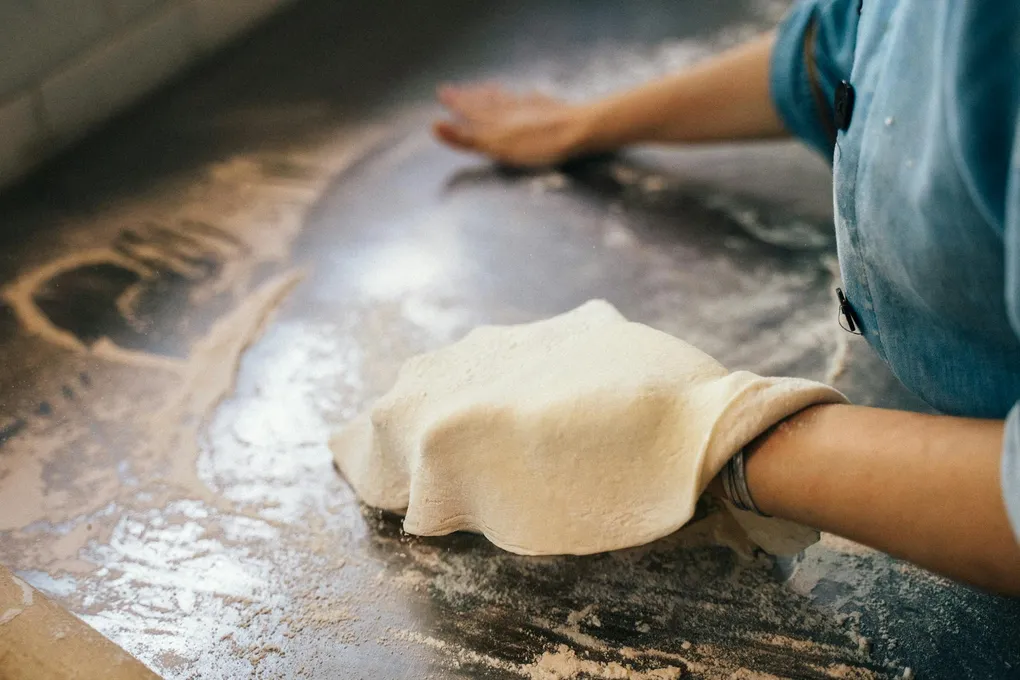
Most pizza dough problems fall into four categories: sticky, tough, dense, or bland. Each has specific causes rooted in the interaction between flour, water, time, and temperature — and each has targeted fixes that don’t require starting over.
This guide maps those four problems to their root causes, drawing on Masi’s catalog of 27 illustrated pizza defects and Iacopelli’s 7 common home baker mistakes. Every fix here is grounded in what the science actually says, not guesswork.
Problem 1: Sticky Dough
Sticky dough clings to your hands, the counter, and the bowl. It’s impossible to shape, tears when you try to stretch it, and leaves residue everywhere.
Root Causes
Too much water for your flour. This is the most common cause. Different flours absorb different amounts of water. For every 1% increment in protein, water absorption increases by 1.5%. If you switch from bread flour (14% protein) to 00 flour (12%) without reducing water, you’ve effectively increased your hydration by 3 percentage points — enough to take a workable dough into a sticky mess.
Damaged starch in the flour. Aggressively milled flour has higher starch damage (8-12% in hard wheat). Damaged starch absorbs 2-4x more water than intact starch initially, then releases it during mixing, creating sudden stickiness. This is more common with cheap or freshly milled flour.
Insufficient mixing. Undermixed dough hasn’t formed a coherent gluten network. The flour and water are combined but not structured. Masi categorizes this as “unstructured (stringy) dough” — the gluten strands are there but haven’t interconnected.
Weak flour. Flour below W220 (roughly 10-11% protein) can’t form a strong enough gluten network to organize the water. Masi’s defect table lists this explicitly: “Flaccid, sticky dough — too much water, weak flour.” The fix is structural, not just hydration.
Fixes
- Reduce water by 5-10g and see if the texture improves. Small adjustments matter.
- Add flour in small increments (10-20g) during mixing, not after. Once the dough is formed, adding flour creates dry pockets.
- Mix longer. If the dough is sticky but the hydration is correct, the gluten network may just need more development. Give it 2-3 more minutes of folding or mixing.
- Switch to stronger flour. If you’re using AP flour and fighting stickiness at 65% hydration, your flour may not have enough protein. Move to bread flour.
- Wet your hands, not the dough. When handling high-hydration dough (68%+), lightly wet your hands instead of adding flour. Water prevents sticking without altering the formula.
Problem 2: Tough Dough
Tough dough resists stretching. It snaps back to its original shape, produces a chewy and heavy crust, and requires force to work with. You can’t thin it out without it contracting.
Root Causes
Over-mixing. The most common cause of tough dough. Extended mechanical action organizes the gluten network excessively, creating a dough that’s strong but not extensible. Masi describes this as dough that becomes “flaccid, sticky, yellow-tinged” at extreme over-mixing, but the more typical result is excessive elasticity — the dough fights every attempt to shape it.
Wrong flour for the style. High-gluten bread flour (14%+) in a Neapolitan recipe creates a dough that’s far too elastic. Neapolitan wants 00 flour at 11.5-12.5% precisely because the weaker gluten produces a more extensible, tender crust. Using bread flour for Neapolitan is using the wrong tool.
Insufficient fermentation. This is the core insight that separates good pizza from mediocre pizza. Protease enzymes gradually break down gluten during fermentation, converting elastic resistance into extensible flow. Under-fermented dough hasn’t had enough enzymatic action to relax. Masi’s defect table: “Resists lamination — under-matured or too structured.”
Cold dough. Gluten tightens when cold. Dough straight from the fridge will always resist stretching. Iacopelli lists insufficient tempering as a key mistake — dough needs 20-30 minutes minimum at room temperature before shaping, and Gemignani insists on 1-2 hours until the dough reaches 60-65F.
Fixes
- Rest the dough. If it’s snapping back, stop working it. Cover it and wait 15-20 minutes. Gluten relaxes with time. This is the simplest and most effective fix.
- Extend your fermentation. If you’re making same-day dough and it’s tough, you’re not fermenting long enough. Move to a 24-hour cold ferment minimum.
- Reduce mixing time. For most pizza doughs, 90 seconds in a stand mixer or 2-3 minutes by hand is sufficient. Forkish specifically warns that over-mixing produces “too much gluten organization = elastic, chewy crust.”
- Match flour to style. Use 00 for Neapolitan, bread flour for NY. Don’t cross them without adjusting your entire approach.
- Temper before shaping. Pull dough from the fridge 1-2 hours before you plan to stretch it. Use a probe thermometer to confirm it’s at 60-65F.
- Rescue method: If dough tears during stretching, re-ball it and rest for 1 hour. Iacopelli confirms it recovers.
Problem 3: Dense Dough
Dense dough produces a heavy, flat crust with no visible air pockets. The crumb is tight and gummy. There’s no oven spring, no poof in the rim, and the pizza feels heavy to pick up.
Root Causes
Dead or insufficient yeast. The most common cause. Yeast dies at 114F (46C) — if your water was too hot, you killed it. Active dry yeast that hasn’t been bloomed in warm water (not hot — 80-85F is Gemignani’s target) may not activate properly. Old yeast packets lose viability.
Under-proofing. The dough hasn’t fermented long enough to generate adequate gas. Masi’s defect table: “Low volume (weak) — weak flour, old/insufficient yeast, cold water.” The four phases of leavening are lag (no visible change), exponential (biggest volume increases), stationary (plateau), and decline (collapse). If you bake during the lag phase, you get dense pizza.
Ambient temperature too cold. A 1C increase in the 20-35C range produces an 8-12% increase in fermentation speed. If your kitchen is 60F instead of 70F, fermentation is significantly slower. The timeline on the recipe assumes a baseline — your environment may need more time.
Hard water. Water above 20 French degrees of hardness creates an overly rigid gluten network (calcium and magnesium ions form excessive ionic bonds with amino acids). This also reduces yeast activity. Masi’s defect table: “Low volume (rigid) — hard water, too much salt.”
Too much salt. Salt above 3% significantly retards fermentation. If you measured by volume instead of weight, crystal size variation could have given you far more salt than intended. Morton kosher weighs 17.6g per tablespoon; Diamond Crystal weighs 9.6g. That’s nearly double.
Fixes
- Test your yeast. Dissolve a pinch of yeast and a pinch of sugar in warm water (80-85F). If it doesn’t foam within 10 minutes, the yeast is dead. Replace it.
- Give it more time. If the dough hasn’t doubled or shown visible bubbles, it’s not ready. Don’t bake by the clock — bake by the signs. Look for: expanded volume, small bubbles on surface, gassy holes on the bottom when you lift the ball.
- Warm the environment. If your kitchen is cold, place the dough in an oven with the light on (oven off). The light generates enough heat to create a roughly 75-80F proofing environment.
- Weigh your salt. Always. Volume measurements are unreliable for salt because crystal sizes vary dramatically between brands.
- Check your water temperature. Use a probe thermometer. Water for yeast activation should be 80-85F. Water for the main dough should target a final dough temperature of 77-82F.
Problem 4: Bland Dough
The crust is edible but flavorless. It tastes like cooked flour. There’s no complexity, no depth, no character. The sauce and toppings carry all the flavor.
Root Causes
No cold fermentation. This is the overwhelming cause of bland pizza dough. Same-day dough at room temperature produces gas (the dough rises) but doesn’t develop flavor. Flavor comes from enzymatic action during cold fermentation: amylase converting starch to sugars, protease converting proteins to amino acids (umami), lipase converting fats to fatty acids. At fridge temperature, these enzymes are 4-5x more active relative to yeast than at room temperature.
Over 50 distinct flavor compounds form during 48-72 hours of cold fermentation that don’t exist in quick dough.
Insufficient salt. Salt is a flavor ingredient, not just a fermentation regulator. At 2% of flour weight, you can barely taste it. Neapolitan dough runs at 2.6-3% precisely because salt is a primary flavor contributor. If your pizza tastes flat, try increasing salt to 2.5-2.8%.
No pre-ferment. A poolish or biga adds a layer of fermentation-developed flavor that straight dough can’t match. Iacopelli’s head-to-head test showed biga produced 10/10 crumb and poolish 9/10 — both far superior to direct-method dough in flavor and texture.
Pale crust (no Maillard). If your crust isn’t browning, it’s not developing the hundreds of flavor compounds that the Maillard reaction produces. Common in home ovens with 00 flour (no malt) or when baking at temperatures below 475F. The crust looks done but tastes one-dimensional.
Fixes
- Switch to cold fermentation. This is the single highest-impact change you can make. Mix tonight, fridge overnight, bake tomorrow evening. Even 24 hours produces a noticeable improvement over same-day.
- Increase salt to 2.5-2.8%. Myhrvold’s position: salt is a flavor constant. Don’t vary it for fermentation control — vary yeast instead. Find your ideal salt percentage and keep it there.
- Add a pre-ferment. A poolish (equal parts flour and water with a pinch of yeast, fermented 12-18 hours) is the easiest entry point. It adds one extra step the day before and transforms the flavor.
- Add diastatic malt. At 0.5-2% of flour weight, diastatic malt provides both sugars for browning and enzymes for ongoing flavor development. It’s the simplest browning fix for home ovens.
- Bake hotter and on steel. Increase oven temperature to maximum. Use a pizza steel. Preheat for 45-60 minutes. Try a broiler finish for the last 1-2 minutes. Browning = flavor.
Iacopelli’s 7 Mistakes: Quick Reference
These are the seven most common home-baker errors, compiled from Iacopelli’s teaching:
| # | Mistake | Fix |
|---|---|---|
| 1 | Pulling dough from container with bare hands | Use a floured spatula |
| 2 | Too much flour on counter/dough | Minimal flour; use perforated peel |
| 3 | Stretching before ingredients are ready | Prep ALL toppings before touching dough |
| 4 | No peel or transfer tool | Buy a peel or use parchment paper |
| 5 | Insufficient stone/steel preheat | 30-40 min AFTER oven reaches max |
| 6 | Adding cheese before pre-baking in home oven | Two-stage bake: sauce first, cheese second |
| 7 | Wrong temperature | Stone target: 450-550F for home oven |
When to Start Over
Sometimes the dough is beyond saving. If it smells strongly of alcohol or vinegar (over-fermented past the point of no return), if it’s turned gray or developed visible mold, or if it literally disintegrates when you try to shape it — compost it and start fresh. Good pizza takes 48-72 hours of planning, but only 10 minutes of active mixing time. Starting over costs almost nothing.
For everything else — sticky, tough, dense, bland — there’s a targeted fix that doesn’t require throwing anything away.