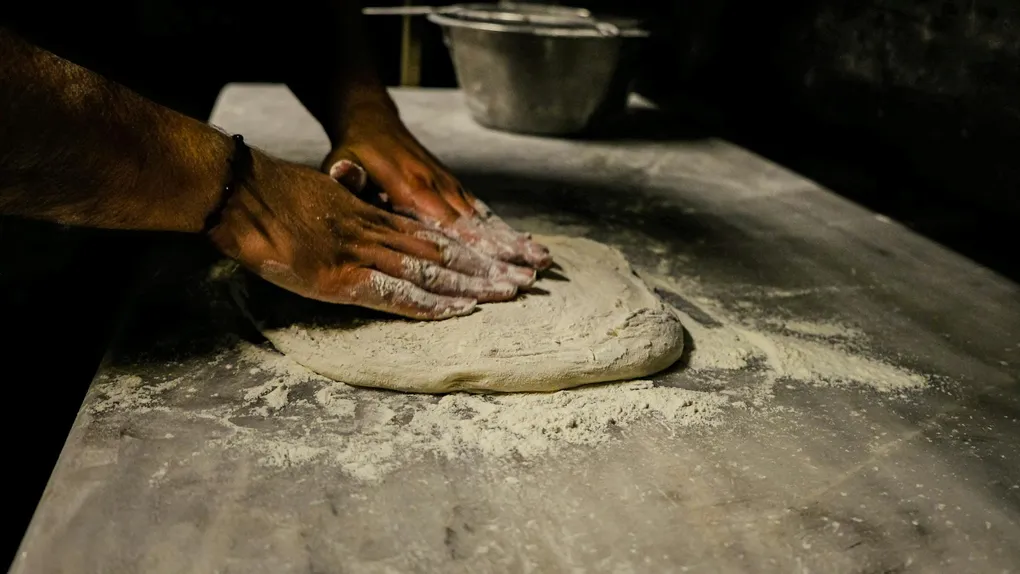
There are three fundamentally different ways to develop gluten in pizza dough, and they produce noticeably different crusts. Hand mixing gives you delicacy. A stand mixer gives you efficiency and uniformity. A no-knead approach — where time and hydration replace mechanical energy — gives you an open, airy crumb with minimal effort. Each has a legitimate place depending on your dough hydration, the style you are making, and how much you value crust texture versus convenience.
The deeper truth: for pizza, less kneading is almost always better than more. Pizza is not bread. Bread wants maximum volume and a tight, structured crumb. Pizza wants delicacy — a crisp exterior, a light interior, and a crust that yields to the bite rather than resisting it. Overworking pizza dough builds the kind of chewy, elastic gluten network that is a virtue in a baguette and a flaw in a Margherita.
Why Gluten Development Matters (and Why Less Is More)
Gluten is the protein web formed when water meets flour. Glutenin provides tenacity (resistance to deformation). Gliadin provides extensibility (viscous flow). Together they create a mesh that traps fermentation gases, gives dough structure, and determines the final texture of your baked crust.
The pizza paradox: You need enough gluten to hold the dough together, retain gas, and support toppings. But too much gluten — too much mechanical development — creates an elastic, chewy, rubbery crust that snaps back when you stretch it and fights you at every step. As Forkish puts it: “Elastic is not a happy word in the pizza maker’s lexicon.” [Forkish Ch3]
This is why fermentation time is the pizza maker’s best friend. Protease enzymes gradually degrade the gluten network during long fermentation, converting an elastic dough into an extensible one. Extended cold fermentation (24-72 hours) does more for pizza texture than any amount of kneading. [Forkish Ch3]
The three mixing approaches represent different trade-offs between mechanical development and time-based development.
Approach 1: Hand Mixing (Forkish’s Preferred Method)
Forkish explicitly prefers hand mixing for most pizza doughs. His reasoning: hand mixing produces less organized gluten, which translates to a more delicate, less chewy crust. The texture he describes — “ethereal, weightless, crisp” — comes specifically from the relative under-development of gluten compared to machine-mixed dough. [Forkish Ch3]
The Pincer Method
Forkish’s signature mixing technique combines two motions:
- Pincer grip: Thumb and forefinger cut through the dough mass repeatedly, like closing a claw through the center.
- Fold: After several pincer cuts, fold the dough over itself from the edges toward the center.
- Repeat: Alternate pincer cuts and folds for approximately 2 minutes.
The pincer method breaks up dry flour pockets, distributes water, and begins gluten formation without the sustained stretching that builds a bread-like network. It is quick, intuitive, and works directly in the mixing container (a 6-quart tub, typically).
The Brief Knead After Rest
After the initial pincer mix, Forkish rests the dough for 15-20 minutes. During this rest, the flour continues absorbing water, and the beginnings of a gluten network form passively (a mini autolyse effect). Then a brief knead — 30 seconds to 1 minute on a lightly floured counter — smooths the dough into a cohesive ball. [Forkish Ch5-6]
That is the entire mechanical development. Two minutes of pincer mixing, a 15-20 minute rest, and 30-60 seconds of light kneading. The remaining gluten development happens over the next 6-48 hours of fermentation.
When to Use Hand Mixing
- Hydration 65-75%: Wet enough that the dough moves and folds easily by hand
- Neapolitan, Roman, al taglio styles: Any style that prizes a delicate, airy crust
- 00 flour doughs: Lower-protein flour develops adequate gluten structure with minimal mechanical input
- Pan pizza: High-hydration pan doughs (75%+) are too wet for effective machine mixing anyway
Approach 2: Stand Mixer
A stand mixer with a dough hook is the standard professional approach and the method Gemignani uses for most of his formulas. It provides consistent, repeatable results and handles stiff, low-hydration doughs that resist hand mixing.
When the Mixer Is Necessary
Forkish explicitly reserves the stand mixer for doughs below 65% hydration — notably his New York dough at 64%. At this hydration, the dough is stiff enough that hand mixing becomes a workout without fully integrating the ingredients. The dough hook on the lowest speed for approximately 90 seconds produces a uniform, well-hydrated mass. [Forkish Ch3]
Gemignani uses a stand mixer for virtually all his formulas, keeping mixing time to 2-3 minutes at the lowest speed. His Master Dough, Napoletana, Chicago Deep-Dish, and Romana doughs are all mixer-mixed. [Gemignani, Master Class]
Critical Rules for Mixer Kneading
Always use the lowest speed. Higher speeds generate friction heat and develop gluten too aggressively for pizza. The goal is incorporation and initial development, not the 10-minute full-speed knead you might use for bread. Gemignani’s instruction: “Knead 2-3 minutes on low.” Never speed 2. Never speed 3. [Gemignani]
Watch for overmixing. Masi describes three mixing outcomes: developed (optimal), underdeveloped (stringy, insufficient gluten), and overmixed (flaccid, sticky, yellow-tinged dough with broken gluten bonds). Overmixed dough cannot be fixed — the covalent bonds that hold the gluten network have been mechanically destroyed. [Masi pp. 70-71]
Monitor dough temperature. The stand mixer’s dough hook generates friction heat. On a warm day, starting with room-temperature flour and warm water, even 2-3 minutes of mixing can push dough above the ideal 75-82F range. This is one reason Gemignani’s ice water technique matters — most of his water (225g of 295g) is ice-cold (38-40F), counteracting the friction heat from mixing. [Gemignani, Master Class]
The Oil-at-End Rule
Gemignani is emphatic: add oil (or any fat) toward the END of the mixing process, not at the beginning. If fat is added too early, it forms a barrier that prevents flour from properly absorbing water. The flour cannot hydrate, gluten cannot form, and the result is a poorly structured dough.
His analogy: “Making dough is like building an engine. You put all the parts together and then you add oil at the end to start it up.” [Gemignani, Theory]
The practical sequence for mixer doughs:
- Combine flour and dry ingredients (malt, if using)
- Add water (ice water first, then warm yeast-water)
- Add pre-ferment (tiga, poolish) if using
- Mix 1-2 minutes on lowest speed
- Add salt
- Mix 30 seconds more
- Add oil last
- Mix 30-60 seconds to incorporate
This aligns with professional bread-baking technique and is one of the most commonly violated rules in home pizza recipes, which often dump everything in together. [Gemignani]
Approach 3: No-Knead (Autolyse and Time)
The no-knead philosophy rests on a core scientific principle: time can replace mechanical energy for gluten development. Given sufficient water and sufficient time, gluten strands will self-organize into a functional network through Brownian motion, enzymatic activity, and the slow hydration of flour particles. You do not need to force them into alignment — they will get there on their own.
The Autolyse Method
The autolyse technique was developed by French baking professor Raymond Calvel in the mid-1970s and has been adapted by virtually every serious bread baker since. For pizza, it works as follows:
- Combine flour and water only. No salt, no yeast, no pre-ferments.
- Mix briefly until there are no dry spots (1-2 minutes, no kneading).
- Rest 20-30 minutes (covered, at room temperature).
- Add salt, yeast, and any pre-ferment. Mix briefly to incorporate.
During the 20-30 minute rest, several things happen:
- Flour fully absorbs water — more complete hydration than any amount of mechanical mixing achieves immediately
- Amylase enzymes begin breaking complex carbohydrates into simple sugars — fuel for yeast and Maillard browning
- Protease enzymes begin breaking down gluten proteins — increasing extensibility
- Reduced oxidation — less mixing means less air incorporation, which preserves flavor compounds that oxidation would destroy
- Better gas retention in the final dough
The net effect: less kneading time needed, more extensible dough, better flavor, and improved volume. [Forkish, FWSY Ch2]
Caveat: Yeast During Autolyse
If you include yeast in the autolyse rest (as some simplified recipes suggest), limit the rest to 20 minutes. Yeast without salt reproduces very quickly, and an overly active yeast population before salt is added can create unpredictable fermentation. Forkish’s recommended approach: flour + water only for autolyse, then add yeast and salt afterward. [Forkish, FWSY Ch2]
Forkish considers autolyse unnecessary for his Elements of Pizza recipes — the lower hydration and tiny yeast amounts of those formulas create what he calls a “natural autolyse effect” during the slow fermentation that follows. The formal autolyse step is more important for his higher-hydration FWSY recipes. [Forkish Ch3, Ch5]
Gemignani offers his own version: presoak flour in water for 30 minutes (or up to 6-8 hours) before adding other ingredients. He positions this as particularly useful for high-hydration doughs and ancient grain flours that take longer to fully hydrate. [Gemignani, Theory]
Three Gluten Structures from One Dough (Iacopelli)
Vito Iacopelli demonstrated one of the most elegant technique insights in pizza making: you can produce three distinctly different crumb structures from the same recipe by varying only the rest time before balling.
Using his standard 70% hydration dough (1000g flour, 700ml water, poolish, 25g salt), 280g balls:
| Method | Rest Before Balling | Crumb Result | Best For |
|---|---|---|---|
| STG Classic | None — ball immediately after mixing | Dense, small regular air cells, chewy | Traditional Neapolitan |
| Alveolated (Iacopelli’s pick) | 20 min covered rest, then ball | Balanced — larger pockets, soft + crunchy | Best all-around home pizza |
| Sponge Texture | 20 min rest, re-ball, 20 min rest, ball again | Ultra-light, very large irregular holes | Maximum airiness |
No extra ingredients. No change in kneading. The only variable is how long the dough rests before being divided into balls — and that rest period allows gluten to relax and reorganize, creating fundamentally different internal structures. [Iacopelli]
This is perhaps the single most actionable technique insight for home pizza makers: a 20-minute wait transforms the crust. It costs nothing and changes everything.
Why High-Hydration Doughs Resist Traditional Kneading
Traditional kneading — the push-fold-turn motion on a floured counter — works well for moderate-hydration doughs (55-65%) but becomes increasingly ineffective as hydration rises.
At 70%+ hydration:
- The dough is too sticky to handle on a counter without adding flour (which changes the hydration ratio)
- The dough spreads rather than holding a mass, making push-fold impossible
- The dough sticks to hands, tools, and surfaces faster than you can develop gluten
- Adding bench flour to manage stickiness creates dry pockets of unhydrated flour
For high-hydration pizza doughs (70-80%, common for pan, al taglio, and home-oven Neapolitan), three alternatives work:
Stretch and fold in the container: With wet hands, grab one side of the dough, stretch it up, and fold it over the center. Rotate the container 90 degrees, repeat. Do 4 folds = 1 set. Repeat every 30-60 minutes for 2-3 sets. This develops gluten gently without ever removing the dough from its container. Gemignani uses this approach for his Sicilian dough (70% hydration), which he explicitly says is “too sticky to knead.” [Gemignani]
Slap and fold: Wet the counter lightly. Pick up the dough, slap the bottom edge onto the counter, then fold the top portion over. Rotate 90 degrees, repeat. This technique works with wet doughs because the motion is fast enough that the dough does not have time to stick. It requires practice but develops gluten efficiently without bench flour.
Time-based development: Simply mix until combined (no dry flour remaining), cover, and let fermentation and enzymatic activity develop the gluten over 12-24 hours. This is Forkish’s approach for many of his recipes — the 24-48 hour cold ferment does the structural work.
Mixer Types for Pizza (Professional Context)
For home bakers, a KitchenAid-style planetary mixer with a dough hook is the standard. But it is worth knowing what the professionals use, because it explains why their results differ:
Fork mixer (TSG-recommended for Neapolitan): Fork rotates at an angle, producing low heat transfer to the dough. The EU regulation specifies 20 minutes at low speed for Neapolitan pizza dough — much longer than home methods. [Masi pp. 73-74]
Spiral mixer (bakery standard): Steel spiral on a vertical axis with an independently rotating bowl. Produces soft doughs with fine, uniform porosity. More efficient than a fork mixer. Most pizzeria-grade mixing is done with spirals.
Diving arm mixer (historical): Two arms enter from outside, lift from center, stretch and release. Simulates hand mixing. Once popular, now rare because of cost and speed. [Masi pp. 73-74]
A KitchenAid with a dough hook is essentially a simplified planetary mixer. It works well for pizza in small batches (1-3 balls), but its 5-6 quart bowl limits batch size, and the dough hook does not simulate any of the above professional mechanisms particularly closely. For most home pizza makers, it is more than adequate — especially since the goal is minimal mixing.
Which Method Should You Use?
| Your Situation | Best Method | Why |
|---|---|---|
| High-hydration dough (70%+) | Hand mix (pincer or stretch-and-fold) | Too wet for counter kneading; mixer incorporates too much air |
| Low-hydration dough (under 65%) | Stand mixer, 90 sec, lowest speed | Too stiff for comfortable hand mixing |
| Neapolitan / Roman / al taglio | Hand mix | Delicacy over structure; less gluten organization = more tender crust |
| New York / bar pizza | Stand mixer | Stiffer dough needs even development; structure supports foldable slice |
| Pan / Sicilian | Stretch-and-fold in container | Wettest doughs; minimal handling; let time and fermentation do the work |
| Maximum crumb airiness | Mix + autolyse + rest before balling (Iacopelli method) | Rest timing, not mechanical energy, determines crumb structure |
| Beginner, any style | Hand mix (pincer method) | Impossible to overmix by hand; builds intuition for dough feel |
The universal rule across all methods: err on the side of under-mixing rather than over-mixing. An under-developed dough will improve during fermentation as enzymes and time organize the gluten network. An over-developed dough — one with broken gluten bonds from excessive mechanical action — cannot recover. When in doubt, stop mixing and let time do the work.