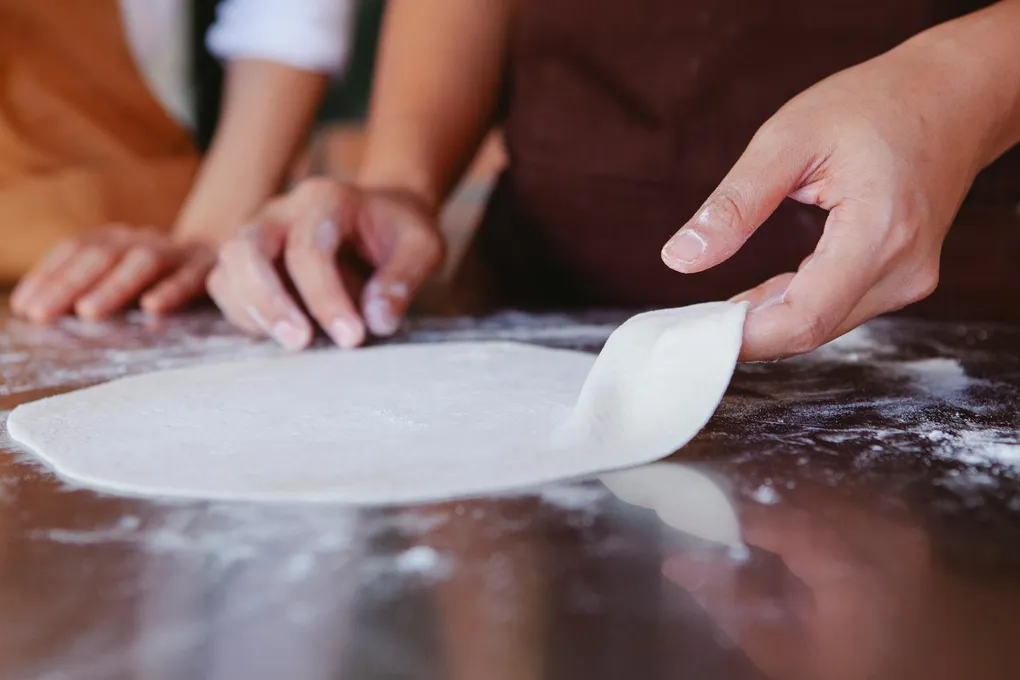
Hydration is the single number that determines more about your pizza than any other variable in your dough formula. It controls how the dough handles in your hands, how it behaves in the oven, and whether the finished crust is crackling-crisp, soft-and-foldable, or a bread-like pillowy square. Get it wrong and no amount of technique will save you.
The hydration percentage is simply the weight of water divided by the weight of flour, expressed as a percentage. A dough with 500g flour and 350g water has 70% hydration. But that number carries enormous consequences.
The Inverse Rule: Hotter Oven = Less Water
This is the foundational principle that most home pizza recipes get wrong, and it comes directly from Ken Forkish’s work in The Elements of Pizza: there is an inverse relationship between ideal dough hydration and oven temperature.
A professional Neapolitan oven at 905F (485C) bakes a pizza in 60-90 seconds. At that speed, very little moisture evaporates from the dough. If you used a 70% hydration dough, the center would be a soggy mess — there is simply not enough time for the water to cook off. That is why the AVPN (Associazione Verace Pizza Napoletana) spec calls for 55-59% hydration in wood-fired ovens.
Now take that same 58% dough and bake it in a home oven at 550F for 7-8 minutes. During those 7 minutes, far more moisture evaporates than in a 60-second bake. The result: a stiff, dry, cracker-like crust that nobody wants to eat.
The fix is more water. A 70% hydration dough baked at 550F for 7 minutes produces a crust that is soft and foldable in the center, with a crisp exterior — the closest a home oven can get to authentic Neapolitan character.
Match your hydration to your oven, or fail. This is not optional.
The Hydration Spectrum: 55% to 87%
55-60%: Stiff Doughs for Extreme Heat
This is AVPN wood-fired territory and ultra-fast portable oven baking (Ooni, Roccbox at 800F+). The dough is firm, easy to stretch without tearing, holds its shape on the peel, and sets almost instantly on the baking surface. At these temperatures, dough needs to be workable enough to turn within 20-30 seconds of entering the oven — any wetter and you cannot slide a peel under it.
Myhrvold’s team found that Neapolitan dough at 55% hydration felt like “modeling clay,” confirming that the low end of this range is too stiff even for wood-fired. Their master Neapolitan recipe landed at ~65%.
Best for: Portable pizza ovens (60-62%), traditional Neapolitan in authentic wood-fired ovens (58-65%).
60-65%: The Workhorse Range
This is Tony Gemignani’s declared sweet spot, and it covers the majority of pizza styles. His 14 published dough formulas cluster between 60% (Chicago deep-dish, einkorn) and 65% (Master Dough, Napoletana, Grilling, Cracker-Thin).
At 60-65%, dough is workable by hand without excessive stickiness, shapes into consistent rounds, handles well during peel loading, and produces a crust with good structure. The crust is crisp enough to fold (New York style) but tender enough to have some chew.
Gemignani is blunt about anything above 70%: “Some recipe writers call overhydrated pizzas ‘rustic.’ I call them a mess.” His concern is practical — high-hydration dough is floppy, tears easily, sticks to everything, and is difficult for home bakers to shape into even circles.
Best for: New York (58-65%), Neapolitan in portable ovens (60-62%), Gemignani’s universal method.
65-70%: Home Oven Standard
This is where Forkish lives. Nearly every recipe in The Elements of Pizza runs at 70% hydration, tuned specifically for a 550F home oven with a 7-8 minute bake.
The extra water compensates for the extended bake time. It produces a crust with a soft, pillowy interior and a crisper exterior — the hallmark of good home-oven pizza. The dough is noticeably softer than a 60% dough: it stretches more easily but is also more prone to sticking and tearing if you are not gentle.
Myhrvold’s experimental data aligns: their New York master recipe at ~62% produced the best results at oven temperatures typical of pizza deck ovens, while artisan-style doughs pushed to ~72% for slower bakes.
Best for: Home oven Neapolitan (70%), home oven Roman (65%), Forkish’s entire recipe library.
70-75%: Pan Pizza and Detroit
Pan pizza dough wants to be wet. The high hydration produces an open, airy crumb that is light and almost focaccia-like. At 75%, you are not hand-stretching this dough on a peel — you are pressing it into an oiled pan and letting it spread over the course of an hour or two.
Forkish’s Saturday Pan Pizza Dough runs at 75%. Gemignani’s Sicilian dough (the highest hydration in his collection) hits 70%. Detroit-style recipes typically fall between 70-75%, and that extra water is what creates the distinctively airy, thick crumb with the crispy frico cheese edge.
Myhrvold tested Detroit at ~75% and found it forgiving — +/-5% still yielded well-balanced comparable pizzas. NY Square was more sensitive: dropping from ~75% to 65% caused a “significant decrease in volume” and the open crumb collapsed.
Best for: Detroit (70-75%), Sicilian (67-70%), pan pizza (75%), Grandma pie (70%).
75-80%+: Al Taglio and Advanced Territory
Roman al taglio (pizza by the cut) runs at 75-80% hydration. Myhrvold tested their al taglio master at ~80% and found 70-75% produced “positive results” while higher percentages became “bland and chewy.”
At these hydration levels, the dough cannot be kneaded traditionally. Iacopelli’s and Forkish’s approach is stretch-and-fold: pull one side of the dough over the center, rotate, repeat, let rest, repeat. The gluten develops through time and gentle manipulation rather than mechanical force.
Focaccia pushes even further. Myhrvold’s master focaccia lands at ~87% hydration, and their testing showed that even at 100%+ hydration, the main effect was decreased volume rather than failure.
Best for: Al taglio (75-80%), focaccia (80-87%). Requires advanced handling and pan-based baking.
Why the Same Hydration Feels Different with Different Flours
Hydration is not absolute. A 65% dough with Caputo 00 Pizzeria (11.5-12.5% protein) feels significantly different from a 65% dough with King Arthur Bread Flour (12.7% protein).
Higher-protein flours absorb more water. Masi’s flour rheology research quantifies this: for every 1% increment in protein, water absorption increases by approximately 1.5%. Additionally, damaged starch (from aggressive milling) absorbs 2-4x more water than intact starch granules.
This means:
- Switching from 00 flour (11.5% protein) to bread flour (13.5% protein) at the same hydration percentage makes the dough feel drier. Add 3-5% more water to compensate.
- Switching from bread flour to 00 flour at the same hydration makes the dough feel wetter. Hold back some water.
- Even within the same flour type, different brands and batches vary. Caputo Pizzeria 00 has a W value of 332 (lab-tested by Myhrvold), while Le 5 Stagioni Pizza Napoletana 00 has W 299. Same category, different absorption.
Gemignani’s Neapolitan farinograph absorption spec (from the EU TSG standard) defines acceptable flour absorption at 55-62%. That is the flour’s capacity, not the recipe hydration. The two interact: a flour with 62% absorption capacity will feel comfortable at 65% recipe hydration, while a flour with 55% absorption will feel wet and slack at the same 65%.
Hydration by Oven Type: The Quick Reference
| Oven Type | Temp Range | Bake Time | Recommended Hydration | Why |
|---|---|---|---|---|
| Portable (Ooni, Roccbox) | 800-950F | 60-90 sec | 60-62% | Ultra-fast bake retains moisture; lower hydration prevents soggy center |
| Breville Pizzaiolo | 700-750F | ~2 min | 62-65% | Transitional zone between portable and home |
| Home oven + steel/stone | 500-550F | 7-8 min | 65-70% | Longer bake drives off moisture; needs more water to maintain texture |
| Home oven pan pizza | 500-550F | 12-15 min | 70-75% | Thick dough needs maximum hydration for open crumb |
The Counterintuitive Truth About Crispness
Gemignani points out something that surprises most home bakers: higher hydration produces a crispier crust, not a softer one. The mechanism is steam. More water in the dough creates more steam during baking. That steam expands the crust from inside, creating a thinner shell that crisps up, while the interior stays moist and soft.
This is why a properly hydrated 70% home-oven dough produces a crust with a satisfying crunch on the outside and a tender pull on the inside. A 55% dough baked in the same oven produces a uniformly dense, cracker-like result — dry through and through.
The catch: above about 70%, the dough becomes unmanageable for most home bakers. It sticks, tears, loses its shape, and resists being loaded onto a peel. The crispness benefit continues, but the handling penalty gets steep.
High-Hydration Innovations
Myhrvold’s team discovered a technique for pushing Neapolitan hydration to ~82% while maintaining normal handling: pregelatinized flour. Cook 5-10% of the flour in water first, creating a paste (the Japanese bread technique called tangzhong). This cooked starch absorbs water without contributing to the gluten network’s stickiness. The result is higher-than-expected volume and a canotto-like puffy rim, with dough that handles closer to a 65% formula.
This is an advanced technique, but it signals where high-level pizza making is heading — finding ways to get the benefits of high hydration without the handling nightmares.
Practical Hydration Adjustment Tips
Start at the lower end of the range for your oven type. If you are making home-oven Neapolitan and the range is 65-70%, start at 65%. Success with lower hydration builds confidence. Increase by 2-3% per batch until you find your handling limit.
Hold back 5-10% of the water. Mix the dough with 90-95% of the recipe water. Assess the texture. Add the remaining water gradually if the dough feels too stiff. Different flour lots absorb differently, and this gives you a safety margin.
Adjust for humidity. In high-humidity environments, flour has already absorbed some atmospheric moisture. You may need slightly less water than the formula calls for. Gemignani suggests increasing salt by 0.5-1% on humid days to strengthen the gluten network if the dough feels weak.
Cold fermentation changes perceived hydration. Dough that felt manageable at mixing can feel much wetter after 48 hours in the fridge. Enzymatic activity during cold fermentation (protease breaking down gluten) loosens the structure. This is normal. Let the dough temper at room temperature for 20-30 minutes before stretching — cold dough tears.
Weigh your water. 1 milliliter of water weighs 1 gram. Use a scale, not a measuring cup. For hydration-sensitive formulas (the difference between 65% and 70% in a 500g flour batch is only 25g of water), precision matters.
Sources: Forkish, The Elements of Pizza (2016); Forkish, Flour Water Salt Yeast (2012); Gemignani, The Pizza Bible (2014); Masi et al., The Neapolitan Pizza: A Scientific Guide (2015); Myhrvold & Migoya, Modernist Pizza Vol 1 (2021); Iacopelli, YouTube (2019-2023).