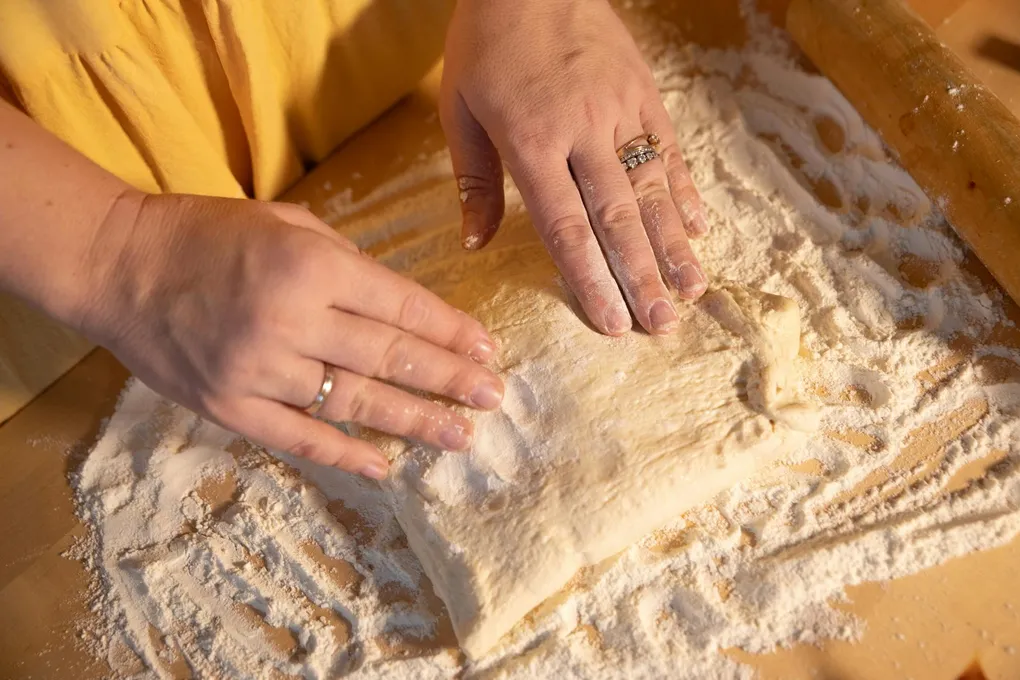
If there is one technique that separates memorable pizza from forgettable pizza, it is cold fermentation. Not better flour, not a more expensive oven, not a secret ingredient. Time in the refrigerator.
Every expert source we have studied — Forkish, Gemignani, Masi, Myhrvold, Iacopelli — converges on the same conclusion: pizza dough that ferments slowly in the cold for 24-72 hours develops a complexity of flavor and a quality of texture that no same-day dough can match. The science explains exactly why, and the practical details determine whether you get that result or a collapsed, sour mess.
The Central Insight: Enzymes Outpace Yeast in the Cold
At refrigerator temperature (4C/39F), yeast activity drops to roughly 10% of its room-temperature rate. The yeast cells are alive but barely active — metabolizing slowly, producing minimal CO2, doing very little to expand the dough.
But the enzymes in flour — amylase, protease, lipase — retain 40-50% of their room-temperature activity. Relative to yeast, enzymes are 4-5 times more active in the cold than at room temperature.
This asymmetry is the entire basis of cold fermentation. The yeast is effectively paused while the enzymes continue working, breaking down complex molecules into simpler ones that contribute to flavor, browning, and texture.
The Three Key Enzymes
Amylase converts starch into simple sugars (maltose, glucose). Flour contains only about 0.5-2% free sugars naturally — not enough for significant Maillard browning or complex flavor. Over 24-72 hours of cold fermentation, amylase unlocks the starch reserves, producing a much richer supply of sugars. These sugars feed the yeast when the dough warms up (producing gas for oven spring), participate in Maillard browning during baking (producing the dark spots and complex crust flavors), and add subtle sweetness to the finished crust.
Protease breaks down proteins into free amino acids. This does two critical things. First, free amino acids are the other half of the Maillard reaction — you need both sugars and amino acids for browning. A cold-fermented crust browns faster and darker than a same-day crust at the same temperature because there are more Maillard reactants available. Second, protease activity makes the gluten network more extensible. Extended protease action is what transforms a springy, elastic dough ball into one that stretches easily without snapping back. Forkish describes the ideal: “delicate and structurally sound at the same time.”
Lipase breaks down fats into fatty acids. The flavor contribution is subtler than amylase and protease, but fatty acid breakdown adds complexity and depth to the crust’s aromatic profile.
What Cold Fermentation Produces
Over 50 distinct flavor compounds form during long cold fermentation that do not exist in quick dough: alcohols, organic acids, esters, and free glutamates (the amino acid responsible for umami). This is not a marginal improvement. The flavor difference between a same-day dough and a 48-hour cold-fermented dough is immediately obvious to anyone who tastes them side by side.
The Acid Profile
Cold fermentation favors acetic acid (sharper, vinegar-like character) over lactic acid (milder, creamy character). This is because the lactic acid bacteria that produce lactic acid are more temperature-sensitive than the pathways producing acetic acid. The result: cold-fermented pizza dough has a relatively sharper, more assertive fermentation flavor compared to room-temperature dough.
This is the same acid shift that gives sourdough bread its tang. In pizza, the effect is more restrained (commercial yeast produces less acid than wild sourdough cultures), but it is perceptible — a subtle sharpness that cuts through the richness of cheese and the sweetness of sauce.
Enhanced Maillard Browning
More free amino acids plus more free sugars equals dramatically more Maillard reactants. Cold-fermented dough browns faster and develops more complex crust flavors at any given oven temperature. This is especially valuable in home ovens at 550F, where achieving proper browning is already a challenge.
But there is a limit. Excessive acidity (beyond ~72 hours) paradoxically slows Maillard browning because acidic conditions inhibit the reaction. The 48-72 hour window is the sweet spot where both enzymatic products and pH are optimized for browning.
The Timeline: When to Pull the Dough
| Duration | Flavor | Texture | Handling | Verdict |
|---|---|---|---|---|
| Same-day (4-8 hr) | Mild, wheaty | Adequate | Easy, elastic | Fine but unremarkable |
| 24 hours | Noticeable improvement | Good extensibility | Slightly softer | The minimum for quality |
| 48 hours | Robust complexity | Very extensible, easy stretch | Softer, more fragile | The sweet spot |
| 72 hours | Peak complexity, subtle sharpness | Extremely extensible | Fragile, needs care | Excellent if handled well |
| 7 days | Intense, complex (Iacopelli: “amazing”) | Sponge-like, very large holes | Very fragile, very wet | Exceptional but demanding |
| Beyond 72 hours | Risk of off-flavors | Structural degradation | Collapses easily | Diminishing returns for most |
Iacopelli tested the same dough at 8 hours, 48 hours, and 7 days. His results: the 8-hour dough had smaller, regular air cells and good leoparding. The 48-hour dough had larger, irregular pockets and very good leoparding. The 7-day dough had very large holes, sponge-like texture, and exceptional leoparding — but it was “fragile, very wet, needs extra flour” and required refrigeration the entire time.
Gemignani’s prescription is absolute: “From today on, I want you to make pizza dough that rises in the refrigerator for at least 24 hours — preferably 48 hours.”
Yeast Adjustment for Cold Fermentation
You cannot use the same yeast quantity for cold fermentation that you would for a same-day dough. Too much yeast in a cold environment produces CO2 faster than the dough can contain it — the dough over-expands in the fridge, blows its container open, and collapses.
Yeast guidelines for cold fermentation:
| Duration | IDY (Instant Dry Yeast) | ADY (Active Dry Yeast) |
|---|---|---|
| Same-day (4-8 hr, room temp) | 0.4-1% | 0.5-1.3% |
| 24 hours cold | 0.25-0.5% | 0.3-0.65% |
| 48 hours cold | 0.2-0.3% | 0.25-0.4% |
| 72 hours cold | 0.1-0.2% | 0.13-0.25% |
Forkish’s 24-48 hour cold retard recipe uses 1.5g IDY per 500g flour (0.3%). Gemignani’s Master Dough with Starter uses 2.2g ADY (0.49%) for a 24-48 hour cold ferment, but his starter contributes additional yeast activity. Myhrvold specifies 0.25-0.5% IDY for long cold fermentation.
The yeast eventually goes fully dormant in the cold. At that point, the process transitions from “fermentation” (yeast producing CO2) to pure “maturation” (enzyme activity only). This is exactly what you want.
Maturation vs. Fermentation: The Critical Distinction
Masi’s scientific framework distinguishes between two processes that happen simultaneously but at different rates:
- Fermentation = yeast producing CO2 and expanding the dough.
- Maturation = enzymatic processes (amylases, proteases) splitting complex structures into simpler elements.
In a warm environment, both happen fast and roughly in sync. In the cold, fermentation slows dramatically while maturation continues at a meaningful rate. This desynchronization is the secret.
Properly matured dough is extensible — it stretches without tearing and without snapping back. Insufficiently matured dough is elastic and fights you. Over-matured dough tears and develops holes because protease has broken down too much gluten.
Strong flours (high W value, high protein) take longer to mature because they have more gluten structure for protease to work through. This is why Masi recommends 24-48 hour cold fermentation for strong flours (W 250+) and only 8-12 hours for weaker flours. Using a weak flour (W 160-200) with a 72-hour cold ferment risks complete structural collapse.
Gemignani’s Two-Phase Cold Ferment (24+24)
Gemignani tested his two-phase method directly against a single long cold ferment and found it superior. The results: “Baked up lighter, crispier, and more flavorful, with a stronger structure (slices held shape rather than flopping over).”
The Method:
Day 1 (Evening):
- Mix dough (flour, water, yeast, malt, salt, oil — in that order, with oil added last).
- Knead 2-3 minutes. Rest 1 hour at room temperature.
- Place entire dough mass in the refrigerator for 24-hour bulk ferment.
- Expect only 25-50% rise — NOT doubling. This is normal.
Day 2 (Evening):
- Remove from fridge. Degas gently in a stand mixer on lowest speed for 30 seconds.
- Divide and shape into 370g dough balls. Seal tightly in containers (pinch the seam closed — gas leaks through weak spots create uneven texture).
- Return to refrigerator for another 24 hours.
Day 3 (Before Baking):
- Remove dough balls from fridge. Temper to 60-65F (1-2 hours at room temperature). Check with an instant-read thermometer.
- Stretch and bake.
Why 24+24 beats 48 straight: The degassing step on Day 2 is the key. Deflating the dough and reshaping it promotes yeast reproduction (fresh nutrients exposed, CO2 expelled) and triggers another round of fermentation during the second 24 hours. The result is a dough that has fermented more actively in total, with stronger structure from the reshape, than a dough that simply sat undisturbed for 48 hours.
Note: Bulk cold fermentation is not necessary for doughs made with a pre-ferment (starter, poolish, or biga). The starter has already done the equivalent of a first fermentation phase.
Forkish’s Approach: Simple and Elegant
Forkish’s most-used recipe is his 24-48 Hour Cold Retard Dough:
- 500g 00 flour, 350g water (70%), 13g salt (2.6%), 1.5g IDY
- Bulk ferment 2 hours at room temperature
- Divide into 3 dough balls
- Refrigerate 16-48 hours
No two-phase degassing, no stand mixer step. Just time. Forkish’s philosophy is that the cold ferment does the work, and the best thing you can do is stay out of the way. His personal favorite is the Overnight Levain Dough (sourdough), but the 24-48 hour cold retard is his recommendation for reliability and convenience: mix at night, pizza the next evening.
Post-Cold Handling: Do Not Rush This
Allow 20-30 minutes minimum at room temperature before shaping. Cold dough tears if worked immediately — the gluten network is tight and rigid from the cold, and the butter-like consistency of the fats (if any are in the formula) makes the dough stiff.
Gemignani specifies 1-2 hours of tempering to reach 60-65F. Iacopelli suggests at least 20 minutes. The difference depends on dough ball size and room temperature, but the principle is universal: some warming is essential.
Visual readiness cues (from Iacopelli):
- The dough ball has expanded to about 1.25x its original size (not doubled).
- Small light bubbles visible on the surface.
- Feels “full of air” and “light.”
- A poke with your finger slowly springs back (not immediately, not permanently).
Over-fermented signs: Too loose or saggy, poke stays without springing back, alcoholic smell, collapsed gluten. If you catch over-fermented dough early, Iacopelli says to re-ball it gently and rest for 1 hour — it can recover.
Proofing Environment
Masi specifies maintaining 70-80% relative humidity during proofing. Below 70%, the dough surface dries, forms a skin, and the skin cracks and flakes during shaping — producing cosmetic defects on the finished crust (the “measles effect” of scattered black spots).
Forkish does not specify humidity — he simply says “cover the dough.” In practice, this means:
- Oiled dough balls in sealed containers with lids (Gemignani’s preferred method).
- Dough balls on a semolina-dusted tray, tightly covered with plastic wrap (Iacopelli’s method).
- Dough balls in a 6-quart dough tub with lid (Forkish’s method).
Any of these work. The goal is preventing surface dehydration while allowing the dough to expand.
The Four Phases of Leavening
Masi’s scientific framework describes four kinetic phases that every dough goes through, whether at room temperature or in the cold (just at very different speeds):
- Lag phase: Yeast synthesizes new cellular components. No visible volume change. Duration varies with conditions.
- Exponential phase: Rapid cell division. Biggest volume increases happen here.
- Stationary phase: Growth stops. Volume plateaus. Cell division and cell death reach equilibrium.
- Decline phase: Nutrient depletion, toxic metabolite buildup. Structure collapses. Off-flavors develop.
Optimal leavening = reaching approximately 3/4 of maximum dough volume. Pushing to absolute maximum volume means you are entering the stationary phase, and any further delay risks decline. For cold-fermented dough, the slow progression through these phases gives you a much wider window — hours instead of minutes — before the dough goes from good to over-proofed.
Cold Fermentation and Nutrition
There is one genuinely documented nutritional benefit of long fermentation, distinct from the debunked digestibility claims. Masi’s research notes that long fermentation creates ideal conditions for phytase enzymes, which hydrolyze phytic acid — an antinutritional factor that binds minerals. The result: increased bioavailability of calcium, magnesium, iron, and zinc in the finished crust. This is a real, measurable effect, not a marketing claim.
The separate claim that low yeast or long fermentation makes pizza “more digestible” has been challenged by Myhrvold: “We were unable to find scientific proof of any of this.” Yeast dies during baking, so the amount used is irrelevant to the digestion of the finished product.
Quick-Start Protocol
For someone who has never cold-fermented pizza dough, here is the simplest possible version:
Evening (Day 1):
- 500g bread flour + 325g water (65%) + 12g salt + 1g instant dry yeast
- Mix by hand until combined. Rest 15 minutes. Brief knead (30 seconds). Form a smooth ball.
- Place in a lightly oiled container with lid. Refrigerate.
Evening (Day 2 or Day 3):
- Remove container from fridge. Divide dough into 3 portions. Shape into balls.
- Let balls rest at room temperature 30-60 minutes.
- Stretch, top, and bake on a preheated steel at your oven’s maximum temperature.
That is it. No starter, no two-phase process, no complicated timing. The cold and the enzymes do the work. When you taste the difference between this and a same-day dough, you will never go back.
Sources: Masi et al., The Neapolitan Pizza: A Scientific Guide (2015); Forkish, The Elements of Pizza (2016); Forkish, Flour Water Salt Yeast (2012); Gemignani, The Pizza Bible (2014); Myhrvold & Migoya, Modernist Pizza Vol 1 (2021); Iacopelli, YouTube (2019-2023).