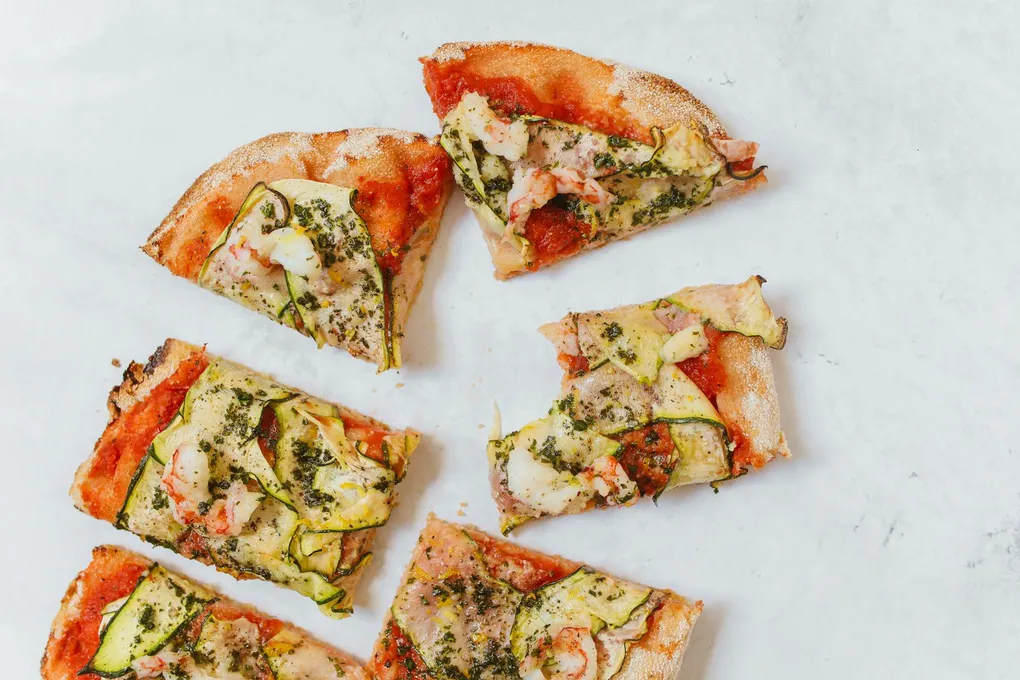
Pinsa Romana has a great story. According to the marketing, it descends from an ancient Roman flatbread — a humble peasant food made from mixed grains, baked on hot stones, stretching back centuries before pizza existed. It sounds wonderful. It’s also almost certainly made up.
That doesn’t mean pinsa isn’t worth eating. The technique behind it — high-hydration, multi-flour, long-fermented dough shaped into an oblong oval and baked until crisp and airy — produces genuinely excellent results. But you deserve to know what you’re actually buying before you pay a premium for it.
The Origin Story (and Why It Doesn’t Hold Up)
The pinsa narrative goes something like this: ancient Romans mixed wheat, millet, barley, and spelt with herbs, then baked the dough on hot stones or ashes. The word “pinsa” comes from the Latin pinsere, meaning “to stretch” or “to press.” Therefore, pinsa is older than pizza, more authentic, and more digestible.
The problem is that virtually all of this traces back to a single company: Di Marco, which trademarked the concept and developed the proprietary flour blend in the early 2000s. There is no continuous tradition of “pinsa” as a distinct Roman food. Nathan Myhrvold, whose Modernist Pizza team visited 255 pizzerias across 20+ countries and baked over 12,000 pizzas, classifies Pinsa Romana as explicitly not a pizza style — it fails his two-criteria test. To qualify as a style, a product must (1) affect the basic structure of the pizza and (2) be made by multiple independent pizzerias in different locations. Pinsa fails the second criterion. It’s a single-company proprietary product with a trademarked flour blend and a manufactured backstory.
This matters because the “ancient” framing is doing real commercial work. Pinsa typically sells at a premium — often 20-40% more than comparable pizza — partly justified by its supposed heritage. Restaurants that serve it are often buying pre-made dough or proprietary flour from a supply chain that traces back to one source.
What Pinsa Actually Is (and Why the Technique Works)
Strip away the marketing and you have a legitimately interesting product. Here’s what defines actual pinsa:
Multi-flour blend: The signature move. Traditional pinsa uses a combination of wheat flour, rice flour, and soy flour. The rice flour contributes crispness and lightness (rice starch gelatinizes differently than wheat starch, creating a more shatteringly crisp texture). The soy flour adds protein and helps with browning. Some versions also incorporate spelt or other ancient grains.
High hydration (80%+): This is significantly wetter than most pizza doughs. For comparison, Neapolitan dough runs 55-65% hydration, New York sits around 62-64%, and even Roman al taglio — the closest pizza relative — typically stays at 75-80%. Pinsa pushes past 80%, which demands either significant handling skill or (more commonly) a long autolyse and extended fermentation to make the dough manageable.
Extended cold fermentation (72-96 hours): The dough ferments in the refrigerator for at least 72 hours, often longer. This isn’t unique — Gemignani prescribes a minimum 24-hour cold ferment and prefers 48, and many pizzerias use 48-72 hour doughs. But pinsa’s 72-96 hour standard is at the upper end. The cold fermentation science is real: at refrigerator temperatures, yeast drops to roughly 10% activity while enzymes retain 40-50%. Amylase continues converting starch to sugars (more Maillard browning), protease breaks down gluten (more extensibility), and the result is genuinely more complex flavor and a more tender crumb.
Oval shape: Pinsa is oblong, not round. This is partly practical — high-hydration doughs are harder to shape into perfect circles — and partly an identity marker. The shape also means pinsa typically has a larger surface-area-to-volume ratio than a round pizza of equivalent weight, which affects the crust-to-topping balance.
Cold-pressed (not stretched): Rather than stretching by hand or tossing like pizza, pinsa dough is pressed outward on an oiled surface. The pressing technique dimples the dough similarly to focaccia, which helps create the characteristic irregular crumb with large and small air pockets coexisting.
The Digestibility Claim
Pinsa marketing frequently claims superior digestibility — the long fermentation and multi-flour blend supposedly make it easier on your stomach than regular pizza. Let’s separate fact from marketing.
What’s true: Long cold fermentation does increase enzymatic breakdown of complex proteins and starches. Protease activity produces free amino acids. Phytase activity (documented by Masi’s scientific research) reduces phytic acid, genuinely improving bioavailability of minerals like calcium, magnesium, iron, and zinc. These are real nutritional benefits shared by any well-fermented dough, not unique to pinsa.
What’s unproven: Myhrvold’s team found no scientific evidence supporting the broader Italian claim that low-yeast, long-fermented dough is inherently “more digestible.” As they noted, yeast dies during baking — the amount used is irrelevant to digestion of the finished product. The digestibility benefits of fermentation come from the enzymatic processes, which depend on time and temperature, not on whether you call it “pinsa” or “pizza.”
The honest framing: A 72-hour cold-fermented pizza dough has the same fermentation-derived benefits as 72-hour pinsa dough. The multi-flour blend may offer marginally different nutritional profiles (rice flour is naturally gluten-free in isolation, soy adds complete protein), but these differences are modest in the context of a finished dish loaded with cheese and toppings.
How to Make Pinsa at Home
If you want to try the technique — and it does produce a genuinely different texture from standard pizza — here’s how to approach it.
The Flour Blend
A common home adaptation:
| Flour | Percentage | Purpose |
|---|---|---|
| Bread flour (13-14% protein) | 60% | Structure and gluten network |
| Rice flour | 25% | Crispness, lightness |
| Soy flour | 10% | Browning, protein |
| Spelt flour | 5% | Flavor complexity |
For 500g total flour: 300g bread flour, 125g rice flour, 50g soy flour, 25g spelt flour.
The bread flour provides the gluten backbone. Without it, the rice and soy flours (which contribute zero gluten) would leave you with a dough that can’t hold gas. If you’re using Italian flour, a W300-320 type (like Caputo red bag) works well — you need the strength to compensate for the non-gluten flours diluting the protein content.
The Dough
| Ingredient | Amount | Baker’s % |
|---|---|---|
| Flour blend (above) | 500g | 100% |
| Water (cold) | 410g | 82% |
| Fine sea salt | 12g | 2.4% |
| EVOO | 15g | 3% |
| Instant dry yeast | 0.5g | 0.1% |
Method:
-
Mix flour blend and water. Combine in a large bowl and stir until shaggy. Rest 30 minutes (autolyse — the flour hydrates, enzymes begin working, and the tiny amount of gluten present starts forming passively).
-
Add salt, yeast, and olive oil. Mix by hand using a pincer method (thumb and forefinger cutting through the dough) for 2-3 minutes. The dough will be extremely wet and sticky. This is correct.
-
Stretch and fold. Every 30 minutes for the first 2 hours, perform a stretch-and-fold in the bowl. Grab one side, stretch it up, fold it over the center. Rotate the bowl 90 degrees, repeat. Four folds per session. This builds structure without kneading, which is critical for a dough this wet.
-
Cold ferment. Cover tightly and refrigerate for 72-96 hours. The dough will expand significantly — use a container at least 3x the dough volume.
-
Shape. Oil your hands and a work surface generously. Gently turn out a portion of dough (about 250g for a personal-sized pinsa). Press outward with fingertips, dimpling the surface, working from the center out. Form an oblong oval about 10-12 inches long and 6-8 inches wide. Don’t try to make it perfectly even — irregularity is part of the character.
-
Bake. Preheat your oven as hot as it goes (500-550F) with a baking steel on an upper rack for at least 45 minutes. Transfer the shaped pinsa to a parchment-lined peel, add toppings (go light — this is a delicate crust), and bake for 7-9 minutes until the crust is golden with dark spots and the edges are crisp.
Topping Philosophy
Pinsa toppings follow the Roman tradition: light, high-quality, not overloaded. Classic combinations include:
- Margherita: San Marzano sauce, fior di latte (torn), fresh basil (added after baking), EVOO drizzle
- Mortadella e Burrata: No sauce. Burrata added after baking, thin-sliced mortadella, pistachios, EVOO
- Cacio e Pepe: Pecorino Romano cream base, black pepper, a touch of EVOO
- Seasonal vegetables: Roasted squash, ricotta, chili flakes, honey drizzle
The key constraint: high-hydration dough is structurally more delicate. Overtop it and it collapses. Gemignani’s universal rule applies with even more force here — use about half the toppings you think you need.
Pinsa vs. Roman Al Taglio: The Real Comparison
The closest legitimate pizza style to pinsa is Roman al taglio (pizza by the cut) — specifically the Bonci-style variant. Both use high-hydration dough (75-80%+ for al taglio, 80%+ for pinsa), long cold fermentation, olive oil enrichment, and rectangular/oblong shapes baked in or on pans.
The actual differences:
| Pinsa | Roman Al Taglio | |
|---|---|---|
| Flour | Multi-flour blend (wheat/rice/soy) | Wheat only (strong flour, W300+) |
| Hydration | 80%+ | 75-80% |
| Fermentation | 72-96 hours cold | 48-72 hours cold |
| Shape | Oblong oval, individual-sized | Large rectangular sheets, cut to order |
| Shaping | Pressed/dimpled | Stretched in pan |
| Crust character | Lighter, crispier (rice flour effect) | Airier, breadier |
| Tradition | ~2000s, single-company origin | Decades-old Roman bakery tradition |
Al taglio is a recognized style made by hundreds of independent pizzerias across Rome and worldwide. Myhrvold documents two distinct sub-styles (Iezzi-style with toppings baked on, Bonci-style with toppings added after prebaking). It has genuine lineage. Pinsa borrows heavily from al taglio’s playbook while adding the multi-flour twist and the origin myth.
The Verdict
Pinsa Romana is a marketing invention wrapped around a legitimate technique. The ancient Roman backstory is fabricated. The digestibility claims are exaggerated. The premium pricing is hard to justify when the same fermentation benefits exist in any well-made long-ferment dough.
But the product itself — high-hydration, multi-flour, 72+ hour fermented, pressed into an irregular oval — is genuinely good. The rice flour creates a distinctly crisp, light texture that standard wheat-only doughs don’t achieve. The extended fermentation produces complex flavor. The oval shape and dimpled surface are fun to make and eat.
Make it because you like the technique and the texture. Don’t make it because a Roman peasant told you to.
Sources: Myhrvold & Migoya, Modernist Pizza Vol 1 (style taxonomy and classification criteria); Masi, Romano & Coccia, The Neapolitan Pizza (fermentation science, enzyme activity); Forkish, The Elements of Pizza (hydration-oven matching, cold fermentation); Gemignani, The Pizza Bible (hydration philosophy, topping management).