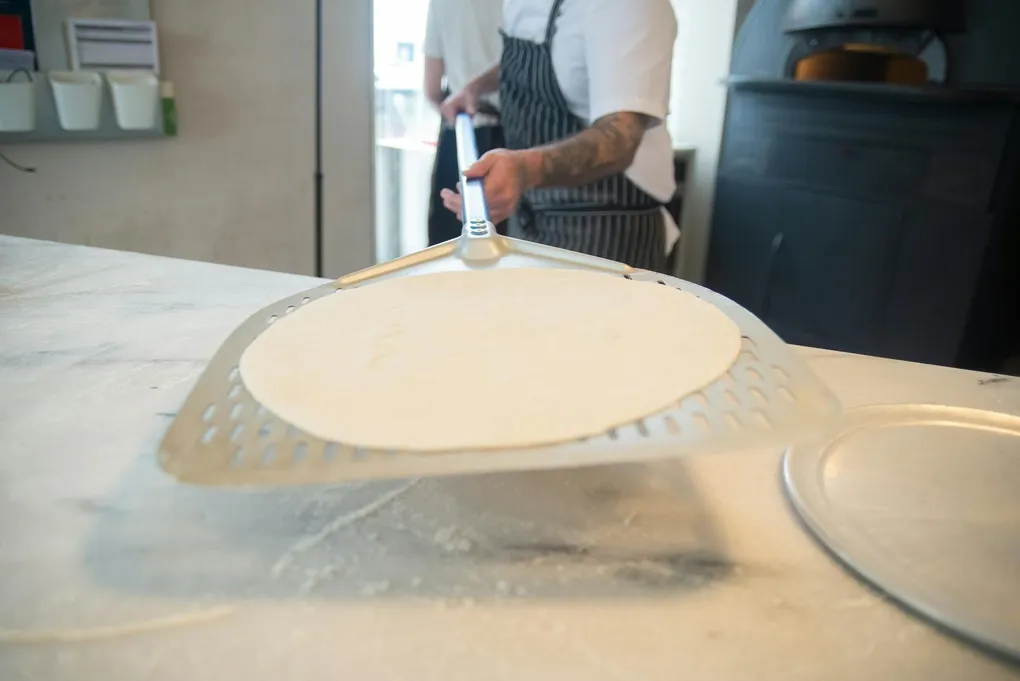
This is the gateway recipe. If you’ve never made pizza dough before, or if every recipe you’ve tried felt like too many steps, too many ingredients, or too much babysitting — start here.
The concept is dead simple: mix four ingredients at night, put the bowl in the fridge, and bake pizza tomorrow evening. No kneading machine. No preferments. No elaborate fold schedules. No checking on the dough every hour. You go to sleep, you go to work, you come home, and your dough is ready.
The reason this works isn’t a trick — it’s science. Time replaces effort. A tiny amount of yeast, given 12-24 hours in a cold environment, does everything that aggressive kneading, warm proofing, and large yeast doses try to accomplish in 2-3 hours. It just does it better.
Why Overnight Dough Is Better Than Quick Dough
This is not a compromise recipe. Overnight dough is genuinely superior to same-day quick dough, for three specific reasons:
1. Flavor Development
At refrigerator temperature (38-40F), yeast drops to about 10% of its room-temperature activity. But the enzymes naturally present in flour — amylase, protease, lipase — retain 40-50% of their activity. This means enzymes are working 4-5 times harder relative to yeast than they would at room temperature.
What the enzymes produce: amylase converts starch into simple sugars (more Maillard browning, more complex crust flavor). Protease breaks proteins into free amino acids (umami, extensibility). Lipase breaks fats into fatty acids (subtle flavor complexity). Over 24-48 hours, this process creates more than 50 distinct flavor compounds that simply don’t exist in a quick dough. Forkish, Gemignani, and Masi all converge on this point: long fermentation is the single most impactful variable in pizza dough quality.
2. Better Texture
Protease gradually weakens the gluten network during cold fermentation. This is a good thing for pizza. Gluten that’s too tight and organized produces chewy, elastic crust that fights stretching and snaps back. Gluten that’s been gently degraded by protease over 24 hours produces dough that stretches willingly, shapes easily, and bakes into a delicate crust — what Forkish calls “ethereal” and “weightless.”
The practical effect: overnight dough is dramatically easier to stretch than same-day dough. It doesn’t snap back. It doesn’t tear. It relaxes under your hands and does what you want.
3. Better Browning
Amylase unlocks sugar from starch reserves during the long cold ferment. Flour contains only about 0.5% free sugars naturally — not enough for significant Maillard reaction in a home oven at 500-550F. After 24 hours of enzymatic activity, the free sugar content is substantially higher. More available sugars plus more free amino acids equals more Maillard reactants. Your crust browns better, with more complex flavor, at the same oven temperature.
This is why Gemignani uses diastatic malt powder in his doughs — it adds amylase to accelerate this process. With overnight dough, you get much of the same benefit naturally, no malt required.
The Recipe
This makes three 12-inch pizzas, enough for 2-3 people.
| Ingredient | Amount | Baker’s % |
|---|---|---|
| Bread flour (12.5-14% protein) | 500g | 100% |
| Water (cool, 65-70F) | 325g | 65% |
| Fine sea salt | 13g | 2.6% |
| Instant dry yeast | 0.8g | 0.16% |
Total dough weight: ~839g, divided into three balls of ~280g each.
Why These Numbers
Bread flour, not 00. Italian 00 flour (W220-270) was designed for 800F+ ovens where the bake finishes in 60-90 seconds, before the weaker gluten has time to matter. In a home oven at 500-550F with a 7-8 minute bake, 00 flour often produces pale, structurally weak crust. Bread flour at 12.5-14% protein provides the stronger gluten network that holds up during a longer bake, plus it’s readily available at any grocery store. King Arthur Bread Flour is a reliable choice.
65% hydration. This is the workable sweet spot for beginners. Wet enough to produce good texture and oven spring, dry enough to handle without frustration. Forkish’s home oven recipes run 70%, which produces excellent results but can intimidate a first-timer. Gemignani’s sweet spot is 60-70%, and he calls anything above 70% “a mess” for home bakers. At 65%, you get a dough that’s slightly tacky but not sticky, shapes easily, and slides off a peel without drama.
0.16% yeast. This is tiny — less than a gram. You need a precision scale (a $13 investment that will transform your baking). The small yeast dose is the key to the whole method. It produces enough CO2 to leaven the dough over 12-24 hours but not enough to blow out the structure. Forkish’s FWSY overnight straight dough uses 0.08% IDY — even less. His 24-48 hour cold retard from Elements uses 0.3%. Our 0.16% gives a flexible window: the dough is good from 12 hours and great through 36 hours.
2.6% salt. Higher than the standard 2% in most bread recipes, but squarely in the pizza range. Neapolitan pizzerias use up to 3% because salt slows fermentation — important when dough sits at room temperature all day without refrigeration. At 2.6%, you get good flavor and moderate fermentation control without making the dough taste salty. Myhrvold advises against varying salt for fermentation control (adjust yeast instead), but this percentage is chosen primarily for flavor.
Method
Night (10 minutes of work):
-
Weigh flour into a large bowl or 6-quart dough tub.
-
Add yeast to the flour and stir briefly to distribute. With amounts this small, you want the yeast dispersed through the flour before water goes in.
-
Add water. Stir with a wooden spoon or your hand until all flour is incorporated. The dough will be shaggy and rough — that’s fine. You’re not kneading.
-
Add salt. Mix another 30 seconds until the salt is distributed.
-
Wet your hands. Reach under the dough, stretch it up, fold it over itself. Rotate the bowl 90 degrees, repeat. Do this 8-10 times (about 1 minute). This isn’t kneading — it’s light folding that begins organizing the gluten.
-
Cover tightly with plastic wrap or a lid.
-
Let sit on the counter 30 minutes. Then put it in the refrigerator.
That’s it. Go to bed.
Next day (30 minutes before baking):
-
Remove the dough from the fridge. It should have expanded noticeably — perhaps 50-75% larger than when you put it in. You should see some bubbles on the surface and around the edges.
-
Turn the dough onto a lightly floured surface. Divide into three equal pieces (~280g each). Shape each piece into a tight ball: pull the edges toward the center, flip seam-side down, and use cupped hands to drag the ball gently across the counter, tucking the bottom under.
-
Place balls on a floured surface or sheet pan. Cover with plastic wrap or a damp towel.
-
Rest at room temperature for 30-60 minutes. This temper step is important — cold dough is tight and will tear if you try to stretch it immediately. Gemignani makes this his fifth commandment: “Never put cold dough in a hot oven.” Cold dough also produces large, uneven bubbles in the first few minutes of baking.
-
While the dough tempers, preheat your oven to its maximum temperature (500-550F) with a baking steel or stone on an upper rack. Preheat for at least 45 minutes — the oven beeping “ready” only means the air is hot. The steel needs much longer to saturate with heat.
-
Stretch, top, and bake.
Flexing the Timing Window
The beauty of this dough is its flexibility. By adjusting the yeast amount, you can stretch or compress the window of usability:
| Yeast (IDY) | Baker’s % | Ready After | Peak Window | Still Usable |
|---|---|---|---|---|
| 0.5g | 0.10% | 18-20 hours | 24-36 hours | Up to 48 hours |
| 0.8g | 0.16% | 12-14 hours | 16-30 hours | Up to 36 hours |
| 1.2g | 0.24% | 10-12 hours | 12-24 hours | Up to 30 hours |
| 1.5g | 0.30% | 8-10 hours | 10-20 hours | Up to 24 hours |
The principle: Less yeast means a wider, more forgiving window. More yeast means faster readiness but narrower peak. If you’re mixing at 10pm and baking at 6pm the next day (20-hour gap), 0.8g is perfect. If you need pizza tomorrow at lunch (14 hours), use 1.2g. If you want maximum flexibility and don’t mind planning two days ahead, use 0.5g and let it ride 24-36 hours.
Forkish’s FWSY overnight straight uses just 0.8g for 1000g of flour (0.08%), which gives a very long window — 18+ hours before peak. His 24-48 hour cold retard from Elements uses 1.5g for 500g flour (0.30%), designed to peak between 24 and 48 hours after mixing.
What If Life Gets in the Way?
One of the biggest advantages of cold-fermented dough: it’s resilient.
You planned to bake at 6pm but dinner plans changed. Leave the dough in the fridge. It will still be good tomorrow. If you used 0.8g yeast, the dough is comfortably usable through 36 hours after mixing.
The dough looks like it doubled overnight. It’s fine. Cold fermentation is much more forgiving than room-temperature proofing. A dough that has doubled in the fridge has plenty of gas but hasn’t exhausted its structural integrity. Ball it, temper 30-60 minutes, and bake normally.
The dough looks like it barely rose. Also fine. Cold dough rises slowly. As long as it shows some expansion and a few bubbles, the fermentation happened. The remaining rise will occur during the room-temperature temper and in the oven (oven spring). If it truly hasn’t risen at all after 16+ hours, your yeast was likely dead — check the expiration date.
You forgot to ball the dough before work. No problem. Ball it when you get home. Give it 30-60 minutes of counter rest to relax and temper before stretching.
Scaling Up and Down
This recipe scales linearly. Use the baker’s percentages to calculate any quantity:
| Pizzas | Flour | Water (65%) | Salt (2.6%) | Yeast (0.16%) |
|---|---|---|---|---|
| 2 | 333g | 217g | 9g | 0.5g |
| 3 | 500g | 325g | 13g | 0.8g |
| 4 | 667g | 434g | 17g | 1.1g |
| 6 | 1000g | 650g | 26g | 1.6g |
For larger batches (6+ pizzas), consider the logistical challenge: all dough balls reach peak readiness at roughly the same time, but your oven can only bake one pizza every 7-10 minutes. Stagger readiness by balling half the dough early and half later, or by keeping some balls in the fridge (cooler = slower) while others temper on the counter. For scaling larger pizza parties, see our guide to scaling pizza dough.
Variations Worth Trying
Once you’re comfortable with the basic overnight dough, small modifications open up new territory:
Add 2% olive oil (10g per 500g flour). Oil inhibits gluten slightly, producing a more tender crust. It also adds richness and improves the dough’s shelf life in the fridge. Add the oil after the initial mix, during the folding step. Note: Forkish deliberately omits oil from his FWSY doughs for maximum crispness.
Add 1% diastatic malt (5g per 500g flour). Malt powder contains enzymes that break starch into sugars, boosting Maillard browning in your home oven. Gemignani uses 2% diastatic malt as a standard ingredient in his master dough. For overnight dough, 1% is enough — the long ferment already generates extra sugars. Omit malt if you’re baking above 650F (unnecessary at those temperatures — browning happens automatically).
Use 00 flour if baking in a portable oven. The whole reason we specified bread flour is home-oven performance. If you own an Ooni, Roccbox, or other oven reaching 700F+, switch to Caputo Pizzeria (blue bag, W260-270) and reduce hydration to 60-62%. The faster bake retains more moisture, so you need less water in the dough.
Add a preferment. Replace 20% of the flour and its corresponding water with a poolish (equal parts flour and water, fermented 12-18 hours with a pinch of yeast). This adds flavor complexity beyond what the straight overnight method achieves. But at that point, you’ve left “simplest recipe” territory.
The Bottom Line
This recipe exists to prove a point: excellent pizza dough doesn’t require skill, equipment, or time spent hovering over a bowl. It requires flour, water, salt, a tiny amount of yeast, and patience measured in hours of sleeping and working. The cold and the time do the work.
Every major pizza authority agrees on this. Gemignani’s core prescription: “From today on, I want you to make pizza dough that rises in the refrigerator for at least 24 hours — preferably 48 hours.” Forkish built his entire approach around the principle that time is an ingredient. Masi’s scientific research demonstrates that cold fermentation enables enzymes to produce complexity that no amount of kneading or warm-proofing can replicate.
Mix it tonight. Bake it tomorrow. That’s all there is to it.
Sources: Forkish, Flour Water Salt Yeast (overnight straight dough, 0.08% IDY); Forkish, The Elements of Pizza (24-48hr cold retard, hydration-oven matching); Gemignani, The Pizza Bible (core cold-ferment prescription, diastatic malt, master dough formulas); Masi, Romano & Coccia, The Neapolitan Pizza (cold fermentation enzyme science, maturation vs. fermentation); Myhrvold & Migoya, Modernist Pizza Vol 1 (yeast by fermentation strategy, poolish timing).