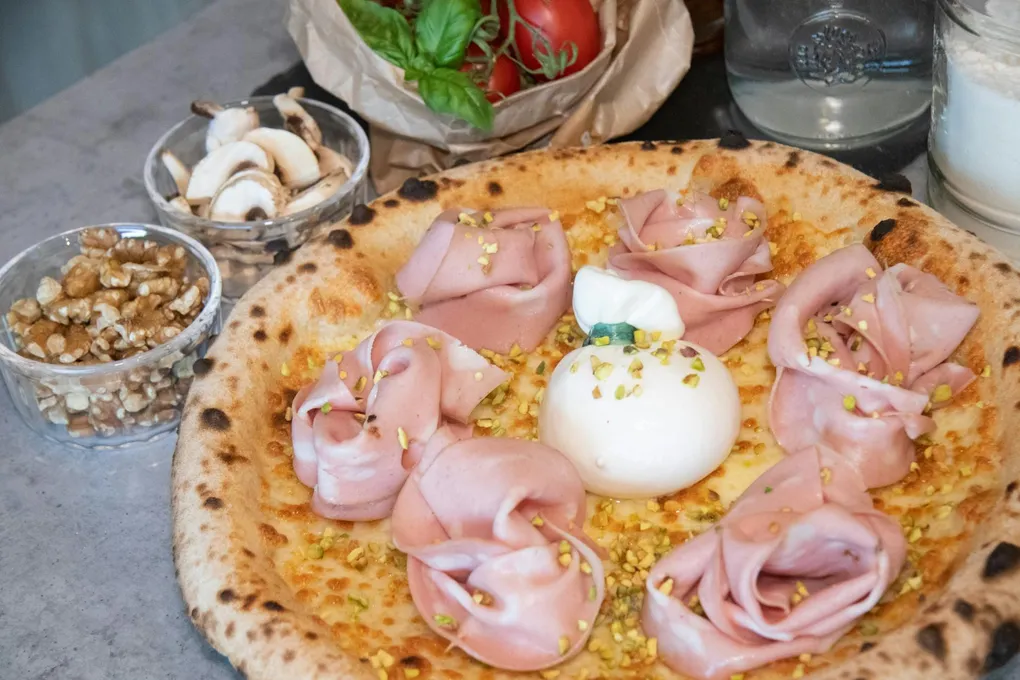
Neapolitan pizza is the only pizza style with a government-approved certification. The Associazione Verace Pizza Napoletana (AVPN) and the European Union’s Traditional Specialty Guaranteed (TSG) designation lay out precise rules for ingredients, mixing, fermentation, oven type, and baking. It’s a beautiful framework. It’s also mostly fiction.
Nathan Myhrvold’s team visited 255 pizzerias across 20+ countries and surveyed AVPN-certified shops directly. Their finding: not a single certified pizzeria in Naples followed all the rules. The AVPN definition, they concluded, was “more aspirational than actual — a committee invention, not historical documentation.” It specified upmarket changes (fior di latte, DOP San Marzano) that weren’t what was actually being served at the pizzerias it claimed to represent.
That’s actually great news for you. It means making excellent Neapolitan pizza at home is less about compliance and more about understanding the principles. Here’s what actually matters.
What the AVPN Spec Says (And Where It Bends)
The official TSG standard (EU Reg. 97/2010) defines Neapolitan pizza with remarkable specificity:
- Flour: Tipo 00, W 220-380, P/L ratio 0.50-0.70
- Hydration: 50-60% of flour weight
- Salt: Dissolved in water before adding other ingredients
- Yeast: 0.17% of flour (about 3g per 1.7-1.8kg flour)
- Mixing: 20 minutes in a fork mixer at low speed
- Bulk ferment: 2 hours at 25C
- Dough balls: 180-250g each, hand-divided
- Second ferment: 6-12 hours at 15-20C (usable after 4 hours)
- Shaping: By hand only — no rolling pin, no mechanical press
- Center thickness: Maximum 0.4cm (with 10% tolerance)
- Oven: Wood-fired, semispherical dome, refractory brick, floor at 400C, dome at 450-470C
- Bake time: 60-90 seconds
In practice, Naples pizzerias deviate freely. Ciro Salvo at 50 Kalo uses 70% hydration and more than 3% salt. Pizzeria da Attilio runs at 62.5% hydration with 3.13% salt. Enzo Coccia at La Notizia forms dough balls just 10-20 minutes after mixing and lets them proof for 10+ hours. These are among the most celebrated pizza makers in Naples, and none of them follow the published spec exactly.
The Home Oven Reality
Your home oven maxes out around 550F (290C). A Neapolitan wood-fired oven runs at 905F (485C). This isn’t a minor difference — thermal radiation follows the T-to-the-fourth power law, meaning a 400C oven produces 16 times more radiant heat than a 200C oven. The baking experience is qualitatively different, not just faster.
This single constraint — oven temperature — cascades into everything else. Here’s what changes and why.
Hydration: 70%, Not 58%
AVPN specifies 55-59% hydration. That’s perfect for a 60-90 second bake where the crust sets almost instantly and there’s barely time for moisture to escape. In your 550F oven, pizza bakes for 7-8 minutes. That’s roughly 7x longer, and the dough loses vastly more water through evaporation.
Forkish’s home Neapolitan recipes use 70% hydration to compensate. The extra water produces a crust that’s soft and foldable in the center (like authentic Neapolitan) rather than stiff and dry. If you use AVPN’s 58% dough in a home oven, you’ll get something closer to a cracker than a pizza.
Myhrvold’s testing confirms the range: their Neapolitan master recipe settled at approximately 65% hydration, with 55% producing “modeling clay” and 70% as the maximum before dough lost elasticity.
Flour: Strong 00 or Bread Flour
In a 60-second Neapolitan bake, weaker flour (W220-270, 11-12% protein) works perfectly because the crust doesn’t bear load for long. In a 7-minute home bake, the gluten network holds weight much longer. Stronger flour outperforms.
For home ovens, reach for Caputo Cuoco/Saccorosso (red bag) at W300-320 and 13-13.5% protein, or Caputo Americana at W360-380, which includes malt for browning at lower temperatures. King Arthur Bread Flour (12.7% protein) also works well.
If you want to use traditional Caputo Pizzeria (blue bag), add 0.5-1% diastatic malt powder to compensate for the lack of browning at 550F. Italian 00 is unmalted by design — it was engineered for ovens where Maillard reaction happens nearly instantly.
Three Home Oven Methods
Every serious pizza authority has a preferred home oven approach. Here are the three that work, matched to the equipment you have.
Method 1: Steel + Broiler (Forkish)
Place a baking steel on the rack 6-8 inches below your broiler element. Preheat the oven at maximum (500-550F) for 45-60 minutes, then switch to broiler on high. Launch your pizza onto the steel. The steel provides bottom heat through conduction; the broiler provides top heat through radiation. Bake 7-8 minutes, rotating once. This is the most reliable method and the one Forkish built his home recipes around.
Method 2: Two-Stage Bake (Iacopelli)
Steel on the top rack. Preheat at broil for 30-40 minutes after the oven reaches target temperature, then switch to static bake at maximum just before launching. First bake: sauce and olive oil only, until the crust is golden and puffed. Remove, brush olive oil on the crust edges, add mozzarella and toppings. Second bake until cheese melts. Total: 7 minutes maximum.
This method exists because home ovens cook slowly enough that cheese burns or overcooks before the crust finishes if everything goes on at once. The two-stage approach gives you the charred-edge cornicione and bubbly cheese that define Neapolitan without the soggy-center compromise.
Method 3: Skillet-Broiler (Lopez-Alt)
Preheat a cast iron skillet on the stovetop for 3 minutes over high heat. Shape a 10-inch dough, top it, transfer to the skillet. Slide under the broiler for 90 seconds to 4 minutes (rotate after 45 seconds). Return to the stovetop for 30 seconds to 2 minutes to char the bottom. This method produces what Lopez-Alt describes as “baby leopard spots, bubbles starting to char, the puff of a cornicione” — and you don’t need a baking steel or pizza peel.
The Dough
Forkish’s 24-48 Hour Cold Retard is his most-used recipe and perfectly suited for home Neapolitan:
- 500g 00 flour (or bread flour)
- 350g water (70% hydration)
- 13g salt (2.6%)
- 1.5g instant dry yeast
Mix by hand using the pincer method (2-3 minutes), rest 15-20 minutes, brief knead (30 seconds to 1 minute). Bulk ferment 2 hours at room temperature. Divide into three dough balls (about 230g each for 10-12 inch pizzas). Refrigerate 16-48 hours.
Pull dough balls from the fridge at least 1-2 hours before baking to temper. Gemignani is absolute on this point (Commandment #5): never put cold dough in a hot oven. Cold dough produces large, irregular bubbles in the first 2-3 minutes that wreck the cornicione. Target 60-65F internal temperature before stretching.
For deeper flavor complexity, try Forkish’s Overnight Levain dough (his personal favorite) or his 48-72 Hour Biga dough, which adds a stiff pre-ferment for acidity and depth.
Shaping: Hands Only
The TSG standard is right about one thing: no rolling pin, no mechanical press. These tools crush the gas structure that creates the puffy, leopard-spotted cornicione.
Start with a mature, relaxed dough ball on a floured surface. Decompress gently from the center outward, leaving the outer inch untouched — that rim becomes the cornicione. The air stays in the edge while the center gets thin.
Forkish teaches a fingertip press from center outward, then gravity-stretching over the knuckles. Iacopelli uses a counter-supported method: flat palms press the center (no stretching, just pressing air toward edges), then a rapid pull-and-rotate where one hand anchors near the rim while the other pulls the opposite edge outward 1-2 inches, rotating slightly with each pull. His dough stays on the counter the whole time — more control for wet, fragile dough. For a full walkthrough of both techniques, see how to stretch pizza dough.
Target 10-12 inches in diameter. The center should be thin enough that you can almost see your hand through it (Masi specifies 0.4cm maximum), with a raised, airy rim 1-2cm wide.
Toppings: The Neapolitan Principle
Less is more. Neapolitan pizza uses far less cheese and fewer toppings than American styles. The focus is on quality ingredients applied with restraint.
Sauce: Hand-crush whole peeled San Marzano tomatoes with salt. That’s it. No cooking — the oven cooks the sauce. Forkish, Gemignani, and Iacopelli all agree that no-cook sauce is the default for Neapolitan. The sauce should be thin enough that you can see the dough through it in places.
Cheese: Fresh mozzarella (fior di latte), cut into thin pieces or torn into chunks. For home ovens with the single-stage method, add cheese 4 minutes into the bake so the final texture resembles true Neapolitan. For the two-stage method, cheese goes on during the second bake. If using fresh mozzarella, Iacopelli recommends cutting it the night before and draining in a colander in the fridge — excess moisture causes soggy centers during the longer home bake.
Oil: A drizzle of extra virgin olive oil before baking. Masi’s research shows EVOO is stable during the bake (won’t reach smoke point even at 380-400C in a 60-90 second window), though about 30% of phenolic compounds are lost. For maximum flavor, add another drizzle after baking.
Basil: Always after baking. Fresh basil’s volatile oils flash off above 350F — adding it before the bake gives you wilted green matter with no fragrance.
The “Rest of Italy” Alternative
If you find true Neapolitan style too floppy, too wet, or too minimalist, know that most Italians outside Naples actually prefer something different. Myhrvold describes “rest-of-Italy Neapolitan” or classico style: crispier crust, more browning, less leoparding, baked at slightly lower temperatures. This is what the majority of top-rated Rome pizzerias serve. It has a lot in common with the best American artisan pizzerias.
In a home oven, this style is arguably easier to achieve. Drop hydration to 65%, use bread flour, bake 8-9 minutes for a more thorough crust set, and don’t stress about leopard spots. You’ll end up with something most Italians would recognize as excellent pizza.
What You’re Actually Aiming For
A successful home Neapolitan pizza has:
- A puffy rim with visible air bubbles and dark brown to black char splotches. The cornicione should sound hollow when tapped.
- A soft, foldable center that’s fully baked but not dry. Each slice flops from rim to tip when held.
- Leopard spots on the underside — dark brown marks from contact with the hot baking surface. These are Maillard reaction products and direct char, not burning.
- Cheese that’s fully melted but not burned and not separated into greasy pools.
- Sauce that’s bright, with the fresh tomato flavor still intact.
You won’t replicate a 60-second wood-fired bake in a home oven. But you can produce pizza that’s closer to what actual Neapolitan pizzerias serve than the AVPN rules would suggest — because the best pizzerias in Naples don’t follow the rules either.