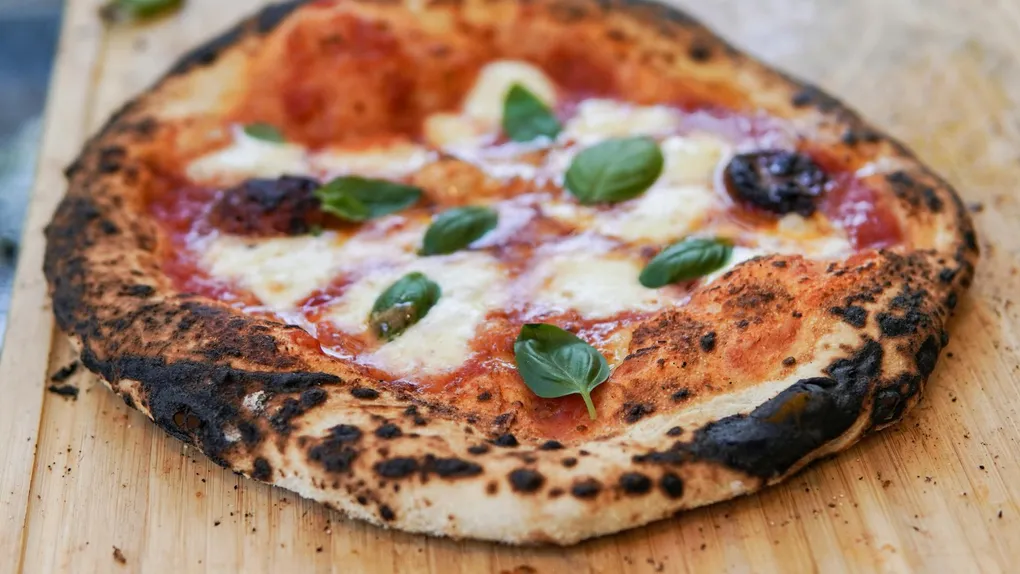
Every time you pull a pizza from the oven, you’re looking at the results of two completely different chemical reactions happening simultaneously on the same surface. The golden-brown crust, the dark spots on the cornicione, the charred edges of a pepperoni slice, the browned cheese — all of it involves browning, but not all browning is the same.
The Maillard reaction and caramelization are distinct chemical processes with different triggers, different temperature thresholds, different reactants, and different flavor outputs. Understanding which one is doing what on your pizza explains why cold-fermented dough browns better, why sugar in New York dough works, and why diastatic malt powder is the most underrated ingredient in home pizza baking.
The Maillard Reaction: Where Savory Complexity Comes From
The Maillard reaction is not a single reaction — it’s a cascade of hundreds of chemical reactions between amino acids (from proteins) and reducing sugars (simple sugars like glucose, fructose, and maltose). It was first described by French chemist Louis-Camille Maillard in 1912 and remains one of the most complex processes in food science.
The Mechanism
Masi et al. (The Neapolitan Pizza) describe the Maillard cascade in three stages:
Stage 1 — Schiff Base Formation: An amino acid’s NH2 group reacts with a reducing sugar’s carbonyl group, forming an unstable intermediate called a Schiff base. This happens relatively quickly and is essentially the “ignition” of the reaction. No color change yet.
Stage 2 — Amadori Rearrangement: The Schiff base rearranges into a more stable Amadori product. This intermediate compound is a branching point — it can proceed down multiple reaction pathways depending on temperature, pH, and water activity. Still minimal color change, but flavor precursors are forming.
Stage 3 — Advanced Glycation End Products: The Amadori products undergo further reactions — dehydration, fragmentation, polymerization — producing hundreds of different compounds. The most visible: melanoidins, the large brown-to-black pigments responsible for crust color. The most flavorful: a spectrum of volatile and non-volatile compounds that create the savory, complex, roasted flavors we associate with baked bread and charred pizza crust.
Among the intermediate products is hydroxymethylfurfural (HMF), an aromatic compound that contributes to the characteristic baked-bread smell. At 180C (356F), Masi notes that destarching of glutamine and asparagine liberates ammonia, which further activates the browning reaction.
What the Maillard Reaction Needs
Two reactants must be present:
-
Amino acids — from protein breakdown. Free amino acids (not bound up in intact proteins) are the most reactive. This is why fermentation matters: protease enzymes during long fermentation break proteins into free amino acids, increasing the pool of Maillard reactants.
-
Reducing sugars — glucose, fructose, maltose. Flour contains only about 0.5% fermentable sugars naturally (Masi). The rest must be unlocked by amylase enzymes breaking down starch during fermentation — or supplied directly through added ingredients like sugar, honey, or diastatic malt.
The reaction begins at approximately 280F (140C) and accelerates significantly above 300F (150C). On a pizza, it only occurs in areas with sufficiently low water content to reach those temperatures. As long as a region of the dough is wet — under sauce, under cheese, or internally hydrated — it cannot exceed 212F (100C) and the Maillard reaction cannot proceed there.
This is why the cornicione and the underside are the primary sites of Maillard browning: they’re the driest parts of the pizza, able to reach the temperatures required.
Caramelization: Where Sweetness Comes From
Caramelization is simpler than the Maillard reaction. It involves sugars alone — no amino acids required. When sugars are heated above their decomposition temperature, they break down (pyrolysis), releasing water, forming new compounds, and producing brown pigments.
Temperature Thresholds by Sugar
Different sugars caramelize at different temperatures:
| Sugar | Caramelization Onset |
|---|---|
| Fructose | ~230F (110C) |
| Glucose | ~300F (150C) |
| Sucrose (table sugar) | ~320F (160C) |
| Maltose | ~356F (180C) |
Caramelization produces a different flavor profile than the Maillard reaction: nutty, butterscotch, toffee-like sweetness rather than savory complexity. On pizza, caramelization contributes the sweet undertones that balance the savory Maillard flavors — particularly noticeable in the cornicione of a well-baked Neapolitan pizza, where both reactions happen simultaneously.
Why They’re Easily Confused
Both reactions produce brown color and complex flavors. Both accelerate with higher temperatures. Both occur on the same surfaces of pizza at the same time. But they’re chemically distinct:
| Maillard Reaction | Caramelization | |
|---|---|---|
| Reactants | Amino acids + reducing sugars | Sugars alone |
| Onset temperature | ~280F (140C) | ~230-356F (110-180C) depending on sugar |
| Flavor character | Savory, roasted, complex, umami | Sweet, nutty, butterscotch, toffee |
| Color | Brown to dark brown to black | Golden to amber to dark brown |
| Requirements | Low water activity, both protein and sugar present | Low water activity, sugar present |
| On pizza | Crust, cornicione, underside, exposed cheese | Crust (where sugars concentrate), cheese edges |
On a pizza, both reactions contribute to the final color and flavor. What you taste as “perfectly baked crust” is actually a blend of Maillard savory complexity and caramelization sweetness.
Why Cold Fermentation Enhances Browning
This is where dough science meets browning chemistry, and it’s one of the most practically important connections in pizza making.
During cold fermentation (4C / 39F), yeast activity drops to approximately 10%, but enzymatic activity remains at 40-50%. Two enzyme classes do the critical work:
Amylase breaks down starch into maltose and glucose. Flour naturally contains only 0.5% fermentable sugars — amylase unlocks the starch reserves over 24-72 hours, dramatically increasing the pool of reducing sugars available for both the Maillard reaction and caramelization.
Protease breaks down proteins into free amino acids. These are the other half of the Maillard equation. More free amino acids = more Maillard reactants = deeper, more complex browning.
After a 48-hour cold ferment, your dough contains significantly more free amino acids AND significantly more free sugars than same-day dough. Both sides of the Maillard reaction equation have been loaded. This is why cold-fermented pizza crust browns deeper and develops more complex flavor than quick dough — the chemistry has been front-loaded by enzymatic action during fermentation.
The 72-hour caveat: Beyond about 72 hours, excessive acidity (from continued lactic and acetic acid production) paradoxically slows the Maillard reaction. Maillard browning is pH-sensitive — it proceeds faster in slightly alkaline conditions and slower in acidic ones. The sweet spot for maximum browning potential is 48-72 hours of cold fermentation.
Why Home Ovens Struggle with Browning
The practical problem: in a 900F Neapolitan oven, the pizza bakes in 60-90 seconds. The intense radiant heat drives the crust surface past 280F almost instantly, giving the Maillard reaction plenty of time and energy to produce deep browning and complex flavors before the pizza is done.
In a 550F home oven with a 7-8 minute bake, the dough surface heats more slowly and radiant energy is dramatically lower (T^4 power law: 400C produces 16x more radiation than 200C). The pizza can finish baking — crust cooked through, cheese melted, toppings done — before the Maillard reaction has produced meaningful color on the crust.
The result is the classic home pizza problem: structurally done but visually pale. The flavors associated with deep browning — the savory complexity, the sweet caramelization, the roasted notes — are underdeveloped.
Three Strategies for Better Home Oven Browning
Strategy 1: Diastatic Malt Powder (The Best Fix)
Diastatic malt powder is the home baker’s most powerful browning tool. It contains two things:
- Maltose — a reducing sugar that directly participates in the Maillard reaction.
- Active amylase enzymes — which continue breaking down flour starch into additional sugars during fermentation and early baking.
The effect: more reducing sugars available at bake time means the Maillard reaction starts earlier and runs further during your limited bake window. The pizza browns deeper in the same 7-8 minutes.
Gemignani uses 2% diastatic malt as a standard ingredient in his Master Dough — not as an optional additive but as a core component. His reasoning: it enhances both browning (color) and tenderness (sugars tenderize the crumb). Kenji Lopez-Alt’s New York dough formula also includes 2% diastatic malt, calling it a “key innovation.”
Myhrvold recommends 0.5-1% for general use.
Important: diastatic, not non-diastatic. Diastatic malt contains live enzymes that actively produce sugars. Non-diastatic malt is just a sweetener — the enzymes have been killed by heat during processing. For browning enhancement, you need the active enzyme version. Find it at beer-brewing supply stores (it’s a standard homebrewing ingredient).
When to omit malt: Above 650F (portable pizza ovens, high-power broiler techniques). At those temperatures, the Maillard reaction proceeds aggressively without help, and extra sugar can push browning into burning.
Strategy 2: Added Sugar
New York-style pizza dough traditionally includes 1-3% sugar (by flour weight). This is not for sweetness — it’s for browning. The sugar provides a ready supply of reducing sugars for the Maillard reaction at home oven temperatures.
This explains a style-level design decision: Neapolitan dough contains no sugar because it doesn’t need it — the 900F oven provides enough thermal energy for rapid browning. New York dough includes sugar because it’s designed for 550-600F deck ovens where browning needs chemical assistance.
Honey serves the same function and adds fructose, which caramelizes at a lower temperature (230F) than sucrose (320F) — potentially starting caramelization earlier in the bake.
Strategy 3: Cold Fermentation (Minimum 24 Hours)
As discussed above, cold fermentation loads the dough with both free amino acids and free sugars. A 48-hour cold-fermented dough at 550F will brown noticeably better than same-day dough at the same temperature, without any sugar or malt additions.
Cold fermentation and diastatic malt compound: the malt provides additional enzymes on top of the flour’s native enzymes, accelerating sugar production during the cold rest. A 48-hour cold ferment with 1-2% diastatic malt produces the maximum browning potential available to a home oven baker.
Browning on Toppings: Cheese and Meat
The Maillard reaction doesn’t just happen on the crust.
Cheese: Mozzarella browns through a combination of Maillard (casein proteins + lactose) and caramelization (lactose alone). Myhrvold observed that mozzarella actually becomes whiter initially during baking — absorbing less heat as it cooks, which is the opposite of most foods. The browning only begins after the moisture has partially evaporated from the surface. This is why cheese-topped pizza needs time: the cheese first melts, then dries, then browns. In a 60-second Neapolitan bake, cheese barely begins browning. In a 7-minute home oven bake, cheese can brown significantly — which is part of the New York style’s character.
Pepperoni: The cupping and crisping of pepperoni is a combination of Maillard browning (protein + sugar), fat rendering, and caramelization of the meat sugars. Natural-casing pepperoni cups more dramatically because the casing shrinks at a different rate than the meat — the edges curl up, exposing thin edges to more heat, which brown and crisp while the center stays moist.
Vegetables: Roasted vegetables on pizza undergo the same Maillard/caramelization browning. Pre-roasting high-moisture vegetables (mushrooms, peppers, onions) removes water, allowing their surfaces to reach browning temperatures faster during the pizza bake.
The Sugar-Browning Connection: A Summary
The quantity and type of reducing sugars available in your dough at bake time is the single biggest variable affecting browning at home oven temperatures. Here’s how each approach contributes:
| Sugar Source | Mechanism | Timing |
|---|---|---|
| Flour’s native sugars | 0.5% free sugars available immediately | From mixing |
| Amylase (flour’s native enzymes) | Breaks starch to maltose/glucose | During fermentation (accelerated by cold) |
| Diastatic malt enzymes | Additional amylase breaks more starch to sugars | During fermentation + early baking |
| Diastatic malt sugars | Maltose directly available | From mixing |
| Added sugar/honey | Sucrose/fructose/glucose directly available | From mixing |
| Protease (free amino acids) | Provides the other Maillard reactant | During fermentation (accelerated by cold) |
A quick same-day dough with no additions has minimal free sugars and minimal free amino acids — the least possible Maillard potential. A 48-hour cold-fermented dough with 2% diastatic malt has maximal free sugars from three sources (native, enzymatic, malt) and maximal free amino acids from protease — the most Maillard potential you can pack into a dough.
The difference is visible. One comes out of a home oven pale and lacking complexity. The other comes out deeply golden-brown with the full range of Maillard and caramelization flavors — in the same oven, at the same temperature, for the same bake time.