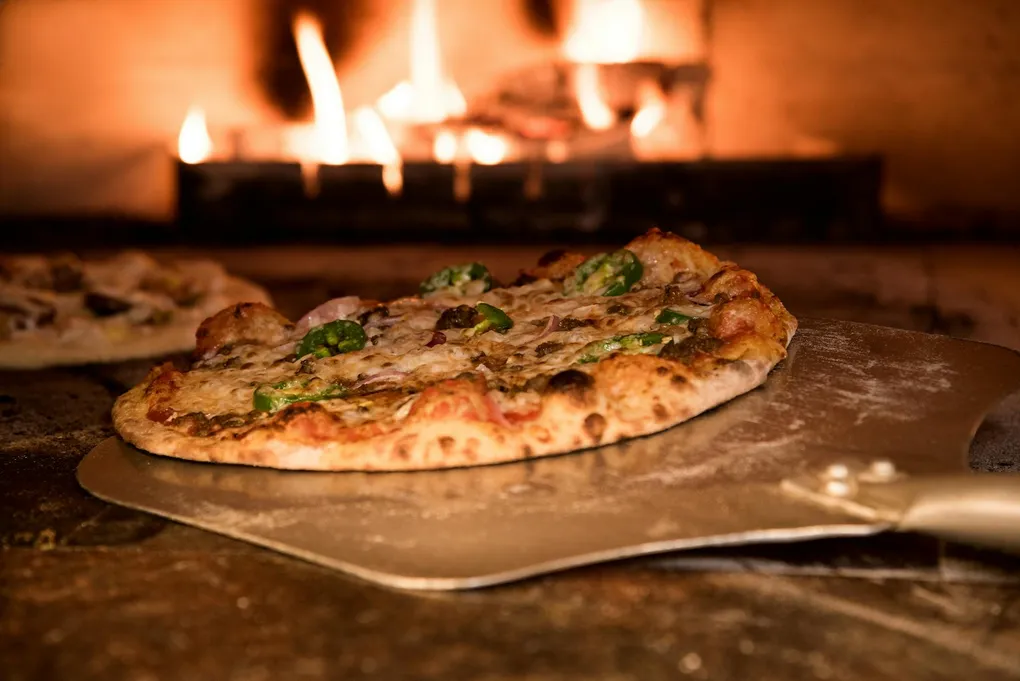
The most stressful 30 seconds in home pizza making happen between the moment you finish topping your pizza on the peel and the moment it’s sitting on the hot stone. In that window, wet dough can bond to wood, a hesitant launch can fold the pizza in half, and a second too long on the peel turns a successful build into a crumpled mess stuck to a floured board.
This isn’t about technique talent. It’s about understanding the physics of why dough sticks, choosing the right peel and dusting material for your oven, and developing a consistent launch-and-turn protocol. Here’s how to make the transfer reliable every time.
Why Dough Sticks to the Peel
There are exactly three reasons your pizza sticks:
1. Moisture broke through the dusting barrier. When wet sauce or high-hydration dough sits on a peel, moisture migrates downward through the flour or semolina layer. Once water reaches the peel surface, it creates adhesion. The clock starts ticking the moment the dough touches the peel — you have roughly 60 seconds before moisture penetrates a semolina barrier and longer (but not unlimited) time with flour.
2. Insufficient dusting material underneath. Not enough flour or semolina between dough and peel. This is the simplest failure mode and the simplest to fix.
3. Over-proofed dough. Dough that’s past peak fermentation is slack, wet, and sticky regardless of how much you dust. If the dough is sticking to everything despite adequate flour, the problem is upstream — the dough is over-fermented, not under-dusted.
The fix for all three is the same protocol: dust generously, build fast, test before committing, and never let a topped pizza sit on the peel.
The Jiggle Test: Your Pre-Launch Safety Check
Before you even think about heading toward the oven, do this:
Grip the peel handle and give it a quick lateral shake — a sharp jiggle side to side. The entire pizza should slide freely on the peel surface, moving as one unit. If any part of the pizza is stuck, you’ll see it grab or bunch up during the jiggle.
If it passes: Proceed to launch.
If it sticks: Lift the stuck edge gently with your fingertips or a bench scraper and blow or sprinkle additional dusting material underneath. Re-test. If it still sticks, the situation is getting worse (more moisture is transferring every second). You may need to slide a bench scraper under the entire pizza and transfer it to a freshly dusted peel.
Gemignani calls this the pre-launch check. Iacopelli calls it the “hovercraft test.” The name doesn’t matter — just never skip it.
Dusting Materials: Flour, Semolina, or Both
The right dusting material depends on your oven temperature.
For Portable Pizza Ovens (800-950F)
Semolina is the gold standard. The coarse, granular particles act as “mini ball bearings” between dough and peel — they roll rather than compress, maintaining separation even under the weight of a topped pizza.
Regular flour burns at 800F. Fine white flour ignites on a 900F stone, producing bitter, acrid smoke that flavors the pizza and fills your cooking area. This is the single most common dusting mistake with portable ovens.
The professional move: 50/50 blend of fine semolina and flour. Gemignani’s standard: “You can’t err on the side of overdusting.” The blend gives you both the ball-bearing effect (semolina) and the moisture-absorbing properties (flour).
Rice flour as insurance: For very wet, high-hydration doughs (70%+), some bakers add rice flour to the blend. It absorbs moisture aggressively and won’t burn as readily as wheat flour. Useful for Neapolitan doughs at the upper end of the hydration spectrum.
For Home Ovens (500-550F)
Semolina, flour, or a 50/50 blend all work. At home oven temperatures, flour doesn’t burn — it just toasts. The choice is more about texture preference: semolina leaves a slightly gritty, cornbread-like bottom; flour leaves a smoother finish; the blend splits the difference.
Forkish’s approach: Use the same flour that’s in the dough — nothing else. No semolina, no cornmeal. His reasoning: it integrates seamlessly with the crust rather than leaving a distinct layer.
Cornmeal: Not Recommended
Cornmeal works (it creates separation) but has drawbacks at high temperatures. It burns readily in portable ovens, producing a gritty, bitter residue on the stone surface. Even in home ovens, the large particles leave a noticeable texture on the pizza bottom that many people find unpleasant. The pizza-chain association (many delivery chains use cornmeal) also doesn’t help perception.
If you have nothing else, cornmeal prevents sticking. But semolina does the same job better in every way.
Peel Types: Why You Need More Than One
Launch Peel (Wooden or Bamboo, 12-14”)
For building and launching raw pizza. Wood is the best material for this job because it absorbs microscopic moisture from the dough surface, creating a natural non-stick effect that metal can’t replicate. Bamboo works identically.
Size: 12-14” paddle, wide enough for your pizza diameter plus 1-2” clearance on each side for dusting overflow.
Maintenance: Don’t wash with soap. Scrape clean, wipe with a damp cloth, dry completely. A wooden peel that stays damp between uses will swell, warp, and eventually crack.
Turning Peel (Perforated Aluminum, 7” Round)
For rotating the pizza during baking. This is a small, round, thin-edged disc on a long handle. The perforations serve two purposes: excess flour falls through (preventing burning on the stone) and steam escapes (preventing soggy bottom from trapped moisture).
The slide-under technique: Approach from the front edge of the pizza, slide the peel under with a slight lifting motion, and pull back while rotating 90-180 degrees. The pizza should spin on the stone surface, not lift entirely off it. Keep the peel low — you’re turning, not scooping.
Handle length matters. For portable ovens with deep cooking chambers, you need 24-30” of handle to reach the back of the oven without burning your hand. For home ovens, shorter handles are fine.
Retrieval Peel (Metal, Solid or Perforated, 12-14”)
For pulling the finished pizza from the oven. Metal is ideal because it’s thin-edged (slides easily under the crust), heat-resistant, and strong enough to support a fully loaded pizza. This can double as your turning peel if you only want to buy two peels total.
The Practical Kit
| Peel | Job | Material | Why |
|---|---|---|---|
| Launch peel | Build + launch | Wood or bamboo (12-14”) | Absorbs moisture = natural non-stick |
| Turning peel | Rotate mid-bake | Perforated aluminum (7” round) | Perforations drop flour, pass steam |
| Retrieval peel | Pull finished pizza | Metal (12-14”) | Thin edge slides under, heat-resistant |
Budget option: A wooden launch peel and a single metal peel that handles both turning and retrieval. Two peels instead of three covers most situations.
The Launch: Gemignani’s Tablecloth Trick
The launch is the moment of truth. Here’s the technique that works:
Setup
- Hold the peel level and parallel to the stone surface. Not angled downward — level.
- Position yourself so the far edge of the peel is directly above where you want the pizza to land on the stone.
- The pizza should be sitting in the middle-to-back portion of the peel — not hanging off the front edge, not pushed all the way to the back.
The Motion
Think of pulling a tablecloth off a table without disturbing the place settings. That’s the exact motion:
- The far end of the peel touches the stone surface.
- Immediately pull the peel sharply toward you, keeping it low and level.
- The pizza stays on the stone due to inertia while the peel slides out from under it.
This is NOT a throwing motion. You are not sliding the pizza through the air. You are not tilting the peel to let the pizza slide off by gravity. You are holding the peel flat, placing it where the pizza should land, and pulling the surface out from underneath the pizza in one quick motion.
Gemignani’s exact language: “Like the tablecloth magic trick. Not throwing or sliding through air.”
Common Launch Failures
| Failure | What Happened | Fix |
|---|---|---|
| Pizza folds in half | Peel tilted downward, front edge caught the stone | Keep the peel absolutely level |
| Pizza lands in a blob | Peel pulled too slowly, dough bunched up | Commit to a quick, decisive pull |
| Pizza is off-center | Aimed wrong | Before launching, position the peel so pizza is centered where you want it |
| Pizza is oval/elongated | Dough slid during launch | Better jiggle test; ensure pizza is free on the peel before approaching the oven |
| Pizza stuck and won’t release | Moisture bonded dough to peel | Work faster next time; more dusting material; fix was needed before reaching the oven |
After the launch: Before you close the oven door, take a few seconds to reach in with your fingertips and gently stretch the pizza into a better circle if it landed unevenly. You have a 5-10 second window before the dough starts to set.
Building on the Peel: The Speed Principle
The single most important rule: minimize the time between placing dough on the peel and launching the pizza.
Here’s the workflow:
- Prep everything first. Sauce in a ladle, cheese portioned, toppings ready to grab. All within arm’s reach.
- Dust the peel. Generous layer of your chosen dusting material.
- Place the stretched dough. Give it the jiggle test immediately. Confirm it slides.
- Top quickly. Sauce first (spiral from center, leave a 3/4” border). Cheese. Other toppings. This should take 30-45 seconds, not 3 minutes.
- Jiggle test again. The pizza should still slide freely. If not, lift edges and add dusting material.
- Launch. Walk to the oven and commit.
Iacopelli’s rule: “Prep ALL toppings before stretching.” If you’re still slicing mozzarella while your stretched dough sits on the peel, you’ve already lost. The moisture is migrating. The clock is ticking.
Turning Protocol for Portable Ovens
In a portable pizza oven (800-950F), the side of the pizza facing the flame or back wall chars within 20-30 seconds. Turning is not optional — it’s the difference between an evenly baked pizza and a half-burned, half-raw disc.
The Sequence
First turn: 20-30 seconds after launch. Don’t turn before 15 seconds — the crust base hasn’t set yet, and the turning peel will drag raw dough and tear it. Wait until you see the cornicione on the back side start to puff and color.
Subsequent turns: every 15-20 seconds, rotating 90-180 degrees each time. The exact interval depends on your oven’s heat distribution. Ooni Koda 16 (L-shaped burner) has a 200F+ gradient from back to front, requiring frequent rotation. Gozney Roccbox has a more even dome but still has a hot back zone.
When to pull: Total cook time 60-90 seconds (Neapolitan at full heat). The cues: cheese is violently bubbling, cornicione is puffed with leopard spots (1-3mm carbonized blisters = good; large uniform black patches = burnt).
The Heat-Shield Technique
Iacopelli’s advanced move for when the bottom is cooking too fast: slide your metal turning peel under the pizza as a barrier between dough and stone. The peel acts as a heat shield, blocking conduction from the stone while the top continues cooking from radiant dome heat. Hold for 10-15 seconds, then remove and let the pizza finish directly on the stone.
This is particularly useful when the stone is too hot (above 850F center) and you’re getting bottom char before the top is done.
Turning Protocol for Home Ovens
Home ovens run at 500-550F with a 7-8 minute bake. The urgency is completely different from portable ovens — you have time.
Single rotation at the halfway point: At 3-4 minutes, open the oven and use a metal peel to rotate the pizza 180 degrees. This compensates for hot spots in the oven (every home oven has them, typically near the back or near the element).
Optional broiler finish: If using Forkish’s steel-and-broiler method, switch from bake to broil for the last 2-3 minutes. Watch continuously during the broiler phase — the top can go from perfectly spotted to burnt in under 30 seconds.
After the Oven
Cooling rack, not cutting board. Place the pizza on a wire cooling rack for 30-60 seconds before transferring to the cutting board. This prevents trapped steam from making the bottom soggy — a detail that Iacopelli emphasizes and that most home bakers skip.
Gemignani’s finishing order:
- Slice first.
- Then add finishing ingredients: grated Pecorino, oregano, fresh basil, garlic oil, arugula, or any delicate topping that would be damaged by the slicer.
- Drizzle EVOO last — the residual heat activates the aromatics without destroying them.
This is his Commandment #9: “Thou shalt slice before adding finishing ingredients.” For fresh-topped pizzas (prosciutto, arugula), top each individual slice rather than the whole pie — it preserves height and ensures even distribution.
Troubleshooting the Launch
| Problem | Likely Cause | Solution |
|---|---|---|
| Dough sticks to wooden peel | Sat too long; insufficient dusting; wet dough | Build and launch within 60 seconds; more semolina; practice builds on dry runs |
| Bitter black residue on stone | Excess dusting flour carbonized | Use perforated peel; run oven on high between pizzas to burn off residue |
| Pizza slides off peel before you’re ready | Too much dusting material; peel tilted | Reduce dusting slightly; keep peel level until launch moment |
| Pizza is misshapen after landing | Dough bunched during launch | Quicker, more decisive pull; ensure pizza was free (jiggle test) |
| Burnt bottom in portable oven | Stone too hot; not turning fast enough | Turn down flame before launching; turn every 15-20 sec; use heat-shield technique |
| One side charred, other side pale | Insufficient rotation | Turn more frequently; smaller rotation increments (90 instead of 180) |
The First-Pizza Rule
Iacopelli’s most practical advice: expect to burn a few pizzas when you start. Treat the first pizza of each session as a calibration run. It tells you the actual stone temperature, the oven’s heat distribution, and how your particular dough behaves on launch. If the first one comes out perfect, great. If it doesn’t, you’ve calibrated for pizzas two through ten.
This isn’t a failure. It’s the process. Even experienced pizzaioli check their oven behavior with the first pie of the shift. The information you get from one sacrificial pizza is worth more than any thermometer reading.