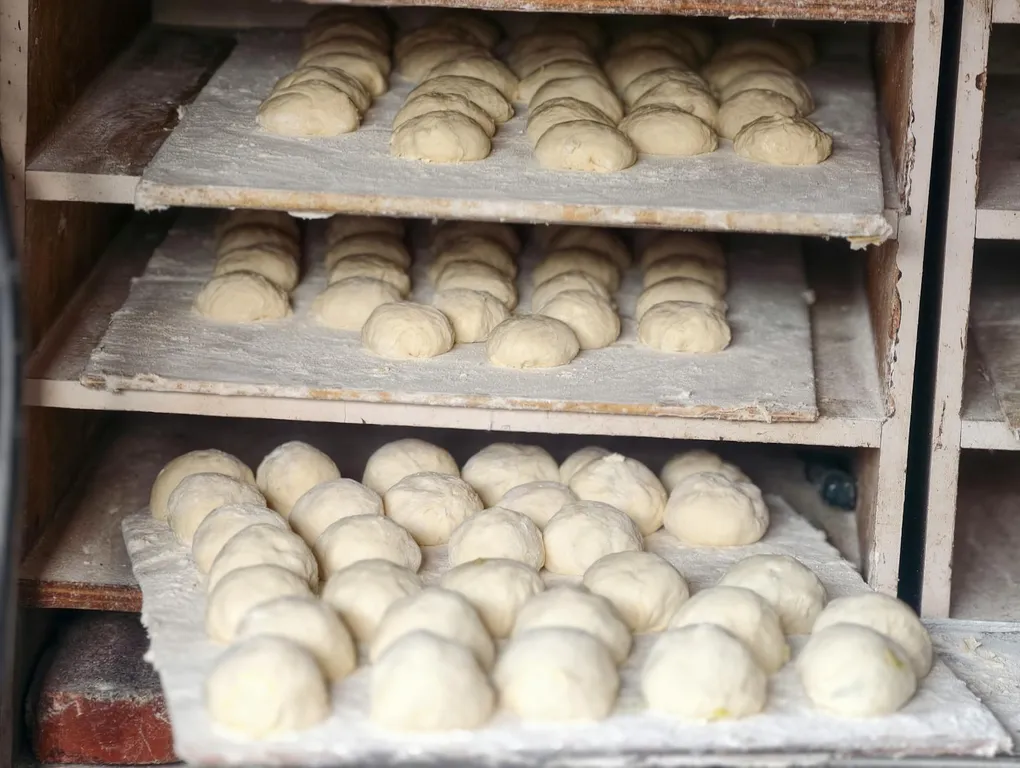
Yeast is the engine of pizza dough. It produces the carbon dioxide that creates bubbles, the ethanol that contributes flavor precursors, and the organic acids that develop complexity over time. But the way most home bakers interact with yeast — tearing open a packet and dumping it in — obscures what’s actually happening inside the dough for the hours or days between mixing and baking.
Understanding yeast biology gives you control over every aspect of your pizza crust: how fast the dough rises, how long to proof, how complex the flavor gets, and how long your dough balls stay usable. Here’s what’s really going on.
Saccharomyces cerevisiae: The Organism
The yeast in your kitchen is Saccharomyces cerevisiae — the same species used for bread, beer, and wine, selected and cultivated for predictable performance. It’s a single-celled fungus that reproduces by budding (splitting off daughter cells) and metabolizes sugars into carbon dioxide and ethanol.
Optimal conditions:
- Growth temperature: 20-30°C (68-86°F) — this is the range where yeast cells divide most efficiently
- Fermentation temperature: 28-35°C (82-95°F) — metabolic activity peaks slightly higher than growth optimum
- Lethal temperature: 50-60°C (122-140°F) — yeast dies during baking
- Optimal pH: 4-6 — slightly acidic, which is what dough naturally becomes as fermentation progresses
The 1-degree rule (from Masi): Every 1°C increase between 20°C and 35°C accelerates fermentation speed by 8-12%. This is why room temperature matters so much. A kitchen at 75°F will proof dough noticeably faster than a kitchen at 68°F — the 4°C difference translates to roughly 30-40% faster fermentation.
What yeast eats: Flour contains only about 0.5% free fermentable sugars — not nearly enough to sustain fermentation for hours. The rest comes from enzymatic action: amylase enzymes break down starch into maltose and glucose, which yeast then metabolizes. This is why long fermentation produces better pizza — the enzymes need time to unlock the flour’s sugar reserves.
What yeast produces:
- Carbon dioxide (CO₂): Creates gas bubbles trapped in the gluten network. This is oven spring, cornicione puff, and crumb structure.
- Ethanol: Flavor precursor that evaporates during baking but contributes to aromatic complexity through intermediate reactions.
- Organic acids: Lactic acid, acetic acid, and others that lower pH and contribute tang.
- Higher alcohols and esters: Aromatic compounds responsible for the complex “perfume” of well-fermented dough. Over 50 distinct flavor compounds form during extended fermentation that don’t exist in quick dough.
The Three Forms of Commercial Yeast
Not all yeast is interchangeable. The three forms you’ll encounter behave differently and convert at specific ratios.
Fresh Yeast (Compressed)
A moist, crumbly block with roughly 72% moisture content and about 6 billion cells per gram. This is the traditional Neapolitan choice — AVPN certification specifically calls for fresh yeast.
Characteristics: Highest leavening power per gram, most perishable (2-3 weeks refrigerated), no expiration date printed. You’ll find it in the refrigerated section near the butter, usually in 2-oz blocks.
Who uses it: Gemignani uses fresh yeast for his Napoletana dough (7g for 453g flour). Traditional Neapolitan pizzerias use it almost universally.
Active Dry Yeast (ADY)
Dried granules with about 8% moisture. The drying process kills roughly 25% of the yeast cells. Those dead cells release glutathione, an enzyme that weakens gluten — which is why ADY dough can be slightly slacker than IDY dough at the same hydration.
Characteristics: Must be dissolved (“bloomed”) in warm water before use. 6-12 month shelf life at room temperature.
Who uses it: Gemignani uses ADY (Red Star brand) for every recipe except Napoletana. He explicitly recommends against instant yeast for pizza: “It defeats the whole purpose of keeping the proofing process as slow as possible.”
Instant Dry Yeast (IDY)
Finer granules with about 5% moisture. More living cells per gram than ADY, and can be mixed directly into flour without blooming.
Characteristics: No blooming required — add directly to dry ingredients. 2-year shelf life unopened. Most consistent batch-to-batch performance.
Who uses it: Myhrvold’s team “strongly recommends” IDY for all applications based on extensive testing. Forkish uses IDY in his Elements of Pizza recipes.
The Conversion Table
These ratios matter when adapting recipes between sources:
| Converting From | Converting To | Multiply By |
|---|---|---|
| Instant dry yeast (IDY) | Fresh yeast | ×3 |
| Fresh yeast | Instant dry yeast | ×0.33 |
| Active dry yeast (ADY) | Instant dry yeast | ×0.75 |
| Instant dry yeast | Active dry yeast | ×1.33 |
| Fresh yeast | Active dry yeast | ×0.44 |
| Active dry yeast | Fresh yeast | ×2.27 |
Example: A recipe calling for 7g fresh yeast converts to approximately 2.3g IDY or 3.1g ADY.
The Gemignani vs. Myhrvold Disagreement
This is one of the sharpest contradictions in the pizza literature. Gemignani insists on active dry yeast and explicitly warns against instant: he wants the slower activation that comes from blooming ADY in warm water, plus the slightly weaker gluten from the glutathione release, which he sees as appropriate for pizza’s desired extensibility.
Myhrvold argues the opposite: IDY’s consistency, reliability, and direct-add convenience make it objectively superior. The dead-cell glutathione from ADY is an unpredictable variable, not a benefit.
The practical take: Both produce excellent pizza. The difference is philosophical more than practical. If you follow Gemignani’s recipes, use ADY as written. If you follow Forkish or Myhrvold, use IDY. Don’t overthink this.
The Four Phases of Leavening
Masi’s scientific framework describes four distinct phases of yeast activity in dough. Understanding these phases tells you exactly where your dough is in its development — and when it’s at peak usability.
Phase 1: Lag Phase
Yeast is awake but not yet producing visible results. Cells are synthesizing enzymes, absorbing nutrients, and preparing for division. No visible volume change. Duration varies with yeast health, temperature, and food availability.
What you see: Nothing. The dough looks the same as when you mixed it. This is the phase where impatient bakers convince themselves the yeast is dead.
Phase 2: Exponential Phase
Rapid cell division at a constant rate. Yeast population doubles at regular intervals. CO₂ production accelerates. This is where the biggest volume increases happen.
What you see: The dough starts rising noticeably. Small bubbles appear on the surface and at the edges of the container. The dough feels increasingly airy and light.
Phase 3: Stationary Phase
Growth plateaus. The number of new cells roughly equals the number dying. Nutrient supply is diminishing. CO₂ production continues but no longer accelerates. Volume plateaus.
What you see: The dough has reached (or nearly reached) its maximum volume. Bubbles are visible throughout. The dough feels very soft and extensible.
This is peak usability for pizza. Masi specifies the target: dough should reach 3/4 of its maximum possible volume — not the absolute peak. At 3/4, there’s enough gas for oven spring but enough structural integrity for shaping and launching.
Phase 4: Decline Phase
Nutrients exhausted. Toxic metabolites (ethanol, acids) accumulate. Yeast cells die faster than they reproduce. The gluten network, weakened by protease activity over time, can no longer hold expanding gas.
What you see: The dough has started to collapse. The surface may show a concave depression where it once domed. It smells strongly of alcohol. It tears easily during handling.
This is over-proofed dough. It can sometimes be rescued by gently reshaping into a ball and resting 30-60 minutes, but the flavor will be more acidic and the structure weaker than properly proofed dough.
Temperature: The Master Variable
Temperature controls yeast activity more directly than any other factor. The relationship is steep and non-linear.
The Temperature Windows
| Temperature Range | Yeast Behavior |
|---|---|
| 0-4°C (32-39°F) / Fridge | ~10% activity. Dormant but alive. Enzymes remain 40-50% active. This is why cold ferment = more flavor. |
| 20-30°C (68-86°F) / Room temp | Optimal growth. Normal fermentation speed. |
| 28-35°C (82-95°F) | Peak metabolic rate. Fast gas production. Risk of over-proofing. |
| 35-46°C (95-115°F) | Stress zone. Still active but cells begin to die at the upper end. |
| 46-60°C (115-140°F) | Death zone. Yeast dies. This happens during the first minutes of baking. |
Why Cold Fermentation Produces Better Pizza
At refrigerator temperature (4°C), yeast drops to roughly 10% activity. But the enzymes in the dough — amylase (starch to sugars), protease (proteins to amino acids), and lipase (fats to fatty acids) — retain 40-50% of their room-temperature activity.
This means enzymes are 4-5 times more active relative to yeast in the cold than at room temperature. Over 24-72 hours, they accumulate enormous quantities of sugars, amino acids, and flavor compounds while the yeast produces only moderate amounts of gas. The result: complex, deeply flavored dough that hasn’t over-proofed.
This is the single most important concept in pizza dough fermentation. It’s why every serious source — Forkish, Gemignani, Myhrvold, Iacopelli — recommends cold fermentation of at least 24 hours.
Target Dough Temperature After Mixing
| Source | Target |
|---|---|
| Forkish (Elements) | 80-82°F (27-28°C) |
| Forkish (FWSY) | 77-78°F (25-26°C) |
| Masi (Neapolitan TSG) | 75°F ± 4°F (24°C ± 2°C) |
| Gemignani | 65-72°F (ice water method keeps it low) |
Forkish targets the warmest dough to kickstart fermentation before refrigeration. Gemignani uses ice water deliberately to keep the dough cool, slowing yeast activity from the moment of mixing. Both approaches work — they just front-load or back-load the fermentation timeline differently.
Masi’s water temperature formula:
T_water = 75 - T_ambient - T_ingredients - 9
The constant 9 represents friction heat from mixing. On a hot day (31°C ambient, 30°C ingredients): T_water = 75 - 31 - 30 - 9 = 5°C. On a cool day, you’d use warmer water.
Yeast Quantities by Strategy
The amount of yeast you use is directly tied to your fermentation timeline. More yeast = faster rise = less flavor development. Less yeast = slower rise = more complexity.
For Room-Temperature Fermentation
| Yeast (IDY, % of flour) | Approximate Rise Time at 72°F |
|---|---|
| 0.8-1.0% | 4-6 hours (same-day pizza). See baker’s percentages explained for how to convert. |
| 0.3-0.5% | 6-8 hours |
| 0.1-0.2% | 8-12 hours |
| 0.01-0.08% | 12-24 hours (Neapolitan ambient proofing) |
For Cold Fermentation (Refrigerator)
| Yeast (IDY, % of flour) | Cold Ferment Duration |
|---|---|
| 0.25-0.5% | 24-48 hours |
| 0.1-0.25% | 48-72 hours |
Forkish’s range: His recipes use as little as 0.08% IDY (0.8g per 1000g flour for his FWSY overnight straight) up to 0.2% for same-day doughs. His 24-48 hour cold retard uses 0.3% (1.5g per 500g flour).
AVPN specification: 0.17% (3g per 1.7-1.8kg flour) for room-temperature proofing — extremely low yeast for an 8-12 hour ambient ferment.
Gemignani’s quantities: Higher than Forkish because he uses active dry yeast, which has 25% dead cells and lower effective leavening power. His Master Dough with starter uses 0.49% ADY (2.2g per 453g flour). His Master without starter doubles that to 1.0% (4.5g per 453g flour) to compensate for the missing preferment.
Sourdough: A Different Kind of Yeast
Wild sourdough fermentation uses a different ecosystem entirely. Instead of a monoculture of commercial S. cerevisiae, a sourdough starter contains multiple wild yeast species plus lactic acid bacteria (LAB) — primarily Lactobacillus species.
How it differs from commercial yeast:
- Slower gas production: Wild yeasts generally produce CO₂ more slowly than commercial S. cerevisiae. Sourdough pizza dough needs longer proof times.
- Broader flavor spectrum: LAB produce lactic and acetic acid in ratios determined by hydration and temperature. Wild yeasts produce different ester and alcohol profiles. The result: more complex, tangier, more aromatic dough.
- pH effects on gluten: The lower pH from acid production increases gluten extensibility, making sourdough pizza dough very easy to stretch once properly proofed.
- Phytase activation: The acidic environment activates phytase enzymes, which break down phytic acid (an anti-nutritional compound in flour). This genuinely increases the bioavailability of minerals like calcium, magnesium, iron, and zinc.
Forkish’s Overnight Levain is his personal favorite pizza dough — pure sourdough, no commercial yeast. He feeds his culture (50g starter + 100g water + 100g flour) 6-8 hours before mixing the final dough.
The Digestibility Debate
Italian pizzaioli universally claim that low-yeast, long-fermented dough is “more digestible.” Myhrvold investigated this and could not find scientific evidence: “We were unable to find scientific proof of any of this.” Yeast dies during baking, so the amount of yeast in the raw dough is irrelevant to digestion of the finished pizza.
What IS scientifically supported: long fermentation breaks down phytic acid (improving mineral absorption) and degrades some gluten proteins (potentially reducing sensitivity for people with mild gluten sensitivities, though not safe for celiacs). The health benefits are real but come from the fermentation duration, not the yeast quantity.
Practical Yeast Management
Storage
- IDY: Keep unopened packages at room temperature (2-year shelf life). After opening, refrigerate in an airtight container. Good for 4-6 months.
- ADY: Same as IDY. Room temperature unopened, refrigerate after opening.
- Fresh: Always refrigerated (1-4°C). Use within 2-3 weeks. Check for a uniform color and crumbly texture — fresh yeast that’s turned dark, slimy, or hard is dead.
Freezing Yeast: The Disagreement
Gemignani says never freeze yeast: “Freezing causes the moisture in cells to expand, which can break the cell wall and kill the yeast.” Masi says freezing at -18°C is fine for up to 3 months. Myhrvold freezes levain cubes as a standard technique.
The reality: Some cell death occurs during freezing, but enough cells survive to leaven dough. If you freeze IDY or ADY, the dry granules have very little moisture and are minimally affected. Fresh yeast loses more activity because of its high moisture content (72%). For fresh yeast, Gemignani’s caution is more justified. For dry yeast forms, freezing is a viable storage extension.
Blooming ADY: Do You Really Need To?
Gemignani always blooms ADY in warm water (80-85°F) before adding to dough. This activates the yeast and confirms it’s alive (it should foam within 5-10 minutes).
Technically, modern ADY formulations can be added directly to flour like IDY — the manufacturing process has improved since the days when blooming was strictly necessary. But blooming gives you a visual confirmation that the yeast is active, which eliminates the worst-case scenario: discovering after 24 hours of waiting that your yeast was dead.
The practical call: If your ADY is fresh (well within its shelf date, properly stored), adding directly to flour works fine. If there’s any doubt about age or storage, bloom it first. The 10-minute investment is worth the certainty.
Putting It Together: Matching Yeast to Your Schedule
| I have… | Use this yeast amount (IDY) | Expected timeline |
|---|---|---|
| 4 hours | 0.8-1.0% of flour | Same-day pizza. Minimal flavor complexity. |
| 8 hours | 0.1-0.2% of flour | Same-day, mixed in the morning. Noticeably better. |
| 24 hours (cold) | 0.3% of flour | Mix evening, pizza tomorrow. Good complexity. |
| 48 hours (cold) | 0.25% of flour | Mix 2 days ahead. Excellent complexity. |
| 72 hours (cold) | 0.15% of flour | Peak complexity, diminishing returns beyond this. |
The non-negotiable: Weigh your yeast on a precision scale (0.1g resolution, about $13). The difference between 0.3g and 0.8g of yeast — invisible to the naked eye — is the difference between a 24-hour cold ferment and a same-day dough that over-proofs. Volumetric measurement (teaspoons) is not accurate enough for the tiny quantities pizza dough requires.